My husband told me my younger sister died while giving birth. Twenty-two years later, the child she supposedly died saving leaned across my Christmas table and whispered: “Mom is still alive. Uncle James keeps her under the old house.”
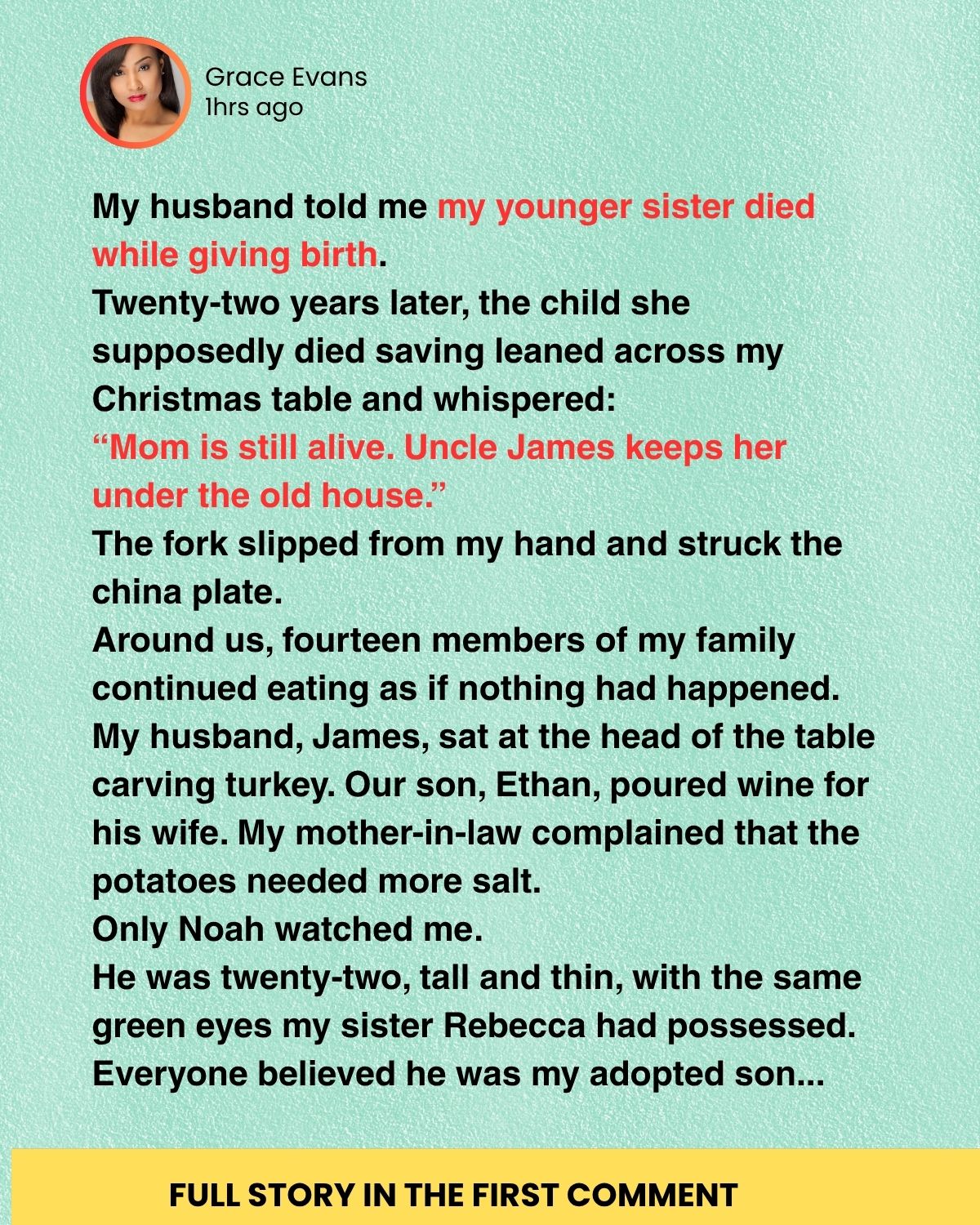
The fork slipped from my hand and struck the china plate.
Around us, fourteen members of my family continued eating as if nothing had happened. My husband, James, sat at the head of the table carving turkey. Our son, Ethan, poured wine for his wife. My mother-in-law complained that the potatoes needed more salt.
Only Noah watched me.
He was twenty-two, tall and thin, with the same green eyes my sister Rebecca had possessed. Everyone believed he was my adopted son.
Legally, he was.
Biologically, he was my nephew.
At least, that was what James and I had told him.
Rebecca had been nineteen when she became pregnant. The father disappeared before the baby was born. James arranged for her to stay at a private maternity home outside the city, where she could deliver without gossip following our family.
Three days later, he came home carrying a newborn.
He told me Rebecca had suffered severe bleeding and died before reaching the hospital.
There was no funeral.
James said the facility had already arranged cremation because Rebecca had signed documents requesting privacy.
I was twenty-six, newly married, and too broken to question him.
I held Noah against my chest while James repeated the same sentence:
“Rebecca wanted you to raise him.”
For twenty-two years, I believed my sister’s final act was giving me her child.
Now that child was telling me she had never died.
I looked toward James.
He was smiling at something Ethan had said.
“Where?” I whispered.
Noah kept his eyes on his plate.
“The Bellwood house.”
My breathing stopped.
The Bellwood house belonged to James’s family. It stood on seventy acres of wooded land almost two hours away. His parents had lived there until their deaths, after which James used the property for storage.
He visited every month.
Sometimes twice.
He always went alone.
“What did you see?” I asked.
“Not now.”
“When?”
“Last week.”
The dining room felt suddenly too warm.
James looked toward us.
“Everything all right?”
Noah lifted his glass.
“Aunt Claire was asking about work.”
James studied my face.
I forced a smile.
“He says the hospital might promote him.”
Noah worked as an emergency-room nurse. James had never approved. He wanted Noah to join the family property business like Ethan.
“That’s good,” James said, though his expression suggested otherwise.
Then he returned to carving the turkey.
Noah did not speak again until after dessert.
He left first, claiming he had an early shift. I waited twenty minutes, then told James I needed to bring food to a sick neighbor.
He looked suspicious.
“On Christmas night?”
“She lives alone.”
“Ethan can take it.”
“I said I would.”
For most of our marriage, that tone would have ended the conversation.
But something in my face made James let me go.
Noah waited in his car three streets away.
I got into the passenger seat.
“Tell me everything.”
He did not start the engine.
Instead, he handed me a photograph.
A woman sat on the edge of a narrow bed in a windowless room. Her hair was gray and unevenly cut. Her face was thin, and one side of her mouth drooped slightly.
But I recognized her.
Rebecca.
My sister had been gone for twenty-two years, yet I knew the shape of her hands.
She held them folded in her lap exactly as our mother had.
I pressed the photograph against my chest.
“How did you find her?”
Noah’s eyes filled with tears.
“Uncle James gave me a key to the Bellwood house because he wanted me to pick up some old medical equipment.”
“What medical equipment?”
“He said he was donating it.”
“Was he?”
“No.”
Noah found several wheelchairs and hospital beds in a locked storage building. Beside them were boxes of medication, feeding supplies, and patient records.
One file bore his mother’s name.
Not Rebecca Miller.
Patient 14-B: Ruth Bell.
The photograph attached to the document showed Rebecca at nineteen.
Noah searched the main house.
The basement door was hidden behind shelves in the pantry. He used one of the keys James had given him.
“I thought it was a wine cellar,” he said. “Then I heard someone singing.”
My eyes closed.
Rebecca used to sing when she was afraid.
Our father had a violent temper. Whenever he shouted downstairs, she would sit in my bedroom and sing quietly until the house became silent.
“What did she say when she saw you?”
“She called me Daniel.”
“Who is Daniel?”
“I don’t know.”
“Did you tell her who you were?”
“I said my name was Noah.”
He swallowed.
“She touched my face and said, ‘Claire named you that.’”
A sob escaped me.
Rebecca knew my son’s name.
“She remembered me?”
“She talks about you constantly.”
“Then why didn’t you bring her out?”
“The door locked automatically behind me.”
Noah had been trapped with her for almost twenty minutes. He found an internal release button near the ceiling and managed to escape.
Before leaving, he photographed the room.
Then he heard James’s vehicle approaching.
He hid in the storage building until James went inside.
“I saw him carry a cooler downstairs.”
“What was in it?”
“I don’t know.”
“Why did you wait a week to tell me?”
“Because I needed to know whether you were involved.”
The words struck me.
“You thought I knew?”
“You raised me as your son. You never showed me her grave. You never took me to meet anyone from the maternity home.”
“James handled everything.”
“That’s what scared me.”
He looked exactly as Rebecca had when she was trying not to cry.
“Mom, who am I?”
I reached for him.
He pulled away.
“I need the truth.”
“You are Rebecca’s son.”
“Are you sure?”
The question confused me.
“Of course.”
“Did you see her give birth?”
“No.”
“Did you see a DNA test?”
“No.”
“What if that was another lie?”
I stared at the photograph.
Every fact I knew about Noah’s birth had come from James.
The maternity home.
The medical emergency.
Rebecca’s death.
Her final wishes.
Even the identity of Noah’s father.
“Why would James keep Rebecca alive?” I whispered.
Noah looked toward the dark street.
“I think she knew something.”
We drove to my best friend Margaret’s house.
She was the only person I trusted who had known Rebecca before she disappeared.
When Margaret opened the door, she took one look at my face and brought us inside without asking questions.
I placed the photograph on her kitchen table.
She stared at it.
Then she began crying.
“You knew,” I said.
Margaret shook her head.
“I suspected.”
“What did you suspect?”
“Rebecca called me from the maternity home.”
“When?”
“Two nights before James said she died.”
My hands curled into fists.
“Why didn’t you tell me?”
“I tried.”
Margaret had come to our house the morning James returned with the baby. He met her at the door and said I was sedated after suffering a breakdown.
“He told me Rebecca had accused you of trying to steal her child,” Margaret said. “He said speaking to you would make things worse.”
“You believed him?”
“No. But your phone was disconnected. Then you and James moved.”
James took me to another state for six months after Rebecca’s supposed death.
He said I needed distance from painful memories.
In reality, he had isolated me from anyone who might question the story.
“What did Rebecca say on the phone?” Noah asked.
Margaret looked at him.
“She said the maternity home was not helping mothers arrange adoptions. It was selling babies.”
The room became silent.
Rebecca discovered that wealthy families paid large sums for newborns. Young mothers were pressured to sign documents, drugged during delivery, or told their babies had died.
Some children went to legitimate adoptive parents who did not know what had happened.
Others disappeared into private networks.
“Where does James fit into it?” I asked.
“His father owned the property.”
Bellwood House had once been a private recovery clinic operated by James’s parents.
The maternity home was part of the same organization.
James worked there while studying business.
Margaret believed Rebecca intended to expose them.
“She said she had copied records,” Margaret continued. “Then the line went dead.”
“Did you go to the police?”
“Yes.”
“What happened?”
“They spoke with James.”
Of course they did.
James’s father was a wealthy donor to the sheriff’s department. His mother sat on the hospital board.
Within days, Margaret received anonymous threats.
Someone broke into her apartment and placed a photograph of her sleeping on the pillow.
She became frightened and moved away.
“I should have come back,” she said.
“Yes.”
The word left my mouth before I could soften it.
Margaret nodded.
“Yes. I should have.”
There was no point pretending forgiveness had already arrived.
We contacted a lawyer named Grace Holloway, who specialized in institutional abuse and illegal adoption cases.
Grace reviewed Noah’s photographs.
“We need to act carefully,” she said. “If your husband realizes you know, he may move your sister.”
“Then we call the police now.”
“Which police?”
I had no answer.
James’s family had deep connections throughout the county. Even after his parents died, he donated to judges, hospitals, and political campaigns.
Grace contacted a federal investigator she trusted.
Before agents could obtain a warrant, the Bellwood house caught fire.
James called me shortly after midnight.
“There’s been an accident.”
I stood in our bedroom watching him from across the room.
He had come home smelling of smoke.
“What happened?”
“An electrical fire at the old house.”
“Was anyone there?”
His eyes stayed on mine.
“No.”
I wondered whether Rebecca was burning alive while he lied to my face.
“Did you call the fire department?”
“Of course.”
I went into the bathroom and locked the door.
Then I called Noah.
He was already driving to Bellwood.
By the time I arrived, flames had consumed the eastern side of the house. Firefighters worked near the main entrance. Police blocked the driveway.
Noah stood beyond the barrier.
“Did they find her?” I asked.
“No one will tell me anything.”
James appeared near the fire trucks.
When he saw us together, his expression changed.
“What are you doing here?”
I struck him.
The slap knocked his glasses onto the wet ground.
Several firefighters turned.
“Where is Rebecca?”
For one second, terror appeared on his face.
Then he recovered.
“Claire, you’re confused.”
“Where is my sister?”
“I don’t know what Noah has told you—”
“He saw her.”
James looked at Noah.
Something cold passed between them.
“You went into the basement.”
Noah stepped closer.
“You kept my mother locked in a room.”
“She is not your mother.”
I froze.
Noah’s face went white.
“What?”
James bent to pick up his glasses.
“You wanted the truth. She is not your biological mother.”
“Then who is?”
James wiped rain from the lenses.
“Claire.”
I thought I had misheard him.
Noah looked at me.
Neither of us moved.
“No,” I said.
James placed his glasses back on.
“Rebecca did not give birth to him.”
“Stop.”
“You did.”
I slapped him again.
This time, he caught my wrist.
“You want the truth?” he said quietly. “You gave birth at Bellwood House twenty-two years ago.”
I tried to pull away.
“That is impossible.”
“You were pregnant when Rebecca disappeared.”
“No.”
“You were almost seven months.”
I remembered weight gain.
Nausea.
Missed periods.
James told me grief had disrupted my body.
Doctors prescribed sedatives.
My memories of those months were broken and unclear.
“You had a son,” James said. “Rebecca helped deliver him.”
The world seemed to tilt.
Noah stared at me.
“Why don’t I remember?”
“Because my parents drugged you.”
James said I became pregnant after he assaulted me while I was unconscious following a party at Bellwood.
My husband.
The man I later married.
At the time, we had been dating, but I had told him I was not ready for sex.
He decided my refusal did not matter.
When I became pregnant, his parents feared scandal.
They moved me into the clinic under the claim that I was grieving and unstable.
Rebecca discovered what happened.
She tried to take me away.
Instead, they confined both of us.
I delivered Noah prematurely.
Then James’s parents gave me medication that erased days of memory and told me Rebecca had died giving birth to the child.
“You married me afterward,” I whispered.
“I loved you.”
The words were so monstrous I could not answer.
“You raped me.”
James glanced toward the officers nearby.
“Lower your voice.”
I screamed it.
“You raped me!”
Everyone turned.
A police officer approached.
James released my wrist.
“This is a family misunderstanding.”
Noah punched him.
James fell into the mud.
Two officers restrained Noah.
I kept shouting about the basement, the woman inside, the patient records, and the illegal babies.
One officer tried to place me in a patrol car.
Then a firefighter emerged from the house carrying someone.
A woman.
Alive.
Rebecca’s face was blackened with soot. An oxygen mask covered her mouth. Her hair and clothes were wet.
I ran toward her.
She opened her eyes.
“Claire?”
I collapsed beside the stretcher.
She touched my cheek.
“You got old.”
I laughed and sobbed at the same time.
“So did you.”
Her gaze moved toward Noah.
“My baby?”
I looked at James.
He had said she was not Noah’s mother.
But Rebecca was reaching for him as if she had waited twenty-two years.
Noah knelt.
“Are you Rebecca?”
She touched his face.
“You have her eyes.”
“Whose?”
“Claire’s.”
The ambulance took her to the hospital.
Federal agents arrived before dawn.
The fire had exposed a hidden records room beneath the basement. Steel cabinets protected many documents from the flames.
Agents found birth certificates, payment ledgers, photographs, and files documenting more than sixty illegal infant transfers.
They also found evidence that James had deliberately started the fire.
He intended to destroy the records and kill Rebecca.
He was arrested at the scene.
At the hospital, doctors confirmed Rebecca had suffered years of forced medication, untreated injuries, and long-term confinement.
A DNA test confirmed I was Noah’s biological mother.
James was his father.
The truth destroyed us in different ways.
Noah had spent his life believing he was born from his mother’s death.
Now he learned he was conceived through violence, taken from me, and raised by the man responsible.
He stopped calling me Mom.
Not because he blamed me.
Because the word no longer felt safe.
Rebecca had raised him during the first six weeks of his life inside Bellwood.
She fed him, held him, and tried to escape with him twice.
When James’s parents realized she would never remain silent, they kept her as a patient under a false identity.
They gave Noah to me only after the drugs had confused my memory.
“You were always searching for him,” Rebecca told me from her hospital bed. “Even when you didn’t know.”
“What do you mean?”
“You would wake up asking where the baby was.”
James told me I was dreaming about Rebecca’s child.
He turned my maternal memory into evidence that I was unstable.
I looked at my sister.
“Why did you call Noah your baby?”
“Because when they took you away, he was all I had.”
Two truths existed beside each other.
I had given birth to Noah.
Rebecca had protected him when I could not.
Neither relationship canceled the other.
James’s trial began fourteen months later.
By then, the story had become national news.
Reporters called Bellwood House a baby-selling prison. Former residents came forward. Adult adoptees demanded access to sealed records.
Several doctors and officials were charged.
James claimed he had been controlled by his parents.
They began the scheme.
They falsified the records.
They ordered Rebecca’s confinement.
But they had been dead for years.
James continued everything.
He visited Rebecca monthly.
He approved her medication.
He kept her locked away.
He lied to Noah and me every day.
During the trial, the prosecutor played security recordings recovered from Bellwood.
In one video, Rebecca sat alone in the basement room.
James stood outside the locked door.
“Tell me where the copies are,” he said.
“You’ll never find them.”
“You’ve lost twenty years for nothing.”
Rebecca looked toward the camera.
“Claire raised her son. That isn’t nothing.”
James stepped closer to the glass.
“She thinks he is yours.”
“She thinks I’m dead.”
“She survives better that way.”
Rebecca smiled faintly.
“No. You survive better that way.”
In another recording, she asked to see me.
James laughed.
“What would you tell her?”
“The truth.”
“She won’t believe you.”
“She believed you once.”
His face changed.
“That was enough.”
I left the courtroom and vomited in a trash can.
For decades, I had treated my marriage as evidence that James loved me.
In reality, the marriage was part of the crime.
By staying close, he controlled my memories, my child, and every question I might ask.
Noah testified last.
James watched him walk to the stand.
For the first time, my husband looked emotional.
“I raised you,” he said during a break.
Noah stared at him.
“You monitored me.”
“I was your father.”
“You made yourself my father by taking away every other choice.”
James received life in prison for attempted murder, kidnapping, sexual assault, fraud, forced confinement, and conspiracy.
He never apologized to me.
In his final statement, he said:
“I gave Claire a family.”
The judge answered before I could.
“You built a family from people you denied the truth.”
Rebecca came to live with me after leaving the hospital.
At first, she slept with every light on.
She hid food beneath the bed.
She panicked whenever doors clicked shut.
She had not used the internet, carried a smartphone, or walked through a supermarket in twenty-two years.
The first time we went shopping, she stood in front of a shelf of shampoo for nearly ten minutes.
“There are too many choices,” she whispered.
I reached for the brand we used as teenagers.
“This one.”
She smiled.
“You still use that?”
“No.”
“Then why choose it?”
“Because we lost enough familiar things.”
Our relationship was not instantly repaired.
She blamed me for marrying James.
I blamed her for not escaping.
Then we hated ourselves for blaming each other.
We attended therapy.
During one session, Rebecca said:
“I kept waiting for Claire to find me.”
I looked at the floor.
“I believed you were dead.”
“You believed him.”
“Yes.”
“Why?”
“Because the truth would have required me to believe my whole life was unsafe.”
She nodded slowly.
“And was it?”
“Yes.”
That was the first day she held my hand.
Noah moved into his own apartment.
He needed distance from both of us.
For months, he spoke only to Rebecca.
I tried not to resent it.
She remembered his first weeks.
She knew the lullaby he liked and the small red mark that had been on his shoulder.
I had memories of his first steps, first day of school, and first heartbreak.
His life belonged to both of us in different ways.
One evening, he came to my house carrying a box.
Inside were old birthday cards I had written to him.
To my wonderful son.
You made me a mother.
I loved you before I knew you.
He placed the cards on the table.
“Were these lies?”
“No.”
“You thought I was Rebecca’s child.”
“I did.”
“Then how could you say you loved me before you knew me?”
“Because the moment James placed you in my arms, my body recognized something my mind had been forced to forget.”
Noah looked away.
“I don’t know what to call you.”
“You don’t have to decide.”
“Rebecca wants me to call her Mom.”
I swallowed.
“Do you want to?”
“I don’t know.”
“Then don’t decide for her either.”
He looked at me.
“Does that hurt?”
“Yes.”
The honesty surprised him.
“But your name for me is not proof of my love.”
He returned the cards to the box.
Before leaving, he hugged me.
It was the first time since the truth came out.
Five years later, Bellwood House was demolished.
Survivors gathered near the property to watch.
Some cheered when the basement walls collapsed.
Rebecca did not.
She stood beside me holding a small metal key.
The key to her room.
“Do you want to throw it into the ruins?” I asked.
“No.”
“Why keep it?”
“To remember the door could be opened.”
Noah joined us.
He was twenty-seven now and worked with an organization helping adults separated from their birth families through illegal adoptions.
He called Rebecca by her name.
He called me Claire in public.
Sometimes, when he was tired or frightened, he still called me Mom.
I never corrected him either way.
Ethan stopped speaking to James after the trial. He struggled with the fact that his father had treated him kindly while destroying the lives of others.
“Was any of it real?” he once asked me.
“The harm was real.”
“That isn’t what I mean.”
“I know.”
James had attended Ethan’s games, helped with homework, and comforted him after a broken engagement.
People want evil to erase every tender memory because that makes judgment easier.
But kindness shown to one person does not cancel cruelty inflicted on another.
Sometimes it only makes the cruelty harder to expose.
On the anniversary of Rebecca’s rescue, the three of us visited the cemetery.
A grave still carried her name.
James had arranged the marker twenty-two years earlier despite there being no body beneath it.
REBECCA MILLER
BELOVED DAUGHTER AND MOTHER
Noah touched the word mother.
“Should we remove it?” I asked.
Rebecca considered the stone.
“No.”
“But the grave is empty.”
“So was the story they gave you.”
She placed the basement key at the base of the marker.
“Let the grave belong to the girl they tried to erase.”
We installed a new plaque beneath it:
SHE DID NOT DIE HERE.
SHE SURVIVED ELSEWHERE.
As we walked back toward the car, Noah took one of Rebecca’s hands and one of mine.
For a moment, we looked like the family people expected us to be.
A mother.
A son.
An aunt.
But those words were too simple.
We were a woman who gave birth and forgot.
A woman who remembered and was punished.
A child raised inside a lie but loved within it.
Our family did not begin with truth.
It began with violence, theft, and silence.
Yet what we became afterward belonged to us.
James had spent twenty-two years deciding what each of us was allowed to know.
In the end, the truth did not restore the years he stole.
It did something more frightening.
It gave us choices.
And for the first time, none of those choices belonged to him.

:max_bytes(150000):strip_icc():focal(734x320:736x322):format(webp)/lauren-boebert-tyler-081026-77fa0d7c1b634dd5b555dbe8886a483a.jpg)