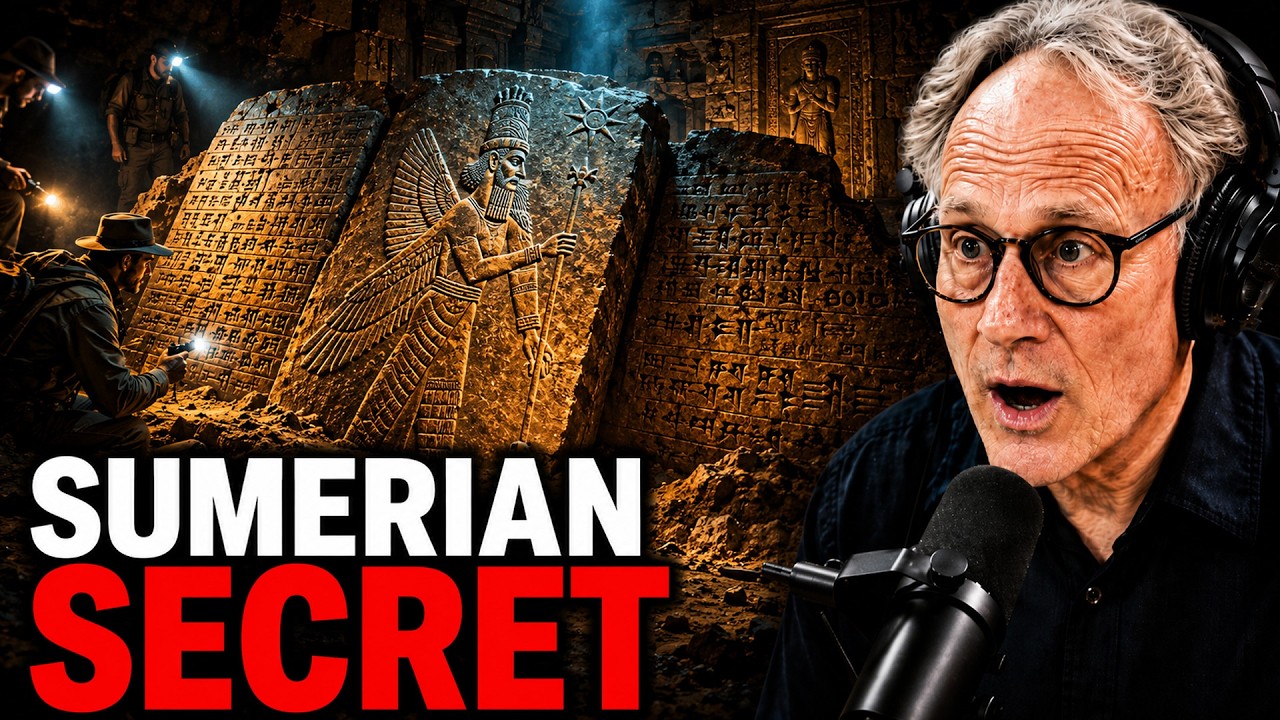
A set of 7,000-year-old clay tablets unearthed from the cradle of civilization has ignited a firestorm of debate among archaeologists, linguists, and amateur historians worldwide. The ancient Sumerian inscriptions describe powerful beings known as the Anunnaki—and no one can fully explain them.
The artifacts, pressed into wet clay long before the pyramids of Egypt rose, survived floods, wars, and the collapse of entire empires. Now, they are forcing scholars to confront one of history’s deepest enigmas: Were these merely religious myths, or do they contain fragments of a forgotten reality?

The tablets detail divine beings who descended from the heavens to shape humanity’s fate. According to the texts, these Anunnaki acted as rulers, judges, and gods. But the most controversial interpretation—popularized by the late author Zecharia Sitchin—claims these were not gods but extraterrestrial visitors who genetically engineered Homo sapiens.
Sitchin argued that the Anunnaki came from a planet called Nibiru, arriving on Earth roughly 450,000 years ago. Their mission: to mine gold for their own world’s deteriorating atmosphere. He claimed they created humans as a slave species by upgrading the DNA of early hominids.
The theory gained a massive following online and in alternative history circles. It seems to eerily predict modern concepts of genetic engineering and atmospheric science—an idea that has enthralled millions. Yet mainstream experts insist the entire framework rests on mistranslations.
Scholars who can actually read ancient Sumerian cuneiform offer a starkly different narrative. They translate “Anunnaki” as “princely offspring” or “those of royal blood”—referring to the children of the sky god Anu. The word “Nibiru,” Sitchin’s supposed rogue planet, actually refers to Jupiter or a celestial crossing point in Mesopotamian astronomy.
The famous Atrahasis epic does describe the creation of humans to take over the labor of lesser gods. But the text says humans were formed from clay mixed with the flesh and blood of a slain deity—a symbolic act, not genetic engineering. There is no 450,000-year timeline, no gold mining mission, no planet Nibiru.
Linguists point out that Sitchin was an author, not a trained ancient language scholar. They argue his translations were selective and often invented. The academic consensus views these stories as powerful creation myths, akin to those found in cultures worldwide—metaphors for humanity’s relationship with the divine.

Yet the debate refuses to die. The tablets continue to fuel heated arguments in lecture halls, YouTube channels, and late-night forums. Why?
Because the Sumerians were genuinely extraordinary. They built the world’s first cities, developed sophisticated laws and irrigation, and created a base-60 mathematical system that gave us the 60-second minute and 360-degree circle.
Their star charts laid the groundwork for Babylonian astronomy, which mapped the cosmos with stunning precision. For a culture that flourished around 4000 BCE, their achievements feel almost anachronistic. And that has left the door open for alternative explanations.
The most famous of their texts—the Epic of Gilgamesh—was rediscovered in the mid-19th century by British archaeologist Austen Henry Layard. He found thousands of clay tablets in the library of Ashurbanipal in Nineveh. Among them were the 12 tablets telling the story of Gilgamesh, a semi-divine king.
The epic follows Gilgamesh and his wild companion Enkidu through adventures that include slaying the monster Humbaba, rejecting the goddess Ishtar, and searching for immortality. The narrative grapples with themes of friendship, hubris, and the inevitability of death. It ends with Gilgamesh learning to accept mortality.

But one section has drawn particular attention. Utnapishtim, the survivor of a great flood, tells Gilgamesh how the gods sent a deluge to destroy humanity—and how he built a boat to save his family and animal life. The parallels with the biblical story of Noah’s Ark are unmistakable.
Scholars now widely agree that the Gilgamesh flood myth predates the Bible by centuries. Some believe it reflects a shared cultural memory of a real catastrophic flood in the ancient Near East. Others argue it’s a literary trope that spread across civilizations.
This flood story has been seized by ancient astronaut theorists as evidence that the Anunnaki were real beings who left behind coded messages. They claim the Epic of Gilgamesh contains “secret messages” from an Anunnaki king for modern civilization—a warning about hubris and a guide to eternal wisdom.
Skeptics counter that the epic is a profound philosophical work, not a spaceship manual. They argue that seeing aliens in every ancient text disrespects the intelligence and creativity of our ancestors. “We keep slapping our ancient ancestors in the face, doubting their wisdom,” one commenter in the video transcript laments.
The tablets themselves are not in dispute. They exist in museums and private collections. Cuneiform has been deciphered since the 1850s, thanks to breakthroughs like the Behistun Inscription.

Scholars can read them. The disagreement is over what they mean.
Are the Anunnaki literal beings who came from another planet—a historical record carved in clay with perfect accuracy? Or are they the symbolic heart of a sophisticated religion, representing the forces of nature at the dawn of civilization?
The tablet texts tell their story. What we choose to believe is up to us. But the fact that thousands of people still argue about this, thousands of years later, suggests something deeper is at play.
Perhaps the real mystery is not extraterrestrial visitation, but the astonishing imagination and ingenuity of the Sumerian people themselves. They wrote about gods who shaped fate—and we are still wrestling with the question of who we are and where we came from.
For now, the tablets remain an unsolved riddle. They sit in climate-controlled vaults, their baked clay inscriptions waiting for anyone who can truly explain them. And nobody can—not yet.
As new translations and archaeological discoveries continue to emerge, the debate over the Anunnaki shows no signs of cooling.
Breaking news updates will follow as further analysis of these ancient texts becomes available. The story of the Anunnaki is far from over.