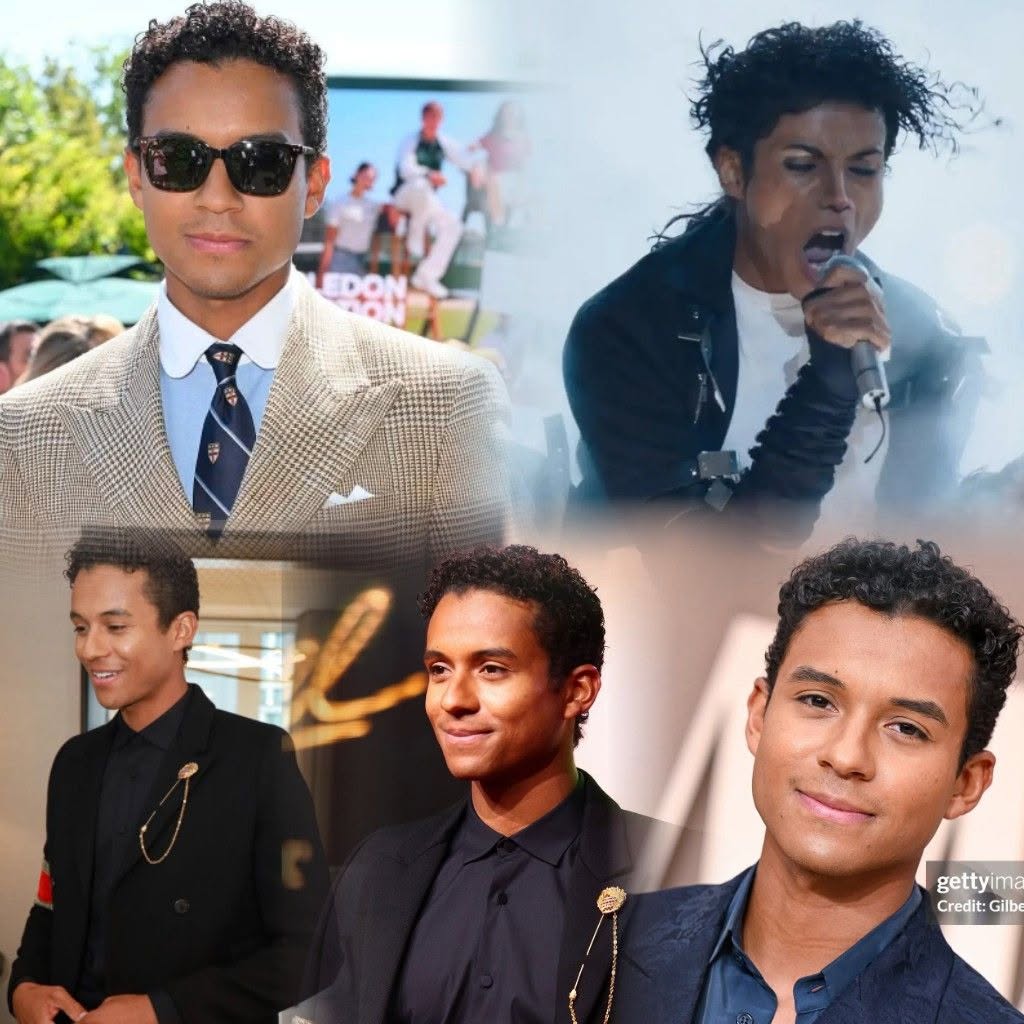
For millions of fans, Jaafar Jackson’s transformation into Michael Jackson was always going to be judged by the obvious things first.

Did he look like him?
Could he move like him?
Could he carry the same stage presence?
Could he make audiences believe, even for a few seconds, that they were watching the King of Pop again?
But behind the making of Michael, the biographical film directed by Antoine Fuqua, there was one private moment that may have mattered more to Jaafar than any trailer reaction, box office result or social media debate.
It happened when his mother saw him in character.
Jaafar, the son of Jermaine Jackson and the nephew of Michael Jackson, was cast as the late music icon in what became one of the most closely watched biopic roles in recent memory. AP reported in 2023 that the film would mark Jaafar’s acting debut, with producer Graham King expressing confidence that he could embody Michael’s spirit and personality. Katherine Jackson, Michael’s mother, also praised the casting, saying Jaafar continued the family’s entertainment legacy.
Still, even inside the Jackson family, Jaafar kept the news quiet for a long time.
In an Interview magazine conversation with his co-star Miles Teller, Jaafar revealed that no one in his family knew he had been cast for a full year. PEOPLE also reported that the secret included his own mother, Alejandra, who did not know for months that her son had been preparing to portray one of the most famous relatives in their family history.
That detail alone shows the weight he was carrying.
This was not just another acting job. Jaafar was not stepping into a fictional character or a distant historical figure. He was playing his uncle — a man whose face, voice, movement and memory remain deeply personal to the Jackson family and sacred to millions of fans around the world.
For nearly a year, Jaafar quietly prepared for the role. He studied Michael’s movement, presence and emotional rhythm. He worked toward a performance that had to satisfy both a global audience and a family that knew the man behind the legend. The pressure began long before the movie reached theaters. Every leaked photo, every still image and every short preview clip was analyzed by fans who had spent decades watching Michael Jackson’s interviews, rehearsals and performances.
Then came the moment with his mother.
When she finally saw him transformed as Michael, the reaction was overwhelming. According to PEOPLE’s account of Jaafar’s Interview comments, his mother found it difficult to connect the image in front of her with her own son because the transformation was so striking. The experience was deeply emotional for her.
For Jaafar, that reaction became more than family approval.
It was a sign that the work was landing.
His mother was not just seeing makeup, costume and choreography. She was seeing a resemblance that carried family memory. She was being reminded of someone whose impact on their lives went far beyond music and fame. In that instant, the line between performance and memory seemed to blur.
That is what makes the story so powerful.
A critic can praise technique. A fan can praise accuracy. A studio can praise marketability. But when someone who knows the family history looks at the performance and becomes emotional, it carries a different kind of weight.
The film itself arrived with enormous expectations. Michael follows Jackson’s early life, his rise with the Jackson 5 and his climb toward solo superstardom. The cast includes Jaafar Jackson as Michael, Juliano Krue Valdi as young Michael, Nia Long as Katherine Jackson, Colman Domingo as Joe Jackson and Miles Teller as John Branca, according to coverage of the film’s cast and release.
The project also became a major commercial event. PEOPLE reported that Michael crossed the $1 billion mark at the global box office in July 2026, becoming the highest-grossing biopic of all time and marking a historic milestone for Lionsgate.
Yet the emotional reaction to Jaafar’s performance may be just as important as the financial success.
Michael Jackson was not an easy figure to portray. He was one of the most documented entertainers in history. Fans know his walk, his smile, his speaking voice, his stage posture and his nervous gestures. They know the difference between eras. They know when a movement feels real and when it feels copied.
Jaafar’s challenge was not only to resemble Michael. It was to suggest the humanity behind the icon.
That is why his mother’s reaction mattered so deeply. It suggested that, beyond the makeup and costumes, something in the performance reached a place of recognition.
Not imitation.
Recognition.
For fans, that distinction is everything.
A Michael Jackson biopic could easily have become a parade of famous outfits and iconic dance moves. But the strongest performances in biographical films are not built only on resemblance. They are built on emotional truth. They make audiences remember not just what a person looked like, but what they made people feel.
That may be why the story of Jaafar’s mother visiting the set has resonated so strongly.
It is not a loud Hollywood moment. It is not a red carpet quote. It is not a viral performance clip.
It is a mother seeing her son disappear into the image of someone their family loved, lost and still carries.
For Jaafar, that may have been the clearest sign that he was honoring Michael’s legacy with the seriousness it deserved.
Because sometimes the greatest compliment does not come from critics, box office records or millions of online comments.
Sometimes it comes from the people who knew the real person best.
And for Jaafar Jackson, that quiet moment behind the scenes may have been worth more than any standing ovation.