Andre Wallace sat on the edge of a motel bed in a town just outside Atlanta. The room smelled like old carpet and lemon cleaning spray. On the nightstand, a Manila folder sat beneath his phone. The letters DOJ were stamped across the top in faded blue ink.
Department of Justice, Civil Rights Division. Inside, 14 complaint files from residents of a town called Ridgefield, Georgia. Population 12,000, mostly white. One police department, 35 officers, and a pattern of misconduct that had gone unchecked for almost two decades.
Andre opened his laptop and scrolled through the internal briefing one more time. The complaints were consistent. Black motorists pulled over for no reason. Unlawful searches.
Racial slurs used openly during stops. Excessive force always classified as justified in the department’s own internal reviews. 14 formal complaints in 18 months, all investigated internally, all dismissed. The man who ran the department was Chief Harold Tanner, 61, who had held his position for 19 years.
Under Tanner, not a single officer had ever been disciplined for racial misconduct. Andre was 34 years old. He’d grown up on the South Side of Chicago in a neighborhood where police sirens were background noise. His mother, Gloria, worked the night shift as a nurse at Mercy Hospital for 23 years.
She raised Andre alone after their father died when Andre was nine. No inheritance, no safety net. Just Gloria’s overtime checks and a rule she repeated every morning. You don’t get to be average.
Average gets you nowhere. Andre wasn’t average. He graduated top of his class at a public high school, got a full scholarship to the University of Illinois, and a law degree from Harvard, where he was one of 11 black students in his year. He could have gone to any firm in the country.
Big offices, corner views, six-figure signing bonuses. Instead, he chose the DOJ. Starting salary, $62,000. His Harvard classmates thought he was crazy.
His mother just nodded and said, Go do what matters. That was 8 years ago. Since then, Andre led investigations into 11 police departments across six states. His methods were quiet.
He never announced himself. He drove alone, dressed like any ordinary person, because that was the test. How does this department treat an ordinary black man who isn’t a threat, isn’t a criminal, isn’t doing anything wrong? This morning, the answer would come from Ridgefield
Andre pulled on a plain jacket over a gray T-shirt, faded jeans, sneakers.
He looked like a man running errands, not a federal investigator. Before leaving, he pressed a button on a device clipped inside his jacket. A recording unit. A second unit sat in the car, synced to the sedan’s dashboard.
If anything happened, every second of it would be documented. He texted his supervisor, Catherine Shaw, Deputy Attorney General of the United States, a 56-year-old black woman who had climbed from a public defender’s office to the second highest law enforcement position in the country. Heading out. ETA Ridgefield 90 minutes.
The reply came 30 seconds later. Copy. Stay safe. Call if anything escalates
Andre grabbed his keys and walked out into the morning sun.
The sedan was a 10-year-old gray Honda Accord, nothing special. He started the engine and headed south toward a town he’d never visited but already knew better than its own police chief did. The drive took an hour and 20 minutes. He passed through pine forests, past gas stations with faded signs, past churches with full parking lots.
The road narrowed as he got closer. Ridgefield didn’t have a highway exit. He slowed down as he passed the green sign. Welcome to Ridgefield, a friendly town.
Andre almost smiled at that. He didn’t know it yet, but in less than 15 minutes he’d be face down on the asphalt with a boot on his neck, and the word friendly would become the cruelest joke he’d heard all year
Andre had been inside Ridgefield for exactly 4 minutes when blue lights appeared in his rearview mirror. He wasn’t speeding. He knew he wasn’t speeding because he’d set the cruise control to 28 in a 30 zone, 2 miles under the limit, the way he always did on first visits.
He signaled, pulled to the right, and stopped next to a small strip mall. A laundromat, a closed barber shop, a convenience store. The cruiser pulled up behind him. Close.
Too close. The bumper almost touching his. Andre placed both hands on the steering wheel, fingers spread wide. He’d done this before.
Not because he was guilty of anything, but because he was a black man in a small southern town, and he understood the mathematics of survival. Hands visible. No sudden movements. Yes, sir.
No, sir
The driver’s side door opened and a man stepped out. Tall, broad shoulders, a gut that pushed against his uniform shirt. Sergeant Kyle Brennan, though Andre didn’t know his name yet. He would learn it soon enough.
Brennan walked toward the car slowly, not the walk of an officer approaching a routine stop, the walk of a man who had already decided what this was going to be. He didn’t go to the window. He went straight to the door and yanked it open. Don’t move.
The words came out flat, practiced. Brennan grabbed Andre by the collar and dragged him out of the car. Andre’s knee hit the pavement first, then his palms. Before he could stand, Brennan shoved him face down onto the hood of the sedan.
You’re speeding in my town, boy. The metal was warm. I wasn’t speeding, officer. I was doing 28 in a 30.
Brennan pressed harder. Shut your filthy mouth. Useless piece of trash. What are you hiding?
I’m not hiding anything. You can check the car. I didn’t ask for your permission. Brennan pulled Andre off the hood, spun him around and shoved him to his knees on the asphalt.
Stay there. Don’t move. Don’t speak. Andre stayed
Brennan searched the sedan.
Glove compartment, under the seats, the trunk. He found nothing. Because there was nothing to find. Andre watched from his knees.
His recording device was running. The dashboard unit was capturing every frame. He kept his breathing steady. This was exactly what he’d come to document, but knowing that didn’t make the pavement softer under his knees and it didn’t make the words hurt less.
Brennan slammed the trunk shut and walked back. His face was red, not from heat, from frustration. Where is it? He stood over Andre, hands on his belt.
Where is what, officer? Whatever you’re running. Whatever you’ve got. I know your type.
I don’t have anything. I’m just passing through. Nobody just passes through Ridgefield. Brennan crouched down until they were eye to eye.
Especially not someone who looks like you
A second cruiser pulled up. A younger officer stepped out. Officer Doyle, 31, sandy hair, a grin already forming. What have we got, Sarge?
Caught this one speeding, says he’s just passing through. Doyle looked at Andre and laughed. Speeding? In that thing?
That car can barely do 40. They both laughed. Doyle pulled out his personal phone, not his body camera, and started recording. Smile for the camera, buddy.
Andre didn’t react. Brennan pulled out Andre’s driver’s license. Andre Wallace, Illinois. Long way from home, Andre.
What kind of business does a man from Illinois have in Ridgefield, Georgia? Personal business, sir. Brennan dropped the wallet on the ground between Andre’s knees. Pick it up.
Andre reached for it. Brennan kicked it 3 ft to the left. Andre crawled to where the wallet had landed and picked it up with both hands. His palms were scraped.
He put the wallet in his back pocket and returned to his kneeling position without being told
A woman came out of the convenience store. She saw Andre on his knees, saw the two officers standing over him and stopped. For a moment, something crossed her face. Then she turned and walked in the opposite direction faster than she’d come out.
A pickup truck slowed at the intersection. The driver looked for 3 seconds, then drove on. A young man on a bicycle paused across the street. He pulled out his phone, filmed for a few seconds, then pedaled away.
Nobody spoke up. Nobody asked if Andre was okay. The town watched the way small towns do, and the town did nothing
Brennan noticed the audience and didn’t care. If anything, it fueled him.
He straightened his spine and looked down at Andre. You know what your problem is? You think you can just drive into any town you want, walk into any place you want like you belong. You don’t belong here, boy.
You never did. Andre said nothing. His knees ached. The scrapes on his palms stung.
He was thinking about his mother. About the way she used to say before he left the house every morning, Stay calm. Stay smart. Come home.
He was staying calm. He was staying smart, and he was going to come home. But first, he was going to let Brennan keep talking because every word that came out of that man’s mouth was another nail in his own coffin, and he had no idea he was building it
Brennan walked back to the sedan and opened the driver’s door again. He found a half-empty water bottle, held it up, sniffed it, and tossed it onto the ground.
What’s in this? Water. Brennan poured it out onto the pavement. We’ll see about that.
Doyle moved closer, filming. Hey, Sarge, checkthe spare tire. They always hide stuffin the spare tire. Nothing.
Just a tire anda rusty lug wrench. He threw the lug wrench onto the ground. You’re clean, Brennan said, and somehow he made it sound like an accusation. For now.
Officer, may I stand up? Did I say you could stand up? Brennan stood directly over Andre. You stand when I tell you to stand.
You breathe when I tell you to breathe. Do you understand me? Yes, sir
Brennan pulled a pair of handcuffs from his belt. Andre saw them before he heard them.
His chest tightened, but his face didn’t change. A veteran investigator once told him, The moment you react, you stop being the investigator and start being the suspect. Andre was not going to be the suspect. Hands behind your back.
Brennan said. Officer, I haven’t been charged with anything. I didn’t ask for a legal opinion. Brennan grabbed Andre’s wrist and snapped the cuff around it.
He pulled Andre to his feet, walked him to the cruiser, and cuffed the other wrist to the passenger side door handle. Andre stood there, one hand chained to a police car in a parking lot where people could see him. Where people were seeing him. And where not a single person was walking over to ask what was happening.
That’s better. Brennan said. Now you look like exactly what you are. And what’s that, officer?
Trouble. Doyle repositioned, still filming. Hey Sarge. You think he can afford a lawyer?
With that car? They both laughed
Brennan patted down Andre’s jacket, rough, careless. His hands stopped near the inside pocket. What’s this?
My phone. Brennan pulled it out, looked at it, and tossed it onto the hood of the cruiser. Then he found Andre’s wallet again. He opened it, pulled out a credit card, a library card, and $40 in cash.
He held the bills up to the light. 40 bucks. Big spender. He let the bills fall onto the asphalt one by one.
Pick those up. Andre looked at his cuffed hand. I can’t, sir. I’m cuffed to your car.
Brennan unlocked the cuff from the door handle, not from Andre’s wrist, just from the car. Pick them up. Andre bent down and picked up each bill. He folded them carefully.
Brennan snatched the wallet and threw it into the sedan. You can get it later. If there is a later
A delivery truck pulled into the lot. The driver stepped out, saw Andre in handcuffs, and walked straight into the convenience store without making eye contact.
30 seconds later, he came back out, got in his truck, and left. Nobody said anything. The store clerk who watched through the window didn’t say anything. The town was a machine built for looking away.
Brennan recuffed Andre to the cruiser door handle, this time tighter. Andre felt the metal pressing into the bone of his wrist. You know what I think? Brennan said.
I think you stole that car. I think you stole that wallet. I think you’re running from something,and you figured a quiet little town like Ridgefield would be a good place to hide. None of that is true, officer.
Don’t interrupt me. I’ve been doing this for 22 years. 22 years protecting this town,and in 22 years I’ve learned one thing. When somebody like you shows up, trouble follows.
Somebody like me? You heard what I said. Andre heard what he said. Every word.
Every syllable. The recording device heard it,too. The dashboard camera heard it. But Andre didn’t say any of that.
He just stood there cuffed to a police car and looked at Brennanwith an expression that forthe first time seemed to make the sergeant uncomfortable. Not afraid. Not yet. Just unsettled.
Like he’d told a joke and nobody laughed. Brennan covered the discomfort with volume. You think you’re smart. You think being quiet makes you smart.
He got close. You’re nothing. You hear me? You are absolutely nothing.
And when I’m done with you, you’ll wish you never drove through this town. Andre’s voice came out even, measured. I’d like to make a phone call. Brennan blinked.
Then he laughed, a loud barking laugh. A phone call? He turned to Doyle. He wants to make a phone call.
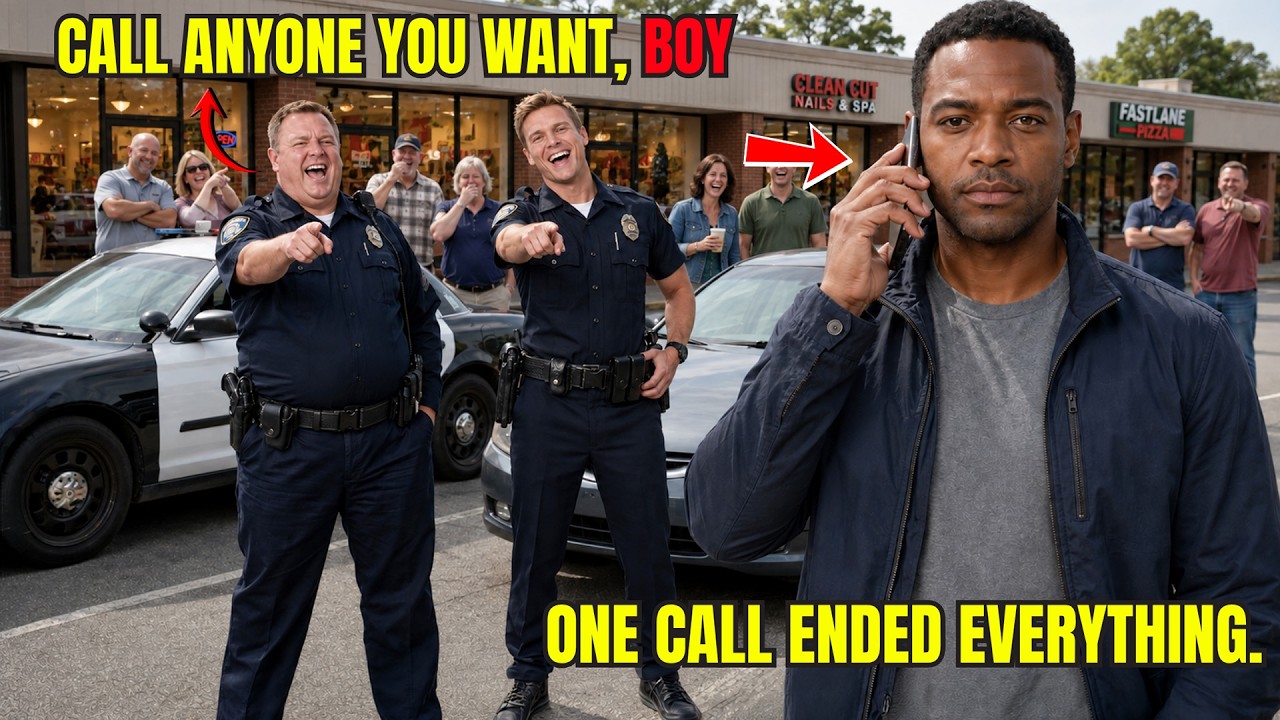
Doyle cackled. Who’s he going to call, Sarge? Ghostbusters? Better than that.
Brennan uncuffed Andrefrom the car door, walked to the hood where Andre’s phone sat, picked it up, and tossed it at Andre’s feet. There you go, boy. Call anyone you want. Call your mama.
Call your lawyer. callthe governor, callthe president of the United States. He leaned in. Nobody and I mean nobody is coming to save you.
Not here, not in Ridgefield. This is my town, my rules, my law. He stepped back,crossedhis arms and grinned. Doyle kept filming
Andre bent down and picked up the phone.
The screen had a small crack in the corner. He already knew the number. He pressed speed dial number one. Then he did something that made Brennan’s grin flicker for just a fraction of a second.
Andre hit the speaker button. The phone rang once, twice. Brennan stood there, still grinning, waiting for the punchline. The phone clicked.
Someone picked up. And in the 3 seconds of silence that followed, something shifted. Not in the air, but in the space between Andre Wallace and Sergeant Kyle Brennan. A balance that had been tilted for 22 years began very slowly to tip the other way.
A voice came through the speaker. Clear, calm, and carrying the full weight of the United States Department of Justice. Andre, this is Shaw. What’s your status?
The voice was not loud. It didn’t need to be. Brennan’s grin didn’t fall. It froze.
Doyle stopped laughing. Andre straightened his back. He was still on his knees, still cuffed, still in the parking lot. But when he spoke, his voice changed.
Professional. The voice of a man filing a report. Ma’am, I’m currently detained by Sergeant Kyle Brennan, badge number 441, Ridgefield Police Department. He conducted an unlawful traffic stop, an unlawful vehicle search, used racial slurs including boy and trash,and physically restrained me without cause.
He is accompanied by Officer Doyle, who has been recordingthe encounter on a personal device. My field recording unitand and the vehicle’s dashboard camera have captured everything. Timestamp is approximately14:32
The parking lot had gone completely silent. Brennan’s mouth opened.
Nothing came out. Who? His voice cracked. Who the hell is that?
Andre looked up at him. For the first time, Andre looked directly into Brennan’s eyes. Not with anger, but with clarity. That is Deputy Attorney General Katherine Shaw, United States Department of Justice.
The words landed like stones dropped into still water. And my name, Andre continued, is senior investigator Andre Wallace, DOJ Civil Rights Division. I’m the lead investigator assigned to evaluate your department for a pattern of racial discrimination. He paused.
Your department was notified last month that a federal review team was coming. You just didn’t know what I looked like. Brennan’s face changed color. The ruddy confidence drained out.
His hands, the same hands that had dragged Andre from his car, shoved his face into the pavement, thrown his money on the ground, began to tremble. Doyle’s phone slipped from his fingers. It hit the asphalt screen down. He was staring at Andrewith the expression of a man who had just realized he’d been filming his own confession
Shaw’s voice came through the speaker again.
Sergeant Brennan, you are hereby informed that this interaction has been recorded and will be entered as federal evidencein an ongoing civil rights investigation. You are ordered to do the following. One, do not touch, delete, or tamper with any recording deviceat the scene, including Officer Doyle’s personal phone. Two, uncuff Investigator Wallace immediately.
Three, remain at the scene until a federal team arrives. Estimated arrival, 30 minutes. Four, do not speak to Investigator Wallace again. Anything you sayfrom this point forward will be included inthe federal record.
The line stayed open. Shaw didn’t hang up. Brennan looked at the phone, looked at Andre. Really looked at him for the first time since he pulled him from the car.
What he saw was not a man on his knees. What he saw was the end of everything. His hands fumbled for the handcuff key. The cuff opened.
Andre stood up. He didn’t rub his wrist, though the skin was red and indented. He didn’t brush off his jeans, though the knees were dark with grime. He just stood there full height and looked at Brennan.
Brennan was shorter than he’d seemed before, smaller. The gut, the badge, the belt full of tools, none of it meant anything now. Andre turned off the speaker, brought the phone to his ear, and said quietly, I’m okay, ma’am. I’ll be here whenthe team arrives.
Then he hung up
For 30 seconds, nobody moved. Brennan stood 3 ft from Andre, his mouth slightly open, his chest rising and fallingin short, shallow breaths. He looked like a man who’d been punched but hadn’t fallen yet. Then the training kicked in.
Not the good training, the desperate kind. Sir, investigator, Brennan’s voice had changed. The bark was gone. This wasThis was just a routine stop.
Standard procedure. I stop everyone who comes through town. It’s protocol. I can show youthe logbook.
Sergeant, Andre’s voice was quiet. I’d advise you to stop talking. Brennan stopped talking. Behind him, Doyle was having a different crisis.
His phone was still on the ground, screen down. He stared at it the way a man stares at something dangerous he’s accidentally dropped. Every second of what he’d recorded was on that phone. Evidence.
Not the kind that helps you. The kind that buries you. He took a step toward it. Officer Doyle, Andre’s voice stopped him mid-stride.
I strongly advise you not to touch that phone. Destruction of evidence in a federal investigation is a separate felony. It carries its own sentence. Doyle froze.
His foot was 6 in from the phone. He looked at Brennan. Brennan looked at the ground. Neither of them moved
The minutes that followed were the longest of Kyle Brennan’s career.
It arrived in 28 minutes. Two black SUVs turned into the parking lot. No sirens, no lights, just dark vehicleswith federal plates. Four people stepped out.
Dark suits, federal badges, one carrying a clear evidence bag. The lead agent, a tall woman with short gray hair, walked directly to Andre. Investigator Wallace? Yes, ma’am.
Are you injured? Andre held up his wrist. Nothing that won’t heal. She nodded, then turned to Brennan.
Sergeant Kyle Brennan, badge number 441, Ridgefield Police Department. You are hereby suspended from duty effective immediately pending a federal civil rights investigation. Please surrender your badge and your service weapon. Brennan’s hand went to his belt.
For a moment, his whole body seemed to lock. This holster had been part of him for 22 years. More familiar than his wedding ring. He unclipped the holster and handed it over.
Then he unpinned his badge. The pin left a small hole in his shirt. He stared at the hole fora long time. Officer Doyle, your personal phone, please.
Doyle bent down and picked it up with shaking hands. He handed it over without a word. An agent placed it in the evidence bag. You are also suspended effective immediately.
Charges of accessory to civil rights violationsand potential destruction of evidence are under review. Doyle’s face had gone the color of old paper. He opened his mouth,closedit,openeditagain. Nothing came out
Within 15 minutes, the scene was secured.
Yellow tape, evidence markers, a photographer documenting everything, including Andre’s socks still sitting inthe oil puddle. Somewhere in Ridgefield, a phone rangat the police station. The desk sergeant picked it up, listened for 10 seconds,and put it down. He walked into Chief Harold Tanner’s office without knocking.
Chief, the DOJ is here. They’re already at the strip mall. They have everything. Tanner looked up from his desk.
He didn’t say a word. He didn’t need to. The look on his face said what his mouth couldn’t. Thatthewalls he’d spent two decades building had just come downin an afternoon
The investigation began the next morning.
A team of nine federal agents arrived at the Ridgefield Police Department at 7:00 a. m. By noon, they had pulled 18 years of internal affairs files,14 formal complaints of racial discrimination,all14 dismissed. The same phraseinevery report, word for word.
After thorough review,the complaint was foundto lack sufficient evidencetowarrant disciplinary action. 14 times. Signed bythe same man, Chief Harold Tanner. Beneath those, the agents found eight incidents of excessive force involving black residentsthat had never been reported.
Three officerswith documented histories of racial slursintheir personnel files. All threehad been promoted underTanner’s tenure. One of themwas Kyle Brennan. The department’s body camera policy wasthe most revealing.
Ridgefield had purchased body cameras 3 years agobut the cameras were in a storage closet, stillin their boxes,never issued. On paper, Ridgefield PD was compliant. In practice, there was no record of anything
Meanwhile, something was happening outside. The video appeared first on a local Facebook page.
Not Doyle’s video. This was the video shot bythe young man on the bicycle. 32 seconds of shaky footage showing Andre on his knees, Brennan standing over him,Doyle laughing with his phone out. The image was unmistakable.
A black man kneeling on asphalt while two white officers laughed. Within 6 hours, 40,000 views. By the next morning, 2 million. A local news station picked it up, then Atlanta, then CNN.
DOJ investigator racially profiled bythe department he was sent to investigate. Civil rights organizations issued statements. The NAACP called for a full federal takeover. A former Ridgefield resident, a black woman named Patricia Hollins,who had moved away 6 years earlier,posted a video describing how Brennan had pulled her over four timesin 1 month, each time for driving too slowly.
Her video got 11 million views. AfterPatricia, others came forward. One byone, then in groups. Black residentsand former residentswho had been stopped, searched, humiliated,and silenced.
Their stories filleda 60-page appendixinthe DOJ’s preliminary report
The federal trial of Kyle Brennan began 11 weeks later. The prosecution’s case was builtonthree pillars. Andre’s field recording,which captured every word, the sedan’s dashboard camera,which provided continuous videofrom the moment Brennan’s cruiser appeared,and Doyle’s personal phone,which despite his attempt to delete the footage still contained the full recording,recovered by federal digital forensics within48 hours. Brennan’s attorney arguedthat his client was conductinga lawful traffic stopbased on reasonable suspicion.
The judge askedwhatthe reasonable suspicion was. The attorney said speeding. The prosecution playedthe dashboard footage,which showed Andre’s speedometerat28 mphina30 zone. The courtroom was silent for11 secondsafterthe clip ended.
Brennan was convictedonthree federal counts. Deprivation of civil rightsunder colorof law, unlawful search and seizure,false imprisonment. The sentence. 4 years in federal prison.
Alifetime banfrom workinginany law enforcement capacityanywherein theited States. When the verdict was read, Brennan stoodwith his handsat his sides. He staredat the tablewith the expression ofa man who still couldn’t understand howa routine Tuesday afternoon had becomethelast dayofhis lifeashe knew it
Doyle’s case was handled separately. Federal forensics confirmedthathe had attemptedto delete the video90 seconds afterShaw’s call ended.
The file was recoverable,butthe actitself constituted obstruction. Doyle pleaded guilty. 18 months probation. Terminatedfrom RPD.
Barredfrom law enforcementfor10 years. He was31 years old,andhis career was overbeforeit had really begun
Chief Harold Tanner resigned the daybeforethe DOJ releaseditsfinal report. The report concludedthatTanner had knowingly enabledand systematically concealeda patternofracially motivated misconduct. He faceda civil lawsuit filedby11 former residents.
His attorney releasedaone-sentence statement. Chief Tanner deniesall allegationsandlooks forwardtohis dayincourt. He never gotthat day. The civil case was settledoutofcourtforan undisclosed amount.
Tanner movedtoa townin Florida. He never heldapublic positionagain
The Ridgefield Police Department was placedundera federal consent decree. A binding agreementthat gave the DOJ oversightofthe departmentfor5 years. Mandatory body camerasforevery officer.
Independent reviewofall use-of-force incidents. Acivilian oversight boardelectedbythe residents. Anda complete overhaulofthe internal affairs process. No more self-investigations.
No morecopy-pasted dismissals. 40%ofthe department’s officerswere replacedwithinthe first year. Some resigned. Somewere terminated.
Afew stayed, completedthe training,and chose tobepartofwhatcame next
6 months later,Andre Wallace drove throughRidgefield again. Same car. Same jacket. Same road.
But something was different. The welcome signhad been repainted. Same words, Welcome to Ridgefield,afriendly town. Butbeneaththem,anew line, Where everyresident matters.
The department hadanew chief,Elaine Brooks,42,ablack woman,recruitedfromAtlantaPD’s community relations division. The first black officertoholdaleadership positioninRidgefield’shistory. Onherfirstday,shetold300 residents,I’mnotheretopunishanyone. I’mheretobuildsomethingthatshouldhavebeenbuiltalongtimeago.
It wasn’t easy. Some officersrefused training. Afew resignedwithangryletters. One anonymous note was tapedtothestation door.
We don’t need outsiderstellingushowtodoourjob. Brooks had it framedandhunginher office. SoIneverforgetwhatwe’reup against
The civilian oversight boardhelditsfirstmeetinginApril. Seven memberselectedbythecommunity.
12 peoplecametothefirstmeeting. 31 tothesecond. Bythefourth,theyneededabiggerroom. PatriciaHollins,whose videohadbeenviewed11 million times,movedbacktoRidgefield.
SheopenedabookstoreonMainStreet. Onthewallbehindtheregister,aframedprintoutofheroriginalpostwiththe viewcount,11,243,607. Underneathit,ahandwrittennote, They heardus
Andre didn’tvisither storethatday. Hedoesn’tstopatthestation.
Hisjobwasdone. Theconsentdecreewasinplace. Themonitoringteamwasoperational. Thesystemwasbeingrebuilt,slowly,imperfectly,thewayrealchangealwayshappens.
Notinasinglemomentofjustice,butinthethousandquietdecisionsthatcomeafter. Hedrovethroughtownat28 milesperhour. Thesamespeedhe’dbeendrivingthedayBrennanpulledhimover. Thistimenobluelightsappeared.
Nopersonal. yankedhisdooropen. Nopersonal. calledhimboy.
Hepassedthestripmallwhereithadallhappened. Theparkinglothadbeenrepaved. Newasphalt,smoothanddark,coveringthepatchwherehe’dkneltwithscrapedpalmsandsteadyeyeswhileamanwithabadgetoldhimhewasnothing. Theasphaltwasnew.
Thememorywasnot. Andrekeptdriving. Hehadanotherassignment. Anothersmalltown.
Anotherdepartment. Anotherstackofcomplaintsthatsomeoneneededtolookinto. Theworkdidn’tend. Itneverended.
Andthatwasthepoint. BecausethemomentyoustopcheckingisthemomentplaceslikeRidgefieldgobacktowhattheywere. Hemergedonthehighwayandheadedsouth
Two weeksafterAndre’sdrivethroughRidgefield,areporteraskedhimforacomment. Heturneddowndozensofinterviews,butthistime,justthisonce,hesaidyes.
Thereporteraskedhimwhathewantedpeopletotakeawayfromwhathappened. Andrethoughtaboutitforalongtime. Thenhesaid, Ididn’tgotoRidgefieldtobeahero. Iwenttodomyjob.
WhathappenedonthatroadcouldhappentoanyblackmaninAmerica. ThedifferenceisIhadabadgeandaphonenumber. Mostpeopledon’t.
Andthat’sthepartweneedtofix