My mother didn’t tell me I was adopted until she wanted me out of the house forever. She stood in the doorway holding a black contractor trash bag like she was doing me a favor. Thirty years of calling me son ended in less than thirty seconds. I wish I could say I yelled, that I demanded answers or slammed the door behind me.
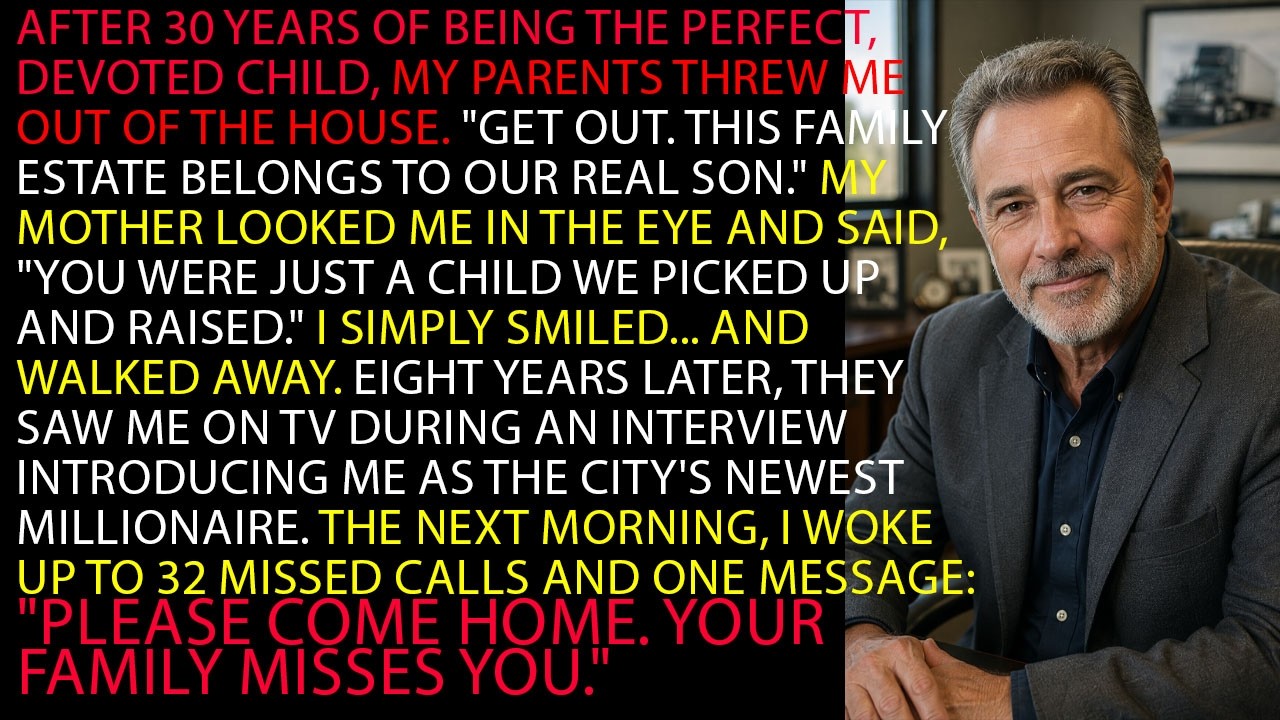
I didn’t. When you spend most of your life trying to keep the peace, silence becomes second nature. My name is Daniel Brooks. I’m fifty-eight now.
Eight years have passed since that afternoon, but I can still smell the pot roast drifting through the kitchen while she told me I wasn’t really family. Funny how your life can fall apart in a room that still smells like Sunday dinner. Back then I was fifty. Every weekday my alarm went off at 4:45 a.
m. I’d make coffee in a dented travel mug, scrape ice off my windshield during Ohio winters, and drive thirty minutes to the warehouse where I’d worked for nearly twenty-six years. It wasn’t glamorous work—loading freight, checking inventory, making sure trucks left on schedule—but it paid the bills. And every Friday, long after my own mortgage was paid off, I still helped my parents with theirs.
Not because they asked every week, but because I thought that’s what sons did. That Saturday had started like hundreds before it. By 6:30 in the morning I was outside their house shoveling the first snow of the season before heading to work. My father hated slippery sidewalks after his knee replacement, and my mother always worried about him falling.
They were still asleep when I finished. I never told them I’d done it. I didn’t need a thank you. Around noon, my mother called.
“Can you come by tonight? ” she asked. “Your father and Kevin need to talk about something important. ”
Her voice sounded ordinary.
No tension. No warning. I figured they wanted to discuss retirement. Dad had turned seventy-six that year, and I’d been quietly helping him organize his finances for months.
“Sure,” I said. “I’ll grab dinner on the way. ”
“Oh, don’t bother,” she replied after a brief pause. “I’m cooking.
”
That should have comforted me. Instead, for reasons I couldn’t explain, something about that pause stayed with me during the drive home. I showered, changed into a clean flannel shirt, and stopped at a bakery anyway. My mother loved lemon bars.
I walked in carrying the white bakery box like I had a hundred times before. Kevin was already there. My younger brother sat at the kitchen table scrolling through his phone. He looked up just long enough to nod.
“Hey. ”
That was Kevin. Always polite enough to avoid criticism, never warm enough to invite conversation. Growing up, I thought he got more attention because he was the younger child.
When he wrecked Dad’s pickup at nineteen, Dad bought another truck. When Kevin dropped out of community college, Mom said college wasn’t for everyone. When he borrowed money for a used car business that failed within a year, they called it bad luck. Whenever I worked overtime to help cover their expenses, they called it responsibility.
I never compared us. Not out loud, anyway. Mom set dinner on the table. Meatloaf, mashed potatoes, green beans.
For twenty minutes everything felt almost normal. Dad asked about work. Mom complained about grocery prices. Kevin talked about football.
Then Dad folded his napkin, reached beside his chair, and placed a large manila envelope on the table. “I’ve updated the estate plan. ”
I smiled. “Good.
It’s about time. ”
He slid the envelope toward Kevin instead of me. Kevin opened it without saying a word. My smile faded.
Dad cleared his throat. “The house, the savings—everything is being transferred to Kevin. ”
I waited. Surely there was another page, another envelope, something.
“There must be a mistake,” I said. “There isn’t,” Kevin answered before either of my parents could speak. I looked at Dad. “What about me?
”
He stared down at the table. His hands trembled slightly. The silence stretched so long I could hear the old refrigerator humming in the corner. Finally my mother spoke.
“Daniel. ” She wouldn’t look at me. “We never wanted you to find out like this. ”
A strange chill settled over me.
“Find out what? ”
She took a slow breath. “You aren’t our biological son. ”
No one moved.
No one blinked. I honestly thought I’d misheard her. “What? ”
“You were adopted,” she said quietly.
“No. ”
She nodded. “We took you in when you were a baby. ”
I laughed once.
Not because anything was funny, but because my mind refused to accept the words. “That’s impossible. ”
“It isn’t. ”
I looked at my father.
“Dad? ”
His eyes stayed fixed on the table. “We loved you,” he whispered. Loved.
Past tense. I swallowed hard. “When were you planning to tell me? ”
Neither of them answered.
“When? ” I asked again. This time my mother met my eyes. “We weren’t.
”
The room suddenly felt smaller. I looked from one face to another, searching for someone to smile and admit it was some terrible misunderstanding. Kevin leaned back in his chair. “It’s not personal,” he said.
“Blood should stay with blood. ”
I stared at him. “You knew? ”
He shrugged.
“I’ve always known. ”
I turned back to my parents. “You let him know before me? ”
No answer.
Thirty years. Birthdays. Christmas mornings. Family vacations.
Hospital visits. Helping Dad after surgery. Driving Mom to chemotherapy appointments when they thought she might have cancer—thankfully, it turned out to be benign. Every memory in my head suddenly felt borrowed.
“Were any of those years real? ” I asked. Dad closed his eyes. “They were.
”
“Were they? ”
No one answered. Mom stood up. “I think it’s best if you leave.
”
I stayed where I was. “I’ve lived as your son for thirty years. ”
“You’ve lived here because we raised you. ”
The difference between those two sentences hit harder than anything else she’d said.
She walked to the hallway closet and returned carrying a black contractor trash bag. “You can take whatever belongs to you. ”
I looked at the bag, then at her. “That’s all?
”
She nodded once. “The house belongs to Kevin now. ”
I didn’t argue. Maybe some part of me understood arguing couldn’t bring back thirty years.
I walked down the hallway toward the room I’d slept in until my late twenties. The walls were freshly painted. The family photos were gone. I opened the closet.
Three work shirts, an old pair of Red Wing boots, my toolbox, a framed picture of Dad and me fishing when I was twelve. I hesitated, then left the picture behind. If it wasn’t real to them, I wasn’t sure it belonged to me anymore. Outside, the November air bit through my jacket.
I loaded the trash bag into my old blue Ford F-150. Before climbing in, I turned back toward the house. The porch light was already off. No one came outside.
No one said goodbye. I drove without knowing where I was going. I called my aunt Linda—straight to voicemail. An old co-worker—no answer.
A church friend I’d helped move twice—his phone had been disconnected. By midnight I found myself parked beneath the bright lights of a Walmart on the west side of Columbus. Truckers idled nearby. A young couple argued quietly in the next row.
Someone pushed a shopping cart through the empty lot. Life kept moving. Mine had stopped. I leaned my seat back as far as it would go.
The cab smelled faintly of motor oil and coffee. I stared through the windshield until the parking lot lights blurred. Just before I closed my eyes, I caught my reflection in the rearview mirror. For the first time in my life, I didn’t know whose son I was.
All I knew was that when morning came, I’d have $1,700 in my checking account, no family, no home, and no idea how to begin again. The first morning after I slept in my truck, I shaved in a Walmart restroom. I stood in front of a scratched mirror with a disposable razor and a paper towel under my chin, trying to look like a man whose life hadn’t fallen apart the night before. Nobody looked at me twice.
An older gentleman washed his hands, nodded politely, and walked out. A young father helped his little boy reach the sink. The world kept turning. Mine felt like it had stopped somewhere around eight o’clock the previous evening.
I drove to work anyway. I couldn’t afford not to. By 7:30 I was loading pallets onto trailers like any other Monday. If anyone noticed I hadn’t slept, they were kind enough not to say anything.
Around lunch, my supervisor Rick sat down across from me in the break room. “You look awful,” he said. “I’ve looked worse. ”
He smiled.
“I doubt that. ”
I almost told him. Instead, I shrugged. “Just didn’t sleep much.
”
He nodded once. “You know where my office is if you ever need to talk. ”
Sometimes kindness hurts more than cruelty. Cruelty expects nothing from you.
Kindness reminds you how badly you want to fall apart. Three weeks later I rented a basement apartment on the south side of Columbus. It had one tiny bedroom and one window just above ground level. If someone walked across the lawn outside, all I saw were their shoes.
The refrigerator buzzed all night. The heat worked when it felt like it. The landlord apologized every month. I always told him it was fine, because compared to sleeping in my truck, it really was.
I filled the apartment with almost nothing. A folding table, a second-hand recliner, one television someone at work sold me for fifty dollars. At night, the place echoed. No voices, no footsteps, no family.
I’d spent thirty years taking care of other people. I had no idea how to take care of myself. Thanksgiving arrived before I was ready. Every year I’d carved the turkey at my parents’ house.
Dad always insisted I made the stuffing better than anyone else. That year I heated up a frozen turkey dinner in a microwave that rotated so loudly it sounded like an old cement mixer. Around six o’clock I looked out my basement window. Across the street, lights glowed inside other homes.
Families arrived carrying casseroles. Children ran through front yards wearing oversized coats. Someone laughed. Someone else burned something on the grill.
Normal life. I sat alone with a plastic fork. For the first time since I was a little boy, I cried while eating dinner. Not loudly.
Just quietly enough that nobody would have heard me if they’d been there. Winter turned into spring. Spring became summer. I worked every overtime shift available.
Weekends I delivered furniture for a local store. Sometimes I drove twelve or fourteen hours a day. Not because I needed luxury, but because staying busy hurt less than sitting still. People often imagine loneliness as silence.
It isn’t. Loneliness is remembering exactly who you wish would call and knowing they won’t. The following October, something unexpected happened. My truck broke down outside a little diner in Grove City.
Steam poured from under the hood. I coasted into the parking lot and stared at the engine for twenty minutes before admitting I wasn’t fixing that myself. The diner was nearly empty. One waitress, three customers.
A woman in her seventies stood behind the register pouring coffee. She smiled. “You look like somebody who’s had a worse day than I have. ”
“I’ve had better.
”
“Coffee? ”
“I probably shouldn’t spend the money. ”
She poured it anyway. “Didn’t ask if you could afford it.
”
Her name tag read Helen. I spent nearly an hour waiting for the tow truck. She kept my coffee cup full. Eventually she asked, “You got family nearby?
”
I looked down. “Not anymore. ”
She didn’t ask another question. Instead, she brought me a slice of warm apple pie.
“I didn’t order this. ”
“I know. ”
“I can’t pay for it. ”
“I know that, too.
”
I finally smiled. The first real smile in months. Before I left, she said something I’ll never forget: “Everybody deserves one fresh start. ”
Those six words stayed with me longer than she probably ever imagined.
A few months later, an opportunity landed in my lap. Not because I was lucky, but because I’d been paying attention. At the warehouse, trucking companies were always late. Deliveries got routed inefficiently.
Drivers crossed the same highways twice. Nobody seemed interested in fixing it. I started building spreadsheets at home. Nothing fancy, just practical.
Fuel costs, delivery windows, shortest routes. One afternoon I showed Rick. He studied the pages. “You made this?
”
“Couldn’t sleep. ”
He laughed. “I’ve been telling corporate this for years. Did they listen?
”
“No. ”
He slid the papers back. “But somebody eventually will. ”
By the time I turned fifty-one, I’d saved nearly every extra dollar I’d earned.
Enough for a down payment on one used twenty-six-foot box truck. Buying it terrified me. Signing those loan papers felt riskier than anything I’d ever done. The truck had nearly 400,000 miles.
The driver’s seat leaned slightly to the left. The air conditioning worked whenever it felt generous. Still, it was mine. My company consisted of one truck, one folding table inside my rented garage, one prepaid cell phone, and one very nervous owner.
I called it Brooks Regional Logistics. The name sounded much larger than reality. That was intentional. Finding customers wasn’t easy.
Many days I drove more miles looking for work than actually working. One manager looked at my business card and laughed. “Regional? You’ve got one truck.
”
He grinned. “I like confidence. ”
He still didn’t hire me. Three months later I met Frank, a retired army mechanic, sixty-two years old, built like an old oak tree.
He looked at my truck for ten minutes before saying, “This thing’s ugly. ”
“I know. But it’ll survive a nuclear war. ”
He agreed to help two days a week.
His payment demands were surprisingly simple. “Coffee. That’s it. And pie every Friday.
”
I laughed. “Deal. ”
From then on, every Friday afternoon became pie day. Frank insisted no serious business decisions should ever happen on an empty stomach.
His favorite saying became famous around our tiny office: “Bad coffee builds good companies. ”
I still don’t know if he believed it, but he repeated it enough that eventually everyone else did. Just as things finally seemed to improve, everything nearly collapsed again. One of my biggest clients, a construction supplier outside Dayton, filed for bankruptcy.
They owed me just over $200,000—money I’d already spent paying drivers, buying fuel, and keeping the truck on the road. The bank called two weeks later. If payment wasn’t received, I knew the rest. They’d take the truck.
I drove home in silence, sat alone inside my garage, looked around at everything I’d built, then at the keys to my old Ford F-150. That truck had carried every possession I owned the night I lost my family. I’d always told myself I’d never sell it. The next morning, I did.
Not because I wanted to, but because companies don’t survive on memories. I watched another man drive away in it. It felt strangely similar to watching my childhood disappear all over again. Frank stood beside me, didn’t say much.
Just placed a hand on my shoulder. “You can always buy another truck. ”
I nodded. He smiled gently.
“But you can’t buy another chance. ”
He was right. So I kept going. And somehow, against every prediction, we survived.
By our eighth year in business, Brooks Regional Logistics had grown from one battered box truck into a fleet serving customers across Ohio and Indiana. Then one Tuesday afternoon, my marketing director walked into my office holding a television station’s business card. “They want to interview you. ”
I shook my head immediately.
“They’ve got the wrong guy. ”
“They don’t. ”
“I haul freight. ”
She smiled.
“No, Daniel. You built something people believe in. ”
I wasn’t convinced, but two weeks later the cameras arrived anyway. And nearly a hundred miles away, someone I hadn’t seen in eight years was about to recognize my face.
The television interview aired on a Thursday evening. I didn’t even watch it. By the time it came on, I was still at the office in Carmel, Indiana, going over delivery schedules. We had three trucks delayed by storms near Fort Wayne, one driver with a sick grandchild, and a customer who needed medical equipment delivered before sunrise.
That was my life. Not television. Not cameras. Just solving problems.
When I finally got home around 9:30, I microwaved leftover chili, watched half a baseball game, and went to bed before the late news even started. I slept better that night than I had in weeks. Then my phone woke me at 6:12 the next morning. I reached for it expecting an emergency from one of my drivers.
Instead, I froze. Thirty-two missed calls. Nine voicemail notifications. One text message.
Every single one came from Columbus. Most were from numbers I hadn’t seen in eight years—Mom, Dad, Kevin, even two neighbors from the old street. The text message was only six words: “Please come home. We miss you.
”
I stared at the screen for a long time. Then I set the phone back on the nightstand without replying. For the first hour of the morning I did exactly what I always did. Made coffee.
Fed the stray orange cat that had decided my porch belonged to him. Watered the tomatoes in my backyard. Routine has a funny way of keeping panic under control. By eight o’clock I was sitting in my office.
My assistant Melissa walked in carrying a folder. “You’ve got another interview request. ”
“I think one was enough. ”
She laughed.
“You’ve become interesting. ”
“I’ve spent thirty years trying not to be. ”
She was about to leave when she noticed my expression. “You okay?
”
I turned the phone around. She looked at the screen. “Family? ”
I nodded.
“Haven’t heard from them in eight years. ”
She didn’t ask another question. She simply closed the office door behind her. Some people understand privacy without being told.
Around lunchtime, my oldest friend called. His name was Eddie. We’d worked together at the warehouse years ago before he retired. He was the kind of man who could fix a lawn mower, grill a perfect steak, and tell you the truth even when you didn’t want to hear it.
“You planning to call them back? ” he asked. “I don’t know. ”
“You want my opinion?
”
“I already know it. ”
“They don’t miss your stories, Danny. ” He paused. “They miss your balance sheet.
”
I leaned back in my chair. “Maybe people change. ”
“They do. ” He paused again.
“But not overnight because somebody was on television. ”
His words stayed with me all afternoon. Still, there was another voice inside me. Not the fifty-eight-year-old businessman.
The little boy who had once believed his mother could fix anything with a hug. That little boy wanted to believe. Wanted to think maybe eight years had changed everyone. Maybe regret had finally caught up with them.
Three days later, I called. Mom answered before the first ring finished. “Daniel? ” Her voice cracked.
“Oh, sweetheart. ”
I closed my eyes. Nobody had called me sweetheart in years. “I got your message.
”
“We’ve been so worried. ”
For eight years, silence. Then she said quietly, “We made mistakes. ”
Dad came on the line.
“You think? ”
“Maybe you could come over Sunday. ”
I should have said no. Instead, I heard myself answer, “I’ll think about it.
”
When I hung up, I felt exhausted. Not because of the conversation, but because hope weighs more than people realize. Sunday morning, I drove the two hours from Carmel back to Columbus. The highway looked exactly the same.
Same truck stops. Same billboards. Same exits I’d driven hundreds of times. Funny how roads don’t care who’s using them.
As I turned onto my old street, my stomach tightened. The maple tree in the front yard had grown taller. Mrs. Henderson next door still had ceramic geese on her porch.
Even the cracked basketball hoop across the street was still standing. Time had moved. The neighborhood hadn’t. Mom opened the front door before I reached it.
For a second I almost didn’t recognize her. She looked smaller, older. Her hair had turned almost completely white. Then she hugged me.
It caught me completely off guard. I remembered that perfume instantly—lavender. The same brand she’d worn my entire life. Only now, it didn’t smell like home.
It smelled like memory. “Oh, Daniel. ” She held me longer than I expected. “I’m so sorry.
”
Dad stood behind her. His shoulders had rounded with age. He looked tired, older than seventy-six. “Good to see you, son.
”
The word landed strangely. Son. Eight years earlier, I hadn’t been one. Now I was again.
Apparently, titles could change when bank accounts did. Kevin walked in from the kitchen carrying four glasses of iced tea. He smiled so broadly it almost looked painful. “Long time.
”
“It has been. ”
He actually pulled out a chair for me. If you’d known Kevin growing up, you’d understand why that alone made me suspicious. Lunch looked almost identical to dozens we’d shared years ago.
Pot roast, mashed potatoes, homemade rolls. Mom kept asking if I was eating enough. Dad asked about Indiana. Kevin complimented my suit.
Everything felt scripted. Like actors performing a family instead of living as one. Twenty minutes passed. Nobody mentioned the interview.
Nobody mentioned money. For one dangerous moment, I almost believed Eddie had been wrong. Then Kevin cleared his throat. “So,” he smiled.
“I guess business has been pretty good. ”
“It’s been steady. ”
“I read your company expanded. ”
“We’ve been fortunate.
”
Dad looked down at his plate. Mom folded her napkin three different times before speaking. “There is something we need help with. ”
There it was.
I felt my shoulders relax. Oddly enough, the truth was easier than pretending. “What kind of help? ”
Kevin answered before anyone else could.
“The economy’s been rough. ”
“Mm. ”
“My dealership closed. ”
“I heard.
”
“I had to borrow some money. ”
“How much? ”
He looked at Mom. She looked at Dad.
Dad finally whispered, “About $180,000. ”
I honestly thought I’d misheard him. “$180,000? The house is collateral?
”
Everything suddenly clicked. The phone calls, the hugs, the smiles, the word son. Mom reached across the table. “We’re family.
”
I looked at her hand—the same hand that had once given me a trash bag. Part of me still wanted to help. That frightened me more than anything else. Maybe love doesn’t disappear.
Maybe it just hides under scars. I excused myself to wash my hands. The downstairs bathroom was occupied, so I walked toward the kitchen sink. Just before turning the corner, I heard voices.
Kevin’s and Mom’s. His voice was low, impatient. “Just keep being nice. ”
Mom whispered something I couldn’t hear.
Kevin sighed. “We’re this close. ” A pause. “Once he signs the check… we’ll never have to deal with him again.
”
Everything inside me went perfectly still. Not angry, not shocked. Just still. I quietly stepped backward before they could see me, walked into the dining room, and picked up my keys.
Dad looked confused. “You’re leaving? ”
“I have an early meeting tomorrow. ”
“But dessert?
”
“Maybe another time. ”
Mom hurried after me onto the porch. “Daniel, please. ”
I smiled politely.
“Thank you for lunch. ”
She searched my face. For a brief second I wondered if she knew I’d heard everything. If she did, she hid it well.
I drove away without looking back. Halfway to the interstate, my phone rang. Melissa. “Daniel.
” She sounded uneasy. “You should probably know. ”
“What? ”
“There are three people in our reception area.
” A pause. “They say they’re your family. ”
I tightened my grip on the steering wheel. “They’re demanding to see you.
”
I didn’t answer Melissa right away. I kept driving. The interstate stretched ahead of me, gray beneath a cloudy Ohio sky. Cars passed on both sides, everyone hurrying somewhere that probably felt important.
For a moment I considered turning around. Not to go back to my parents’ house—to keep driving west, south, anywhere. Because there are days when walking away feels easier than standing your ground. Then I remembered something Frank used to tell every new driver we hired: “Problems don’t get smaller while you’re driving away from them.
”
I let out a slow breath. “I’m about forty-five minutes out,” I told Melissa. “Is everyone okay? ”
“They’re loud,” she admitted, “but nobody’s been hurt.
”
“Did they threaten anyone? ”
“No. ”
“Good. ”
She hesitated.
“I moved them into the conference room. ”
I smiled despite everything. Melissa had more common sense than people twice her age. “Thank you.
”
“I also asked Mr. Henderson to sit in. ”
Our company attorney—smart woman, very calm. Exactly who I’d want there.
“I’ll be there soon. ”
Brooks Regional Logistics wasn’t a huge corporation. We had just over sixty employees. Most of them knew me by my first name.
Drivers walked into my office without appointments. Dispatchers argued with me about football scores. Every Friday somebody brought donuts. It wasn’t fancy.
It was family. The kind built one ordinary day at a time. When I walked through the front doors, the receptionist looked relieved. “They’re still in there.
”
“Thanks, Lisa. ”
Several employees glanced up from their desks. Nobody asked questions. That alone told me everything—they’d heard enough already.
I straightened my jacket, picked up a bottle of water, and walked into the conference room. My parents sat on one side of the table. Kevin paced near the window. Melissa sat quietly near the door.
Beside her were our attorney Susan Henderson and our chief financial officer Martin Cole. Not because I planned to embarrass anyone, but because if accusations were going to be made, there needed to be witnesses. Kevin spoke first. “There he is.
”
I nodded. “Kevin. ”
Mom immediately stood. “Oh, Daniel.
” She reached toward me. I gently stepped back. “I’m glad everyone has a chair. ”
She slowly lowered her hand.
Dad looked exhausted—older than I remembered just a week earlier. “I didn’t want it to happen like this,” he said. “I know. ”
Kevin slammed both hands onto the table.
“We’re losing the house. ”
Susan calmly looked at him. “Sir, please lower your voice. ”
He ignored her.
“You’ve got millions. ”
I finally sat down. “I’ve worked hard. ”
“You owe us.
”
There it was. Not please, not help, not could you. You owe us. I folded my hands.
“What exactly do I owe you? ”
Kevin laughed. “Everything. ”
I looked at my father.
“Do you believe that? ”
He opened his mouth, closed it again. Mom answered instead. “We raised you.
”
“You did. For thirty years. ”
“Yes. So don’t pretend you don’t have responsibilities.
”
I nodded slowly. “I agree. ”
For the first time since I’d entered the room, Kevin smiled. He thought he’d won.
Then I continued. “I’ve been thinking a lot about responsibilities. ”
I reached into my briefcase—not for a checkbook, but for my laptop. I placed it on the conference table and turned it around.
On the screen was a spreadsheet. Thousands of entries. Dates, times, medication names, doctor appointments, blood pressure readings. Martin recognized it immediately.
“I’ve seen that file. ”
I nodded. “I’ve kept it for years. ”
Mom frowned.
“What is that? ”
I looked at her. “It’s Dad. ”
I clicked through page after page.
2011, prescription refill. 2012, physical therapy appointments after knee surgery. 2013, cardiology visits, blood pressure readings, medication changes. 2014, insulin schedule after his diabetes worsened.
I looked at Dad. “You remember this? ”
His eyes filled. “I do.
”
I kept scrolling. There were reminders for every specialist, every blood test, every surgery, every prescription refill, every follow-up appointment. I never missed one. I finally closed the laptop.
Then I said the only sentence I’d rehearsed during the entire drive: “I remembered every pill Dad ever took. ”
Nobody spoke. “I remembered every doctor’s appointment. ”
Silence.
“I remembered every insurance renewal. ”
Mom’s eyes dropped toward the table. “I remembered birthdays, Christmases, anniversaries. I remembered when the roof leaked, when the furnace broke, when Dad couldn’t drive, when Mom was scared the biopsy might be cancer.
”
I paused, then quietly asked, “Can either of you tell everyone in this room my birthday? ”
The conference room became perfectly still. I wasn’t trying to humiliate them. I honestly wanted to know.
Dad stared at his hands. Mom looked toward the ceiling as though the answer might be written there. Kevin rolled his eyes. After nearly twenty seconds, Mom whispered, “April.
”
She stopped. Dad closed his eyes. Neither of them knew. Not the month, not the day.
Nothing. I smiled sadly. “I never forgot yours. ”
Nobody moved.
Even Kevin had stopped talking. Susan quietly removed her glasses. Melissa stared down at her notebook. Martin looked out the window.
I don’t think anyone wanted to witness that moment. Yet everyone did. Dad suddenly spoke. “I tried.
”
The room turned toward him. “I tried to tell you. ”
Kevin frowned. “What are you talking about?
”
Dad reached into the inside pocket of his old jacket. His hands shook as he unfolded a yellowed envelope. “I’ve carried this for years. ”
He handed it across the table.
I recognized my own name written on the front. Daniel. Nothing else. No address.
No stamp. I carefully unfolded the paper inside. The date at the top read June 14th, 1998. My father had written it:
“Mary, we have to tell Daniel the truth.
He’s becoming a young man. If he hears it from someone else someday, he’ll never trust us again. ”
Halfway down the page, another handwriting crossed through the letter. Red ink.
One word: “No. ”
My mother’s handwriting. I looked up slowly. Dad’s voice barely carried across the room.
“I wanted you to know. ”
Mom covered her face. “I was afraid. ”
“Of what?
”
“You’d leave. ”
I stared at her. “I only left because you pushed me out. ”
She began crying.
Not loudly. Not dramatically. Quietly. The way people cry when they finally run out of excuses.
Kevin stood abruptly. “This is ridiculous. ” He pointed toward me. “He isn’t even your real son.
”
Dad surprised everyone—including me. He stood slowly, painfully, then looked directly at Kevin. “No. ” He swallowed.
“He’s the son who stayed. ”
The room froze. Kevin laughed. “What?
”
Dad’s voice grew steadier. “When I had surgeries, Daniel came. When I couldn’t pay bills, Daniel paid them. When your mother needed rides, Daniel drove.
”
He looked at Kevin with heartbreaking disappointment. “You only came when you needed money. ”
Kevin’s face reddened. “So you’re taking his side now?
”
Dad didn’t answer. He didn’t have to. The silence answered for him. I reached into my briefcase once more.
This time I removed a folder. “I won’t give you $180,000. ”
Kevin slammed his fist onto the table. “I knew it.
”
But I slid the folder across to him. Inside were documents—an intake appointment at one of Indiana’s best gambling recovery programs, six months of prepaid counseling, a financial restructuring service, debt management specialists. Every bill already covered. Kevin looked at the papers.
Then at me. “What the hell is this? ”
“It’s help. ”
“I asked for money.
”
“No. ” I shook my head. “You asked for rescue. ”
I leaned forward.
“If I pay your debts today, you’ll create new ones tomorrow. ”
Kevin grabbed the folder and threw it across the room. Pages scattered across the carpet. “I don’t need your charity.
”
“No,” I answered quietly. “You need your own responsibility. ”
He stormed out, slamming the conference room doors so hard the glass rattled. Nobody chased him.
Mom sat frozen. Dad looked twenty years older than when he’d walked in. I stood. “I hope both of you find peace.
”
Mom reached toward me one last time. This time, she didn’t ask for money. She whispered, “I’m sorry. ”
I believe she meant it—for the first time.
But some apologies arrive years after they can change anything. As they slowly walked toward the elevator, Melissa stepped beside me. “You okay? ”
I watched the doors close behind my parents.
“I don’t know. ”
She nodded gently. “That’s an honest answer. ”
Two weeks later, a handwritten envelope arrived at my office.
The return address was from Columbus. I expected another plea from my parents. Instead, the sender’s name stopped me cold: Helen Parker. The woman from the diner.
Except the letter wasn’t signed by Helen. It was signed by someone else. Her granddaughter. I knew something was wrong the moment I saw the handwriting.
The envelope was addressed neatly, but the return address wasn’t the diner in Grove City. It was a small house in Hilliard, Ohio. Inside was a single sheet of paper:
“Dear Mr. Brooks, my name is Emily Parker.
I’m Helen Parker’s granddaughter. Grandma passed away peacefully last week. She talked about you more than you probably realized. Before she died, she asked me to give you something.
She said, ‘He’ll understand why I kept it. ’ If you’re willing, I’d like to meet you. ”
I read the letter three times. Then I quietly closed my office door.
For several minutes I simply sat there. Helen had never asked me for anything. She never knew how much those free cups of coffee and slices of pie had mattered. She probably thought she just helped a tired stranger.
She had done much more than that. She had reminded me I still belonged somewhere. The funeral was held on a cool Saturday morning at a little Methodist Church outside Grove City. It wasn’t large—maybe sixty people.
Retired teachers, neighbors, former customers from the diner, a few truck drivers still wearing work boots. The kind of people who measure a person’s life by the kindness they leave behind instead of the money they earn. I slipped into the last pew. I didn’t want attention.
This wasn’t about me. The pastor smiled as he shared stories about Helen. “She believed nobody should leave hungry. ”
People laughed softly.
“Oh, and she was convinced pie solved at least half of life’s problems. ”
That brought louder laughter. I laughed too, because it was true. After the service, Emily found me standing beside Helen’s favorite flower bed.
“You must be Daniel. ”
“I am. ”
She hugged me before I could say another word. “Grandma was right.
”
“About what? ”
“You really do have kind eyes. ”
I wasn’t sure what to say to that. She led me to her car and opened the trunk.
Inside sat an old wooden box with brass corners. “This is yours. ”
“I don’t understand. ”
“Neither did I.
” She handed me a small key. “I promised Grandma I wouldn’t open it. ”
I unlocked the box. Inside were several photographs, a faded diner receipt with my name scribbled on the back, a handwritten recipe for apple pie.
Then I saw something that made my breath catch. A familiar blue Ford key. I stared at it. “No.
”
Emily smiled through tears. “She bought it. ”
I looked up. “My truck?
”
She nodded. “The man who bought it eventually traded it in. Grandma recognized the license plate from an old photograph you once showed her. ”
I couldn’t speak.
“She purchased it three years ago. But she said one day you’d come looking for home. ”
Emily reached into the box and handed me another envelope—Grandma’s handwriting. Inside was one short note:
“Daniel, some things aren’t valuable because they’re expensive.
They’re valuable because they carried us through the hardest days. Welcome home. —Helen”
I finally cried. Not because of the truck, but because someone who wasn’t family had remembered what mattered to me.
The truck still ran. Barely. Frank laughed for nearly five minutes when I drove it into the company parking lot the following Monday. “I thought this old thing was halfway to Mexico.
”
“So did I. ”
He patted the hood. “This truck refuses to die. ”
“So do we.
”
He grinned. “Now you’re talking. ”
A month later, I received another phone call. This one came from Mrs.
Eleanor Whittaker—my fourth grade teacher. She had seen the television interview and somehow tracked me down. “I’ve been trying to decide whether to call. ”
“I’m glad you did.
”
“There are things you deserve to know. ”
The following weekend I drove back to Columbus again. Mrs. Whittaker was eighty-three.
Her living room looked exactly like you’d expect an old teacher’s home to look—books everywhere, family photographs, a grandfather clock ticking softly in the corner. She disappeared into a hallway and returned carrying a small tin box. “I’ve kept this for decades. ”
Inside were three things: a black-and-white photograph of a young woman holding a baby, a silver heart-shaped necklace, and a folded letter.
“Your birth mother was one of my students. ”
I gently picked up the photograph. The woman couldn’t have been older than twenty-three. She was smiling at the baby in her arms.
Me. Mrs. Whittaker sat beside me. “She adored you.
”
I swallowed hard. “I was always told…”
“I know what you were told. ” She shook her head. “She never abandoned you.
”
According to the records Mrs. Whittaker had helped preserve, my birth mother had been critically injured in a multi-car accident while traveling to stay with relatives after my father’s sudden death. She died two days later. The emergency shelter handling displaced families temporarily placed me into protective care.
By the time extended relatives were located, paperwork had already taken a different path. Mrs. Whittaker handed me the letter. “It was never mailed.
”
I unfolded it carefully. The handwriting was neat, steady. “If anything ever happens to me, please tell my little boy that every heartbeat I have belongs to him. I hope he grows up knowing he was loved before he could remember it.
”
The room disappeared. I wasn’t fifty-eight years old anymore. I was the little boy who had spent nearly his entire life wondering why his own mother didn’t want him. Now I finally knew the truth.
She had loved me until her last heartbeat. Winter arrived quietly that year. A few weeks before Christmas, I bought the house on Maple Street—the same house where I’d been handed a black trash bag eight years earlier. My parents had already sold it after the foreclosure process began.
Walking through the empty rooms felt strange. The kitchen looked smaller. The hallway seemed shorter. Pain has a way of making places feel larger in our memories.
Frank stood beside me. “What are you going to do with it? ”
I smiled. “Something useful.
”
Six months later, the old house reopened with a new sign: Brooks Family Resource Center. We offered free support for foster families, adoptive parents, grandparents raising grandchildren, adults searching for biological relatives. No fees. No conditions.
Just help. The kind I once needed. Not long after the center opened, my parents came to see me. They looked older than their years.
My mother held my father’s arm as they walked. She didn’t ask for money. Neither of them did. Dad looked around the building before speaking.
“You turned the house into this? ”
“I did. ”
He nodded slowly. “I’m proud of you.
”
Those were words I’d wanted to hear since I was a boy. Strangely, they no longer had the power they once would have. Mom wiped away tears. “We spent years believing blood made a family.
” She looked around at the children playing in the waiting room. “We were wrong. ”
I walked over and hugged both of them. Not because everything had been repaired—some things never are.
I hugged them because carrying anger had become heavier than carrying forgiveness. Forgiveness didn’t erase the past. It simply stopped allowing the past to control my future. They left quietly.
We never became the family we once pretended to be, but we found peace. Sometimes that’s enough. One Sunday afternoon, the backyard behind my house in Carmel was full. Drivers from work, Frank arguing with someone over barbecue sauce, Melissa chasing her toddler across the lawn, Emily laughing as she tried Helen’s apple pie recipe.
Children from the resource center played catch near the old blue F-150. I sat on the porch with a glass of iced tea listening to the kind of noise I used to dream about when I lived alone in that basement apartment. A little boy named Noah wandered over. He’d been living with his grandparents after entering foster care the year before.
He looked up at me. “Mr. Brooks? ”
“Yeah, buddy.
”
He hesitated. “My grandpa died. ”
“I’m sorry. ”
He kicked at the grass.
“Would it be okay? ” He looked embarrassed. “If I called you grandpa sometimes? ”
For a second I couldn’t speak.
Then I smiled. “I’d like that very much. ”
He grinned, grabbed my hand, and ran back toward the other kids. I looked across the yard at the old truck, at the people laughing together, at the life I never expected to have.
And I realized something. The greatest revenge wasn’t becoming a millionaire. It wasn’t proving my parents wrong. It was building a life where nobody had to earn the right to belong.
Money may have brought people back into my life. But love—real love—was what finally gave me a home.