The night my wife passed, I sat in the hospital corridor for two hours before I could make myself stand up. Thirty-one years of marriage, taken by pancreatic cancer that moved fast and didn’t apologize. I had been her caregiver for the last eight months—driving to chemo, changing IV lines, sleeping in a recliner beside her bed just to hear her breathe. When she was gone, I was hollowed out.
I was 64 years old and felt a hundred. My daughter flew in from Phoenix the day after the funeral. She sat across from me at the kitchen table, held my hand, cried, and said all the right things. She said she was worried about me handling everything alone—the bills, the accounts, the mortgage.
She said she just wanted to help. She had a document already prepared. She laid it on the table between two mugs of coffee and pointed to the signature line. She told me it was a durable power of attorney, just temporary, just so she could take care of things while I recovered.
She used the word temporary four times. I counted later. I signed it. I was on two prescriptions—one for anxiety, one to help me sleep.
I signed it and went to bed and didn’t think about it again for eleven days. On the twelfth day, my debit card was declined at the grocery store. I drove to the bank and sat across from a young woman who looked genuinely sorry for me. She told me the joint accounts had been closed and the funds transferred out weeks prior.
My name had been removed from the mortgage. She printed a statement and slid it across the desk. I sat there reading it the way you read something in a foreign language—recognizing the letters but unable to make them mean anything. When I got back to the house, my key didn’t work.
The locksmith sticker was still on the new deadbolt. Through the front window, I could see the living room was empty. Thirty years of furniture, photographs, my wife’s piano, my engineering drafts framed on the wall—everything gone. Not packed for me.
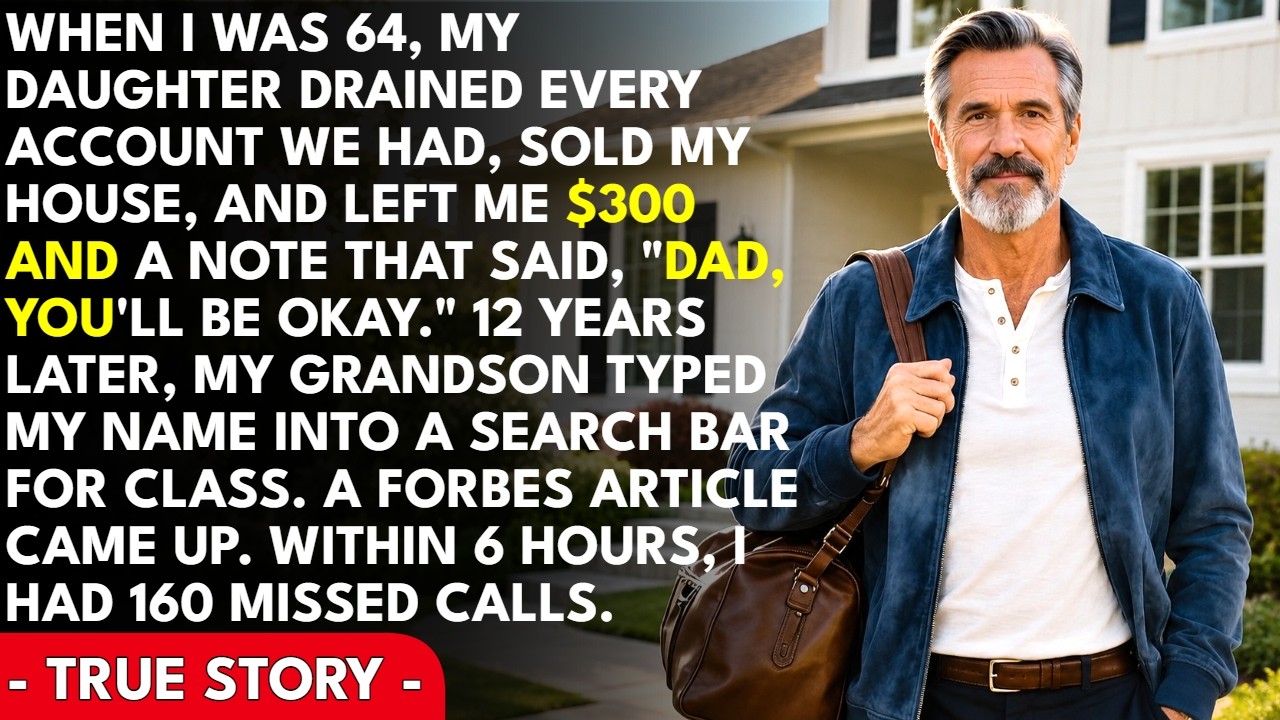
Just gone. The white envelope was taped to the mailbox. Three hundred dollars in twenties, folded once, and a note: “Dad, you’ll be okay. ”
I sat on the porch steps for a long time.
I didn’t call the police. I didn’t call a lawyer. I sat there and looked at my hands and thought about every hour I had put into that house. Every mortgage payment, every repair, every Sunday afternoon in the yard with my grandson, Milo, while my wife watched from the kitchen window.
I thought about my daughter at age nine, asking me to carry her on my shoulders through the county fair because the ground was too muddy for her shoes. I tried to make it compute. It never did. I spent three weeks in a men’s shelter in Columbus before an old colleague from my civil engineering days found out what had happened and offered me a drafting position at his small firm.
I was overqualified. I took it without hesitation. I showed up every morning at 7:30 and I worked. I didn’t allow myself to stop because the moment I stopped, I started thinking about Milo.
He was seven when they took him to Phoenix. He had a gap between his front teeth and used to fall asleep on my couch watching baseball, his head on my arm. That image of him lived in my chest pocket for twelve years like a folded piece of paper. I started my own infrastructure consulting firm at 67.
By then I had rebuilt enough personal capital, I had the reputation, and I had the drive of a man who had been left for dead. The firm specialized in sustainable public works—water treatment facilities, municipal bridges, green transit infrastructure. By the time Forbes ran a profile on me, we had completed projects in nine states. My legal counsel, a meticulous woman named Harriet who never raised her voice and never lost a case, had helped me structure the company so that no one could reach into it and take from me again.
Last Tuesday, my grandson sat down at a library computer at State University to work on a business class profile assignment. He was supposed to pick an entrepreneur in the infrastructure sector. His professor had handed out a list of suggested names. Milo didn’t use the list.
He told me later he typed my name out of nowhere, like something told him to. He wasn’t even sure I was still alive. The Forbes article came up first. The headline read: “The engineer who built an empire from nothing at 65.
”
There was a photograph of me standing in front of a community center my firm had just finished in Dayton. I was smiling. I had laugh lines around my eyes. According to Milo, I looked like a man who had no memory of ever being destroyed.
He called me on the spot. He was crying so hard I could barely understand him. He told me what he’d been told for twelve years—that I abandoned the family, that I walked out on my wife while she was sick, that I drained the accounts and disappeared with a woman from my office. I listened.
I let every lie land in the air between us where we could both look at it clearly. When he finished, I said, “Your grandfather doesn’t abandon people, son. He was abandoned. There is a difference, and I can prove every word of it.
”
He was still crying when my daughter took the phone. Her voice came on the line, nothing like I remembered. There was a manufactured panic in it, a breathless performance of a woman frantically relieved to hear from a lost father. She said they’d been looking for me.
She said her husband had always regretted how things ended. She said, “Dad, we’re in trouble. His construction company is under audit. There are accounting irregularities.
We need help. Just a bridge loan, just enough to get through the quarter. ”
I let her talk. Then I said, “Come to the firm’s annual partner dinner Thursday night.
Bring your husband. Milo is welcome, too. I’ll have an announcement to make. ”
She asked about the loan.
I told her everything would be settled Thursday night. She believed me. That was the thing about my daughter that twelve years hadn’t changed. She heard what she wanted to hear.
She translated “everything will be settled” into “everything will be given. ” She had made that same translation once before, at a kitchen table over two mugs of coffee and a document I should never have signed. I put the phone down and called Harriet. She had already begun pulling my son-in-law’s business records the moment Milo’s discovery broke.
What she laid out over the next two hours was not a picture of a man facing a temporary audit. My son-in-law had been running his residential construction company as a personal expense account for years. He’d falsified labor costs, inflated supplier invoices, and systematically overcharged seven different municipal clients—three of them on federally funded projects. The total exposure was close to two million dollars.
The Ohio Attorney General’s office had opened a criminal investigation six weeks prior. He wasn’t calling me for a bridge loan. He was calling me for a lifeboat. And he thought I was still the drowning man he’d left on the porch twelve years ago.
Harriet said, “He’s operating on twelve-year-old information. ”
I told her to prepare the full documentation package. I told her Thursday night. She asked if she should contact the AG’s office in advance.
I said not yet. Let him put on his good suit first. The annual partner dinner was held at the Meridian Club downtown, eight stories up, floor-to-ceiling windows overlooking the city. Two hundred seats filled with investors, city officials, engineers, and journalists who covered the infrastructure sector.
I watched my daughter and son-in-law arrive from a position near the second-floor railing where I could see the entrance without being seen. My daughter wore a dress that had not been bought on her husband’s salary. His suit was custom. They moved through the crowd with the practiced ease of people who believed they were the guests of honor.
When I took the podium, the room settled. My staff knew that when I stepped to a microphone, something significant was about to happen. I began: “Twelve years ago, I was 64 years old, standing on the front porch of a house I no longer owned, holding $300 and a note that told me I would be okay. ”
A murmur moved through the crowd like a wave.
“I was not okay. Not immediately. But I built this company, this team, and this foundation in the years that followed. Tonight, I want to make one announcement that has been twelve years in the making.
”
Down in the front row, my son-in-law leaned forward. My daughter’s hands were pressed together in her lap. “Effective immediately, 100% of my personal equity in this firm is being placed into a newly established legal entity called the $300 Fund. Its sole purpose is to provide legal defense and financial advocacy for elderly Americans who have been financially exploited by members of their own families—the sons and daughters who wait until a parent is grieving and medicated and alone, and then hand them a pen.
”
The silence that hit the room was physical. I reached into my jacket pocket and removed a small remote. The company logo on the projector screen dissolved. In its place appeared a high-resolution photograph: a close-up of a white envelope, three folded twenty-dollar bills, and a handwritten note on ruled paper.
“Dad, you’ll be okay. ”
“That note,” I said, “is the reason this fund exists. ”
Camera flashes erupted from the press section. I heard my daughter’s sharp intake of breath from the front row.
I watched my son-in-law’s jaw go rigid. He had the look of a man who has just realized the building he walked into has no exits. Then a door at the back of the ballroom opened. Milo walked in.
He was nineteen, wearing a collared shirt, his backpack still on one shoulder like he had come straight from campus. He looked terrified and absolutely certain at the same time. He walked down the center aisle without looking left or right. When my son-in-law saw him, he was on his feet instantly.
“What are you doing here? ” His voice was low, meant to be controlled, but the podium mic caught the edge of it. My daughter reached for Milo’s arm. He pulled it away cleanly, without drama, like he had made the decision hours ago and there was nothing left to decide.
He stepped up onto the stage and stood beside me. “My grandfather did not abandon us,” he said. His voice shook at first, then steadied. “I was seven when my parents told me he walked out on my grandmother while she was dying.
I was nineteen when I typed his name into a search bar and found out he had been standing on a porch with nothing in his hands while they were signing papers on a new house in Phoenix. I found the transfer records. I found the power of attorney filing. My father forged my grandfather’s signature on the property deed transfer.
The POA did not authorize that. It was a crime. It has always been a crime. I handed that documentation to the right people two days ago.
”
The ballroom came apart. My son-in-law shoved through the velvet rope at the front of the stage and moved toward Milo. Two security staff reached him before I did, but not by much. I put myself between my son-in-law and my grandson on reflex.
I planted my feet, looked at him, and said two words so quietly only he could hear them: “Not again. ”
He stopped. Something shifted in his face—not remorse, not exactly, but the recognition of a man who has run out of road. My daughter grabbed a microphone from a stunned event coordinator and began talking fast.
I had fabricated everything. I was a grieving old man who had nursed a grudge for a decade. Her husband had only been protecting family assets during an impossible time. She was surprisingly composed for the first thirty seconds.
Then Harriet walked out from the side corridor carrying a leather folder. She handed one document to the reporter from the Columbus Dispatch who covered white-collar crime. She handed another to the investigator from the Ohio AG’s office who had been seated quietly in the back row at my invitation. What followed was not dignified.
Standing in the center of a two-hundred-person dinner, my daughter and her husband dismantled each other. She said the forgery was his idea. He said leaving $300 was hers—that she had told him it was enough to make it look like they tried. He said that phrase into a live microphone with cameras rolling and journalists writing.
Harriet told me later it was the cleanest confession she had ever witnessed in a room that wasn’t a courtroom. The investigators let it finish on its own. When it did, they moved. I did not watch the handcuffs go on.
I had seen enough. I found Milo sitting on the bottom step of the service staircase with his hands over his face, his shoulders shaking. I stood in front of him and waited until he looked up. His eyes were swollen.
“What happens now? ” he asked. “Now,” I said, “you call your professor and tell him you found your entrepreneur. ”
Something cracked open in his expression.
Not a smile—the beginning of one. I sat down next to him on that step, not to offer money or promises or easy comfort, just to sit with him the way you sit with someone when the smoke is still in the air and the only reasonable thing to do is breathe. Two weeks later, Milo signed an internship agreement with the $300 Fund. Standard hourly pay, twenty hours a week, real work—intake calls, case file preparation, coordinating with pro bono attorneys on behalf of elderly clients in active exploitation situations.
He called me after his first week and told me his first case was an 81-year-old retired school teacher in Akron whose stepson had drained her pension account using a forged signature. He said it was the hardest phone call he had ever made. He also said it was the only thing he had ever done that felt completely worth doing. My son-in-law was sentenced to seven years on the fraud charges.
Two counts of forgery, three counts of federal contract fraud. My daughter accepted a plea agreement—three years suspended, five years of probation, full restitution ordered. The house in Phoenix was sold by the court to partially satisfy the civil judgment. I did not go to watch.
I had already received everything I was going to receive from that chapter of my life. I did visit my daughter once at the county facility before her transfer. I sat across the table from her and looked at the face I had known since the delivery room of a Cincinnati hospital in 1976, trying one more time to locate the moment it went wrong. I still couldn’t find it.
Maybe there was no single moment. Maybe it seeped in over years through a hundred small choices, each one slightly larger than the last, until one day you’re handing your father an envelope with $300 in it after his wife’s funeral and telling yourself it’s enough to make it look like you tried. She asked if I would help with her legal fees. I reached into my jacket pocket.
I placed a folded white envelope on the table between us. $300—every bill I had kept in a safe deposit box for twelve years, waiting for this precise moment. “That’s everything you left me,” I said. “Every single dollar.
”
She looked at the envelope for a long time. She didn’t reach for it. I stood up, buttoned my jacket, and walked to the door. Before the guard buzzed me out, I turned back once.
“You were right about one thing,” I said. “I figured it out. ”
I drove home in the quiet. No phone buzzing, no missed calls stacking up.
I thought about Milo at his desk in the fund’s downtown office. I thought about the school teacher in Akron. I thought about the thousands of people who had signed something they should never have signed, handed a pen at the exact moment they had no defenses left. The $300 Fund received over 400 case inquiries in its first two months of operation.
Harriet brought on six additional attorneys. We were active in fourteen states. When I got home, I made a pot of coffee and sat out on the back porch in the dark. There is a cardinal that comes to the oak tree every evening around this time.
I don’t know if it’s always the same bird, but I’ve started to think it might be. I sat there watching it and feeling something I had not felt in a very long time. Not happiness, exactly. Something deeper and quieter.
The specific piece that belongs to a man who built something real out of nothing, who held the line when no one was watching, and who lived long enough to see the truth stand up in a crowded room and speak for itself without his help. $300. Four words on a piece of paper. That was all they thought I was worth.
They were off by a considerable amount.