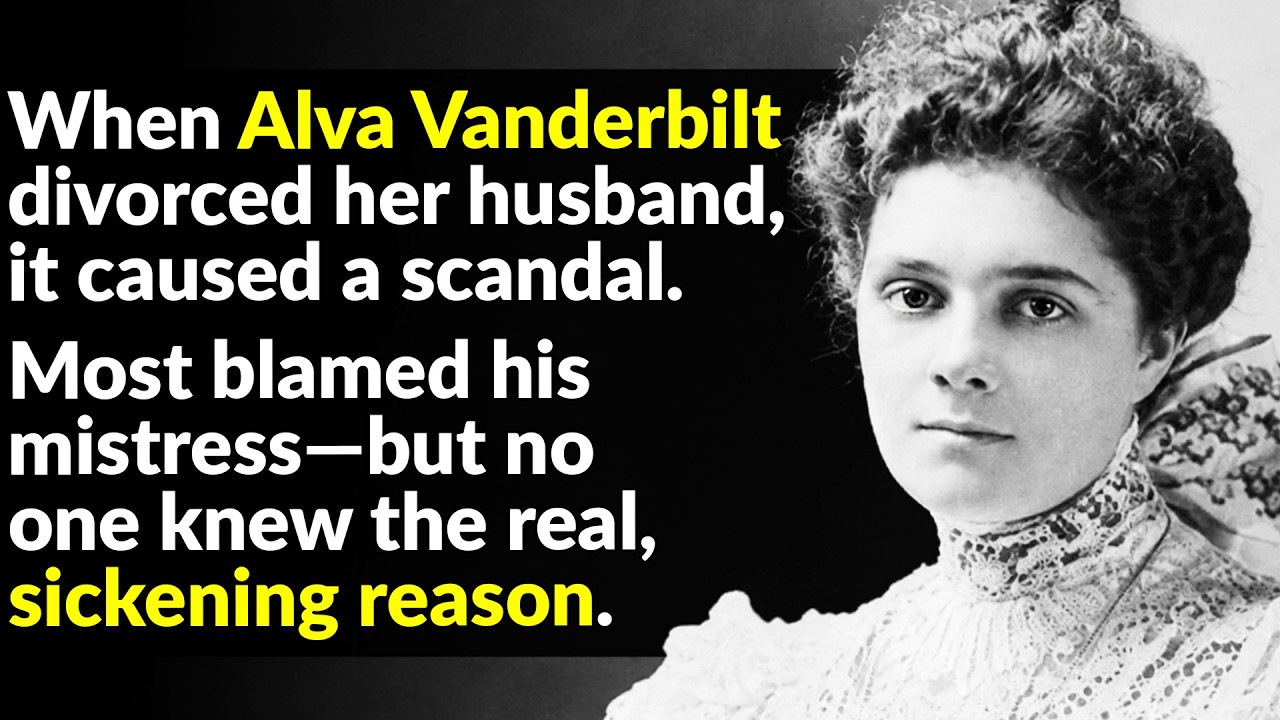
Alva Vanderbilt’s divorce from her husband was a scandal that tore through polite society, but no one guessed the real reason behind it. At first, whispers blamed a mistress on his side, then claims that Alva had strayed herself. The truth, when it finally surfaced, was far more sickening than anyone could have imagined, and it struck at the heart of the closest friendship Alva thought she had. Her story was just one chapter in a long and painful saga of American heiresses who traded their fortunes for European titles.
These were the dollar princesses, daughters of the Gilded Age’s new money, married off to the continent’s oldest, most insolvent families. They were promised fairy tales, but what they got were Faustian bargains that left many of them broken, humiliated, or dead. The pattern was set early. Born in 1854, Jeanette “Jennie” Jerome was the daughter of an American financier with a mysterious edge.
One admirer noted she had “more of the panther than of the woman in her look. ” Her parents knew what they had and were determined to profit from it. In 1873, Jennie met Randolph Churchill, the third son of the Duke of Marlborough, and he proposed within three days. The wedding itself took nearly a year because both families spent months haggling over money and inheritances.
Jennie gave birth to her most famous achievement just months later: Winston Churchill, the future Prime Minister of Britain. But Winston arrived two months premature after Jennie reportedly fell, and many quietly speculated she had been pregnant before the wedding. When asked about his unusual birth, Winston later quipped, “Although present on the occasion, I have no clear recollection of the events leading up to it. ”
Whatever passion Jennie once had for her husband didn’t last.
She drifted into a string of affairs with some of the most powerful men in Europe, including King Edward VII himself. She was an absent mother, but her infidelities had a strange side effect: the men she took to bed were so influential that her affairs doubled as diplomatic sessions, and her husband’s career rose in esteem. She even became friends with Queen Alexandra, the wife of her royal lover. In 1895, Randolph died, leaving Jennie a widow.
She didn’t change her habits. In her forties, still beautiful, she married George Cornwallis-West, a man only nineteen days older than her own son Winston, who nicknamed her “Pussycat. ” There was no happy ending there either. By 1909, Cornwallis-West had fallen for Jennie’s close associate, the actress Mrs.
Patrick Campbell. After their divorce in 1914, he married Campbell. In 1918, in her sixties, Jennie married again, this time to Montagu Phippen Porch, who was three days younger than Winston. It was scandalous, but it scarcely mattered.
Jennie’s final days were ugly. In May 1921, she slipped on a staircase in high heels and broke her ankle. Gangrene set in, leading to an amputation that failed to save her. She died that June from a post-amputation hemorrhage at 67.
Other dollar princesses fared even worse. Railroad magnate Jay Gould’s daughter Anna, born in 1875, was plain-looking while her husband, Boniface de Castellane, known as Boni, was a notoriously vain dandy. Boni burned through ten million dollars of the Gould fortune in just a few years, much of it spent on lavish gifts for his mistresses. In 1906, Anna divorced him and, to everyone’s surprise, married his cousin Elie de Talleyrand.
That marriage had its own shadows: in 1929, her eldest son with Talleyrand took his own life after the couple refused him permission to marry. Still, Anna had the last laugh. Boni wanted to remarry within the Catholic Church, which required an annulment from the Vatican. It took until 1924, with Time magazine noting that no matrimonial case had dragged on so long since Henry VIII tried to annul his marriage to Catherine of Aragon.
Then there was Winnaretta Singer, born in 1865, one of twenty-four children of Isaac Singer of the Singer sewing fortune. Her early life was tragic: her father died when she was ten, and her mother remarried a man who abused Winnaretta. The moment she came of age, she seized her million-dollar inheritance and left. At twenty-two, she married Count Louis de Ségur-Montaigne, a French nobleman drawn to her money.
But on their wedding night, the count discovered her secret. Although everyone in her inner circle knew Winnaretta was a lesbian, the count had missed the gossip. When they were alone, she climbed onto an armoire and threatened to kill him if he touched her. The marriage was annulled after five years, with surprisingly little hassle, given the lack of evidence of intimate relations.
In 1893, Winnaretta married again, this time to Prince Edmond de Polignac, a man thirty-one years her senior, in a lavender marriage that suited them both perfectly. She carried on affairs with the painter Romaine Brooks and with Olga de Meyer, a rumored illegitimate daughter of King Edward VII. One scorned lover even showed up outside her Venetian palazzo and shouted, “If you are half the man I think you are, you will come out here and fight me. ”
Some dollar princesses had loving marriages and still ended in tragedy.
Mary Leiter, born in Chicago in 1870, was beautiful, well-bred, and educated. At twenty, she met George Curzon, a Member of Parliament and heir to the barony of Scarsdale. Unlike so many others, Mary married for his political ambition rather than his title, and their union in 1895 was a genuine love match. Mary’s charm became a political asset, and when George won re-election soon after the wedding, many credited her.
George rose to become Viceroy of India, making Mary the Vicereine, the highest title a woman could hold in the Indian Empire. But something was missing: a son and heir. Instead, Mary gave birth to three daughters, the last born in 1904 while she was Vicereine. She tried again and suffered a bitter miscarriage.
Weighed down by what she saw as her failure and by endless political duties, her health collapsed. Back in England for a visit, she fell so ill she slipped in and out of a coma. She miraculously recovered, but doctors had already told her husband to prepare for her death. George returned to India without her, and Mary pushed herself to follow far earlier than she should have.
In the summer of 1906, an infection and a terrible cough ravaged her. She wrote to her brother, “I sometimes fear and feel I shall never be well again. ” She was right. That July, she suffered a fatal heart attack at thirty-six, proving that even a successful dollar princess marriage could go horribly wrong.
But the most tangled story belonged to two women bound together by friendship and betrayal. Consuelo Yznaga, born in New York in 1853 into Cuban nobility, grew up with the future elite of society. Her childhood best friend, Alva Smith, later married William Vanderbilt. While Alva kept her money stateside, Consuelo went the dollar princess route, marrying George Montagu, a future Duke of Manchester, with a dowry worth millions.
Almost immediately, she discovered her husband was a brute who squandered her fortune on gambling and mistresses. Her father-in-law banished the couple to Ireland for years just to control him. When her husband finally died in 1892, Consuelo’s new freedom may not have been healthy. Around that same time, Alva Vanderbilt shocked society by demanding a divorce from William.
Rumors flew, but the truth was darker than anyone guessed: William hadn’t just cheated on his wife. He’d cheated with her best friend, Consuelo Yznaga. The most painful part was that Alva had named her own daughter, Consuelo Vanderbilt, after her traitorous friend, who was also the girl’s godmother. That goddaughter became perhaps the most tragic dollar princess of all.
From the moment of her birth in 1877, Alva was determined to marry her daughter to European aristocracy. She forced the girl to wear a steel rod to perfect her posture and whipped her with a riding crop for any misbehavior. When Consuelo protested, Alva snapped, “I do the thinking. You do as you are told.
”
Consuelo grew into a stunning beauty. The playwright James Barrie wrote that he would stand all day in the street just to see her get into her carriage. Her mother aimed her at the biggest catch in Europe: Charles Spencer Churchill, the ninth Duke of Marlborough, cousin of Winston Churchill. There was only one problem: Consuelo was in love with Winthrop Rutherford, a socialite fifteen years her senior, who had none of a duke’s possibilities.
Instead of giving in, Consuelo planned to elope. Her mother found out, locked her in her room, and threatened to harm Rutherford. When Consuelo still refused, Alva grew mysteriously ill. The more Consuelo resisted, the closer Alva came to death’s door, until the terrified girl agreed to the wedding.
Alva promptly made a full recovery. The wedding was the talk of society, but so was Consuelo’s behavior: she wept uncontrollably behind her veil as the Duke pocketed a settlement worth nearly one hundred million dollars today. The honeymoon revealed her mistake. The Duke admitted he had married her only to save his ancestral home, Blenheim, and that he was in love with someone else.
He had no intention of romancing her beyond producing an heir. Consuelo gave him a son but remained miserable and rekindled her affair with Rutherford. She confessed she still wanted to elope. There were even rumors her second son belonged to him.
The Duke reluctantly agreed to consider a split, and in 1900, Consuelo went to London to discuss the elopement, only to learn that Rutherford didn’t want to marry her. In the aftermath, she had an affair with the Duke’s cousin, Reginald Fellows. The couple separated in 1906 and divorced in 1921. By then, even Alva admitted in court, “I forced my daughter to marry the Duke.
” Consuelo eventually found happiness with Jacques Balsan, an early lover of Coco Chanel, and stayed married to him until his death in 1956. When she died in 1964, many saw it as the end of the dollar princess era. But one of the very first such princesses preceded the Gilded Age entirely. Born in 1785, Elizabeth Patterson was the eldest daughter of the second wealthiest man in Maryland.
In 1803, she met Napoleon Bonaparte’s wayward brother Jerome, who was stalling in America, afraid to return to France. Everyone warned her against him. Her father even received an anonymous letter claiming Jerome’s vows were only a way to waste more time in the United States. The more objections raised, the more determined Elizabeth became.
She threatened to elope if her father didn’t give his blessing. On Christmas Eve 1803, she married Jerome and became Napoleon’s sister-in-law. It was a disaster. Napoleon ordered his brother home without his bride.
Jerome sailed back with the now-pregnant Elizabeth, but Napoleon’s men wouldn’t even let her set foot in Europe. Jerome swore he would never abandon her, then promptly caved to his brother’s demands, accepting a post as an admiral and later the crown of Westphalia. Napoleon annulled the marriage, Elizabeth was officially divorced in 1815, and Jerome married a German princess just two years after their son was born, a son he refused to support. Elizabeth never saw her husband again, except once.
In 1822, they accidentally crossed paths at the Pitti Palace in Florence. They made brief eye contact. Neither spoke. Jerome later told his current wife, “That was my American wife.
” Elizabeth lived to ninety-four, long outliving her reputation as the woman who chose her own doomed marriage and fought for it, even as her successors were not always so lucky.