“If I were 20 years younger, I’d marry you. ”
Walter Brooks said it without even looking at her. The words slipped out as he fitted the last board on the old oak gate that separated their two farms. The moment he realized what he’d said, his hands trembled and his heart pounded.
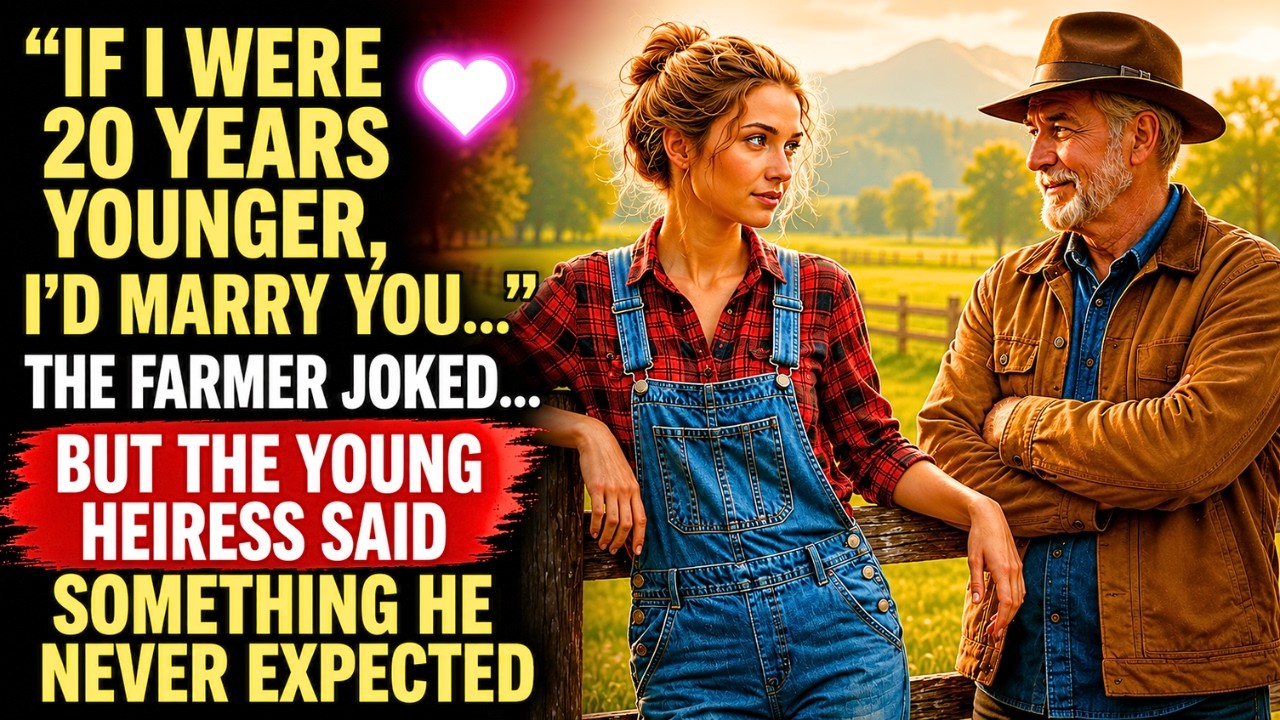
Melanie stood frozen. She was 27. He was 57. Everyone in Willow Creek knew Walter as a quiet, hardworking man who had never really recovered from losing his wife years ago.
He kept to himself, helped anyone who asked, and went home before anyone could drag him into conversation. But that morning, he had just told her he’d marry her. “Forget it,” he said quickly, closing his eyes. “That was a foolish thing to say.
”
It didn’t sound foolish. His face was tense. There was no joke in his eyes—only fear. “You’re young,” he continued, his voice lower.
“You’ve got your whole life ahead of you. I shouldn’t be putting those kinds of ideas in your head. ”
Melanie set down the hammer and stepped closer. “And who said I need you to be younger?
”
Walter looked up as if he’d been jolted. For a few seconds, he just stared at her. “Melanie, don’t say that just because I helped you fix a fence. ”
“I’m not saying it because of the fence.
”
“Then why? ”
She hesitated. His question wasn’t harsh. It was frightened.
Walter wasn’t pushing her away because he felt nothing. He was pushing her away because he felt more than he believed he had the right to feel. Melanie looked at the gate he’d repaired. She’d spent nearly two hours struggling with it alone.
Walter had arrived quietly, seen her struggling, and simply started to help. He didn’t ask if she could pay. He didn’t lecture her. He just stayed.
“Because you always show up when I need you,” she said. “Because you treat me like I’m capable even when I make mistakes. Because you don’t try to impress me. And because when you’re around, I don’t feel like I have to pretend to be someone else.
”
Walter turned pale. He looked away as if he couldn’t bear to hear it. “You don’t know what you’re saying. ”
“Yes, I do.
”
“You don’t. ” His voice cracked. “You don’t know what it’s like to wake up and realize the years have slipped away. To look at a woman like you and know everything she still has to live for—and realize I might not be able to keep up.
”
Melanie felt her throat tighten. This wasn’t the reserved Walter she’d watched from across town. This was a man tired of protecting himself. “Do you think I want someone to keep up with a checklist?
” she asked. “I want someone who’s present. Someone who doesn’t run when things get hard. Someone with the courage to be honest with me.
”
“You make everything sound so simple. ”
“No, I just don’t want to complicate what’s clear. ”
The silence between them grew heavy. Walter brought a hand to his face, searching for a way out—anything that would restore the distance between them.
But Melanie didn’t want to go back. “I’m not asking you to decide anything right now,” she said. “Just don’t pretend you didn’t feel anything. ”
He lowered his hand.
His expression changed, almost imperceptibly. Melanie saw the exact moment he gave up trying to deny it. “I felt it,” he admitted, his voice low and raspy. Melanie held her breath.
Walter took a step closer, then another. They were too close now to pretend this was just a conversation between neighbors. He looked at her face, then at her lips, and stopped. “This could end up hurting you.
And it could hurt me, too. ”
“I’ve survived a lot of things, Walter. ”
“Then maybe it’s time to actually live something. ”
The words hit him in a way she hadn’t expected.
He stood completely still, his eyes welling with emotion, but he didn’t let a tear fall. Melanie slowly raised her hand and touched his arm. Walter looked down at her hand, then closed his fingers over hers. His touch was firm yet gentle.
He seemed on the verge of saying something important. A loud horn blasted at the entrance of the Harvey farm. Melanie pulled her hand back. Walter turned toward the dirt road.
A black car was heading toward the house, kicking up dust. It was too new, too big, far too expensive for anyone to show up without warning in these parts. The car stopped in front of the porch. A tall man stepped out, wearing a light dress shirt, dark trousers, and shoes that weren’t made for walking in mud.
He held a black briefcase and looked directly at Melanie’s house. Walter went rigid. “Do you know this man? ” Melanie asked.
Walter paused. “No. But nobody comes to a farm with a briefcase like that to deliver good news. ”
The man walked through the newly repaired gate and stopped a few feet away.
“Melanie Harvey? ”
She nodded. He opened the briefcase. “My name is Nathan Cross.
I’ve come from the capital regarding your property. ”
Nathan Cross pulled out a thick document folded in three, stamped with the state seal. “Perhaps it would be best for you to sit down before you read this. ”
“I’ll read it standing,” Melanie said, reaching out her hand.
She scanned the first few lines. The more she read, the harder her face became. “Is this an eminent domain seizure? ”
“State Route 9,” Nathan said, pointing to a map on the second page.
“A new highway connecting the capital to the northern county line. The current route cuts the Harvey farm right in half. ”
“In half? ”
“Right through your main orchard, unfortunately.
”
Walter stepped forward, snatched the map from her hand, and ran his eyes over the red line. Then he stopped. “That line doesn’t stop on her property,” he said low. “It keeps going, right across the boundary.
That’s my land. ”
“Correct. ”
Walter slowly looked up. There was nothing soft left on his face.
“So you didn’t come to deliver one piece of news. You came to deliver two. ”
Nathan tucked his pen into his shirt pocket. “That’s precisely why I came in person.
You still have time to contest it. ”
Melanie and Walter exchanged a glance. Quick, almost involuntary, but they both understood the same thing in that instant. Whatever else stood between them, they now had a common enemy—a red line on a map.
They spent the afternoon on the porch with blueprints spread across the old wooden table. Nathan explained each route with a patience that Melanie, despite herself, began to find useful. He asked questions, took notes, and pointed out loopholes in the state paperwork that even Walter hadn’t noticed. “Here.
” Nathan circled a paragraph. “Their environmental assessment was rushed. If there’s active and continuous agricultural production on these lands, the route has to be re-evaluated by law. That alone will delay the project for months.
”
“Months isn’t a cancellation,” Walter said. “No, but it buys us time to fight properly. ”
Walter crossed his arms and leaned against the porch column, just outside the circle of light. From there, he watched.
He watched the way Nathan leaned over the maps next to Melanie. How the two of them were almost the same age. How the young man spoke of the future with the natural ease of someone who had all the time in the world ahead of him. For the first time in a long time, Walter felt a tightness in his chest that had no name but had an age.
His own. “Mr. Brooks,” Nathan called. “You’re in this as much as she is.
The petition is stronger if both farms file together. ”
Nathan straightened up, his tone shifting, becoming more cautious. “There is just one detail. City Hall won’t accept two separate petitions from neighbors.
If your lands are going to fight together, they need to prove they were always in some way unified. You have to show a historical partnership of production—a record that the two farms operated in tandem in the past. An old inventory, a joint deed, any official document that links one to the other. ”
Walter had gone pale.
“An inventory,” he repeated softly. “Exactly. Without that document, both petitions will fall. Do you have anything like that saved?
”
Walter paused, searching through years inside his own head. “I did. My father kept everything—the deeds, the crop records, the agreements with her grandfather. There was an old inventory.
It linked both properties. I remember seeing it once when I was still a boy. ”
“And where is it now? ” Nathan asked.
Walter looked at Melanie, then out at the field, then down at the floor. “I have no idea. ”
“Then we’re going to search until we find it,” Melanie said. The following morning, they stood before a dusty hatch in the ceiling of Walter’s hallway.
A wooden ladder pulled down with a dry crack that echoed through the entire house. “Does this still hold weight? ” Melanie asked, testing the first step. “It held my father, and he weighed twice what you do.
”
“That’s not very reassuring. ”
Walter climbed up first. A cloud of dust descended onto his face, and he sneezed three times in a row, nearly losing his footing. “Classy,” Melanie commented, climbing up behind him.
“Just wait until you breathe in there. ”
She didn’t have to wait long. The smell of mold and old paper hit her nose, and she sneezed, bumping her head against a low beam. “Ow!
”
“Watch the ceiling. ”
“Now you tell me. ”
The attic was a labyrinth of stacked boxes, furniture covered in yellowed sheets, and rusted metal trunks. They searched for nearly two hours, exchanging dry comments about absurd relics—a moth-eaten cowboy hat, a collection of empty coffee cans, a family portrait so faded no one could recognize anyone’s face.
It was in front of an iron trunk pushed against the back wall that they bumped into each other. Walter went to open the lid at the exact same instant Melanie reached down to pull the latch. Their hands met on the cold metal. Neither of them drew back right away.
“Sorry,” Walter said softly, but he didn’t move. “You don’t have to be. ”
They stayed like that a second longer than any explanation could justify until Walter finally lifted the lid. Inside, resting on top of a stack of old notebooks, was a book bound in dark leather, worn at the edges.
Walter recognized it instantly. His whole face changed. “That’s Ruth’s diary. ”
Melanie took a step back.
“Do you want to stop here? ”
“No. ” Walter picked it up with both hands, carefully, as if he were holding something alive. “It’s been a long time.
”
He opened it. His late wife’s small, slanted handwriting filled line after line, chronicling her daily life with a tenderness that made Melanie feel like she was trespassing on something sacred. Walter turned the pages slowly, his face growing tighter, until he suddenly stopped on one of the final sheets. He fell silent for a long time.
“Walter? ”
He didn’t answer. His eyes scanned the page, his free hand gripping the edge of the diary. Melanie stepped closer and read over his shoulder.
Ruth had written, in her final weeks of life, a direct request to her husband: that when he was ready, he should let the sadness fade away little by little, that he should laugh again without guilt, and that he should build something new without feeling like he was betraying what they had built together. Walter’s breathing grew heavy. A single tear rolled down his cheek, silent, and he didn’t even try to hide it. Melanie didn’t say a word.
She just wrapped her arm around his shoulders, firm and unhurried. “She knew,” Walter finally managed, his voice thick. “She knew I’d need to hear this one day. ”
“She loved you very much.
”
“She did. ”
As he closed the diary, a yellowed piece of paper slipped from inside the cover and fell to the floor between their feet. Walter bent down and picked it up. He carefully unfolded it, his eyes running across the handwritten lines.
The sadness on his face slowly gave way to confusion. “Is it the inventory? ” Melanie asked, her heart racing. “It is.
”
Relief surged through her. “We found it. ”
“We did. ” But Walter didn’t look relieved.
He seemed to grow paler by the second, his eyes locked on a clause in the middle of the page. “But there’s something else here, Melanie. ”
“What? ”
“According to this,” he said slowly, “the Harvey farm has a massive debt accumulated over years with the Brooks farm.
And right below there’s a stamped clause stating that if the debt wasn’t cleared, the farm would be taken as collateral. ”
Melanie began to speak but couldn’t finish. Walter finished it for her. “That means your farm, by law, is mine.
”
Melanie didn’t move. She stood in the middle of the attic, staring at the paper in Walter’s hand as if looking at it long enough would make the words reorganize themselves. “Melanie. ”
“Three months.
” Her voice sounded strange, almost too calm. “I buried my grandfather, left everything behind, came here, and spent three months clearing weeds from an orchard that was already yours. ”
“It’s not like that. ”
“It’s written right there.
”
Walter took a step toward her. “It’s written on a paper stuffed inside a trunk for forty years. I will never use this. Never.
You don’t have to worry about a thing. ”
She raised her eyes. There was a weariness in them that none of her jokes could mask. “The problem isn’t you using it, Walter.
It’s that it exists now. ”
She went down the ladder without waiting for an answer. Walter was left standing in the attic with the inventory in his hands, hearing her footsteps cross the hallway and the front door slam. He didn’t call after her—not because he didn’t want to, but because for the first time since they’d met, he didn’t know what to say.
The following morning, when Walter pushed open the door of the general store, the hum of conversation stopped as if someone had pulled the plug on a radio. Every eye was on him. “Good morning,” he said, because it was the only polite thing that occurred to him. Nobody replied.
Old Doris Pratt behind the counter broke the ice with the delicacy of a brick. “Is it true the Harvey farm is yours now, Walter Brooks? ”
He took a bag of flour from the shelf. “It isn’t.
But there’s a document. An old piece of paper. That’s not the same thing. ”
“Old paper is worth more than new words,” grumbled Mr.
Kemp from the back. “Your family sweated for that land. You’ve got a right to it. ”
“And what was she going to do?
” cut in another voice. “Poor thing, end up with nothing? ”
“Poor thing, my foot. ” Doris crossed her arms.
“Did you see the two of them fixing that fence together? Some girls know exactly where they’re stepping. A debt that size disappears real fast the moment the lady becomes mistress of the house. ”
Walter set the flour bag on the counter.
“Doris, I’m just saying what everyone’s thinking. ”
“Then think quieter. ”
He paid, took the bag, and walked out. But those words kept hammering in his head all the way to his truck.
An hour later, Melanie parked in front of the store, walked in with her chin high, and went straight to the counter with a tin of coffee in her hand. The silence returned. “Good morning, Mrs. Pratt.
” Melanie smiled broadly, without a drop of shame. “Just the coffee. You can start getting the change ready, because from what they’re saying around town, it’s the last bit of money I have left in the world. ”
Someone coughed.
“Oh, and before you ask,” she continued, turning to face the entire store, “yes, I fixed a fence with Mr. Brooks. I held the hammer and everything. I confess it was a brilliant plan to seduce a fifty-seven-year-old man and take his farm.
You know how it is. Nothing excites a widower more than a woman hitting her finger with a hammer. ”
A young man in the back let out a laugh and choked. Doris turned red to the roots of her hair.
“I didn’t mean that. ”
“Yes, you did. ” Melanie took her change. “But it’s fine.
In a town this size, you either laugh or you go crazy. I chose to laugh. Good morning. ”
She walked out, her step firm, her heart beating faster than she let show.
She arrived at her farm near lunchtime and found Nathan’s black car already parked in front of the house, a new folder of documents open on the hood. “You’re early,” she said. “I arrived yesterday, actually. ” He closed the folder.
“And before noon I’d already heard three different versions of your love life. ”
“Any of them good? ”
“None of them fair. ”
Just then, they heard the engine of the old truck coming up the dirt road.
Walter got out without turning off the engine. He crossed the yard with the inventory in hand, his face that of a man who had spent the entire morning deciding something and had finally made up his mind. “Walter, what—”
He stopped in front of her. He raised the document in the air between the three of them, in full view of Nathan, in full view of anyone who cared to look.
“This town can say whatever it wants about me,” he said, his voice deep and steady. “But it won’t talk about your honor because of a piece of paper. ”
He tore the inventory down the middle, then again, and threw the pieces to the ground. Melanie stood in disbelief.
“You just tore up a fortune. ”
“I just tore up a problem. ”
Nathan, however, wasn’t looking at either of them. He was crouched on the ground, picking up the pieces with a strange urgency, fitting them together between his fingers.
“Nathan. ” Melanie called out. He didn’t reply. He held one fragment up to the sunlight, turning it slowly.
When he finally spoke, his voice had lost all the politeness of an architect from the capital. “Mr. Brooks, who did you say signed this? ”
“My father.
Why? ”
Nathan looked at the paper, then at them. “Because this signature is erased underneath. This document is a fake.
”
“Fake how? ” Walter demanded. “Fake as in someone erased one signature and wrote another on top of it. I don’t know who, I don’t know when, but I know the pen that signed underneath is not the same one that signed on top.
”
“My father kept this his entire life. ”
“Maybe your father never knew. ”
Melanie sat down on the porch step. “So someone went into that attic.
Someone took the real inventory and left a lie in its place. ”
The three of them looked at each other. That was the question. No one could answer it for the next seven days.
The week dragged by. Walter turned the attic upside down once more, this time alone. Melanie searched through dusty archives at city hall, made calls to registry offices, and piled the kitchen table high with papers. Nothing.
Only one name kept surfacing at the bottom of the old documents, written in the same cramped handwriting: Elias Crane, the attorney who had managed both farms for thirty years before vanishing. And Nathan started showing up every day. He’d arrive in the morning with increasingly creative excuses—a map he needed to double-check, a form only she could sign. He spent hours on the porch talking, laughing at her jokes.
One Wednesday, he arrived holding a handful of wildflowers. “What’s this? ”
“Flowers. ”
“I know that.
I’m asking what they’re for. ”
Nathan gave the most disarming smile in the world. “I saw them by the side of the road on my way over. Thought they were pretty.
Thought of you. ”
Melanie took the flowers. “Thank you. ”
What she didn’t see was the old truck parked up at the bend of the road, the spot that overlooked the entire farm.
Walter saw everything. He saw the black car. He saw the flowers. He saw her laugh.
That day he didn’t visit, nor the next, nor the day after that. Melanie noticed it the first morning, pretended she didn’t the second, and by the third she was looking toward the property line every ten minutes, hoping to see that hat appear on the other side of the oak gate. She could have walked across the field and knocked on his door. She could have.
But something—pride, fear, or both—held her back. If he wanted to, he would come. He always came. But Walter didn’t.
On Friday, Nathan appeared again and set his folder on the kitchen table. “Melanie, I need to be frank with you. ”
“When someone says that, it’s never good news. ”
“The state won’t wait.
If we don’t present a valid petition with a valid document, the route gets approved at the end of the month. You lose the farm to the asphalt. And Mr. Brooks does, too.
”
The air fled her lungs. “I know. ”
“It doesn’t look like you do. It looks like you’re waiting for something.
”
Melanie didn’t answer, because she was. The harvest ball took place every autumn in the Witmore barn, the biggest social event in Willow Creek. Yellow string lights hung from the rafters. Tables were loaded with apple pie.
The band was five old men who had played the exact same set for twenty years, and nobody ever complained. When Melanie walked in that Saturday, the entire barn went quiet. She’d swapped her boots for a dark blue dress that swayed with the breeze, her hair down for the first time since she’d arrived in town. The very mouths that had spent the week gossiping about her couldn’t find a single word to say.
“Miss Harvey. ” Nathan appeared before her, extending his hand. “May I have the honor? ”
She hesitated for half a second, then accepted.
Nathan danced well—the way big-city men learned to at expensive weddings. Light, confident, never stepping on toes. He cracked quiet jokes, spun Melanie at just the right moment, and made her laugh three times in a row. From the corner of the room, leaning against a wooden beam, Walter watched.
He held a glass he hadn’t brought to his lips a single time. “You going to stand there all night? ” asked Frank Whitmore, stopping beside him. “I’m fine right here.
”
“You look miserable right here. ”
Walter finally took a sip. “Look at him, Frank. Then look at me.
”
“I’m looking. He’s thirty-four years old. ”
“So what? My father married my mother when he was sixty.
She was twenty-two years younger. They stayed together until their final days. You know the only foolish mistake he made? ”
“What?
”
“Waiting two years out of fear. ” Frank slapped his shoulder. “Two years, Walter. He used to cry when he talked about it.
”
The music changed. A slow waltz, the kind that fills a barn with silence. Walter looked at his glass, then at the dance floor. He went.
He crossed the middle of the floor with the entire town watching and stopped in front of the pair. “Excuse me,” he said to Nathan without taking his eyes off Melanie. “This one’s mine. ”
Nathan opened his mouth.
Nothing came out. He took a step back. Walter extended his hand. Melanie looked at that calloused hand, her heartbeat so loud she was certain the band would lose the rhythm.
She placed her hand in his, and the world shrank until it fit right there. They said nothing. They didn’t need to. He guided her with quiet confidence, his palm resting on her back.
Melanie let her forehead nearly touch his shoulder. Almost. His fingers squeezed hers once, gently, and she squeezed back. “You vanished,” she murmured.
“I know. ”
“Don’t do that again. ”
Walter swallowed hard. “Melanie, I—”
The entire barn plunged into darkness.
A crash outside. A flash of white. Rain poured down all at once on the roof as if the sky had torn open. The string lights went out.
Screams, nervous laughter, chairs scraping. Melanie felt Walter’s hand slip from hers. “Walter? ”
Then a hand gripped hers—firm, resolute—and pulled her through the crowd in the darkness to the back of the barn, where the roar of the rain was louder than anything.
The lights flickered back on with a snap. Melanie looked at the man beside her. It wasn’t Walter. Nathan was still holding her hand, his chest rising and falling quickly, his eyes locked on hers.
“I can’t pretend anymore,” he said. “Melanie, I’m falling in love with you. ”
She opened her mouth. No sound came.
Across the room, amidst the crowd settling back down, she saw Walter’s hat disappearing through the door into the rain. “I—” Melanie pulled her hand away. “I have to go. ”
“Melanie, I’ll think about it,” her voice trembled.
“I promise I’ll think about it. ”
She ran out after Walter. But when she reached the parking lot, his old truck was already gone. She stood there alone, unsure what to do.
Then she got in her car and drove home in silence, her heart heavy. Melanie had barely reached her porch when a gust of wind ripped away part of the roof. The crash was so loud she ducked by instinct as two roof tiles flew across the yard and disappeared into the apple trees. She ran inside and slammed the door.
The house was dark—the power had cut out during the night. Her phone had no signal, and rainwater was already leaking through an expanding spot on the living room ceiling. The storm that started at the dance had worsened overnight. Trees had fallen across both roads in Willow Creek, and the battery-powered radio reported that no one would enter or leave the valley until road crews cleared the way.
Melanie placed a bucket under the leak. Five seconds later, another one appeared. She fetched another bucket, and when she returned, she heard wood cracking above her head. She grabbed a tarp from the barn, dragged a ladder to the side of the house, and began to climb in the pouring rain.
She’d barely reached the third step when a shout cut through the storm: “Get down from there! ”
Melanie nearly fell from shock. Walter was walking through the orchard wearing a raincoat, a rope coiled over his shoulder, a toolbox in hand. She hadn’t called.
She couldn’t have. Even so, he was here. “Walter, get down! The roof is open!
”
“I saw it from my place. I can tie the tarp down. ”
“Walter, it’s raining! ”
Walter stopped on the ladder and looked at her.
“Thanks for the update. ”
Melanie almost laughed, but at that moment another section of the roof gave way, and they both returned to the task immediately. For nearly an hour, Walter worked on the roof while Melanie held the ladder and passed up materials. The rain beat down; the wind made every movement difficult.
When he finally secured the tarp, he climbed down completely soaked. Melanie grabbed a towel. “You could have been hurt. ”
“You were climbing up alone.
”
“That doesn’t answer my question. ”
“It answers it well enough. ”
They spent the afternoon protecting the furniture and boarding up two windows the wind had damaged. By the time the rain finally let up, it was already dark.
Walter tried his phone. Still no signal. “The roads are still blocked,” Melanie said. “You’re not crossing the field in the dark.
”
“My place is close. ”
“There are trees falling. I just spent an hour bossing you around. Now it’s my turn.
”
Walter put his phone away. “Fine. ”
She hadn’t expected it to be so easy. “Fine?
”
“Yes. Just like that. You want to argue? I was prepared to save it for tomorrow.
”
Melanie smiled and walked to the kitchen. But as soon as she opened the pantry, her smile vanished. “We have a problem. ”
Walter appeared at the door.
“Another one? ”
“One can of beans, half a pack of pasta, two potatoes, and something in a jar that I don’t have the courage to identify. ”
Walter picked up the jar and inspected it. “Pickles.
”
Melanie took a closer look. “Was that a cucumber once? ”
They made dinner together, chopping potatoes by candlelight. Melanie combined the ingredients into something she refused to call a recipe, and Walter tasted the first spoonful.
“Well? ” she asked. “It’s hot. That’s a point in its favor.
”
“Tell the truth. You put pickles in the pasta. ”
“I was under pressure. ”
“And the beans.
Protein. ”
Walter tasted another spoonful before answering. “Interesting. ”
“Is that the polite word for horrible?
”
“Yes. ”
Melanie started to laugh, and Walter tried to keep a straight face but ended up laughing too. After dinner, the house was freezing. Walter lit the fireplace and they pulled their chairs close to the hearth.
For a few minutes, they spoke only about the damage. Then Melanie asked the question she’d been holding back. “Why did you leave? ”
Walter knew that question would come.
“I thought I should. ”
“That’s not what I asked. ”
He stared at the fire. “I saw Nathan holding your hand.
He pulled you through the dark. Then he spoke with you. ”
“Did you hear what he said? ”
“I didn’t need to.
”
“So you left without knowing what I answered. ”
Walter didn’t try to defend himself, which irritated her more than a bad excuse. “I ran after you,” Melanie said. “All the way to the parking lot.
You were already gone. ”
Walter hadn’t known that. But Melanie continued before he could speak. “That’s the problem.
You assume, and you run. ”
The words hit Walter because they were true. At the dance, he had made a decision for her once again. “I was wrong,” he said.
Melanie waited for more. Nothing came. “Do you want me to make up a better excuse? ”
“No.
”
“Then I was wrong. ”
“Nathan said he’s falling in love with me,” Melanie said. Walter nodded. “I figured.
”
“I told him I’d think about it. ”
That hurt, and Melanie noticed. Even so, Walter didn’t stand up or try to flee. “Will you?
” he asked. “I already have. ”
Walter looked down. Melanie stood and walked toward the fireplace.
“Nathan is a good man. Intelligent, funny. He didn’t do anything wrong. ”
“I know.
”
“And maybe it would be easier to like him. ” She turned to face Walter. “Except I don’t stand looking at the property line waiting for Nathan to show up. I didn’t spend three days irritated because Nathan didn’t visit.
And I didn’t run out into a rainstorm after him, either. ”
Walter rose slowly. “Melanie, don’t. ”
“Now you’re going to listen to me to the end.
”
He fell silent. “You got here today before I asked for help,” she continued. “And I finally understand why that gets to me so much. Because you always show up.
”
The answer dismantled his last defense. Walter stepped closer. “I don’t know how to do this right,” he said. “What?
”
“Start over. ”
Melanie understood he wasn’t talking about the farm. “Neither do I. ”
“You seem to.
”
“I almost put pickles in the beans. ”
Walter smiled. “You put them in the pasta. ”
“Exactly.
Don’t trust me. ”
He laughed softly, and the tension eased for a moment. Neither of them moved away. Walter stood close enough that Melanie realized he wasn’t looking for an exit.
For the first time, he was there because he had chosen to stay. “When my wife died,” he said, “I organized the whole house in two days. Packed up her clothes, paid the bills, handled the funeral. Everyone said I was strong.
But the truth is, I was doing chores because I didn’t know what to do with myself. Working was easier. ” He looked directly at her. “Now I’m afraid of wanting something again.
”
Melanie took his hand. “I can’t promise nothing bad will happen. ”
“I know. ”
“But I can promise that if you run again, I’m crossing the field to get you in the rain.
Especially in the rain. ”
Walter carefully placed his hand on her face, giving her time to pull away. Melanie stayed where she was. Walter leaned in.
She closed her eyes. A crash was so violent they both threw themselves to the side. A whole section of the living room ceiling collapsed—wood, plaster, dust falling onto the sofa. Melanie screamed.
Walter pulled her close by the fireplace, shielding her head until the noise stopped. “Are you all right? ” he asked. “I think so.
”
Walter looked at the ruined living room while Melanie still clung to his shirt. “Walter. ”
“Yes? ”
“Did my house just stop you from kissing me?
”
He looked at her. “It seems so. ”
Melanie pointed at the ruined ceiling. “I knew this house had problems.
”
The following morning, they began clearing the debris. After nearly two hours of work, Melanie pulled a broken board near the wall and noticed something metallic showing between the beams. “Walter. ”
He dropped the bag of rubble.
“What is it? ”
Melanie cleared away more wood and found a small iron box hidden inside the wall. The lock had broken when the ceiling collapsed, and Melanie managed to open the lid. Inside were documents wrapped in fabric.
Walter picked up the first one and read it once. Then he went back to the beginning and read it again. “Melanie, what? ”
He handed her the paper.
It was the original inventory of the two farms—with legitimate signatures, official seals, and records of joint production spanning decades. Melanie sat on the floor. “This saves the properties. ”
“It does.
”
She laughed in disbelief and hugged him so hard she nearly knocked him over. “We did it! ”
“The house did it. ”
“Don’t ruin the moment.
”
Walter smiled, but then noticed another document at the bottom of the box. A yellowed envelope sealed with wax. On the front, two last names were written by hand: Harvey and Brooks. Walter opened it.
Melanie began reading over his shoulder. The smile vanished from both their faces. It wasn’t another inventory. It was a will.
And the first clause stated that the two farms should never have been separated. “Walter, this doesn’t save the farms. ”
“How, doesn’t it? ”
“It says the lands should never have been separated.
Read the last condition. ”
Walter went straight to the passage Melanie was pointing to. The protection over the lands would only remain valid as long as the two properties functioned as a single family entity under a single last name. Walter finished reading and grew serious.
“A single last name. Harvey and Brooks. ”
Melanie said, “We’re still two families. ”
The will confirmed that Melanie’s grandfather and Walter’s father had been majority partners for decades.
They shared production, equipment, and land rights. Legally, they should never have been separated. But someone had divided the properties anyway. And now, to use this document against the highway, they needed to prove the farms would operate as one again.
“Did your father never talk about this? ” Melanie asked. “Never. He said they were partners.
That’s all. ”
Melanie sat among the debris. “So someone forged the inventory, separated the lands, and hid the will inside a wall. ”
Walter picked up the real inventory.
“Elias Crane. You think it was him? ”
“I think we need to find this man. ”
Before Melanie could reply, the sound of an engine came from the driveway.
Nathan’s black car stopped in front of the house. He got out, and when he saw the tarp over the roof, he quickened his pace. “What happened? ”
“The house lost an argument with the storm,” Melanie replied.
Nathan looked at the ruined living room. “Are you both all right? ”
“We are. But we found something.
” Melanie placed the will in his hands. Nathan read it standing. When he reached the last clause, he went back a few lines and checked again. “Where was this?
”
“Inside the wall,” Walter answered, “along with the original inventory. ”
Nathan’s head shot up. “You found the original? ”
He walked into the kitchen and spread everything out on the table.
For the next several minutes, he compared dates, signatures, and records while Melanie waited, growing increasingly impatient. “Nathan, say something. ”
“The inventory is authentic. ”
Melanie felt immediate relief.
“Then we can stop the highway. ”
“Maybe. ” Nathan looked up. “The will proves the two farms formed a single operation.
It’s very strong evidence against the current route. The problem is this condition. A last name. ”
“So we register the farms together again,” Walter said.
“That would take weeks. We don’t have weeks. ” Nathan closed his folder and fell silent for a moment. “The state inspectors arrive tomorrow.
”
Melanie stood up. “Tomorrow? You said the inspection would be at the end of the month! ”
“They moved it up.
”
“Why? ”
“They didn’t tell me. ”
Walter approached the table. “Did someone pressure the department?
”
Nathan looked at him. “It’s possible. ”
Melanie felt desperation rise. They had spent days searching, faced a storm, found the documents by chance inside a wall.
Now, when they finally had a shot, the state was moving up the inspection. “How much time do we have? ” she asked. “To present a petition capable of stopping everything until the inspectors arrive?
”
“Then find a way. ”
Nathan fell silent. Melanie noticed. “You’ve already found a way.
”
“I found a possibility. ”
“What is it? ”
Nathan looked at Walter before answering. “If the properties become part of the same family again, I can request an immediate suspension of the inspection while we do the legal reorganization.
”
Melanie frowned. “Become part of the same family. How? ”
Nathan hesitated.
Walter understood first. “Marriage? ”
Melanie looked at him, then at Nathan. “Are you saying I need to get married by tomorrow?
”
“I’m saying that’s the only quick solution I found. ”
“That’s crazy. ”
“I know. ”
Nathan didn’t smile.
“I spent the morning talking to lawyers. I didn’t find another way out. ”
“If there’s a marriage,” Walter asked, “is the inspection cancelled? ”
“Suspended.
We’ll have time to register a new farming operation under a single last name. ”
“And if there isn’t? ” Melanie asked. Nathan answered bluntly.
“Tomorrow, the inspectors proceed with the process. ”
Melanie stepped away from the table. “So we find the right documents, and we can still lose everything? ”
“Yes.
I’m sorry. ”
Nathan closed the will and walked over to Melanie. “Marry me. ”
“No.
”
Nathan seemed surprised by the speed of the answer. “You didn’t even think. ”
“Because you just asked me to marry you in my kitchen with half the living room destroyed. I know where we are.
”
“Then you also know this is absurd. ”
“I do. But tomorrow at nine, two inspectors are going to walk through that gate and start the process that takes these lands from you. ” Nathan kept his voice firm.
“I’m not trying to buy a chance with you. What I said at the dance is still true. But this is something else. I’m offering a solution that can protect the farm.
”
“Marriage isn’t a form, Nathan. ”
“I know it doesn’t seem like it. But Melanie, I’m thirty-four years old. I know exactly what I’m proposing.
We can create a new firm under my last name. As soon as the inspection is suspended, we resolve the rest calmly. And the marriage—we decide what to do with it later. ”
Walter, who had remained quiet, asked the question Melanie didn’t want to hear.
“If she marries you, what is the chance of saving the farm? ”
Nathan thought before answering. “Very high. ”
“And if she doesn’t?
”
Nathan looked directly at him. “Tomorrow the inspection continues. ”
Walter nodded slowly. “Then there is no choice.
”
Melanie turned to him. “Yes, there is. You heard what he said. ”
“I heard him.
And I also heard you promise you’d stop deciding things for me. ”
“I’m not deciding. ”
“It sure feels like it. ”
“I’m looking at what’s in front of us, and I’m looking at you.
”
Walter felt the weight of those words, but this time he wasn’t thinking about his own age or what the town would say. He was thinking about the Harvey farm, the house that had almost collapsed that night, the apple trees Melanie had been trying to save since she arrived, and the possibility of her losing everything because she couldn’t accept Nathan as long as Walter remained by her side. “Melanie, you fought for these lands since the day you arrived. Nathan can save your farm.
”
“And you? ”
Walter didn’t answer. Nathan closed his folder. “I’ll give you some time to talk.
I need your answer by seven. If you accept, I still have to prepare the documents. ”
“And if I say no? ”
Nathan was silent for a few seconds.
“Tomorrow I’ll be here just the same, and I’ll try everything I can. ”
His answer made it clear why Melanie liked him. Nathan wasn’t a bad man trying to take advantage of her desperation. That was precisely what made the decision so difficult.
He left. Melanie went back to the kitchen. Walter was gathering his tools. “Don’t even think about it.
”
“I need to check my house. ”
“Walter. ”
“Melanie, you have a decision to make. ”
“I know.
”
“Then make it. ”
“And what are you going to do? Vanish while I think? ”
“I won’t interfere.
Your existence isn’t interference. ”
Walter closed his box. “I need to go home. ”
Melanie realized that pushing him right now would only make him shut down.
“Fine. Go. ”
Walter picked up the toolbox. “Melanie, I—”
“Go, Walter.
”
He left. Melanie tried to focus on the documents, but couldn’t. Nathan’s proposal made sense. It was quick, legal, and could save both properties.
He was a good man. But every time she tried to imagine her own signature on a marriage certificate next to his name, she saw Walter crossing the orchard in the middle of the storm. At 6:20, Melanie gave up deciding on her own. Nathan was expecting an answer in forty minutes.
She needed to talk to Walter first. She crossed the orchard, passed through the oak gate, and went to his house. The front door was open. “Walter?
”
No reply. She walked in. That was when she spotted two suitcases near the stairs. Walter appeared in the hallway carrying a cardboard box.
“What is this? ” she asked. “I’m leaving Willow Creek for a while. ”
“You promised you wouldn’t run again.
”
“I’m not running. ”
“There are two suitcases at your door, Walter. ”
“I know. ”
“Then explain what you call this.
”
Walter set the box on the floor. “Nathan can save your farm. ”
“And what does that have to do with you leaving? ”
“Because as long as I’m here, you won’t be able to say yes to him.
And tomorrow morning, you need to say it. ”
Walter picked up his suitcase and walked past her, down the porch steps, and loaded the luggage into his truck. Then he drove away. Melanie felt anger swell inside her.
“Fine, Walter. If you want to run, you’re going to have to do it looking at my face. ”
She drove after him and found him at the train station. He was already on the platform, suitcase in hand.
“Walter Brooks. ”
He stopped. Several people looked at Melanie, but she didn’t care. She crossed the platform and went straight up to him.
Walter could tell from her expression that this conversation would be different from their previous ones. “Melanie, shut up. ”
He blinked, surprised. “I… I was only trying to…”
“Walter.
” He quieted down. Melanie stood before him, angry but not here to beg. She was tired of chasing a man who always found a different reason to withdraw as soon as things progressed. “I’m twenty-seven years old,” she said.
“I’m an adult. I run a farm. I pay my bills. And I’m fighting the state so I don’t lose my home.
So stop treating me like I don’t have the capacity to decide what’s best for myself. ”
“I’ve never thought you were incapable. ”
“Then stop deciding for me. ”
“I’m not.
”
Melanie pointed at his suitcase. “You’re leaving so that I’ll accept Nathan. That is exactly deciding for me. ”
“He can save the farm.
”
“I know. Then you understand why. ”
“No, I understand his proposal. What I don’t understand is why you keep thinking you have the right to choose my response.
”
Walter tried to keep his composure. “Because I know what’s at stake. ”
“No, Walter. First you thought you were too old for me.
Then you decided the town would talk. When Nathan showed up, you vanished for three days. At the dance, you left without hearing my answer. Now you’ve packed two suitcases because you decided I need to marry another man.
”
Walter felt every word. There was no exaggeration in anything Melanie said. “Stop making excuses,” she continued. “Every time I tear one down, you come up with another.
”
“They aren’t excuses. ”
“Then what are they? ”
Walter looked at the train. “Fear.
”
Melanie lowered her voice, but not her anger. “Fear of what? ”
“Of making you unhappy. ” Walter paused.
“You might want a family. Children. You might want to travel, see the country, do things that I no longer have the twenty-year-old energy for. ”
“Are you sick?
”
“No. ”
“Is there something you haven’t told me? ”
“No. ”
“Then why are you speaking as if you need a nurse just to board the train?
You’re fifty-seven, not a hundred and seven. ”
The station worker announced only a few minutes remaining before departure. Walter glanced at the train car. Melanie noticed, and something inside her hardened.
“Go,” she said. “What? ”
“Get on the train. You want to leave that badly?
Go. But don’t say you’re doing this for me. You’re doing it for yourself. It’s easier to get on this train than to admit you like me.
It’s easier to hand me over to Nathan than to run the risk of staying. ”
“You think I don’t like you? ”
“I think you’re too much of a coward to admit it. ”
Walter froze.
Anger flushed his face. “Watch it, Melanie. ”
“Watch what—the truth? You don’t know what you’re saying.
”
“Then you say it. That you like me? ”
Walter opened his mouth. Not a single word came out.
Melanie let out a short, humorless laugh. “Just as I thought. ”
She turned away. Walter grabbed her arm.
“Wait. ”
Melanie looked down at his hand. Walter let go instantly. “I don’t know how to say these things the way you do,” he said.
“I’ve noticed. ”
“That doesn’t mean I don’t. ”
“Don’t what? ”
Walter froze again.
Melanie lost the last of her patience. “My god, Walter. Stop making excuses and just marry me, you stubborn old man. ”
The entire platform seemed to hear.
Walter’s eyes widened. Melanie realized she’d spoken too loudly, but there was no reason to back down now. “That’s right,” she continued, still angry. “Can’t you see that I’m in love with you, and you’re in love with me, too?
So stop running. Stop planning my life and just own up to it once and for all. ”
Walter didn’t reply. Surprise had completely erased the tension from his face.
Melanie crossed her arms. “Say something. ”
“You called me old. ”
“Is that what you heard?
”
Walter smiled. It wasn’t a shy or nervous smile. For the first time since Melanie had known him, he seemed to have stopped looking for a problem. Then he dropped his suitcase and walked toward her.
“Walter, I’m really—”
He kissed her. Melanie went quiet instantly. Walter held her face and kissed her with an intensity that didn’t match the man who had spent weeks choosing every word. Melanie responded without hesitation, grabbing his shirt, completely forgetting about the people on the platform.
The lady standing nearby clapped. Someone else joined in. Walter pulled back just enough to look at her. “This is your fault.
”
“What? ”
“Now the whole town will know before Frank. ”
Melanie almost laughed. “Walter, I know.
”
He grew serious. “I love you. ”
Melanie’s anger vanished. Walter had finally said it.
No excuses, no talk about age, no trying to decide her future. “Took you long enough,” she replied. “I was trying to make sure of what? ”
“That you were as stubborn as you seemed.
”
“And you’re worse. ”
She smiled. Walter held both her hands. “Melanie Harvey, will you marry me?
”
She stayed quiet. “For love,” Walter continued, “and also to protect our farms together. ”
Melanie felt her eyes fill with tears, but her smile appeared first. “Are you asking me to marry you at a train station?
”
“You asked me first. ”
“I was angry. ”
“It still counts. ”
“Melanie.
Will you? ”
She kissed him again. When she pulled back, she said, “Yes. Yes, yes, yes, you stubborn old man.
”
The train left without him. A few minutes later, they drove back to the farm with Walter’s suitcases in the bed of the truck. Melanie mentioned she still had to give Nathan an answer. “I’ll speak to him,” Walter said.
“No. We’re just starting, and you already want to make decisions for me again. ”
Walter gripped the steering wheel. “Fine.
I’ll speak to Nathan. ”
“And you’re going to stand beside me. ”
“Am I allowed to decide that? ”
Melanie smiled.
“You are. ”
She tried calling Nathan. No answer. She called again.
Nothing. “He was expecting my call by seven,” Melanie said. “Maybe he’s speaking with his lawyer. ”
“Nathan answers even when he’s speaking with his lawyer.
”
Walter tried calling, too. The phone rang until voicemail. As they turned onto the road to the Harvey farm, Melanie noticed red and blue lights flashing near the house. “Walter!
”
There were police cruisers near the house, the barn, and Nathan’s car. Walter parked before even reaching the porch. They got out. “This farm is mine,” Melanie said to the officer who tried to block her way.
“Ma’am, stay behind the vehicle. ”
Then she saw Nathan. He was standing beside the black car with his hands secured behind his back. “Nathan!
”
He turned. Melanie tried to reach him, but an officer blocked the path. “Why is he in handcuffs? ”
Walter came up beside her.
“Officer, tell us what happened. ”
The officer looked at them. “Nathan Cross is being detained under suspicion of forgery of public documents and interference with a state process. ”
Melanie felt shock wave through her.
“That makes no sense. Nathan! ”
Nathan tried to step closer, but the officers led him toward one of the cruisers. “Melanie, don’t sign anything!
”
An officer opened the car door. “Nathan! What’s happening? ”
He resisted just long enough to look at her.
“They knew about the will! ”
Melanie stood frozen. Who knew? Nathan tried to answer, but the officer placed him inside the cruiser and shut the door.
Melanie ran toward the vehicle, but Walter grabbed her before she could get close. It was then that a man in a suit stepped out of Melanie’s house, carrying the iron box found inside the wall. Walter recognized it instantly. Melanie followed his gaze.
The man handed the box to an officer. When Melanie looked for the will on the kitchen table, she understood—the documents had been seized. She turned to the officer. “And what do I do now?
Wait for the inspectors to arrive tomorrow and tell them the proof that saves my farm is in a police station? ”
“Ma’am, I cannot discuss an ongoing investigation. ”
“You can walk into my house and take everything? ”
Walter held her arm before the argument escalated.
“Melanie, no. ”
“Walter, Nathan is in a police car. My documents are gone. Nobody is explaining anything.
”
The officer kept his voice firm. “Mr. Cross was reported for forgery of public documents. Until we verify the origin of the inventory and the will, neither will be returned.
”
“We found that box,” Walter said. “I was here. ”
“Your statement will be recorded. ”
Melanie looked toward the cruiser where Nathan sat, locked inside.
For the first time since the will had appeared, she feared the document meant to save the farms would instead destroy whatever chance they had left. The following morning, the inspectors didn’t show up. A state judge’s order had temporarily suspended the inspection until the origin of the documents was confirmed. That bought them time, but it didn’t clear Nathan.
Over the next two days, Willow Creek practically forgot about the highway and talked only about the architect’s arrest. Melanie went to the police station twice. The first time, she couldn’t see him. The second time, she spoke with Nathan for a few minutes, accompanied by a lawyer.
“Tell me you didn’t forge anything,” she pleaded. Nathan looked offended. “I didn’t. ”
“Then how did your signature appear on the reports?
”
“They copied it. ”
“Who? ”
“I still don’t know. ”
Nathan explained that the afternoon before the arrest, he’d received a strange call from Mayor Richard Callaway.
The man knew he was investigating old documents—worse, he had mentioned a condition in the will that Nathan had never discussed with city hall. “That’s why I said they knew. I recorded part of the call. ”
Melanie felt hope surge.
“Then show it to the police! ”
Nathan let out a tired laugh. “Why do you think I haven’t been released? The recording proves Callaway knew about the will.
It doesn’t prove he forged my signature. ”
She understood. They still had to link the mayor to the documents. “And if they can’t?
” Melanie asked. Nathan grew serious. “Then you and Walter need to find another way to protect the farms. Melanie, don’t waste time trying to save me.
My lawyer will take care of me. ”
Melanie left the station even more worried. Walter was waiting in the truck. “Well?
”
“He’s innocent. ”
“How can you be so sure? ”
Walter started the engine. “Because a guilty man wouldn’t spend a whole night trying to stop you from signing documents that could benefit him.
”
That afternoon, the police found the first piece of evidence. A forensic expert confirmed that Nathan’s signature on the reports had been digitally copied from an old project. Hours later, investigators seized computers at city hall. The second piece of evidence appeared on the morning of the third day: Richard Callaway’s files contained altered versions of the surveys for both farms—modified maps, fake reports about soil quality, and messages exchanged with two investors interested in the lands near the future highway access.
The plan was simple. Devalue the properties, force the highway through, then buy up the nearby areas for much less than they were worth. Nathan was released shortly after noon. Melanie and Walter were at the station when he walked out.
“You look terrible,” Melanie said. Nathan looked at his rumpled clothes. “Thanks. I missed you, too.
”
She hugged him. “I knew you hadn’t done it. ”
“Yesterday you asked me to swear it. ”
“I was just double-checking.
”
Walter shook his hand. “The mayor? ”
Nathan grew serious. “Arrested.
”
Richard Callaway had been detained that morning. With the forged surveys and the route manipulation confirmed, the state cancelled the highway project in that region. This time, there was no new deadline and no new inspection. The farms were saved.
Later, Melanie found Nathan alone near the oak gate. “Nathan, I need to tell you something. ”
“You’re marrying Walter. ”
Melanie was taken aback.
“How do you know? ”
“The desk officer knew. The woman who brought my coffee knew. I think half the station knew.
”
“Nathan, I’m in love with him. ”
Her honesty stunned him. But he didn’t hide behind anger. “I realized too late.
You were important to me. ”
“Melanie, you don’t have to turn this into a pretty farewell. ”
She fell silent. Nathan continued.
“I care about you. But caring about someone doesn’t give me the right to make their choice harder. ”
Melanie felt relief she hadn’t anticipated. “Are you all right?
”
“Not particularly. ”
She almost laughed. “At least you’re honest. ”
“I’ll survive.
” He hugged her, and as he pulled back, he pointed toward the Brooks farm. “I just hope he knows how lucky he is. ”
“I remind him every day. ”
“I have no trouble believing that.
”
The following afternoon, Melanie was at Walter’s farm when an unfamiliar car drove down the dirt driveway. A tall young man stepped out—brown hair, a backpack over his shoulder, and a serious expression Melanie recognized immediately. Not because she had seen him before, but because he had Walter’s eyes. “Dad.
”
Walter stepped out of the barn and froze. “Benjamin. ”
The young man smiled and hugged him. Melanie stayed where she was.
Walter had never mentioned a son. When Benjamin noticed her, he looked at his father. “Who’s this? ”
Walter hesitated.
It was brief, but Melanie caught it. “This is Melanie Harvey. My neighbor. ”
Benjamin extended his hand.
“Nice to meet you. ”
“Nice to meet you. ”
He looked at Walter again. “You never spoke about her.
”
Melanie waited. Walter answered, “She’s a friend. ”
The word hit Melanie harder than she expected. At the station, Walter had asked her to marry him.
Now, in front of his son, she was a friend. Melanie didn’t make a scene. She said her goodbyes shortly after and went home. Walter showed up on her porch that night.
“You’re angry. ”
“No, Melanie, your friend is tired. ”
Walter closed his eyes for a moment. “I should have told you about Benjamin.
After his mother died, he went to study in Chicago. He barely comes to the farm. I’m usually the one who visits him. ”
“That explains where he lives.
It doesn’t explain why I didn’t know he existed. ”
“I was wrong. ”
Melanie crossed her arms. “And the friend part?
”
“I was caught off guard. ”
“You had several options. Fiancée was one of them. ”
“I’m going to tell him tomorrow.
”
“Don’t wait too long. Willow Creek is small. ”
Walter had no idea how right she was. The following morning, Benjamin went to the town bakery.
While waiting at the counter, he overheard two women at the table beside him. “Thirty years difference. The proposal was at the station, and Melanie said yes. Of course, she’s marrying Walter Brooks.
”
Benjamin turned slowly. “Excuse me, who is marrying Walter Brooks? ”
The two women went silent. That was enough.
Benjamin walked out without buying anything. When he reached the farm, he found Walter and Melanie behind the barn, repairing the wire mesh on an old chicken coop. “Dad. ”
Walter looked up.
Benjamin walked straight toward them. “Are you marrying her? ”
Melanie set down the pliers. Walter stood up.
“Benjamin, I was going to talk to you. ”
“When? After the wedding? ”
“Don’t speak like that.
”
“I asked if you’re marrying her. ”
“I am. ”
The direct answer hit Benjamin hard. “And yesterday she was just your friend.
”
“I should have told you. ”
“You should have. It all happened very fast. ”
“Fast?
I find out in a bakery that my father is marrying a woman I met yesterday. ”
Melanie realized this argument was between the two of them. “I’ll let you two talk. ”
Benjamin looked at her.
“No. Stay. ”
Walter hardened his voice. “Benjamin, she’s going to be part of the family.
So stay. ”
Melanie remained where she was. Benjamin pointed at his father. “You spent years talking about my mother as if she were the only woman who ever existed for you.
And now you’re marrying someone almost my age. ”
The sentence stunned Melanie. Walter grew serious. “Watch how you speak to her.
”
“I don’t know her. ”
“Then don’t say things you don’t know. ”
Benjamin laughed, but he was furious. “You know what I do know?
That I arrived yesterday and you lied to my face. ”
“I didn’t lie. ”
“You called your fiancée a friend. ”
Walter didn’t reply.
Benjamin looked at Melanie. “I don’t know what you want from my father. ”
“Benjamin, that’s enough. ”
“But I know I’m not going to pretend I’m happy.
”
Melanie remained calm. “Nobody asked you to. ”
The response seemed to irritate him even more. “Fine, because I’m never going to accept this marriage.
”
Walter took a step forward. “You don’t decide that. ”
Benjamin stared at his father. “Then maybe you don’t need me here either.
”
He turned and walked away. Walter tried to catch up, but Benjamin got in his car and sped down the road. Melanie found Walter standing by the chicken coop. “Give him time.
”
“I should have told him yesterday. ”
“You should have. ”
Walter looked at her. “You could lie a little.
”
“I promise to stop making it easy for you to run. ”
The following morning, Melanie found an envelope among the mail. The name of a medical clinic from the capital was in the upper corner. She recognized it immediately.
Weeks before, she had taken some routine tests, and with all the confusion over the lands, she had nearly forgotten. Melanie opened the letter in the kitchen. She read the first page, then went back to the beginning. Walter came in through the back door.
“Benjamin still isn’t answering. ”
Melanie didn’t reply. He noticed the letter in her hands. “What happened?
”
She looked up. “Walter, we need to talk. ”
He stepped closer, but Melanie folded the letter quickly. “What did the doctor say?
”
“Nothing. ”
Walter stopped. “Melanie, I said it’s nothing. ”
She tucked the envelope into a drawer and left the kitchen before he could press her.
During the rest of the morning, Melanie tried to act normally. She talked about the harvest, checked the chicken coop twice, and complained about a spoiled apple as if that were the biggest problem on the farm. Walter didn’t ask again. That was precisely what made her nervous.
Early in the afternoon, Melanie walked into the barn. When she returned, she found Walter sitting at the table with the letter open. “Did you go through my drawer? ”
“You’re hiding a medical diagnosis.
”
Her anger vanished. Walter read all of it. The tests indicated a rare condition affecting her immune system. It was treatable, and the doctors were optimistic, but Melanie would need to spend six months in the city for intensive treatment.
“I was going to tell you when I knew how. ”
“Start by telling the truth. ”
Melanie sat down. “I was afraid.
Of this. Of everything. We just saved the farms. Benjamin doesn’t even want to look at me.
You have two properties to look after, and now I have to disappear for six months. ”
“You’re not going to disappear. ”
“Walter, we are going to the city. ”
Melanie was confused.
“We? ”
“I’m coming with you. And the farms—I’ll hire help. Both of them.
I’ll organize everything and go to every single appointment. ”
Melanie felt her eyes fill with tears. “You didn’t even think. ”
“I thought about it for the last five minutes.
”
“That’s not thinking. ”
“It’s enough for me. ”
She tried to laugh but started to cry. Walter walked over to her.
“Why are you crying? ”
“I thought you would be scared. ”
“I am scared. ”
Melanie raised her face.
“Then why are you so calm? ”
“Because running away has already caused me too much trouble. ”
A month later, they left for the city. Walter placed the farms under the care of Frank and two hired hands.
He rented a small apartment a few blocks from the clinic and turned Melanie’s routine into an operation she considered excessive. He knew the medication times, knew the doctors by name, carried a folder with all the tests. The third time Walter asked a nurse if a side effect was normal, Melanie tugged his sleeve. “She already answered.
”
“I’m double-checking. ”
“You’ve double-checked twice now. ”
Despite the complaints, Melanie felt closer to him every day. The treatment, however, began to take its toll.
One night, after a particularly difficult week, Melanie sat on the bed and began to cry. Walter put down his book. “Are you in pain? Nausea?
”
“Walter, stop. ”
He fell silent. “I’m afraid I won’t get better. ” Melanie wiped her face.
“The doctor said—I know what they said. But you’ve already lost someone you loved. I don’t want to make you go through that again. ”
Walter understood before she finished.
“No. Listen to me. No. ”
“Walter, maybe it would be better if we broke up.
”
He stared at her. “Have you lost your mind? ”
“I’m serious. ”
“So am I.
You could meet someone else—someone who doesn’t…”
Walter hugged her before she could continue. “I love you. There is no ‘but. ’”
She tried to pull away, but Walter kept holding her.
“You forced me to admit I was in love with you at a crowded station. You yelled at me to marry you. Now it’s going to take a lot more than a medical letter to get rid of me. ”
Melanie cried and laughed at the same time.
“That’s not romantic. ”
“I’m tired. ”
“I noticed. ”
Walter kissed her forehead.
“We are going to finish this treatment. Then we’re going back home and getting married. That’s it. ”
“Are you deciding for me again?
”
Walter grew serious. Melanie smiled. “Just kidding. Terrible timing.
”
During the third week, Melanie began to feel new symptoms—increased nausea, shifting fatigue. The doctors ordered additional tests. Two days later, they sat before the doctor. “I have two pieces of news,” he said.
Walter squeezed her hand. “The first is that we repeated all the tests. The previously identified condition is no longer present. ”
Melanie frowned.
“What do you mean? ”
“You are cured. Completely. ”
Walter had to shift in his seat.
“And the second piece of news? ”
The doctor opened the results. “The symptoms from last week had no relation to the illness. ” He turned the sheet toward them.
“Melanie is pregnant. ”
Walter froze. Melanie put her hand to her mouth. “With twins.
”
Walter turned pale. “Two. ”
Melanie turned to him. “Walter, I know how twins work.
”
“I’m just trying to keep up. ”
The doctor began to laugh. Walter rested his hands on his knees. “I’m going to be a father at fifty-eight.
”
“You are,” Melanie replied. “Of two babies. Walter, breathe. ”
“I am breathing.
”
“It doesn’t look like it. ”
He got up, took two steps, and had to sit down again. Melanie started laughing. “The man who climbed onto a roof during a storm is going to pass out because of two babies.
”
Walter looked at her. Then he smiled and cried. Two days later, they returned to Willow Creek. The news arrived before they did.
Nathan showed up that afternoon to congratulate them and brought another surprise. “I’m getting to know someone. ”
Melanie’s eyes widened. “The new veterinarian?
”
“Bill. ”
Walter nodded. “Good profession. ”
Nathan looked at Melanie.
“Does he always react like that? ”
Over the following months, the farms changed routine. Walter watched Melanie’s every step and built two wooden cribs on the porch. That was where Benjamin showed up.
Walter set down his tools. “Son. ”
Benjamin looked uncomfortable. “I heard about the babies.
”
Melanie remained near the door. “Dad, I was unfair. ” Benjamin paused. “I was angry because it felt like you were replacing my mother.
But I thought about it a lot. She wouldn’t want you to be alone forever. ” He looked at Melanie. “I can’t say I know you.
It would be hard to say. But I want to try. ”
Melanie nodded. “So do I.
”
Benjamin looked back at Walter. “And I support the marriage. ”
Walter hugged his son. Melanie quietly walked into the house.
“Melanie. ” Benjamin called. She turned back. “You, too.
”
The three-way hug was awkward, but it worked. The preparation for the wedding took over Willow Creek. Frank tried to run the decoration and was banned after hanging three horseshoes over the altar. Margaret Bell organized the flowers and spread the word about the ceremony time before the couple had even decided on it.
On the wedding day, the old manor house was completely renovated. Walter waited at the altar. When Melanie appeared, wearing a dress made by local seamstresses that accommodated her already large belly, he stood staring at her. “Don’t start crying,” Frank whispered.
“Shut up. ”
Melanie reached the altar, smiling. The vows were simple. Walter promised to stay.
Melanie promised to remind him of that promise whenever it was necessary. During the reception, they began their first waltz. “Are you comfortable? ” Walter asked.
“You’ve already asked seven times. ”
“It was five. ”
Melanie stopped dancing. “Walter, what?
”
She squeezed his arm. “I think my water broke. ”
The music continued for three seconds. Then the barn turned into chaos.
Hours later, Melanie gave birth to a healthy boy and girl. Walter cried more than both babies. Days later, at the civil registry, he received the documents and read the names. The boy was named after Melanie’s grandfather.
The girl carried the name of Walter’s late wife. Walter paused. “Melanie, are you sure? ”
“She was part of your life.
She’s Benjamin’s mother. ”
Walter hugged his wife. Years went by. The old farm no longer looked old.
The manor house was renovated. Flowers surrounded the porch. Two children ran among the apple trees while Benjamin tried to keep them from climbing a fence. Walter watched everything, standing beside Melanie.
He approached from behind and hugged her. “To think I almost let the twenty years convince me. ”
Melanie turned her face to him. “Good thing you didn’t wait twenty years to discover that age was never the problem.
”
“And what was it? ”
“Courage. It always was. ”
Walter kissed her.
Out in the field, one of the children yelled for their father. Walter closed his eyes. “I bet five dollars they broke something. ”
“They’re your children.
”
“Ours. ”
“Then they’re yours when they break something. ”
Walter laughed and stepped off the porch. Melanie watched him cross the yard after the children.
The man who once believed he was too old to start over now ran between two apple trees, his kids laughing, Benjamin coming right behind. “Walter! ” Melanie shouted. He stopped.
“I love you. ”
Walter smiled. “I love you, too. ”
One of the children tugged his shirt.
“Dad, come on! ”
And Walter went—because this time, he had no reason left to leave.