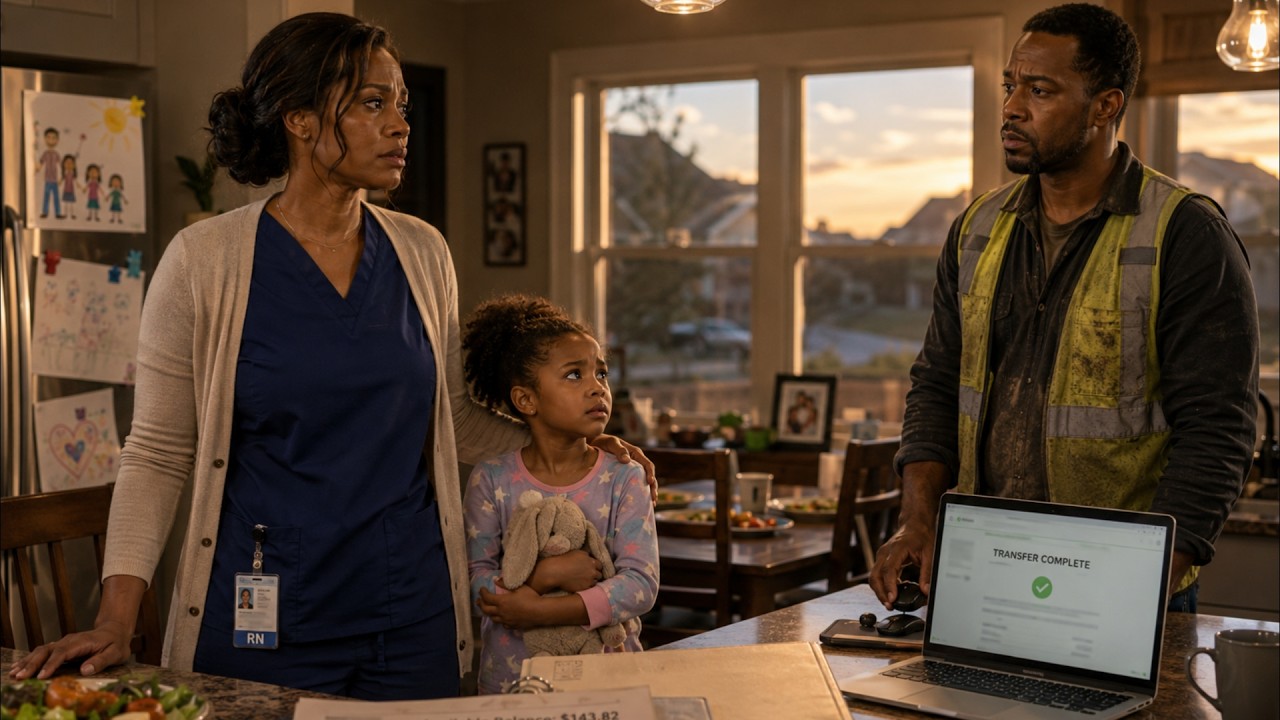
The night my husband emptied our savings to stop his brother from losing the family house, our daughter asked me if we were going to lose ours too. Daniel looked at me and said, “It’s my family. I have to help them. ”
I looked at our little girl, took a deep breath, and realized something that changed everything.
He had chosen his family over ours. So eventually, I chose peace. But to understand why I walked away so calmly, you need to understand everything that came before. My name is Natalie Brooks, and I’m 35.
I work as a pediatric nurse at a children’s hospital outside Sacramento, a job I’ve loved since the day I started, even on the hardest shifts. Caring for children teaches you patience in a way few other jobs can. You learn to stay calm when a room feels chaotic. You learn to keep showing up for someone even when they can’t fully explain what’s wrong.
Looking back, I think those same instincts followed me home and shaped how I approached my marriage for far longer than they should have. I met my husband, Daniel, when we were both in our late 20s, working entry-level jobs in the same city. Both of us broke in that hopeful way people are broke when they still believe the hard years are temporary. Daniel was studying to become a civil engineer, working construction on the side to pay for it.
He was steady, hard-working, and had a quiet kind of devotion I found more attractive than anything flashy. He remembered small details about my day. He showed up early to things. He talked about the future like it was something we were building together, brick by brick.
We got married in a small ceremony our combined savings barely covered. For the first several years, our marriage looked exactly like the life we’d promised each other. We lived in a cramped one-bedroom apartment, worked long hours, and slowly built toward a stability neither of us had grown up with. When our daughter, Lily, was born, Daniel held her in the hospital room, looked at me with tears in his eyes, and said, “She’ll always come first, no matter what.
” I believed him completely, because at the time I had no reason not to. The early cracks were so small I don’t think either of us recognized them as cracks at all. Daniel’s family had always struggled financially in ways his own hard work had helped him escape. His parents, Carol and Frank, had raised three children on modest incomes, and Daniel, being the oldest and most financially stable, had slowly become the person everyone turned to whenever something went wrong.
At first, it looked like ordinary family generosity. A few hundred dollars to cover his mother’s car repair. A weekend spent watching his sister’s kids so she could work a second job. A missed Saturday because his father needed help fixing a leaking roof before the next storm.
I want to be honest that none of these individual moments bothered me much at the time. I believed in family. I believed in showing up for the people you loved. What I didn’t fully register, at least not for a long time, was the pattern forming underneath all those reasonable-sounding requests.
Every time I gently raised a concern, usually about the accumulating cost or the plans we’d have to cancel, Daniel would say the same three words in the same reassuring tone: “Just this once. ” I believed him every time. It took me embarrassingly long to notice that “just this once” had become the permanent operating condition of our marriage. Daniel’s younger brother, Ethan, was 34, chronically underemployed, and seemed to move from one setback to the next with a kind of practiced helplessness that always found its way back to Daniel’s doorstep.
A car that needed replacing. A landlord threatening eviction. A business idea that needed just a little more capital to finally take off. Each crisis felt urgent and specific in the moment, and each time Daniel quietly stepped in, usually without fully discussing the financial details with me until after the money had already changed hands.
Our own life absorbed the cost of all that generosity in small, cumulative ways. We canceled a family vacation to Yellowstone two years in a row. Once because Ethan needed help with a security deposit, once because Daniel’s parents needed help covering a medical bill that had gone to collections. Our fifth wedding anniversary came and went with a quiet dinner at home instead of the weekend trip we’d talked about for over a year, because Daniel’s parents asked him to help cover a roofing repair that same week.
Somehow, our own plans always seemed to be the ones that could wait. I raised these concerns with Daniel more than once, always gently, always trying to frame it as a conversation about priorities rather than an accusation. He would listen, nod, and agree we needed to set clearer boundaries, then within weeks find himself back in exactly the same position the next time his family called. I don’t think he was being dishonest.
I think he genuinely believed each time that this particular situation was the exception, the last one, the final favor before things settled into a more sustainable rhythm. They never did. Everything came to a head on an ordinary Tuesday evening about eight months ago. I came home from a long shift to find Daniel unusually quiet, sitting at our kitchen table with his laptop still open.
When I asked what was wrong, he told me carefully that Ethan’s landlord had begun formal foreclosure proceedings on the small house Ethan was renting to own, and without an immediate lump sum payment, Ethan would lose the property entirely within the week. I asked how much money we were talking about. Daniel told me a number that made my stomach drop. It was close to the entire balance of the emergency savings account we had spent the better part of six years building.
Money we had specifically set aside for unexpected crises in our own lives. Before I could fully process what he was describing, he told me, quietly, that he had already transferred the money that afternoon. He hadn’t asked me. He hadn’t discussed it with me beforehand.
He had simply made the decision on his own and informed me after the fact, the way you’d mention a minor errand rather than a decision that had just erased years of careful planning for our own family’s security. Lily, who was seven at the time, had wandered into the kitchen partway through the conversation, picking up on the tension the way children do, even when they can’t understand the specifics. She asked in a small voice whether we were going to lose our house, too, the way Uncle Ethan almost had. I remember the particular ache of that moment, watching my seven-year-old daughter absorb an anxiety about financial security that no child her age should have to carry.
I asked Daniel, as calmly as I could manage, why he hadn’t talked to me first. He looked at me genuinely confused by the question and said, “What was I supposed to do? They’re my family. ” I asked him quietly, “And what are Lily and I?
” He didn’t answer right away. The silence that followed hurt far more than any argument we’d ever had. It wasn’t an angry silence. It was worse.
It was the silence of someone who had never actually considered the question before, someone for whom the answer wasn’t obviously “you’re my family, too,” at least not with the same automatic urgency. In the weeks that followed, I found myself doing something I hadn’t done in years: sitting with our actual history rather than each individual incident in isolation. I thought about every missed anniversary, every canceled vacation, every medical appointment quietly postponed, every promise about next time that had never actually arrived. I realized, painfully, that I hadn’t been losing ground to Ethan specifically or to Carol and Frank specifically.
I’d been losing ground slowly and consistently to Daniel’s inability to ever tell his own family no, and to my own willingness, for far too long, to accept “just this once” as an actual answer. I didn’t confront Daniel again in anger. I didn’t threaten to leave. I didn’t demand an apology.
Instead, I quietly began doing something I should have started much earlier. I made an appointment with a financial advisor on my own, and together we mapped out a plan to slowly rebuild the emergency savings that had just been wiped out, this time in an account only I had access to. I applied for a leadership position that had opened at the hospital, a role I’d been quietly interested in for over a year but had never pursued because the additional hours felt hard to justify given how thin our finances had become. I started meeting with a therapist, mostly to work through my own guilt about even considering the possibility of leaving a marriage I had once believed in completely.
I looked, quietly and without telling Daniel, at a few small rental properties near Lily’s school. Not because I had decided anything yet, but because I wanted to know, for the first time in years, that I actually could. Daniel didn’t notice much of this happening. I don’t say that to be unkind.
I think he genuinely believed, the way he always had, that whatever tension existed between us would eventually settle back into its familiar rhythm. He had no reason to expect anything different, because nothing different had actually happened as a result of these conversations in the past. About four months later, Daniel’s parents called with another financial emergency, this time involving an unexpected medical bill Carol’s insurance hadn’t fully covered. Daniel came to me the way he usually did by that point, more out of habit than genuine consultation, already halfway expecting me to go along with whatever arrangement he proposed.
This time, I told him, calmly and without raising my voice, that I couldn’t help him make this particular decision, because Lily and I wouldn’t be living in that house much longer. He laughed at first, assuming I was making some kind of pointed joke about the pattern we’d fallen into. When I quietly handed him the folder containing the paperwork I’d been preparing with a family law attorney for the past several weeks, I watched the laughter fade from his face entirely. I want to be clear that I wasn’t handing him those papers out of anger, and I wasn’t trying to punish him for anything specific.
I was handing them to him out of a clarity that had taken me nearly a year to fully arrive at. I loved Daniel. I don’t think that ever stopped being true. But loving someone and continuing to sacrifice your own family security for them indefinitely had turned out to be two very different things, and I had finally reached the point where I understood I couldn’t keep pretending otherwise.
A few weeks later, both families gathered at Carol and Frank’s house at Daniel’s request, hoping, I think, that a group conversation might change my mind, or at least allow everyone to understand what had happened. I could tell, walking in, that Carol expected the conversation to end with some kind of apology from me, an acknowledgment that I’d overreacted, a return to the familiar order of things. Instead, I sat down and, as calmly as I could, walked everyone through the actual history. Not as a list of accusations, but simply as facts laid out clearly one after another.
The canceled anniversary trip. The postponed dental work. The Yellowstone vacation we’d promised Lily twice and canceled twice. The emergency savings that had taken six years to build and had disappeared in a single afternoon without a conversation.
I didn’t raise my voice once. I didn’t need to. Every sacrifice I described had one thing in common, which I stated plainly at the end. Our own household had always, without exception, come last.
The room was quiet for a long time after I finished. I watched Daniel’s expression change slowly, as though he were hearing the shape of his own choices laid out clearly for the first time, rather than experienced one justified moment at a time the way he’d always lived them. Even Frank, who rarely said much during family conversations, finally spoke quietly, looking at his son. He said, “Son, I never asked you to sacrifice your marriage for us.
”
I don’t think Daniel had ever considered, until that exact moment, that this was actually what had been happening. I want to be clear about what happened after that conversation, because I think it matters. Daniel didn’t lose everything. He wasn’t publicly humiliated, and nobody in either family turned against him.
What he lost was the thing that mattered most, and he lost it specifically because he had failed for years to protect it the way he protected everyone else’s crises. He moved into a small apartment a few miles from Lily’s school. He began therapy of his own, something I don’t think he would have considered before. He slowly began repaying our emergency savings from his own income on a schedule we worked out together with the help of a mediator, without me ever having to ask twice.
He finally set real boundaries with Ethan, boundaries that held for the first time in either of their lives. He visits Lily every week, not because any court ordered him to, but because he told me quietly that he finally understood exactly what he had almost let slip away. Something else changed, too, something I hadn’t fully anticipated. Without Daniel automatically absorbing every financial emergency that came his family’s way, his family slowly began adjusting on their own.
Ethan, forced for the first time to face the consequences of his own instability without an automatic rescue waiting on the other end of a phone call, found and kept a steady job for the first time in years. Carol stopped assuming financial help would simply appear whenever she asked for it. The particular cycle of dependence that had quietly shaped Daniel’s entire adult life slowly, gradually began to break. Not because I destroyed anything, but simply because the automatic safety net finally disappeared.
My own life, in the meantime, moved forward in ways I hadn’t expected to feel so steady. I was promoted to head of pediatric nursing about six months after everything settled, a role I’d wanted for years and finally had the space and confidence to pursue fully. I bought a modest townhouse near Lily’s school using money I had rebuilt entirely on my own over the following year. Lily, given time and the stability of two calm, cooperative parents rather than one household quietly buckling under constant financial strain, flourished in a way that made every difficult decision along the way feel worth it.
Two years later, Daniel and I sat together at Lily’s elementary school graduation, not as husband and wife, but as two people who had settled with real effort into something calmer and more honest than what we’d had in those final difficult years of our marriage. At one point, watching Lily cross the small stage they’d set up for the ceremony, Daniel said quietly, “I spent years trying to keep everyone happy. I didn’t realize I was making the people I loved most carry the cost of that. ”
I smiled gently and told him something I believed completely by that point.
We both deserved peace. For a long time, I believed that loving someone meant enduring every disappointment and simply waiting patiently for them to change on their own. I’ve learned since everything that happened that peace isn’t something another person hands you. It’s something you choose deliberately the moment you stop sacrificing your own well-being to keep someone else comfortable.
Daniel was never a bad man. He was a man who had spent his whole life unable to tell the difference between loyalty and obligation, between showing up for family and quietly disappearing from the family he’d actually built himself. By the time he finally learned the difference, our marriage had already become another casualty of his silence. I didn’t leave because I stopped loving him.
I left because I finally started loving myself and the little girl who deserved to grow up believing that home should always feel safe, not something perpetually at risk because someone else’s crisis always came first. Sometimes choosing peace doesn’t look like giving up at all. Sometimes it simply means finally choosing the family that had been quietly waiting the whole time for someone to protect them, too.