The roar of the crowd at Buenos Aires’ Luna Park stadium on November 23, 1938, was not for a boxing match or a theatrical performance. It was a thunderous ovation for Adolf Hitler. Thousands of Argentines, from all walks of life, packed the venue for a rally organized by the Argentine Hitlerist German Group, a local Nazi organization.
The event, known as the Concord rally, was a public spectacle of adoration for the Third Reich, a chilling display of support that turned the “Paris of South America” into a stage for fascist fervor. This was not an anomaly; it was a symptom of a deep ideological infection that would, within a decade, transform Argentina into the most infamous safe haven for the architects of the Holocaust.
 Just seven years later, the world was a graveyard. The streets of Berlin, once the heart of the Thousand-Year Reich, were reduced to rubble and blood. On May 2, 1945, at 2:50 a.
m. , General Helmuth Weidling surrendered the German capital to the Red Army. The war in Europe was over, but for the high-ranking Nazis who had orchestrated genocide, a new battle had begun: the fight for survival.
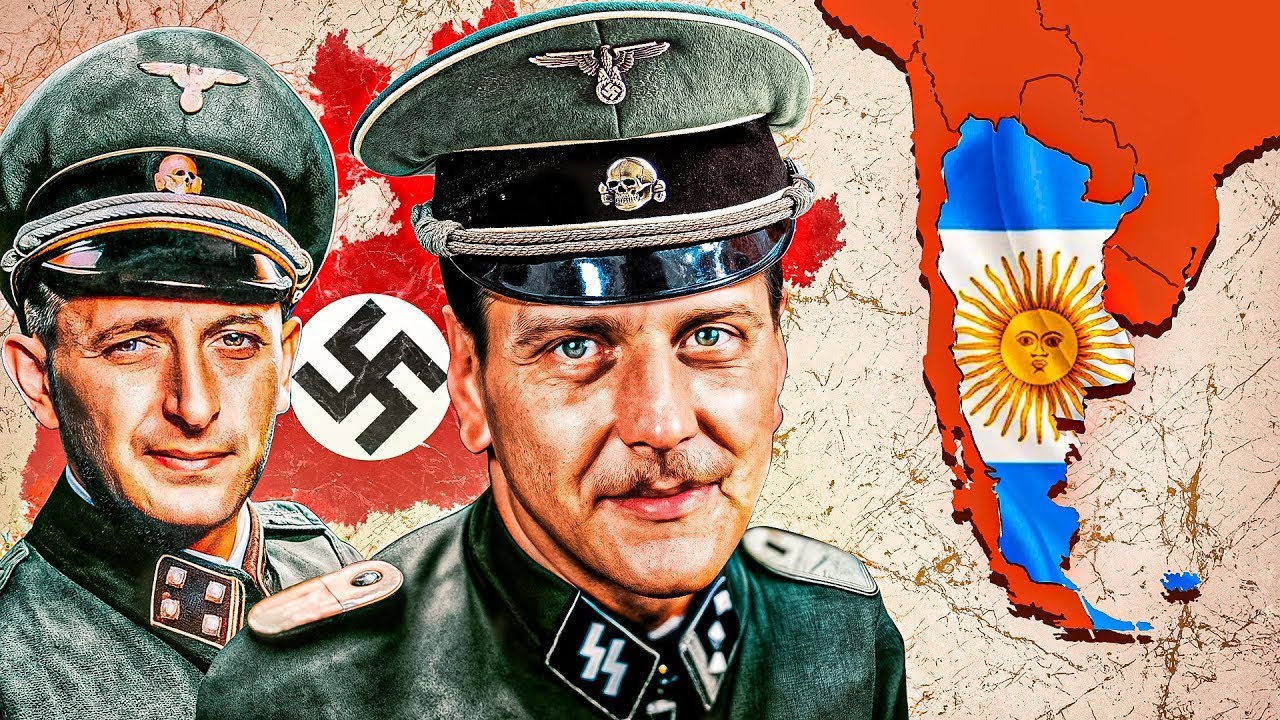
They knew the hangman’s noose awaited them at Nuremberg. They had planned for this moment, and their escape routes, the infamous “ratlines,” were already in motion. Among the potential destinations—Spain, the United States, Brazil—one country stood out as a beacon of hope for the damned: Argentina.
The answer to the question of why so many Nazis fled to Argentina is not a simple one. It is a story woven from the threads of Argentina’s own political turmoil, the cynical pragmatism of its future leader, and the complicity of a global network that stretched from the Vatican to the shores of the Rio de la Plata. On June 4, 1943, a military coup known as the Revolution of ’43 brought a nationalist government to power in Argentina.
This regime, led by General Pedro Pablo Ramirez, was determined to maintain neutrality in the global conflict, a stance that infuriated the United States. As the tide of war turned against Germany, pressure from Washington became irresistible. On January 26, 1944, Argentina broke off relations with the Axis powers, a move that triggered a political crisis, forcing Ramirez to resign.
Into this power vacuum stepped a man who would change Argentina’s destiny: Juan Domingo Peron. A colonel who had served as a military attaché in Mussolini’s Italy from 1939 to 1941, Peron was deeply impressed by the fascist model. He saw in it a system that could balance capital and labor, a tool to forge a powerful, industrialized Argentina.
 After a brief arrest and a massive popular uprising that secured his release, Peron won the presidency in February 1946. His vision for Argentina was grand, and it included a secret alliance with the defeated Nazis. Peron believed that the scientists, engineers, and military minds of the Third Reich could be the key to transforming his nation into a superpower.
The infrastructure for this dark migration was already in place. The ratlines were a shadowy network of complicity that snaked across Europe. In Spain, Francisco Franco, a fellow fascist, provided a crucial gateway.
The Catholic Church, particularly through figures like Austrian Bishop Alois Hudal in Rome, played a pivotal role, issuing false identity documents and providing shelter in monasteries. Otto Skorzeny, the legendary SS commando who had rescued Mussolini, became a key organizer of these escape routes. In Italy, the Croatian priest Krunoslav Draganovic coordinated with the Red Cross and Vatican officials to forge passports and arrange passage.
These networks were not just a few scattered sympathizers; they were a sophisticated, multi-national operation designed to cheat justice.
Argentina under Peron was the final destination. The president himself, along with his wife Eva, were sympathetic to the fascist cause. They saw the Nazis not as war criminals, but as valuable assets.
 Argentine diplomats, such as Carlos Fuldner, who had served as consul in Hamburg, actively facilitated the issuance of fraudulent documents. Ludvig Freude, the brother of Peron’s personal secretary, provided logistical support. Shipping magnate Alberto Dodero used his fleet to transport fugitives across the Atlantic.
The Argentine government’s immigration policies were deliberately lax, and the country had no extradition treaties that could threaten the new arrivals. For a Nazi on the run, Argentina was a promised land.
The most notorious of these fugitives was Adolf Eichmann, the logistical mastermind of the Holocaust. Using a false passport under the name Ricardo Clement, Eichmann arrived in Buenos Aires in July 1950. He lived a quiet, unassuming life, working at a Mercedes-Benz factory and later at a rabbit farm.
He moved his family to a modest house in the suburb of San Fernando. For a decade, he evaded justice, a ghost living openly in a country that chose to look the other way. But the long arm of Israel’s Mossad was reaching out.
On May 11, 1960, a team of agents ambushed Eichmann as he stepped off a bus. He was bundled into a car, drugged, and smuggled out of the country on an El Al flight. His trial in Jerusalem was a global sensation, a televised reckoning that ended with his execution in 1962.
 But Eichmann was just one of many. Dr. Josef Mengele, the “Angel of Death” of Auschwitz, who had performed horrific experiments on twins and other prisoners, also found refuge in Buenos Aires.
He arrived in 1949, living openly under his own name for a time, working as a pharmacist. Unlike Eichmann, Mengele was tipped off about the Mossad’s interest and fled to Paraguay and later Brazil, where he died in 1979, never facing justice for his crimes. The list of Nazi war criminals who lived freely in Argentina is a roll call of infamy: Erich Priebke, who participated in the Ardeatine Caves massacre in Rome; Walter Rauff, the inventor of the gas van; and Dr.
Aribert Heim, known as “Dr. Death” of Mauthausen.
These men were not just hiding; they were working. Peron’s grand plan for technological advancement relied heavily on Nazi expertise. Kurt Tank, the chief designer of the Focke-Wulf fighter planes, was recruited to lead Argentina’s aerospace program.
He designed the Pulqui I, the first jet aircraft in Latin America, and worked on the ambitious Condor missile project. German physicist Ronald Richter was put in charge of the Huemul Project, a secret and ultimately fraudulent attempt to create a nuclear reactor in Patagonia. These projects, while often failing to meet their grand ambitions, represented a massive transfer of military technology and scientific knowledge from a defeated regime to a rising South American power.
The legacy of this dark alliance is a stain on Argentina’s history. The presence of these high-ranking Nazis created a culture of impunity and denial. It took decades for the country to begin confronting this past.
The capture of Eichmann was a triumph for justice, but the vast majority of the criminals who fled to Argentina died in their beds, never held accountable for their crimes. The question of why Argentina became a haven is a complex one, rooted in the nation’s own political struggles, the ideological sympathies of its leadership, and a calculated decision to trade moral integrity for technological and military advancement. It is a story of a city that once welcomed the world’s best and brightest, only to become a silent sanctuary for its worst and most depraved.


