On May 24, 1992, a grieving man walked through a quiet cemetery to place flowers on his father’s grave. Then he stopped cold. In the distance, a man appeared to be assaulting a woman. The man rushed off to find help.
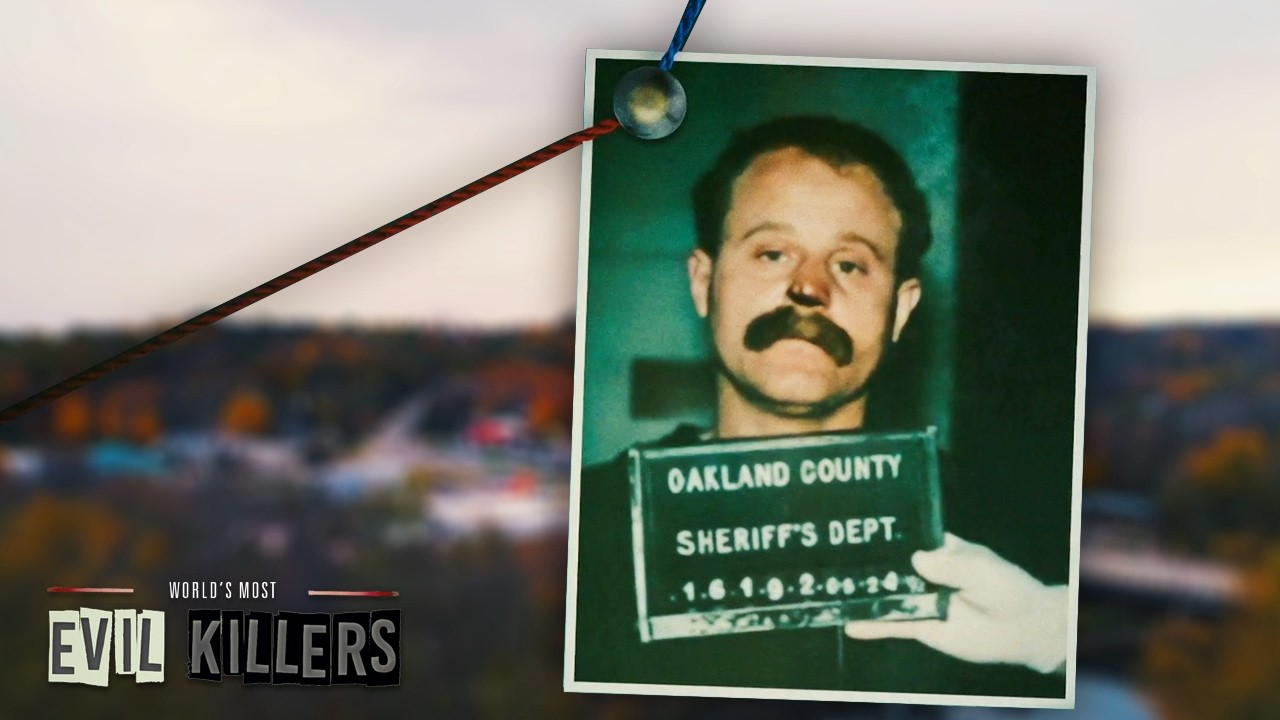
After a police chase, the assailant was caught. The woman he’d attacked was found in the trunk of his car, barely alive, with a device around her neck strangling her. The attacker was 38-year-old Leslie Allen Williams. Police soon discovered this wasn’t his first abduction.
Evidence in his home linked him to four missing teenage girls. Williams confessed to their murders with no emotion whatsoever. “When we interviewed him, he expressed no emotion. It was like he was ordering a cup of coffee.
”
In July 1992, at Oakland County Circuit Court in Michigan, Williams pleaded guilty to the murders of 18-year-old Kami Villanueva, 16-year-old Michelle Urban, her 14-year-old sister Melissa, and 15-year-old Cynthia Jones. He led police to the sites where he’d buried their bodies. The hardest part, detectives later noted, was this: Williams told every one of those girls he would let them go. If they just did what he said, they’d be okay.
He said he’d release them. Then he killed them anyway. The families and the public were horrified to learn that Williams had been let out of prison early for good behavior. He’d been a career criminal.
Time after time, parole boards released him back onto the streets. It was shortly after one of those releases that the first girl disappeared. If Williams hadn’t been caught in May of 1992, investigators believe, he would not have stopped. —
Leslie Allen Williams was born on July 4, 1953, in Detroit, Michigan.
His home life was broken from the start. His mother worked as a prostitute out of the house. His father sexually abused Williams’ sisters. When authorities learned of the abuse, the father was committed to a state hospital for the criminally insane.
Then Williams’ mother moved the family to California. She remarried, but the marriage failed. The night before the divorce hearing, her husband came to her home, shot her in the head, and killed himself. Leslie Allen Williams was 9 years old.
He had no parents left. He and his brother were sent back to Michigan to live with their grandparents in Milford. By age 17, Williams was already turning to crime. In 1970, he was arrested for breaking into a home.
That began a long criminal career, a steady litany of burglary, sexual assault, and attempted kidnappings. Between 1972 and 1983, he was in and out of prison endlessly. Each time, he was released early. In 1983, Williams broke into a woman’s home.
The burglary escalated to attempted kidnapping and sexual assault. As a habitual offender, he received a sentence of 7 to 30 years. Finally, it seemed Williams would be locked away for decades. He would be an old man by the time he got out.
But inside, he became an absolute model prisoner. His prison psychiatrist wrote a glowing report, saying Williams had made splendid progress and was ready for rehabilitation. In 1990, after serving just six years of that 30-year sentence, Williams was released on parole. People were manipulated by the idea that because he was polite, he wasn’t dangerous.
But the criminal justice system had just put a repeat, serial offender back on the street. —
On the early hours of September 15, 1991, 18-year-old Kami Villanueva was home alone in South Lyon, Oakland County, Michigan. Her older sister was out on a date. Kami was a bright honor student.
Cheerful. Shy. She didn’t party and still lived at home. When her sister came back, Kami was gone.
Her room was undisturbed. Her inhaler, her purse, her denim jacket—the one she never left without—were all still there. It was as if she’d vanished into thin air. Her sister reported her missing the next day.
There were no signs of forced entry. Police had no clue what had happened to her. Two weeks later, another call came in. Two teenage sisters, 16-year-old Michelle and 14-year-old Melissa Urban, had gone missing.
The girls had a perfectly normal sister relationship—partly friendship, partly rivalry. They lived in a rural area near Hartland, about an hour northwest of Detroit. After a Sunday dinner with family on September 29, 1991, they went out for an evening walk. The next morning, their father knew something was wrong.
They hadn’t come home. A young trooper was sent to the house. The parents were frantic. The police retraced the route the sisters took on their walks, but found nothing.
They interviewed friends and neighbors. No one had seen the girls. Then the trooper discovered something troubling: Michelle and Melissa had run away once before, years ago, and returned after a weekend. At first, police hoped that was the case again.
But as the days stretched into weeks, the hope faded. They had never been gone this long. They had left behind things they never would have left behind. Concern turned to fear.
Police brought in Michigan state profiler David Minzey to help. Minzey focused on victimology. These were low-risk victims. Something terrible had likely happened to them.
With three high school girls gone in the span of three weeks, it was clear something had come into the area. The communities were rural, sparsely populated, almost crime-free. Authorities knew the disappearances were likely connected. But they couldn’t find the link.
—
Just a year before the girls vanished, Leslie Allen Williams had been released on parole. He moved first to Wayne County, then to Oakland County. His parole officers considered him a model parolee. He reported in regularly, showed his check stubs, attended counseling.
He caused no trouble at all. He was ideal to deal with. While Williams was settling into his new life, the Oakland County police remained baffled by Kami’s case. Before they could connect the dots, another girl disappeared.
On January 4, 1992, 15-year-old Cynthia Jones was sitting in her 16-year-old boyfriend’s car at Central Park in Milford. She was an honor student, a cheerleader, cheerful and happy with her boyfriend. A man in a ski mask ran up to the car. He told them he needed the car.
He claimed he’d robbed a place. He forced them out and marched them into a nearby wooded area. He tied the boyfriend to a tree. Then he took Cindy deeper into the woods.
The boyfriend never saw her again. Minutes later, the boyfriend freed himself and called police. They searched the entire park. Nothing.
Cindy’s boyfriend couldn’t identify the attacker because his face was covered. The police had barely any leads. For a time, the boyfriend was even considered a suspect. Police couldn’t find any evidence connecting him, and six days later, he was ruled out.
He was traumatized. He had watched the girl he was falling in love with being taken by a masked man, then was suspected of her abduction himself. Police were facing four missing girls. Three different police departments were investigating separately, with little communication between them.
This was before the age of wireless alerts. There was nothing to connect the disappearances. —
Then, on May 24, 1992, luck changed. In Springfield Township, a man was visiting his father’s grave.
He pulled up and saw another car blocking the path. One door was open, but the car was empty. He looked off into the distance and saw a man assaulting a woman. The attacker noticed him.
“Leave us alone,” he yelled. “We’re just having sex. ”
The witness knew that wasn’t true. Both were fully clothed, and the woman was clearly being attacked.
The witness found a traffic policeman nearby. When the cop arrived, the attacker sped out of the cemetery. A harrowing car chase followed. At one point, the man wrecked his car and ran on foot.
But police caught him. The assailant was 38-year-old Leslie Allen Williams. Williams was slightly shamefaced as he was arrested. Then he told the officer something chilling: the woman he had been attacking was in the trunk of his car.
She wouldn’t be able to breathe for long. The officer opened the trunk. The woman was near death, being asphyxiated by a device around her neck. He got to her just in time.
Williams was taken into custody. He gave up little during questioning. But investigators ran his record and found his long history of violent crimes. A search warrant was executed at his home.
They found plastic zip ties. They found a ring in his car. The ring belonged to Kami Villanueva. Police made contact with Williams’ ex-girlfriend.
What she told them filled the detectives with dread. During their relationship, she had given Williams a kitten to care for. Williams told her later that he’d killed the kitten. He said he buried it.
The ex-girlfriend gave police the location of the burial site. Detectives headed straight there, dug, and realized they were uncovering Cammie Villanueva’s body. With the evidence overwhelming, Williams confessed to Cammie’s murder. The details were horrifying.
While on parole in 1990, Williams had worked at a gas station. One of his co-workers had a sister named Cammie Villanueva. Williams saw her coming and going. He knew where she lived and what her habits were.
He targeted her. Cammie was home alone, sitting in her bedroom playing solitaire. Williams dressed in a ski mask and approached with a pocket knife. He found her door unlocked.
He forced her into his car and took her to a nearby cemetery, where he raped and strangled her. Strangulation is personal for killers. It allows them to control their victim’s life. It’s the ultimate exercise of power.
Williams buried Cammie in a shallow grave in a field. Months later, he returned. He dug her up and had sex with the body. Necrophilia is not unheard of among killers.
They revisit bodies to relive the moment, to feel that power again. Williams didn’t just kill these girls—he savored them. —
Williams’ confession didn’t stop with Cammie. Over the next few days, detectives uncovered the full nightmare.
Williams admitted to kidnapping and murdering the Urban sisters. He had been watching them for days. He was court-ordered to see a psychotherapist just miles from their home, and he used the area to stalk them. When the sisters went for their evening walk, Williams hid in the bushes.
When they passed, he jumped out with a small knife. He grabbed one sister. The other submitted, fearing for her sister’s life. He had taken photographs of them before killing them—souvenirs he kept in his home.
He tried to incapacitate them with starter fluid, then suffocated them. He drove four miles to the outskirts of Fenton, Michigan, and buried the teenage sisters in a shallow grave in a cemetery. He covered them with blankets to protect the bodies from the earth, perhaps to keep them accessible for later visits. Detectives asked Williams what he told the girls before he killed them.
He said he told them he would let them go. If they just did what he said, they’d be okay. He’d release them. Investigators who heard this found it made the case so much worse.
—
Then Williams revealed his final victim. Cynthia Jones. “He took Cindy in his car and, like the other victims, he raped her,” the profiler said. “He did change his MO a little bit, though.
With Cammie he’d strangled; with the two sisters he’d suffocated. But with Cynthia, he stabbed her in the chest with his knife and buried her in a shallow grave. ”
Police had already found Cammie. Now Williams agreed to lead them to the other three burial sites—the Urban sisters in Fenton and Cynthia Jones on Bruno Road.
Williams confessed for his own benefit. He could point to his cooperation and say, “Look what a great guy I am, how sincere I am. ” It was a strategy to make himself look remorseful. But investigators saw no remorse.
He showed zero emotion, as if he were ordering a cup of coffee. On June 3, 1992, Williams pleaded guilty to all four murders. He told the court he wanted to save taxpayers the expense and spare the families the grief of a trial. It took little time to sentence him.
On July 7, 1992, Williams received life without parole for Cynthia Jones’ murder. That same day, he was given four consecutive life terms for kidnapping, attempted murder, and attempted rape of the woman at the cemetery. Over the following months, he was sentenced to consecutive life terms for the murders of Cammie Villanueva and the Urban sisters. Cammie’s mother was horrified that her daughter had been killed by a man paroled early.
The families of the victims began campaigning for reform of Michigan’s parole system. “I think Leslie Allen Williams represents a failure of the entire criminal justice system, particularly the parole system,” said one investigator. “Leslie Allen Williams never should have been on the street. And there are four young ladies that are dead because of that.
”
In the year Williams was released, nearly 9,000 people were granted parole in Michigan. After his conviction, the parents of Michelle and Melissa Urban pushed for change. Later that year, legislation was enacted to reform Michigan’s parole system. But for the investigators, the scars remained.
“People who work on a serial killer case never want to do that again,” said profiler David Minzey. “It is so physically and emotionally draining. It affects their family life. There’s a lot of pressure from the media, from the public.
”
He paused. “I personally feel there is no such thing as justice in a case like this. The girls will never be brought back. The only thing we have is the knowledge that Williams will never be able to do this again.
So at least the other young women out there will be safe. ”
Leslie Allen Williams, a man who was endlessly released by a system that failed to see his true nature, took the lives of four teenage girls in just nine months. He is forever remembered as one of the world’s most evil killers.