The archives of history have long hidden a troubling truth about daily existence in Nazi Germany: for millions of ordinary citizens, the years before World War II were not experienced as tyranny, but as a period of renewal, stability, and tangible progress. New historical analysis reveals how a nation recovering from deep crisis came to embrace a regime whose ultimate ambitions would devastate Europe and seal the fate of millions.
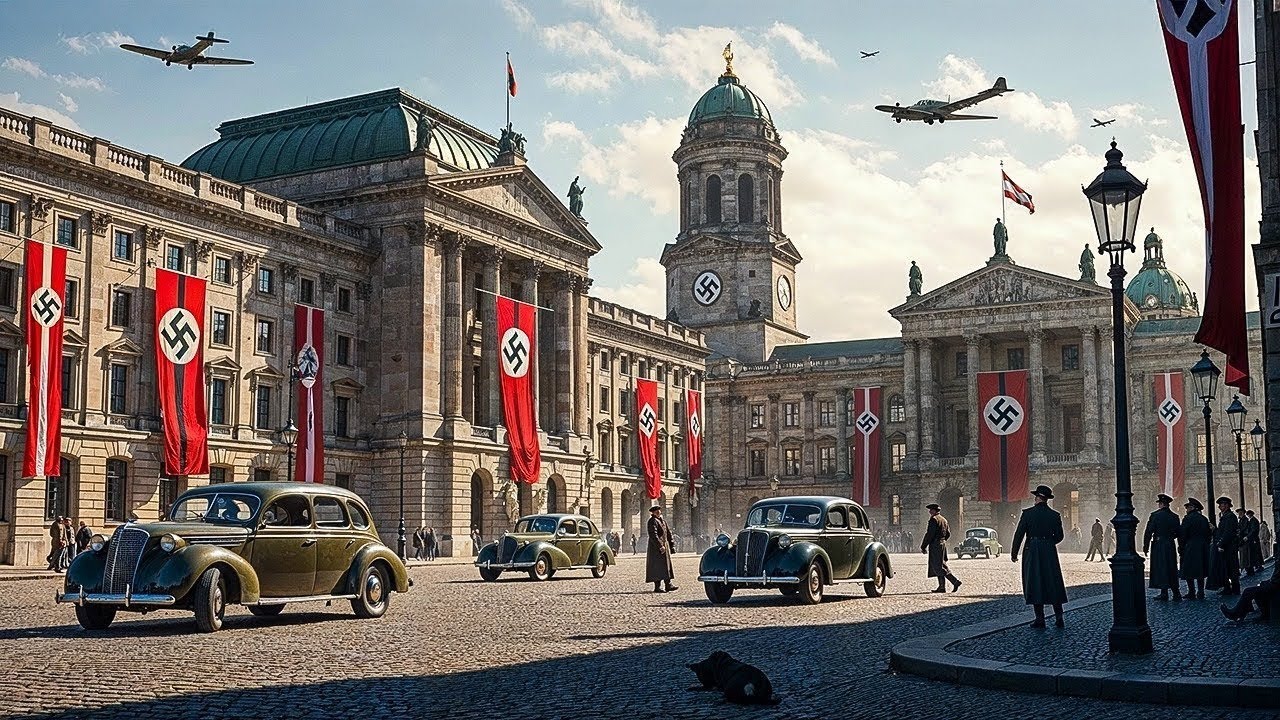
Between 1933 and 1939, the everyday life of most Germans was marked by a sense of prosperity and security that actively reinforced support for the Nazi regime. At the height of Nazism’s popularity, the common experience was one of political stability and visible material improvements, leading many to believe the country had finally left behind the uncertainty of the postwar period and entered a phase of continuous progress.
On the streets and in homes across Germany, there was an atmosphere of satisfaction. People claimed they did not want war because everything was going well. Entire families enjoyed stable incomes, modern appliances, cars, and small luxuries that seemed to confirm that life had significantly improved, although this prosperity did not reach all sectors equally, it gave the powerful impression that the regime had brought wealth to the masses.
The popularity of the Third Reich was not based solely on higher wages or business expansion, but on something deeper: the conviction that Germany had regained control of its destiny. This collective perception strengthened confidence in a better future for both the present generation and its descendants, as National Socialism conveyed the idea that a new era had begun. For Germans living at that time, the improvements were tangible, and the regime seemed to have no viable alternative.
Yet the economic recovery was not immediate and was accompanied by deep frustrations. Low wages, high prices, and the slowness of the process generated discontent among large segments of the population, partly due to the excessive expectations the regime itself had raised. Between 1933 and 1934, unemployment fell significantly from almost 5 million to less than 3 million, but by 1935, more than 2 million Germans were still without work.
The solution applied was a vast public works program that absorbed hundreds of thousands of unemployed into work brigades. Many were assigned to the construction of new highways, but conditions were harsh, wages low, and work days long. Even workers with stable employment saw their freedoms limited.
In 1935, the Arbeitsbuch was introduced, a document that restricted the possibility of changing jobs, while labor demands increased and the factory environment became oppressive, dominated by surveillance and intimidation.
Although in the prosperous years between 1937 and 1939 many enjoyed material improvements, discontent did not disappear entirely. The regime had succeeded in reducing unemployment, but at the cost of a rigid, unequal, and controlled labor system in which a large part of the working population felt exploited and voiceless. Propaganda attempted to present a picture of economic success, but the reality was far more complex.
By 1937, the number of unemployed had fallen below 1 million. The growing labor shortage opened more opportunities for women, although their wages were lower than men’s. Female workforce participation reached 37% in 1939, including over 6 million married women compared to 4 million who worked in 1933.
Overall incomes did not rise much above the levels of the late 1920s, but the sense of stability became a more important factor than wage increases.
The disappearance of mass unemployment had a decisive effect on consolidating the regime. Millions of people who had lived in precarious conditions began to experience a more stable life, convinced that the new government had restored their dignity. However, in 1937, German households had barely regained the standard of living they had in 1928.
Life remained modest and simple; rye bread was often accompanied by margarine or jam, while products such as butter or cold cuts were rare luxuries.
Compared to the English, French, or Americans, Germans ate more austerely, though always in sufficient quantity to avoid hunger. Newspaper advertising showed an optimistic image of the consumer economy, but most working-class households still lacked basic goods such as radios or bicycles. Only a small percentage of households owned refrigerators, washing machines, or vacuum cleaners, as military rearmament absorbed most of the national resources, limiting the availability of consumer goods.

Still, what maintained morale was not so much material abundance as the illusion that prosperity was on the way. Among Hitler’s most emblematic projects was the idea of motorizing the country with the creation of the Volkswagen, the people’s car, presented as a vehicle accessible to any ordinary citizen. The Volkswagen was not just a car; it represented a symbol of hope and progress, embodying the promise of a more prosperous era in which Germany would be rich and powerful.
The ambitious holiday complex nearly completed in Prora on the island of Rügen reflected this vision well. There, a parking lot for 5,000 vehicles had been designed, intended for a country where every family could reach their vacation in their own car. The automobile was the centerpiece of the Nazi ideal of modernity, mobility, and prestige, a fantasy Hitler clung to even after the disaster at Stalingrad.
Although many workers protested against the freezing of wages, they continued to appreciate one of the most visible changes of the 1930s: the increase in annual vacation days from 7 to 12. The German Labor Front channeled this change through the Strength Through Joy program, which initially had a marked propagandistic and social control character. By 1936, its motto was clear: “Enjoy life.”
Funded by mandatory deductions of 1. 5% of each worker’s salary, the Strength Through Joy program offered millions of Germans access to forms of leisure that had previously been unthinkable. Its activities included discounted tickets for theaters and concerts, countryside excursions, and for the luckiest, cruises to destinations such as Italy, Spain, or Norway.
In 1937, 1. 4 million Germans enjoyed vacation packages, and around 130,000 were able to embark on cruises.
One of the greatest attractions of the time was in fact the country itself. Millions of Germans began to consume Germany as a product, visiting destinations imbued with political and cultural significance. Even sites with strong symbolic meaning were integrated into itineraries, including the Bavarian prison where Hitler had written Mein Kampf in 1924.
For many, posing in front of these sites was a way to identify with the central figures of the regime.
The Germans experienced the collective life of the Third Reich more intensely through Hitler’s successes in foreign policy. In January 1935, the reintegration of the Saar into the Reich following a referendum was met with overwhelming enthusiasm. Two months later, the streets once again filled with crowds to celebrate the restoration of the German army through the mass recruitment of the new Wehrmacht, interpreted as the definitive end of the humiliation imposed by Versailles.
The prestige of the regime gained even more strength with the Anschluss of Austria in March 1938, when millions celebrated the union with massive enthusiasm. However, the people did not desire the war that Hitler already had in mind. An anecdote from the 1936 Berlin Olympics illustrates this well: Hitler was surprised by the enthusiasm with which Berliners welcomed the French team, understanding that the people desired peace and reconciliation, not a new war.
Yet the regime’s obsession with racial purity was already reshaping daily life. By the mid-1930s, practically all Germans except Jews and those excluded for other racial reasons began obtaining the Aryan Pass, the so-called racial passport. This document became the basis for genealogical archives that the Nazis promoted in every household, tangibly representing the ambition to redefine Germans as a racially pure community while segregating Jews.
 The Aryan Pass became the key tool for enforcing the Nuremberg race laws enacted in September 1935. Every person within the Third Reich had to fit into one of four categories: Germans with all four grandparents Aryan, Jews with three or more Jewish grandparents, first-degree Mischlinge with two Jewish grandparents, and second-degree Mischlinge with only one Jewish grandparent. Marriage regulations reflected this rigid racial hierarchy.
The effect was devastating. While possessing an Aryan identity opened all doors to the future within the Reich, having Jewish ancestry meant losing fundamental rights from citizenship to legal equality, sealing the fate of millions under a relentless system of discrimination. The state did not issue these racial passports directly; each citizen had to prepare it personally, gathering documents and proving lineages to demonstrate their Aryan status.
Women under the Reich faced their own imposed destiny. Nazism interpreted sexual freedom and the low birth rate of the Weimar Republic as unmistakable signs of moral decay. According to its ideology, women were to embody the ideal of the three Ks: Kinder, Kirche, Küche.
Hitler himself claimed that the rights of women in the Third Reich basically consisted of each finding a husband. This model resonated with many women hit hard by the economic crisis.
The regime restricted women’s access to university, setting a maximum of 10% of the total student body. They were also forbidden to work as judges or prosecutors because they “cannot think logically or reason objectively, being governed by their emotions.” The strict 𝒔𝒆𝒙 segregation established by the regime and the expulsion of women from almost every public sphere did not exactly make finding a partner easy.
During the large Nuremberg Rally of 1936, which drew 100,000 attendees from the Hitler Youth and its female counterpart, the League of German Girls, 900 girls under 18 returned from the event pregnant. Meanwhile, the regime considered that women should be austere and lacking sexual attractiveness. Getting a permanent wave was forbidden and punished even by head shaving.
Young women had to wear their hair in two blonde braids, a symbol of Germanic purity.
The authorities even conceived that once the war ended, the bravest soldiers could marry two women. Another plan was actually carried out: the Lebensborn program, homes for single women who were impregnated by SS members considered genetically suitable. Under Himmler’s direction, these centers impregnated around 8,000 candidates.
Before marriage, couples had to obtain approval from the hereditary health court, which could impose forced sterilization on those deemed undesirable.
Births were conceived as an act of service to the Reich. Every August 12th, Hitler awarded the Cross of Honor of the German Mother to the most prolific women: bronze for four or more children, silver for six, gold for eight. The 10th child was considered especially patriotic, personally sponsored by Hitler and had to be named Adolf.
Families received tax reductions and practical benefits like free school uniforms and discounted utilities.
Even humor became a dangerous act of resistance. Since the law of December 20th, 1934, any comment that could be interpreted as mocking the party leaders was classified as a crime. Nevertheless, humor continued to circulate.
According to postwar surveys, about 27% of Cologne’s residents had told at least one illegal joke during the Third Reich. The figure most ridiculed was Joseph Goebbels, whose constant presence, short stature, and affairs made him a perfect target.
The fear of speaking freely was so deep that phrases of self-protection became routine. The “German glance” involved quickly looking around before speaking to ensure no one was listening. The origin of all these precautions lay in fear of the Gestapo, but its real power was not as absolute as often believed.
In 1939, Cologne with 750,000 inhabitants had only 99 Gestapo agents, about 7,500 citizens per agent. In most parts of the country, the ratio was similar.

The power of fear was based more on collective perception than on the actual material capability of the organization. Records show that 26% of denunciations came from ordinary Germans while only 17% originated from the criminal police. In Cologne, 26% of cases arose from neighborhood conflicts, 3% of denunciations were against bosses, and 4% against spouses.
Even the intimacy of the home could become a field of suspicion and betrayal.
By the early 1940s, a large portion of the German population was aware of brutal facts: mass executions of unarmed civilians, the inclusion of women and children among the victims, and the scale of massacres in places such as the Kiev ravine, known as Babi Yar. However, the lack of detailed information about camps like Auschwitz allowed many to interpret these massacres as isolated incidents rather than a systematic plan of extermination.
When it became clear that the war would not be easily won, continuing to fight became the only imaginable option to preserve something of the life that had been enjoyed before. The real shock came with Stalingrad in the winter of 1943, when the perception of the war changed forever. Yet even then, what held together the so-called community of destiny was the conviction that Germany would have no future after a lost war.
The announcement of total war in February 1943 represented a decisive turn. Propaganda sought to transform defeat into a new source of national energy. German women were to take their place in the war industry, resources were to be redirected to the front, and any resistance to sacrifice was labeled a threat to the community.
Society was persuaded that present suffering was the inevitable price to avoid an even darker fate.
By the summer of 1943, the air war had brought destruction directly to German homes. Massive bombings of cities such as Cologne and Hamburg made it clear that the front was no longer only in distant lands. While tens of thousands of Allied airmen lost their lives in the air campaign, civilian casualties in Germany exceeded half a million, mostly women and children, especially in the final stages of the war.
The bombings did not provoke an internal rebellion; the regime did not collapse from within. Instead, the devastation served to reinforce the Nazi propaganda message that the enemies sought the total annihilation of Germany. In Berlin, entirely destroyed neighborhoods were given biting nicknames: Charlottenburg became “the city of rags” and Steglitz “nothing standing.”
The ability to laugh at one’s own misfortune served to maintain a sense of normality amidst the horror.
The final stage of the war multiplied casualties at an unimaginable rate. Between July 20th, 1944 and May 8th, 1945, more German soldiers died than in all the previous 5 years of the war. In the last 98 days alone, around 1.
4 million German soldiers perished at a rate of approximately 14,000 per day. Civilian losses peaked in 1945, when British and American bombings devastated city after city in a relentless effort to force surrender.
The entry of the Red Army into German territory was accompanied by a wave of revenge. Thousands of German women were victims of mass rapes, a process that did not stop even after the capitulation. Thus, in postwar German memory, the most vivid recollections remained linked to these punishments: bombings that raised entire neighborhoods, desperate flights, sexual assaults, and the collapse of daily order.
For many, the war ended up being remembered as a succession of sudden catastrophes breaking into communities that perceived themselves as peaceful. Bombs falling from the sky, waves of refugees filling towns and villages, and the arrival of enemy troops sealing the Reich’s final collapse. The story of how a nation’s enthusiasm for stability and prosperity became the foundation for genocide and world war remains one of history’s most chilling cautionary tales.