The last surviving soldiers of the Waffen-SS, once the elite armed wing of the Nazi regime, are vanishing into history, leaving behind a legacy of unanswered questions about justice, denial, and the ease with which perpetrators of genocide slipped back into ordinary life.
As of 2025, the remaining veterans number fewer than a handful, each over 100 years old, scattered across Europe and North America in deliberate anonymity. They represent the final living connection to an institution convicted at Nuremberg as a criminal organization, yet their fates after 1945 followed radically different paths—from labor camps in the Soviet Union to comfortable retirement in Western democracies.
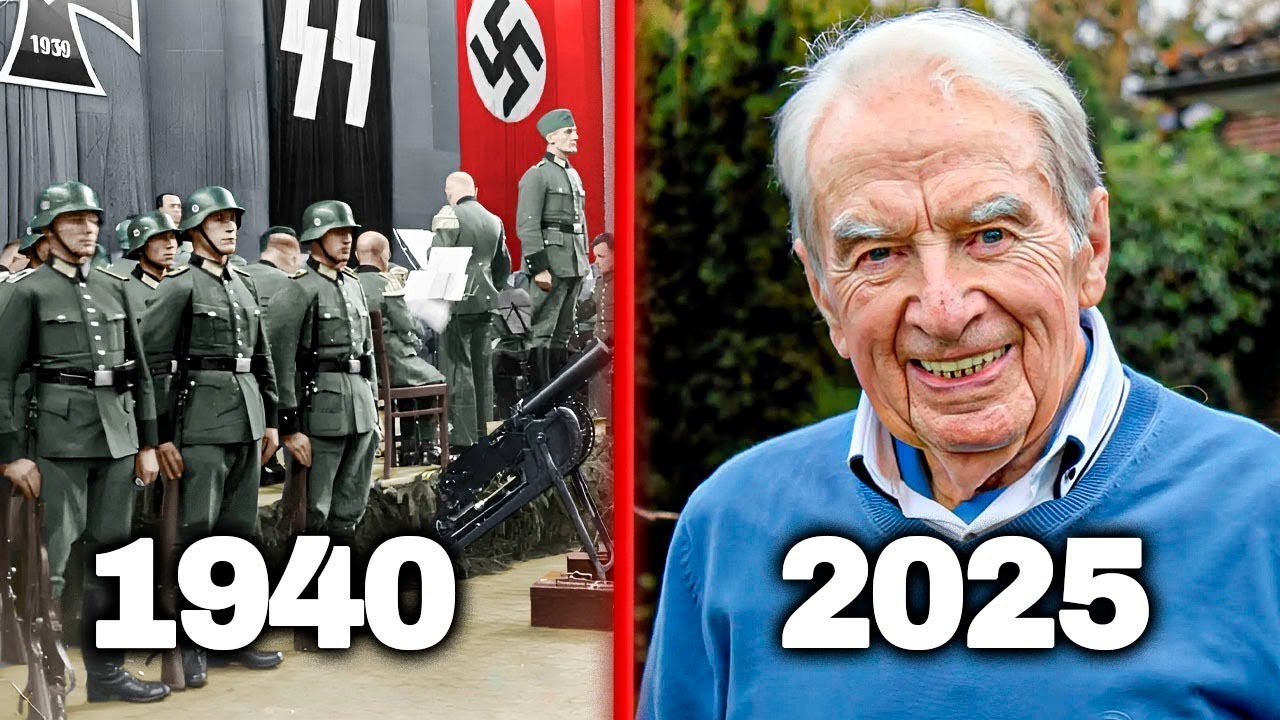 In May 2023, the death of Harder Gersch, a former commander of the first SS Panzer Division Leibstandarte Adolf Hitler, at the age of 103 marked a symbolic threshold. He was among the last high-ranking SS officers alive, and his passing signaled that the generation responsible for history’s most systematic genocide was reaching its final end.
The collapse of the Third Reich in 1945 triggered a desperate scramble among SS members to avoid capture, punishment, and accountability. Some officers briefly hoped that tensions between the Western Allies and the Soviet Union would erupt into open conflict, allowing the Nazi state to survive in some form and continue its war against Bolshevism.
When that hope evaporated, the priority became destroying evidence. Heinrich Himmler ordered that concentration camp prisoners must not fall alive into enemy hands, leading to the infamous death marches that killed thousands in the harsh winter of 1945. Prisoners were forced across frozen terrain without adequate clothing or food, their bodies left along the roadsides of a collapsing Reich.
Admiral Karl Dönitz, Hitler’s designated successor, dismissed Himmler from his posts on May 6, 1945. Days later, Himmler bit into a cyanide capsule while in British custody, choosing suicide over responsibility. Many of his subordinates made the same choice; others were captured by Allied forces, and some escaped to South America and other destinations beyond the reach of European justice.
For the ordinary SS soldier, survival required navigating a chaotic landscape of destroyed railways, bombed bridges, and occupying armies with vastly different rules of engagement. Those with family in rural areas held some hope of returning home; those who had fought in Western Europe prayed to reach relatives in relatively intact cities, while others deliberately sought capture by American or British forces rather than risk falling into Soviet hands.
The Allies, for their part, knew exactly how to identify SS members. Many carried the notorious blood group tattoo, and American divisions forced German prisoners to line up shirtless with their arms raised so that those bearing the mark could be separated. German troops quickly learned to cover the tattoos with makeup or, in extreme cases, cut the skin away entirely.
Lower-ranking soldiers who had joined after 1943 often faced relatively light treatment: internment in prisoner-of-war camps followed by release. High-ranking officers faced intensive interrogation and, in many cases, execution or lengthy imprisonment. The treatment varied dramatically depending on which Allied nation held the captive.
The Soviets routinely executed SS soldiers who attempted to surrender, and entire Waffen-SS divisions were annihilated by the Red Army under such circumstances. Those who survived were subjected to forced labor under conditions that often proved fatal. The Western Allies, by contrast, were known for taking prisoners and pursuing judicial processes, though Canadian brigades in particular developed a reputation for summary execution of SS captives.
Among the most notorious survivors was Otto Gunga, Hitler’s personal adjutant, who received direct orders to ensure the cremation of the Führer’s body after his suicide on April 30, 1945. Gunga carried out the order, wrapping Hitler’s corpse with Eva Braun’s in blankets and supervising the burning in the garden of the Reich Chancellery.
Captured by the Soviets in May 1945, Gunga endured more than a decade of imprisonment and torture in Soviet labor camps. Interrogators demanded to know whether Hitler had truly died or escaped using a body double. Gunga refused to provide the answers they sought and was not released until 1956.
 He never published a memoir, lived quietly in Germany, and died in 2003 at age 86 of cardiac arrest. He maintained until the end that Hitler had shot himself in the right temple, a detail that conflicted with accounts from other bunker witnesses who remembered Gunga telling them the Führer had shot himself in the mouth.
Rochus Misch, Hitler’s bodyguard and telephone operator, was the last living witness to the Nazi regime’s final days. He was born in 1917 in Silesia, orphaned young, and joined the SS in 1937. He was selected for the Führer’s escort command and served throughout the war as a bodyguard, messenger, and telephone operator.
Misch was inside the bunker when Hitler and Eva Braun died, and he was among the first to view their bodies. He was also present when Joseph and Magda Goebbels murdered their own children before taking their own lives. On May 2, 1945, he escaped the bunker but was quickly captured by Red Army soldiers.
After nine years in Soviet prisons, Misch returned to Berlin and opened a home interiors shop, which he ran until retiring in 1985. Unlike Gunga, Misch never showed remorse. He defended Hitler until his death in 2013 at age 96, describing his former boss as a very normal person and a very wonderful boss, and denied that his own daughter’s Jewish ancestry was real.
For those SS veterans who managed to return to German society, the postwar years brought a concerted campaign to rehabilitate their reputation. In 1949, the ban on forming veterans’ associations was lifted, giving rise to the HIAG, the Mutual Aid Association of Former Members of the Waffen-SS, led by Paul Hausser, one of the most senior former Waffen-SS commanders.
The HIAG’s stated goals included camaraderie, legal assistance, and support for families, but its real mission was the rehabilitation of the Waffen-SS as an honorable military force distinct from the criminal SS apparatus. The organization demanded that its members receive the same war pensions and legal status as regular Wehrmacht soldiers.
The campaign enjoyed some success. In 1953, West German Chancellor Konrad Adenauer described Waffen-SS members as soldiers just like everyone else. The Allied powers, increasingly focused on the emerging Cold War, proved receptive to arguments that Germany’s military tradition should be restored as a bulwark against Soviet communism.
In 1951, Dwight Eisenhower issued a public statement proposing to distinguish between regular soldiers and the criminal group around Hitler, a move that SS veterans interpreted as vindication. Some Wehrmacht officers received war pensions that year, though SS members remained excluded, still classified as part of a criminal organization.
The HIAG’s public events drew substantial crowds. A 1952 gathering in Verden attracted mass attendance, but the organization’s carefully cultivated image was damaged when a convicted war criminal, Hermann Bernhard Ramcke, declared that the real war criminals were the Western Allies and that the blacklist of former SS members would soon become an honor roll. American newspapers ran headlines about Hitler’s guards celebrating their former chief.
 Despite such controversies, the HIAG maintained political connections with both major German parties and successfully lobbied for amnesty and the release of war criminals. It published periodicals, organized commemorations at cemeteries, and mourned executed war criminals annually. By 1959, more than 15,000 people attended gatherings at Hamelin Cemetery.
The organization also provided support and social networks for convicted war criminals, welcoming figures like Walter Reder, responsible for Italian massacres, and Herbert Kappler, perpetrator of the Ardeatine massacre. Historians later concluded that the HIAG’s statements were anti-Semitic and anti-democratic, showing no repentance and continuing to spread Nazi ideology.
Parallel to the HIAG operated Stille Hilfe, or Silent Aid, a network founded by Princess Helene Elisabeth von Isenburg to support former SS members who were detained, convicted, or on the run. The organization helped notorious war criminals including Adolf Eichmann, Johannes von Leers, Walter Rauff, and Josef Mengele escape to South America.
Gudrun Burwitz, Heinrich Himmler’s daughter, joined Stille Hilfe in 1951 and became one of its most prominent figures. Known as the Nazi princess, she publicly denied the Holocaust and worked for decades to support imprisoned war criminals. She died in 2018, maintaining her father’s legacy to the end.
The escape networks were effective. Alois Brunner, a close associate of Eichmann who organized deportations from Vienna, Greece, Slovakia, and France, fled to Egypt and then Syria, where he reportedly advised the regime of Hafez al-Assad on torture and repression techniques. Despite extensive efforts by Nazi hunters, Brunner never faced justice and reportedly died in Damascus in 2001.
Other SS veterans integrated into Western societies with astonishing ease. Friedrich Peter, who served in an Einsatzkommando unit responsible for murdering at least 17,000 Jews and 25,000 Soviet prisoners of war, became a school principal and later led the Freedom Party of Austria, serving as a member of parliament and negotiating with the Social Democratic Party.
Peter’s past was 𝓮𝔁𝓹𝓸𝓼𝓮𝓭 in 1975 by Simon Wiesenthal, but Austrian Chancellor Bruno Kreisky, himself a Holocaust survivor, defended Peter fiercely. Peter served as a member of the board of the national broadcaster and remained influential in Austrian politics until his death in 2005, having outlived the exposure of his crimes.
Helmut Oberlander, an ethnic German from Ukraine who served as an interpreter for Einsatzkommando 10a, immigrated to Canada in 1954 and built a successful construction business in Ontario. He obtained citizenship in 1960, and for decades the Canadian government fought to strip him of it based on his wartime service with a death squad responsible for more than two million deaths.
Oberlander’s case dragged through the courts for more than two decades, with citizenship revoked and restored repeatedly. He died in 2021 at age 97, still in Canada, having never been deported to Germany where he faced prosecution. His case illustrated the extraordinary difficulty of pursuing justice against these men decades after their crimes.
 Even when justice was achieved, it often came too late. Oskar Gröning, the so-called accountant of Auschwitz, spent decades as a bank clerk in Germany before coming forward publicly to condemn Holocaust denial. His testimony that he had witnessed the gas chambers, the cremations, and the selection process brought him to trial in 2015, at age 93.
Gröning was convicted as an accessory to at least 300,000 murders and sentenced to four years in prison. He died in 2018 at age 96 before his sentence could begin. His case was celebrated as proof that accountability could still be pursued, but it also showed how close the window had come to closing entirely.
Karl Hoecker, an adjutant at Auschwitz and Majdanek, denied involvement in selections despite evidence linking him to the ramp where victims were chosen. He was sentenced to seven years in prison and released in 1970, returning to his job as a bank cashier. His photo album, which surfaced in 2006, provided chilling documentation of camp life among the perpetrators.
The evidence against many of these men was available for decades, but the political will to prosecute them faded during the early Cold War. The HIAG and Stille Hilfe successfully lobbied for amnesty and rehabilitation, while the need to rebuild West Germany as an ally against the Soviet Union tempered the pursuit of justice.
By the time the pursuit resumed in earnest, many of the accused were too old to stand trial or too close to death to be punished. The German legal system required proof of individual involvement in murder, not just service in an organization that carried out genocide, making convictions difficult even where culpability was clear.
Some former SS members who were not caught by the Allies or the Soviets simply disappeared. The HIAG maintained a tracking service that attempted to locate more than 40,000 Waffen-SS members missing in action. Many used false identities, and others were sheltered by networks that extended across the Atlantic.
Today, as the last surviving SS veterans approach the end of their lives, the question is not whether they will face justice, but whether their histories will be accurately recorded. With each death, primary sources for understanding the Nazi era disappear, leaving historians to rely on documents, photographs, and the testimony of those who witnessed their crimes.
The cases of Gunga, Misch, Gröning, Oberlander, and Brunner illustrate the uneven application of justice in the postwar period. Some SS men spent years in Soviet labor camps, some escaped to sympathetic regimes in the Middle East and South America, and some simply resumed their careers in Germany and Austria, their wartime pasts remaining unexamined for decades.
As 2025 marks the 80th anniversary of the end of the Second World War, fewer and fewer living witnesses remain to testify about what happened. The last SS veterans are centenarians now, mostly silent, scattered across countries that once fought against them or that welcomed them as refugees.
Their deaths will not bring closure to the victims or their descendants, but they will mark the end of a generation that chose, in many cases, to carry its secrets to the grave without apology or acknowledgment.