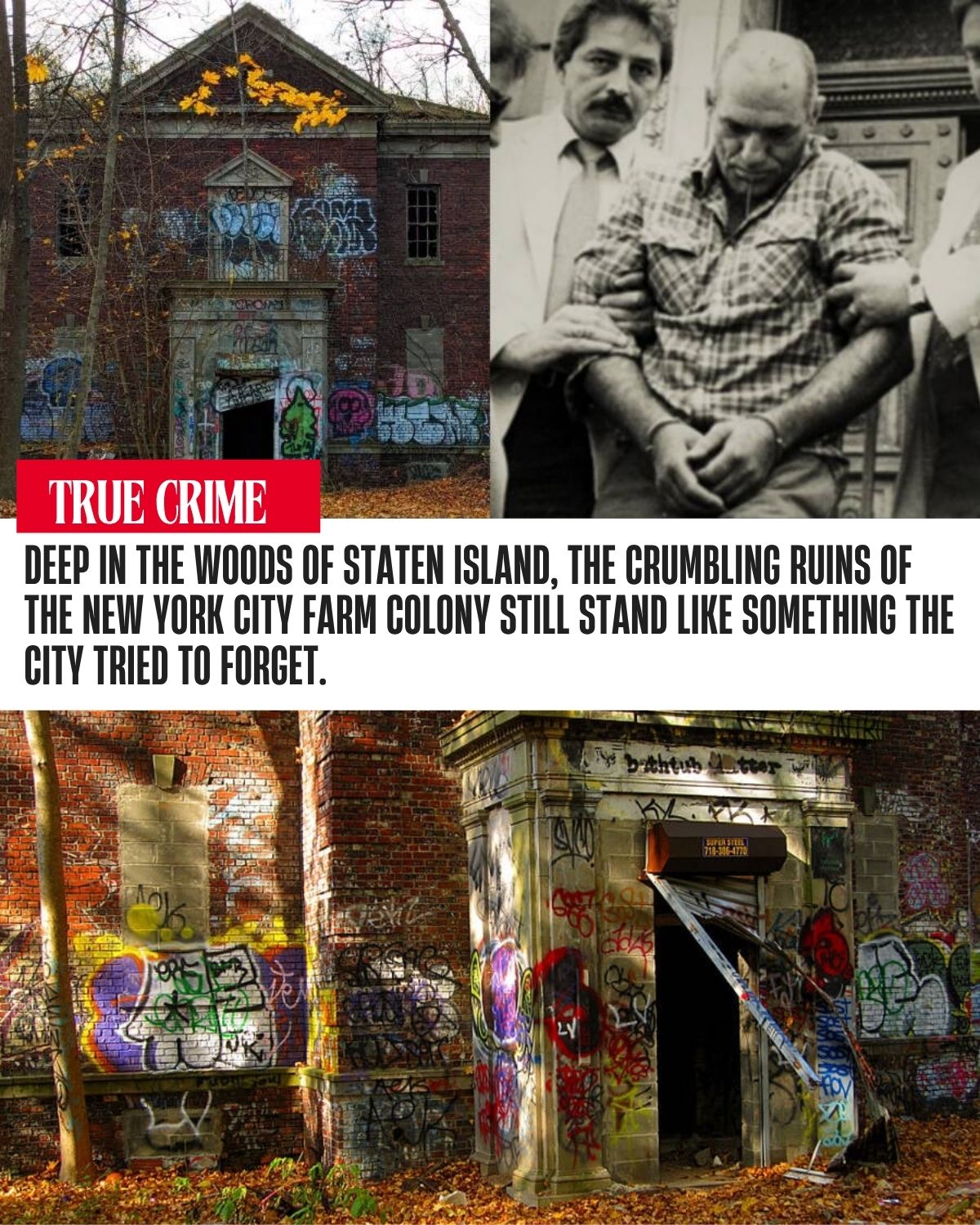
Hidden deep within the woods of Staten Island, the crumbling remains of the New York City Farm Colony still stand as one of the city’s most haunting abandoned sites. Once built as a place of shelter for poor, elderly, and vulnerable New Yorkers, the former institution is now a landscape of broken windows, collapsing brick walls, graffiti-covered corridors, and dangerous ruins.

At first glance, the abandoned complex looks like another forgotten relic of old New York. But behind its decaying buildings lies a history that stretches from 19th-century social reform to urban legend, mysterious disappearances, and one of Staten Island’s most chilling criminal cases.
Today, the New York City Farm Colony is remembered not only for its original mission as a poor farm and hospital, but also for its eerie connection to the Cropsey legend and convicted child killer Andre Rand.

A Poor Farm Built to Shelter New York’s Vulnerable
The New York City Farm Colony was first established in 1830 as the new Richmond County Poor Farm. At the time, poor farms were created to house people who had nowhere else to go. In exchange for food and shelter, residents worked on the land and helped support the institution.
Originally made up of farmhouses, the site was intended to serve society’s most vulnerable residents. Over time, the complex expanded to include a cholera hospital and housing for people described at the time as mentally ill.
After Staten Island became part of New York City in 1898, the institution became known as the New York City Farm Colony. In 1915, it merged with the nearby Seaview Hospital, strengthening its role as a major public welfare and medical site.
The original farmhouses were gradually replaced with large brick buildings designed in the Dutch Colonial style. Historic photos show orderly, well-maintained structures standing along quiet roads, far removed from the dangerous ruins that exist today.
A Once-Thriving Institution
During the early 20th century, the New York City Farm Colony was considered a successful public institution. It housed people facing poverty, disability, illness, and old age, including residents with conditions such as epilepsy, blindness, and deafness.
Despite its difficult mission, the colony became productive. Its residents reportedly grew enough food to support both themselves and other city-run institutions.
Its population grew steadily. What began with a few hundred residents expanded to around 800 people in the 1910s, then about 1,400 in the 1930s. By the 1940s, the Farm Colony reached its peak, with approximately 1,700 residents living on the grounds.
But by the middle of the 20th century, the institution began to decline.
Decline, Abandonment, and Decay
Several changes contributed to the downfall of the New York City Farm Colony. As social security and public assistance programs expanded, able-bodied residents had more options and no longer needed to remain at the site. Over time, the population became increasingly elderly and dependent on institutional care.
As residents left or aged, the buildings began to deteriorate. The once-grand complex slowly lost its purpose and structure. By 1975, the New York City Farm Colony was abandoned for good.
In the decades that followed, the site fell into severe disrepair. Nature began reclaiming the grounds, while vandals, graffiti artists, and urban explorers entered the buildings despite warnings and restrictions. Today, many of the remaining structures are unstable, with exposed elevator shafts, broken glass, toxic dust, mold, and collapsing stairwells.
Though a 1985 landmark ordinance helped prevent the site from being demolished, it did not restore the property. As a result, the Farm Colony remains one of the largest concentrations of abandoned buildings in New York City.
Dark Stories Behind the Ruins
Although the New York City Farm Colony began with a humanitarian mission, darker stories have long surrounded the site. Reports have described overcrowding and poor conditions during parts of its operation. Its staff also allegedly included troubled figures, including notorious bank robber Willie Sutton.
One of the most disturbing stories connected to the grounds involves a young boy who reportedly disappeared in the 1920s after being seen walking into the woods near the Farm Colony with an older man. The incident helped fuel local fears and contributed to the legend of Cropsey, a Staten Island boogeyman said to haunt the area.
For generations of Staten Island children, Cropsey was a frightening figure whispered about in neighborhoods and schoolyards. But in the 1980s, that urban legend became uncomfortably close to reality.
The Andre Rand Connection
In the 1980s, several children on Staten Island disappeared, intensifying public fear around the abandoned institutions and wooded areas nearby.
One of the most widely known cases involved 12-year-old Jennifer Schweiger, a girl with Down syndrome who disappeared and was later found buried in a shallow grave near the defunct Willowbrook State School, close to the ruins of the New York City Farm Colony.
Andre Rand, a convicted sex offender, was later charged in connection with Schweiger’s kidnapping and murder. He has also been suspected in other child disappearances, though not all allegations resulted in convictions.
Because of Rand’s crimes and the proximity of the Farm Colony to other abandoned institutions, the site became closely tied to Staten Island’s darkest legends. For many, the ruins were no longer just an abandoned poorhouse. They became part of a larger story about fear, disappearance, and the thin line between folklore and real danger.
The Farm Colony Today
Today, the New York City Farm Colony remains closed to the public. Although its buildings still attract urban explorers and curious visitors, entering the site is dangerous and prohibited. The ruins contain unstable floors, open shafts, broken glass, mold, and other hazards common to long-abandoned structures.
A redevelopment plan was approved in 2016 to transform part of the site into housing, including apartments and condominiums. However, years later, much of the property still remains vacant and decaying.
Even in ruin, the Farm Colony’s architecture hints at its once-important role in New York’s public welfare system. The brick structures, though scarred by graffiti and weathered by time, still suggest the scale and ambition of the institution that once stood there.

A Haunting Reminder of New York’s Forgotten Past
The New York City Farm Colony is more than an abandoned site. It is a reminder of how New York once attempted to care for its poor, sick, elderly, and disabled residents through large public institutions. It is also a place where history, neglect, crime, and urban legend have become deeply intertwined.
Its story began with an idea of shelter and service. It ended in abandonment, decay, and fear.
Today, the ruins remain hidden among the trees of Staten Island, standing as one of New York City’s most unsettling forgotten landmarks. They tell a story not only of poverty and public welfare, but also of how places built for protection can become, over time, symbols of danger, mystery, and loss.