Seven days of unrelenting rain. No sun, no pause, just a constant, hammering deluge that turns the world to mud and the air to a cold, wet blanket. For us, it is a minor inconvenience, a reason to cancel plans and binge-watch shows.
But strip away the modern comforts, the insulated walls, the reliable heating, the twenty-four-hour grocery delivery, and the same seven days becomes a brutal, unforgiving test of survival. The ancient struggle against the elements is not a matter of mere discomfort; it is a fight against a multifaceted foe that attacks the body, the mind, and the social fabric of a group, and the lessons learned from this primordial battle still echo in our daily lives.
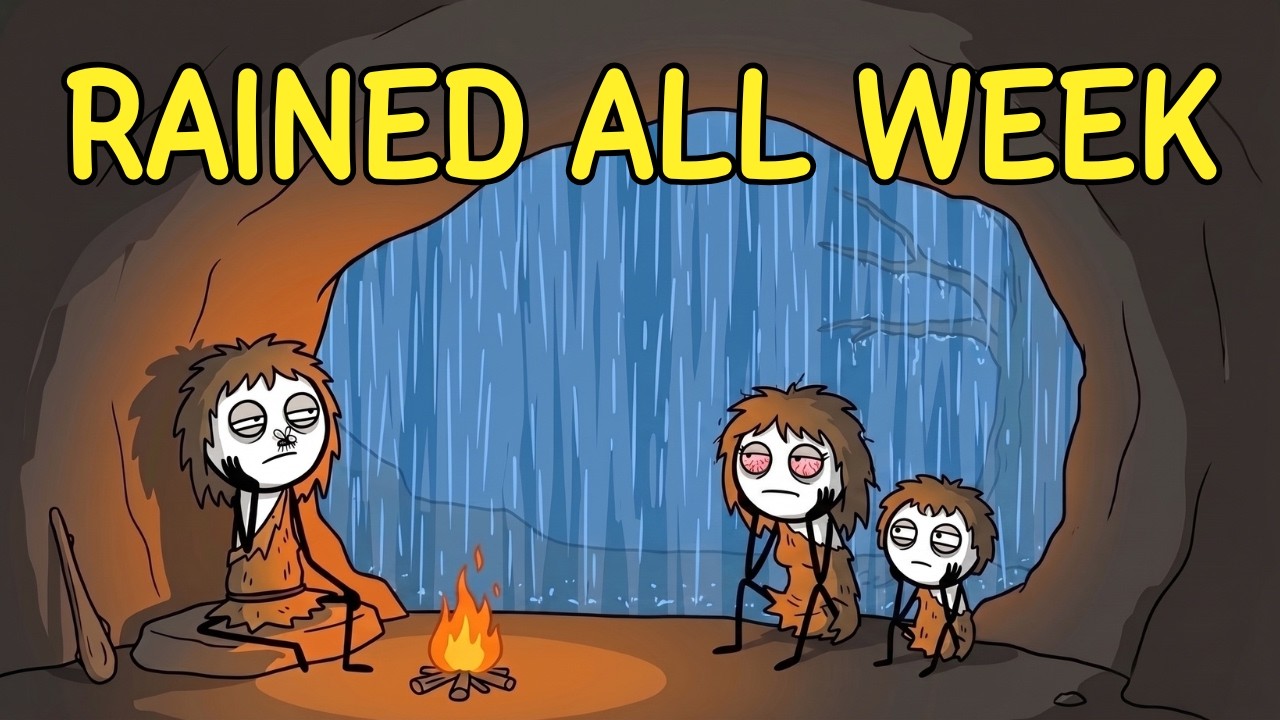 This is not a scenario of drowning. The water itself, in its liquid form, is not the direct killer. The true enemy is the mechanism of heat loss.
A soaked pelt, a dripping cloak, or just skin that has been wet for hours, loses heat exponentially faster than a dry one when met with even a mild wind. It is a pathway to hypothermia, a silent death in weather that never even approaches freezing. The rain initiates a cascade of challenges, a four-pronged attack that our ancestors had to outsmart, not with brute force, but with unyielding foresight and communal cooperation.
The first casualty is the center of their material world: the fire.
Fire is the universal life force, the anchor of human existence. It cooks, it purifies, it dries, and it keeps the fear and the predators at bay. Yet, fire is also fragile, and water is its ancient, elemental nemesis.
A single downpour floods a hearth, extinguishing its flame in minutes. Wet wood refuses to catch. The most critical creation of human ingenuity can be ended with a simple splash of rain.
This is why, for most of human history, the goal was not to start a fire, but to never let one stop. The flame was a living creature that had to be fed, guarded, and protected in a world that was often hostile to its existence.
This protection demanded ritual and diligence. We know that fire was so precious that people developed elaborate preservation systems. They stocked dry tinder, shaved bark, and dried fungus, long before the first cloud appeared.
This material, wrapped in a skin and kept close to the body, was their most valuable possession. The desperation and foresight to protect fire is proven by the discovery of the “Iceman” in the Alps, a man who died 5,000 years ago and was preserved in ice. His gear was still carrying a fire kit, a piece of dry fungus, and a striking stone.
This single artifact is a testament to a universal, millennia-long obsession: never be caught without the ability to create light and heat. But after securing the flame, the next enemy is the one you can’t control: your own physiology.
The second attack wave arrives in the form of a cold, wet draft. The fight is not to get warm, but to stay dry. The first line of defense is finding shelter.
For hundreds of thousands of years, the most valuable asset a group could own was the open mouth of a cave, a rock overhang that kept out the rain. These weren’t just campsites; they were properties prime, and evidence exists of the same cave properties being used for hundreds of generations, with hearth layering on top of old hearth, and debris of stone flakes telling a story of continued habitation. But there was never enough stone for everyone.
 So, human inventiveness took flight. They built roofs from frameworks of bone and wood, covering them with animal hides that were treated with fat and grease to repel water, effectively making sessile raincoats. A dry body, in a dry shelter, was a significant step.
But a dry body still needs energy, and that is the third wave.
The third enemy is starvation. The weather that was 𝓀𝒾𝓁𝓁 you also hides the food. Animals hide, plants are soaked and scattered, and rivers become raging, dangerous torrents.
Every venture outside is a venture that risks a fatal loss of body heat. So, for a week, the entire camp is burning energy but consuming very little. This is a fatal collapse if you wait, the crisis hits you unprepared.
This is where humans earned their stripes. They used the resources when they were good. They didn’t eat everything in one day.
They dried meat in the sun, smoked the skin to 𝓀𝒾𝓁𝓁 bacteria, rendered fat for sustenance, and buried food in the frozen ground to preserve it, hide it from scavengers. They created a strategic stockpile of food in the back of the cave. This is a direct look at a concept that is uniquely human: anticipating a future you cannot yet see.
A squirrel gathers because of instinct, but we gather with purpose. We close our eyes and picture a scenario. The rain punishes the day when the sun shone.
It punished the one who lived only for today.
The final enemy is the most insidious one. The fourth wave is not a physical threat, but a temporal one. It is the enemy of time itself.
Six days of confinement, stuck in a corner, with nothing to do but stare at the same faces and the same, wet, gray sky. This leads to a modern phenomenon we call “cabin fever.” But boredom is not a symptom of being bored; it is a dangerous cocktail of psychological stress.
 In a group of hunters, you need every single member. A fight that splits the camp could be as deadly as the cold because a group of help is most vulnerable when it is separated. So, how did they manage?
They found an outlet, they found the one thing that could be done in a dark cave with only a lamp, which is you pick up a stone and you start to create.
We see this exact answer in every piece of the oldest art on Earth. Much of it is found deep in the blackness of caves, not in the well-lit entrance. This work implies they had time, they had light.
They made lamps from that Fat and a piece of rock, and they went deep into the earth to paint and to carve. Over thousands of years, the damp ground is covered with tiny stone chips, the debris, the “distance” of tool-making, evidence of a constant, focused craft. This came from the pressure cooker of the rainy season.
You grind pigments, you sew hides with bone needles to make waterproof clothes, and most importantly, you make string. String is the undiscovered hero of human civilization. It binds a blade aa to a handle, it raises a shelter, it sets a trap, and all of this complex technology starts with a simple twist of plant fiber.
It appears that the first string was a product of necessity, a string that could hold things together, created by someone trapped inside, waiting to hunt again. And the most powerful thing was the final one.
But perhaps the most powerful tool was not physical but entirely social and cognitive. That is the power of talk. When you are trapped with a group for a week, you eventually stop talking about the immediate struggle, and you start, intensely, into the past.
You speak of the distant times, of myths, of the geographical details of where water can be found in a drought, and you encode the knowledge of the group into a long, spoken narrative. The most astonishing fact is that these stories are not just stories. Some of them, Told and retold for 7,000 years, encode the memory of ancient coastlines that drowned at the end of the ice age.
They have passed from grandparent to grandchild, across continents, and they preserve actual geological events. This oral tradition was not just a nice thing; it was a survival manual that kept you alive through the ta, and it was passed down during the rainy season. It was a thousand-year-old data storage system, the cloud, and it was updated by voices in the firelight.
The rain finally stops. The sun breaks through. And the world that emerges is the most magical and productive time of the year.
 The ground is the track pad of the world, a soft, damp surface where every animal that moves leaves a perfectly crisp tracks, unmissable for a hunter. The plants and msg tips shoot up overnight. The water sits in fresh, clear pockets in the rocks.
In warmer climates, the termites swarm. The termite, a soft, wriggling blob of protein, is a feast that requires no hunting. The climate, the rain will anger at you, on its way to leave you a feast.
The rain that threatened to 𝓀𝒾𝓁𝓁 you has prepared a bounty for you. The resilience of the human race is not a single invention; it is all the pieces. It is in the fire that was kept, the roof, the food.
It is an integrated system.
Every single piece of that system is a template for the future. The rain was a perfect test. A lion is a problem you must solve in the moment.
But a week of rain is a problem you solve a week in advance. The potential to survey the sky and predict, to prepare, to store, and to design, is the defining characteristic of a species. It is the very same blueprint that makes a modern house.
You don’t rely on our bodies; you rely on your thinking. The future is not spoken, you plan for it. We are so comfortable today that we often forget that the white wall of the city, the basic ability to heat water for a shower, is the result of a cultural memory that has been waiting for it.
When you get your warm, dry house and, shut the door and the beat, the flane hearts that warm you, the insulation, the ledge that shields you, they are all connected to the great ancestors. The solution was not in the storm, but in the calm before. The entire trajectory of human progress can be seen in this simple line: A week of rain didn’t just get survived, it taught a hungry, restless animal to look at a brilliant blue sky and prepare for a storm it could not yet see.
The weather, in its most destructive form, is the undeniable reason we’re still here to talk about it, because it will be taught us to think about tomorrow, to put effort into a future we cannot touch. It forged the very act of planning. The eyes of the steady raindrops on the roof are not simply the sound of water, but the ancient echo of the first battles won against the relentless march of time, thriller, and fear.