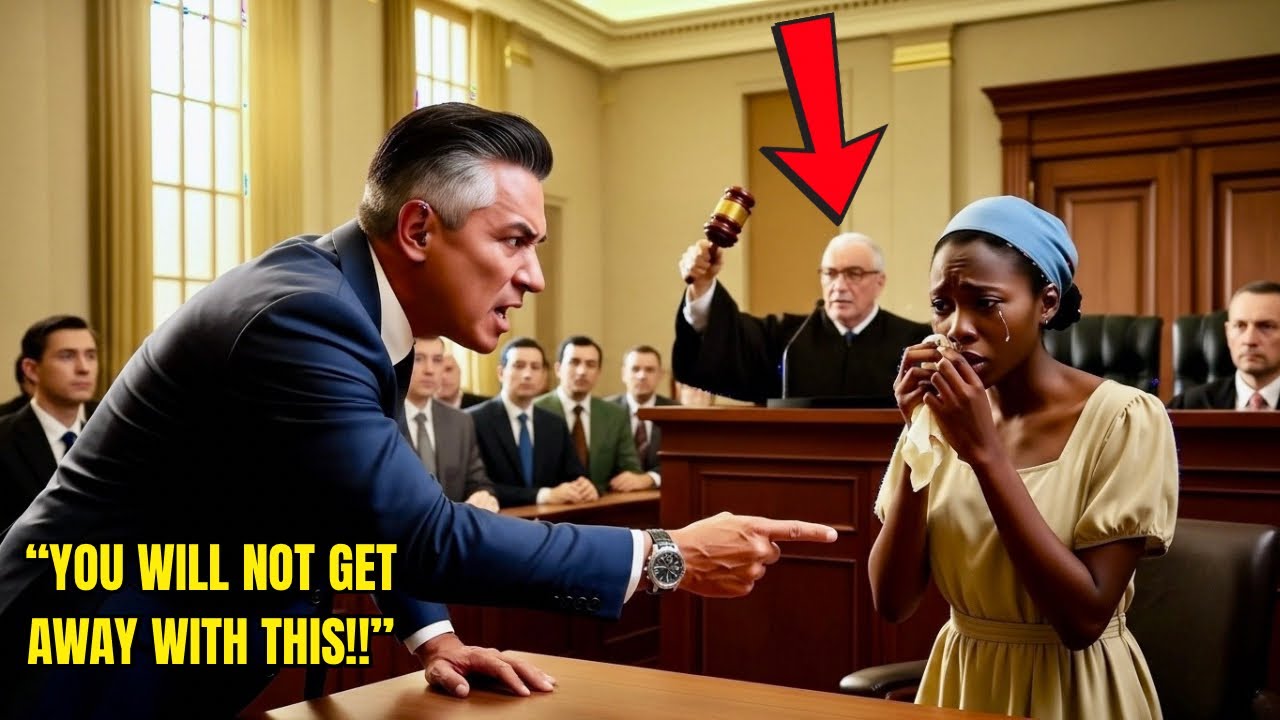
“If that pile of scrap metal can beat my Ferrari, I’ll transfer the entire company to you. ”
The crowd roared. Three hundred people packed the showcase hall, and Preston Holloway grinned into the microphone, pointing straight at Isaac. He walked toward him, his smile twisting into disgust.
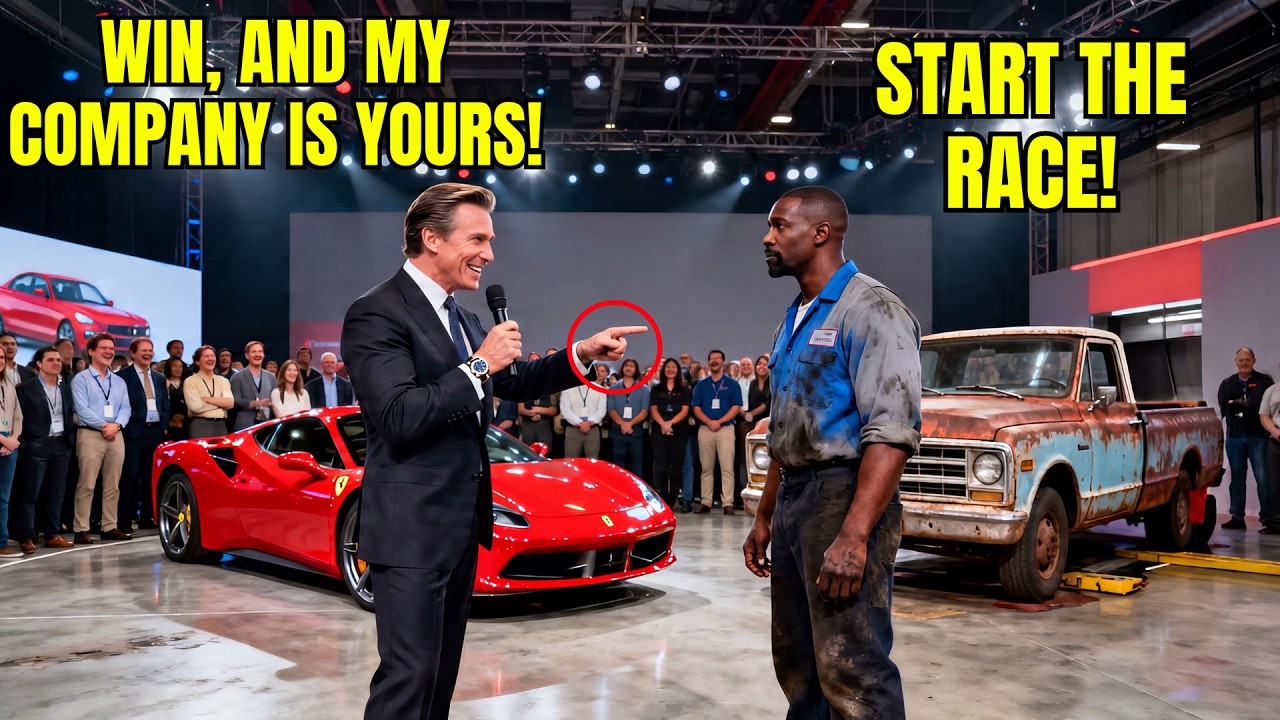
“Look at you—grease-covered face. You smell like a cockroach crawling in my display case. ”
“I’m just here to keep your machines running, sir. ”
“My machines.
You can barely keep that rust bucket alive. ”
“It’s a special car, sir. ”
“Oh, really? A gutter comparing itself to the ocean.
How ridiculous. ”
The whole room laughed at Isaac. He didn’t move. He didn’t blink.
“That’s all right, sir. Rust and cockroaches—harder to kill than you think. ”
Nobody knew what lived under that rusted hood. But they were about to learn the most expensive lesson of their lives.
Isaac Crawford arrived at Apex Dynamics every morning at 5:45—fifteen minutes before the lights clicked on, forty-five minutes before anyone in a suit thought about coffee. He parked in the loading bay, not by choice. Contract workers weren’t allowed in the main lot. That space was reserved for people with real badges.
Badges with names and photos. Isaac’s badge was a barcode. No photo, no name. Just a number scanned at the gate like a shipping label.
The guard never looked up when he swiped it. Apex Dynamics had two worlds. Upstairs: the corporate tower, glass walls, Italian leather chairs, air that smelled like nothing. Preston Holloway’s corner office overlooked Midtown Atlanta like a throne room above a kingdom.
Downstairs: the manufacturing floor, concrete, steel, fluorescent lights buzzing like trapped flies, the smell of machine oil and scorched metal. Robotic arms cycling through their sequences. Pick, weld, place, repeat. This was Isaac’s world.
Line four—the oldest production line in the building. Nobody wanted to maintain it because the parts were outdated and the manuals had missing pages. Isaac didn’t need manuals. He could hear a misaligned bearing inside a sealed gearbox from six feet away.
He could feel a voltage irregularity through a servo motor just by pressing his palm against it. The machine spoke to him in a language no degree could teach. But to Apex Dynamics, he was invisible. A barcode that showed up early and left late.
The disrespect didn’t come all at once. It came in a slow, steady drip—the kind that wears a hole through stone. The first drop fell on a Monday. Isaac found a critical alignment flaw in a new robotic arm prototype.
The wrist actuator pulled 0. 3 degrees left on every rotation—invisible to the eye, catastrophic over 10,000 repetitions. He documented everything: measurements, photographs, a full analysis, a manufacturing burr inside the reduction gear creating asymmetric friction. He submitted the report through the company system, properly filed, timestamped, his name right at the top.
Thursday morning, conference room B, weekly engineering review. Tommy Bridges—29, blonde, Preston’s handpicked protégé—stood at the front. On the screen behind him: Isaac’s report, word for word, diagram for diagram. But the name at the top had changed.
Tommy Bridges. Senior Associate Engineer. “Great catch, Tommy,” Preston said from the head of the table. “This is the initiative that separates leaders from laborers.
”
Isaac watched through the glass door. Contract workers didn’t attend engineering reviews. He saw his own words on that screen. He saw Tommy shaking Preston’s hand.
He turned and walked back to line four. Ray Whitfield caught him near the tool cage that afternoon. “I saw what happened,” Ray said quietly. “I know.
”
“I could say something. ”
“To who? Ray—the man who just shook his hand? ”
Ray went silent.
They both knew. The second drop hit harder. A delegation of German investors visited Apex Dynamics for a facility tour. Preston wanted perfection: the lobby polished to a mirror, fresh flowers on every desk, a string quartet in the atrium.
Isaac was heading to line four through the main corridor when two security guards blocked him. “Contract workers. Use the freight elevator. You know the policy.
”
“The freight elevator is down. I filed the report myself. ”
“Then wait. ”
The investors stood twenty feet away, watching.
Preston walked past at that exact moment. He saw Isaac, saw the guards, saw the investors staring. He didn’t stop. “Rules exist for a reason,” he said, loud enough for every ear in the corridor.
“We can’t have people wandering where they don’t belong. ”
One investor shifted uncomfortably. Nobody said a word. Isaac took the stairs.
Eleven flights. Tommy Bridges was waiting at line four, leaning against the railing, smirking. “Rough commute? ”
Isaac said nothing.
Reached for his tools. “You know what your problem is? ” Tommy stepped closer. “You don’t know your place.
Guys like you—decent with your hands, but that’s the ceiling. You’ll never be more than a pair of hands. ”
Isaac tightened a bolt. Steady, measured.
“Hands are enough,” he said. Tommy snorted. “Sure, buddy. Whatever helps you sleep.
”
The third drop almost cracked the stone. Friday night, 11:47 p. m. Isaac was the only technician on the floor.
The main servo controller on line four suffered a cascading failure. Three robotic arms locked mid-cycle. Alarm sirens screamed. Red lights spun across the ceiling.
If the line stayed down past midnight, Apex would miss a $2. 3 million deadline for their largest automotive client. Isaac worked four hours and thirteen minutes. No break, no backup.
He isolated the failed controller, bypassed corrupted firmware, rerouted power distribution, and recalibrated all three arms by hand, one by one, in near darkness. The emergency had killed the overhead lights on the east side. He used a flashlight clamped between his teeth. By 4:02 a.
m. , line four was running. The deadline met. $2.
3 million saved by one man in the dark with a flashlight in his mouth. Monday morning, the incident report landed on every manager’s desk. Isaac read his copy by the coffee machine on the manufacturing floor—the one with the cracked pot nobody from corporate ever fixed. The report credited the overnight maintenance team.
No name. No mention of four solo hours. No mention of the flashlight. Ray Whitfield found him in the tool cage.
“I wrote your name in the original draft,” Ray whispered. “Somebody upstairs pulled it out. ”
Isaac folded the report and slid it into his back pocket. He didn’t say another word about it.
Not that day, not that week. But he kept it. He kept every single one. Three weeks after the showcase—three weeks after Preston called him a cockroach in front of three hundred people—Apex Dynamics received the news every executive had been chasing.
The Pentagon shortlisted the company for a $120 million contract: Precision Robotic Assembly Arms for Military Drone Manufacturing. A live demonstration was scheduled in four weeks. Six evaluators would visit: three officers, two civilian engineers, one procurement director. This was Preston Holloway’s white whale.
The contract that would carve his name into every trade journal in the country. He spared nothing. Two outside consultants were hired: Dr. Alan Marsh from MIT and Gregory Dunn from Carnegie Mellon.
Combined fee: $280,000. They arrived with matching blazers and matching confidence. Isaac watched them from the far end of the calibration lab. He listened to them outline their approach—stress parameters, resonance tolerances, calibration sequences.
Within twenty minutes, he spotted three fundamental errors in their methodology. The servo motors they planned to use—a cheaper model Preston approved to save $18,000—oscillated at a frequency that would clash destructively with the original gearbox housings. Isaac had flagged this exact problem in the report Tommy stole. He said nothing.
Not yet. Two weeks before the Pentagon visit, the first prototype arm failed during a stress test. The sound was sickening—metal shrieking against metal, a whine so sharp every technician covered his ears. Then a crack loud as a gunshot.
The arm ripped itself apart. Gears scattered across concrete. Sparks rained from the ceiling. Dr.
Marsh and Gregory Dunn stood frozen beside the wreckage. Preston stormed onto the floor fourteen minutes later, tie loose, face red. He demanded to know who was responsible. The consultants stammered: material fatigue, vendor defects, testing anomalies—expensive words that explained nothing.
Isaac stood thirty feet away, replacing a cable housing on line four. Close enough to hear every hollow excuse. Close enough to smell the burnt lubricant from the destroyed arm. He knew exactly what had gone wrong.
The resonance frequency mismatch between the cheap new servos and the old gearbox housings. The very flaw he had documented, reported, and watched someone else take credit for. He could have walked over right then. Could have explained the problem in thirty seconds flat.
Could have saved this company months of chaos. But he thought about the stolen report. The erased name. The freight elevator.
The word cockroach. And he stayed exactly where he was. One week later, the second prototype failed. Different symptoms, same root cause.
This time, the arm didn’t just break—it seized violently mid-cycle, bent its own mounting bracket, and cracked the steel platform bolted to the floor. Two technicians nearby dove behind a workbench. Shrapnel pinged off the safety barrier like shattered glass. Dr.
Marsh and Gregory Dunn resigned the next morning. They cited insufficient infrastructure and unforeseen material incompatibilities. Translation: they had no idea what was wrong and didn’t want their reputations attached to the wreckage. Their $280,000 in consulting fees walked out the door with them.
Preston didn’t even try to stop them. Preston Holloway stood in the middle of the manufacturing floor that afternoon, surrounded by wreckage and silence, the faint smell of burnt metal still hanging in the air. Two destroyed prototype arms. No consultants.
No backup plan. A $120 million contract slipping through his fingers like water. Four weeks shrunk to two. He called an emergency all-hands meeting on the manufacturing floor.
Every engineer, every technician, every contract worker. Fifty people standing in a half-circle around the wreckage of what was supposed to be Apex Dynamics’ future. Preston paced in front of them. His voice was sharp.
His patience was gone. “I want solutions. Not excuses, not theories. Solutions.
Whoever fixes this—name your price. ”
He looked around the room. Engineer after engineer looked down at their shoes. Nobody volunteered.
The silence was deafening. And in the back of that half-circle, standing where he always stood, behind everyone else, below everyone else, Isaac Crawford wiped his hands on a rag and waited. Something in Preston’s expression shifted. Not respect.
Something closer to desperation. What Isaac did next changed everything. But to understand why, you need to know where those hands first learned to speak. Isaac Crawford was nine years old when he learned that machines could kill.
His mother worked the morning shift at a packaging plant outside Baton Rouge, Louisiana. His father worked the evening shift at the same facility. They overlapped for eleven minutes every afternoon in the parking lot—just long enough to trade car keys and kiss goodbye. On a Tuesday in October, a faulty hydraulic press on the east production line failed during a cycle reset.
The safety interlock had been broken for two weeks. Management knew. They hadn’t fixed it. Both of Isaac’s parents were on the floor when the press came down.
He moved in with his grandmother, Eloise Crawford, a seamstress who lived in a shotgun house on a dirt road three miles from the nearest paved street. She made her living hemming church dresses and patching work pants. When the neighbors’ appliances broke—toasters, box fans, window units—they brought them to Eloise. Not because she could fix them, but because she charged less than throwing them away.
Eloise couldn’t fix engines, but she understood broken things better than anyone Isaac ever met. She would sit at her sewing table, hold a torn dress up to the light, and say the same thing every time. “Everything broken has a logic to its breaking. Find the logic, and you find the fix.
”
Isaac applied that principle to everything with moving parts. By ten, he was taking apart the neighbors’ broken box fans and putting them back together. By twelve, he was rebuilding lawnmower engines in the backyard for ten dollars each. By fourteen, he could diagnose a carburetor problem by sound alone—the way a piano tuner hears a note that’s a quarter tone flat.
He never went to college. Couldn’t afford it. The guidance counselor at his high school told him trade school was his best option. Isaac didn’t argue.
He just kept working. Library books became his textbooks. Junkyards became his laboratory. Trial and error became his curriculum.
By eighteen, people across three parishes knew his name. The kid who could fix anything mechanical. Eloise got sick when Isaac was twenty-one. Cancer—the kind that doesn’t negotiate.
She spent her last months in the same shotgun house, in the same bed where she’d sewn ten thousand hems. Isaac drove home from Atlanta every Friday night and back every Monday morning—six hours each way. He never missed a single weekend. On her last night, Eloise reached for his hands.
She held them up in the lamplight. Grease under every nail. Scars across both palms. Calluses so thick they looked like leather.
“Hands don’t lie,” she said. “Show them what your hands can do, and the mouth won’t matter. ”
She died the next morning. Isaac buried her beside his parents in a cemetery with no headstones—just small metal markers pushed into the red Louisiana dirt.
He carried her words with him every day after that. They became his compass, his shield, his excuse not to fight back. Hands don’t lie. Show them what your hands can do.
Don’t argue. Don’t explain. Don’t defend. Just build.
Just fix. Let the work speak. But silence has a cost. When you swallow your pride long enough, people start to believe you don’t have any.
Isaac had been quiet for so long that the world mistook it for weakness. The question this story is really asking—the one Isaac hadn’t answered yet—is whether there comes a moment when the hands aren’t enough. When you have to open your mouth and let the truth come roaring out. There was one thing Isaac built that told his whole story without saying a single word.
The truck. A 1989 Chevrolet C1500. He found it in a scrapyard outside Baton Rouge when he was fifteen. Rusted frame, cracked windshield, no engine.
The junkyard owner let him have it for two hundred dollars because nobody else wanted it. Isaac spent three years rebuilding that truck from nothing. Every weekend, every spare dollar. He sourced an LS3 engine block from a wrecked Camaro.
Bored out the cylinders himself. Forged the internals by hand. Welded custom exhaust headers in his grandmother’s backyard using a secondhand MIG welder he bought at a pawn shop for sixty dollars. Then he added a turbocharger—custom-mounted, hand-tuned.
When he was done, that truck—the one everybody laughed at, the one that looked like it belonged in a landfill—could produce over 650 horsepower. More than most sports cars on the road. The frame weighed nearly five hundred pounds less than a Ferrari because there was nothing inside it but engine and intention. Nobody knew.
Not one person at Apex Dynamics had ever looked past the rust and the dents to wonder what was underneath. They saw a junker. They saw a man who couldn’t afford better. They never looked under the hood.
That was the mistake they were all about to pay dearly for. The silence lasted twelve seconds. Isaac counted. Then Ray Whitfield did something he had never done in fourteen years at Apex Dynamics.
He stepped forward out of the half-circle, into the open space between the wreckage and the man demanding answers. His hands were shaking. His voice was not. “Isaac Crawford flagged this exact problem three weeks ago, in writing, timestamped, filed through the system.
The report identified the resonance frequency mismatch between the new servo motors and the original gearbox housings. Every word of it was accurate. ”
Every head in the room turned toward the back of the half-circle. Toward the man in the oil-stained coveralls.
Toward the barcode badge. Preston stared at Isaac. Isaac stared back. “Explain,” Preston said.
One word. Isaac set down his rag. He walked through the half-circle of engineers who parted like water around a stone. He stopped in front of the destroyed prototype arm, looked at it the way a surgeon looks at an X-ray.
Then he spoke quietly, clearly, without a single note of anger or self-pity. “The new servo motors oscillate at 142 hertz under load. The original gearbox housings have a natural resonance frequency of 144 hertz. When you run them together at full speed, the two frequencies couple—the vibration amplifies instead of cancelling.
After roughly six thousand cycles, the internal stress exceeds the fatigue limit of the housing bolts. The gearbox tears itself apart from the inside. ”
The room was dead silent. Tommy Bridges, standing near the front, had gone white.
Preston didn’t thank him. Didn’t acknowledge the report. Didn’t ask how a contract maintenance technician knew more about servo resonance coupling than two consultants with a combined $280,000 fee. Instead, he narrowed his eyes.
“You’re a maintenance tech,” Preston said slowly. “You don’t have the credentials to diagnose resonance coupling. Where did you get this? ”
“From the gearbox, sir.
It told me. ”
A few engineers in the back exchanged glances. Tommy Bridges stared at the floor. “The gearbox,” Preston repeated.
His tone was the kind a man uses when he’s deciding whether to laugh or fire someone. “You diagnosed a servo resonance failure by listening to a gearbox. ”
“Yes, sir. ”
“And you think you can fix it?
”
“I know I can fix it. ”
Preston looked around the room at his engineers who had failed, at the empty space where his $280,000 consultants used to stand, at the wreckage of two prototype arms that were supposed to win him a $120 million contract. Then he looked back at Isaac. And in that look was something Isaac had seen a hundred times before: the particular expression of a man who cannot believe that the answer to his problem is standing in front of him wearing coveralls and a barcode.
“Fine,” Preston said. “You want to prove you’re more than a wrench turner? Here’s your chance. Fix both arms alone.
No team. No budget for new parts. You have 72 hours. ”
He paused, letting the number hang in the air.
“You pull it off, I’ll acknowledge you publicly in front of the Pentagon delegation. You fail—you’re terminated. And I will personally make sure your name is blacklisted from every vendor and contractor in this industry. ”
The terms were designed to guarantee failure.
72 hours. Two destroyed arms. No parts. No help.
Preston wasn’t offering a chance. He was building a trap. Isaac hesitated. For the first time in this story, he hesitated—not because he doubted his hands, but because he understood the game.
Win or lose, Preston would find a way to bury him. Then a voice came from the back of the room. Low, steady, the kind of voice that makes loud rooms go quiet. “I’d like to see this.
”
Vernon Steele stood up from a folding chair near the exit. Sixty-eight years old, gray beard trimmed close, eyes that had seen the inside of more engines than most people had seen photographs of. He had spent thirty-one years at Cummins Engineering and another six as a propulsion consultant for NASA at the Stennis Space Center in Mississippi. He was the most respected name on the Apex Dynamics Technical Advisory Board.
And until this moment, he had not said a single word. He walked to the destroyed arm, ran his fingers along the fractured gearbox housing, picked up a torn bolt, and held it to the light. Then he looked at Isaac. “I’ve seen this kind of failure once before,” Vernon said.
“Stennis, 1994. A propulsion test rig tore itself apart from resonance coupling. The engineer who diagnosed it didn’t have a degree either. ”
He let that sentence land.
Then he turned to Preston. “I’ll witness the 72 hours. Every step, every decision, documented and verified. If the work is sound, my name goes on the evaluation.
You won’t want to argue with my name, Mr. Holloway. ”
Preston’s jaw tightened. Vernon Steele’s reputation was untouchable.
Refusing him would look worse than accepting the challenge. The trap Preston built for Isaac had just been fitted with a lock—and Vernon was holding the key. “Fine,” Preston snapped. “72 hours.
Clock starts now. ”
He turned and walked off the floor without looking back. Tommy Bridges followed three steps behind, the way he always did. The half-circle dissolved.
Engineers drifted back to their stations. A few looked at Isaac with something that might have been curiosity. Most just looked away. Vernon Steele walked over to Isaac.
He didn’t shake his hand, didn’t offer encouragement. He simply pulled up a folding chair next to the wreckage, sat down, and took a thermos of black coffee out of his bag. “Whenever you’re ready,” Vernon said. Isaac stood alone on the manufacturing floor.
In front of him, the wreckage of two robotic arms worth more than everything he had ever owned combined. Behind him, a 72-hour clock that had already started ticking. To his left, a folding chair occupied by the most respected engineer in the American industrial sector, watching in silence. To his right, a security camera with a small red light blinking steadily, recording every second for a man who wanted him to fail.
The stakes were simple. Win, and everything changes. Lose, and he would be erased. Not just fired.
Erased. The way his name was erased from the incident report. The way his report was erased and replaced with Tommy’s name. The way his presence was erased every time he was told to take the freight elevator or stand in the back of the room.
Preston Holloway had spent years making Isaac Crawford invisible. Now he was betting that invisibility would hold for seventy-two more hours. Isaac looked down at his hands. Grease-stained, scarred.
The same hands his grandmother held up to the lamplight on her last night alive. Hands don’t lie. He crouched beside the first destroyed arm, placed both palms flat against the shattered gearbox housing, closed his eyes, and listened. Vernon Steele watched from his folding chair.
He lifted his thermos to his lips, took a slow sip, and—for the first time in a very long time—the old engineer smiled. The clock was ticking. 72 hours. Two arms.
One man. Hour one. Isaac didn’t pick up a single tool. He stood over the first destroyed arm and stared at it the way a detective stares at a crime scene.
Then he began to take it apart—not with wrenches and ratchets, but with his hands. Bolt by bolt, bracket by bracket, wire by wire, he laid every single component on the concrete floor in precise rows, sorted by system, by function, by size. Over 340 parts from the first arm alone. The security cameras recorded everything.
Engineers watching the feed from upstairs thought he had lost his mind. Tommy Bridges leaned back in his chair and said to no one in particular: “He’s just making a bigger mess. ”
Vernon Steele said nothing. He watched.
He drank his coffee. Hour four. Isaac did the same thing to the second arm. 340 more parts on the floor.
The manufacturing floor now looked like an autopsy—two machines opened up and spread across the concrete in rows so precise they could have been measured with a ruler. Then Isaac did something that nobody watching on the security feed could explain. He picked up each servo motor one at a time and ran it at full speed. But instead of watching it spin, he pressed it against different surfaces—against the workbench, against the concrete floor, against his own chest.
He closed his eyes each time and tilted his head slightly, the way a musician tunes an instrument by ear. He was listening for vibration signatures. Feeling the frequency through his bones and his skin. This was the skill that no university could teach and no textbook could explain.
Isaac had learned it in a backyard in Baton Rouge—pressing his palm against junkyard engines until he could feel the difference between a healthy machine and a dying one. By hour eight, he had his answer. He walked to the center of the floor, picked up a piece of chalk, and knelt down on the concrete. He wrote two numbers:
142 hertz
144 hertz
Then he drew an arrow between them and a single word beneath: coupling.
The problem wasn’t the servos. It wasn’t the gearboxes. It was what happened when you put them together. Two components that worked perfectly in isolation became destructive as a pair.
The frequencies were so close—just two hertz apart—that under load, they amplified each other’s vibration instead of canceling it out. Like two tuning forks placed side by side, feeding off each other until the metal couldn’t take it anymore. The consultants missed it because they tested each component separately. Isaac found it because he tested them as a system.
He thought the way machines think—in relationships, not in isolation. Vernon Steele leaned forward in his chair, adjusted his glasses, checked the numbers on the floor against a frequency analyzer he had borrowed from the calibration lab. Then he nodded once. Just once.
That single nod from that particular man was worth more than every degree hanging on every wall in the Apex Dynamics corporate tower. Upstairs, behind his glass desk, Preston Holloway watched the security feed. He didn’t understand the chalk numbers. He didn’t understand the vibration test.
But he understood the nod. And for the first time since he issued the challenge, something cold moved through his chest. Not fear—not yet—just the faint, unfamiliar sensation that he might have made a terrible mistake. Hour 12.
Isaac had a diagnosis. But a diagnosis without a solution is just a death certificate. The correct fix was obvious: replace the cheap servo motors with the original spec units that matched the gearbox housing frequency. Simple—except the original motors were a special order from a supplier in Stuttgart.
Lead time: fourteen days minimum. Isaac had sixty-four hours left. So he did what no consultant, no engineer, and no textbook would have suggested. He didn’t replace the parts.
He changed what the parts could do. Isaac walked to the Apex manufacturing floor’s CNC milling machine, then to the manual lathe. He powered both on. The hum of the machines filled the empty floor like a heartbeat coming back to life.
He fed a block of aerospace-grade aluminum into the lathe and began to cut. He was machining dampening collars—custom-designed, precision-milled aluminum sleeves that would fit over the existing gearbox housings and change their resonance characteristics by shifting the natural frequency of the housing just three hertz, from 144 down to 141. The destructive coupling with the servo motors would disappear entirely. The vibrations would cancel instead of amplify.
The concept was elegant. The execution was brutal. Each collar required tolerances within two-thousandths of an inch. On a manual lathe, without computer assistance, one slip of the hand—one moment of fatigue—and hours of work would become scrap metal.
Isaac needed four collars, two for each arm. Each one took approximately four hours to machine. Sixteen hours of continuous precision work on a lathe that vibrated if you breathed too hard near it. He didn’t eat.
He drank water from a bottle he refilled at the maintenance sink. His eyes never left the cutting edge. His hands never shook. The sound of metal on metal filled the building—a high, clean whine that echoed off the walls hour after hour after hour.
Nadine Lawson, the VP of operations, stopped by at hour 20. She stood at the edge of the manufacturing floor with her arms crossed and watched Isaac work the lathe. She had come down to check on the situation. She stayed for forty minutes.
When she left, the skepticism on her face had been replaced by something she couldn’t quite name. Later, alone in her office, she would realize what it was. Awe. Hour 28.
The third collar was finished. Isaac held it up under the fluorescent light and turned it slowly in his fingers—smooth, precise, not a single tool mark visible to the naked eye. He set it beside the first two on a clean cloth, like a surgeon laying out instruments. Hour 30.
The fourth collar was done. Isaac tested each one against its matching servo motor. The frequency analyzer confirmed what his hands already knew. The destructive vibration was gone completely.
The harmonics smoothed into a clean, steady hum—the sound of a machine that would run for a hundred thousand cycles without flinching. Vernon Steele picked up one of the collars and examined it under a magnifying loop. He measured it with a micrometer, checked the tolerance, checked it again. Then he set it down carefully and looked at Isaac with an expression Isaac had never seen directed at him before—not in his entire life.
It was the look one craftsman gives another when words would only cheapen what the hands have done. He hadn’t fixed a problem. He had invented the fix. Hour 30.
The diagnosis was complete. The dampening collars were machined. Now came the part that separated a mechanic from a master. Reassembly.
Isaac began putting the first arm back together. But he wasn’t rebuilding it to original spec. He was rebuilding it better. During the disassembly, his hands had found twelve additional flaws that had nothing to do with the resonance problem.
Cable routing that wasted six inches of travel per cycle. Unnecessary weight in the wrist actuators—forty grams of steel that served no structural purpose. A lubrication channel in the elbow joint that was forty percent blocked by a manufacturing burr nobody had caught at the factory. He fixed every single one.
Rerouted the cables. Trimmed the dead weight. Cleared the lubrication channel with a tool he fashioned from a piece of piano wire and a dental pick he found in the maintenance drawer. Twelve problems that had been invisible since the day these arms were built.
Twelve problems that nobody had ever looked for—because nobody had ever taken these machines apart with this much care. Hour 40. Vernon Steele insisted Isaac sleep. Isaac refused.
Vernon stood up from his chair, walked over, and put his hand on Isaac’s shoulder. It was the first time anyone had touched him in the entire 72 hours. “Four hours,” Vernon said. “Your hands need rest, or they’ll betray you.
”
Isaac looked at him, looked at the half-assembled arm, looked at the clock. Then he lay down on a piece of clean cardboard on the concrete floor, used his folded coverall sleeves as a pillow, and closed his eyes. He was asleep in ninety seconds. He woke up three hours and fifty minutes later, splashed water on his face, picked up his tools, and went back to work.
Hour 58. Both arms were fully reassembled. The dampening collars seated perfectly. The twelve additional fixes integrated seamlessly.
Isaac connected the power supply, stepped back, and hit the activation switch. The manufacturing floor went silent. Every camera pointed at the two arms. Every screen upstairs showed the same feed.
Isaac stood with his arms at his sides. Vernon Steele stood up from his folding chair for the first time in nearly sixty hours. The arms moved. Smooth.
Fast. Precise. They performed a synchronized test sequence—pick, place, weld simulation, return—with a fluidity that looked less like machinery and more like choreography. The cycle time flashed on the monitoring screen.
1. 44 seconds faster than original factory specification. Vernon watched the arms cycle three times. Then he walked over to the monitoring console, checked the vibration readings, checked the torque output, checked the positional accuracy.
Every single metric was not just within spec. It was better than spec. He turned to the security camera. He knew Preston was watching.
He knew the Pentagon delegation would review this footage. He looked directly into the lens and said seven words:
“These are the best-calibrated assembly arms I have ever seen in forty years. ”
Tommy Bridges watched from behind a glass partition on the second floor. He put down his coffee slowly.
Something behind his eyes cracked—the kind of crack you can’t repair with confidence or credentials or a stolen report. Isaac Crawford stood between two perfect machines, covered in grease and dried sweat, eyes bloodshot, hands steady as the day he was born. Surrounded, at last, by proof that the world could no longer ignore. The Pentagon delegation arrived on a Tuesday.
Three officers, two civilian engineers, one procurement director who smiled at no one. Preston greeted them in his best suit. The corporate tower gleamed. After a polished presentation, they moved to the manufacturing floor.
The two arms Isaac rebuilt stood center stage. Preston introduced them with a speech crediting “our world-class engineering team. ” He did not mention Isaac. He did not mention the 72 hours.
The arms performed flawlessly. Precision picks. Rapid assembly. Stress load tests.
The Pentagon team was impressed. The procurement director nodded. Then one of the civilian engineers crouched beside the first arm and pointed at the custom dampening collar. “What is this?
It’s not in your documentation. ”
Preston froze. He looked at Tommy. Tommy looked at his shoes.
Vernon Steele cleared his throat from the front row. “Perhaps the person who machined those components should explain. ”
Every head turned to the back of the room. Isaac walked forward.
For the first time in his life, he spoke in front of people who were actually listening. He explained the resonance problem. The dampening collar solution. The tolerances.
The twelve additional improvements. Every answer precise. Every detail exact. The Pentagon engineers stopped writing and simply listened.
The procurement director looked up. “What is your title here? ”
Isaac glanced at Preston. “Contract maintenance technician, sir.
”
The director underlined something in his notebook twice. Vernon said quietly, “Those are the most capable hands in this building. ”
Afterward, Preston positioned himself in front of every camera. He shook hands with the Pentagon officers.
He gave quotes to an industry reporter. When asked about the custom components, he smiled. “That’s visionary leadership—knowing when to trust your team. ”
Isaac heard it from the hallway.
Badge still a barcode. Then Vernon Steele walked into the lobby. He spoke loud enough for everyone to hear—the Pentagon team, the reporters, the security cameras still rolling. “Mr.
Holloway. Three weeks ago, you made a public wager in front of three hundred witnesses. You said if Mr. Crawford’s truck could beat your Ferrari, you would sign over your entire company.
The footage exists. The witnesses exist. Do you intend to honor your word, or shall we discuss integrity in front of your Pentagon partners? ”
The lobby went silent.
Preston’s smile disappeared. The procurement director watched with his pen frozen. Every camera rolling. Preston had no exit.
He couldn’t refuse in front of the Pentagon. And he was certain—absolutely certain—that no rusted truck could touch his Ferrari 488 Pista. “Fine,” he said. “Right now.
Let’s end this. ”
They lined up on the service road behind the Apex campus. Quarter-mile straight, flat asphalt. The Pentagon delegation lined the fence.
Employees poured outside, phones raised, cameras everywhere. Preston sat in his Ferrari. 710 horsepower. $350,000 of Italian precision.
He revved the engine. The sound was sharp, clean, full of money. Isaac sat in the Chevy. Rust on every panel.
Dents on both doors. Under the hood, a hand-built, turbocharged LS3 producing 650 horsepower in a frame that weighed five hundred pounds less than the Ferrari. Nobody knew. Not until now.
Green light. The Ferrari launched, tires screaming. The crowd roared for Preston. For two hundred yards, the Ferrari led.
Then, from somewhere deep inside that rusted body, a sound split the air like a cannon. The turbo spooled. The Chevy surged. It passed the Ferrari like the Ferrari was standing still—and crossed the finish line three car lengths ahead.
The crowd went insane. People screaming. People grabbing each other. People who had never spoken a word to Isaac Crawford chanting his name.
Preston sat in his Ferrari at the end of the road, hands on the wheel, face white. The engine was still running. The race was over. Isaac climbed out of the Chevy.
The crowd rushed toward him. Vernon Steele was the first to reach him. The old man didn’t say a word. He just put both hands on Isaac’s shoulders and held them there.
And Isaac—for the first time anyone could remember—smiled. Ray Whitfield stood at the edge of the crowd, tears running down his face. He had watched Isaac eat silence for years. He had watched the name get erased, the credit stolen, the dignity stripped away—one indignity at a time.
And now he was watching the man who endured all of it, standing in the afternoon sun beside a rusty truck that had just humiliated a $350,000 Ferrari. Nadine Lawson stood beside the Pentagon procurement director. She watched him write something in his notebook. He tore the page out and handed it to her.
She read it. Her hand covered her mouth. What happened next didn’t just change Isaac Crawford’s life forever. It exposed a truth that Preston Holloway had spent his entire career trying to bury.
And the price for the man who dared to call a genius a cockroach was about to come due. The footage was already everywhere. Phones had captured every second—the dare, the race, the finish. Preston Holloway had made a public bet in front of three hundred witnesses, a Pentagon delegation, and a dozen cameras.
There was no rewriting this. There was no corporate spin that could undo a quarter mile of asphalt. His lawyers drew up the transfer documents that evening. Preston signed them in a conference room with the blinds drawn.
His hand shook. The company. His name. His legacy.
His throne. Now, legally, it belonged to Isaac Crawford. Isaac looked at the documents. He looked at Vernon.
He looked at Nadine Lawson. He looked at Ray Whitfield standing in the doorway. Then he pushed the papers back across the table. “I don’t want your company.
”
The room stopped breathing. “I never wanted your company. I never wanted your title, or your corner office, or your name on a building. I wanted one thing.
The same thing I’ve wanted since the day I walked through that gate with a barcode instead of a name. ”
He paused. The room waited. “I want to be a real employee—full-time, with a badge that has my photograph and my name on it.
Not a barcode. A name. That’s all I’ve ever wanted. ”
Ray Whitfield’s hand went to his mouth.
Nadine Lawson closed her eyes. Vernon Steele nodded slowly, as if he had known all along that this was exactly what Isaac would say. The Pentagon procurement director stepped forward. He handed Nadine the note he had written during the race.
She read it aloud:
“The contract is approved. $120 million. One condition: Isaac Crawford serves as lead technical engineer on the project. Non-negotiable.
”
Nadine Lawson looked at Isaac. “I’m creating a new position. Senior Robotics Integration Specialist. Full salary, full benefits, equity in the company.
And your name—your full name—on a badge, with a photograph. Effective immediately. ”
Isaac nodded once. “One more thing,” he said.
“Every contract worker in this building gets the same. Photo badges. Real names. No more barcodes—for anyone.
”
Nadine didn’t hesitate. “Done. ”
Ray Whitfield was the first person to cross the room. He grabbed Isaac’s hand with both of his own, tried to speak, couldn’t—just held on.
The video hit the internet that night. Someone had edited together the showcase footage—Preston calling Isaac a cockroach, snapping his fingers at security, telling them to hose the floor—with the race footage: the rusty Chevy crossing the finish line three car lengths ahead of a $350,000 Ferrari. Isaac’s face when he climbed out. Preston’s face when he didn’t.
By morning, it had two million views. By the end of the week, fourteen million. The hashtag #Justice4Isaac trended for three days straight. News outlets picked it up.
Industry publications ran it on their front pages. Cable news panels debated it. Social media tore Preston Holloway apart—not for losing a race, but for what the race revealed. The way he spoke to Isaac.
The word cockroach. The snapped fingers. The barcode badge. The stolen report.
Every layer of contempt stripped bare for the world to see. The Pentagon’s due diligence team launched a full audit of Apex Dynamics as part of the contract onboarding. What they found made the video look like the least of Preston’s problems. Preston had personally authorized the cheaper servo motors that caused the prototype failures—overruling his own engineering team’s recommendation to save $18,000.
A procurement shortcut that nearly destroyed a $120 million contract. Isaac’s original report flagging the resonance issue was in the system, timestamped and filed. Tommy Bridges’ version—identical in every detail except the name at the top—was filed four days later. The plagiarism was undeniable.
The company’s contract worker policies—barcode badges, freight elevator restrictions, systematic exclusion from credit and recognition—constituted potential labor practice violations that created unacceptable reputational risk for a Department of Defense partner. The Apex Dynamics board of directors met on a Thursday morning. The vote was unanimous. Preston Holloway was removed as CEO.
Not with a speech, not with a press conference—with a closed door and a reduced severance package. The official statement cited “leadership decisions that introduced unacceptable risk to a critical defense contract. ”
Everyone knew what it really meant. Tommy Bridges was reassigned to a non-client-facing role pending an internal ethics review.
His corner of the engineering floor was cleared out by Friday. Nobody said goodbye. His career wasn’t over. But the trajectory—the fast track, the golden boy path—was finished.
He knew it. Everyone knew it. On his last day, Preston Holloway walked out of the Apex Dynamics building carrying a cardboard box. His Italian leather briefcase sat on top.
His name plate was inside. The security guard at the gate—the same one who had never looked up when Isaac swiped his barcode—held the door open, and said nothing. In the parking lot, Preston stopped. The Chevy was there.
Still rusted. Still dented. Still parked in the loading bay—though not for much longer. It sat in the afternoon light, like a monument to everything Preston had refused to see.
He stared at it. The truck he had called a pile of scrap metal. The truck that had beaten his Ferrari. The truck built by the man he had called a cockroach.
He stood there for a long time. Then he got into his Ferrari. The engine started with a sound that used to make him feel powerful. It didn’t anymore.
He drove out of the lot slowly. No one watched him leave. No one waved. The Ferrari was quieter than the Chevy.
Always had been. But quiet isn’t the same as fast. And fast isn’t the same as earned. Preston spent his whole life confusing shine for power.
On a quarter mile of asphalt, the truth caught up. Six months later, Isaac Crawford still arrived at 5:45. Still drove the Chevy. His badge now had a photograph.
His office sat beside the manufacturing floor. He refused the tower. One morning, a young Black woman in brand-new coveralls stood in the loading bay, staring at the rusty truck. Her first day.
Isaac walked over and smiled. “Don’t let the rust fool you. Come on—I’ll show you around.
”