Three nights into my stay at Banner Desert Medical Center, I was still learning how to breathe without my left side reminding me it existed. Broken right shoulder, three cracked ribs, a head contusion the attending physician called minor in the same practiced tone he probably used for a great many things that weren’t particularly minor to the person experiencing them. I was 63 years old, and the silence of a hospital room at 2:00 in the morning has a texture I’d hoped never to encounter again. The door to room 214 opened.
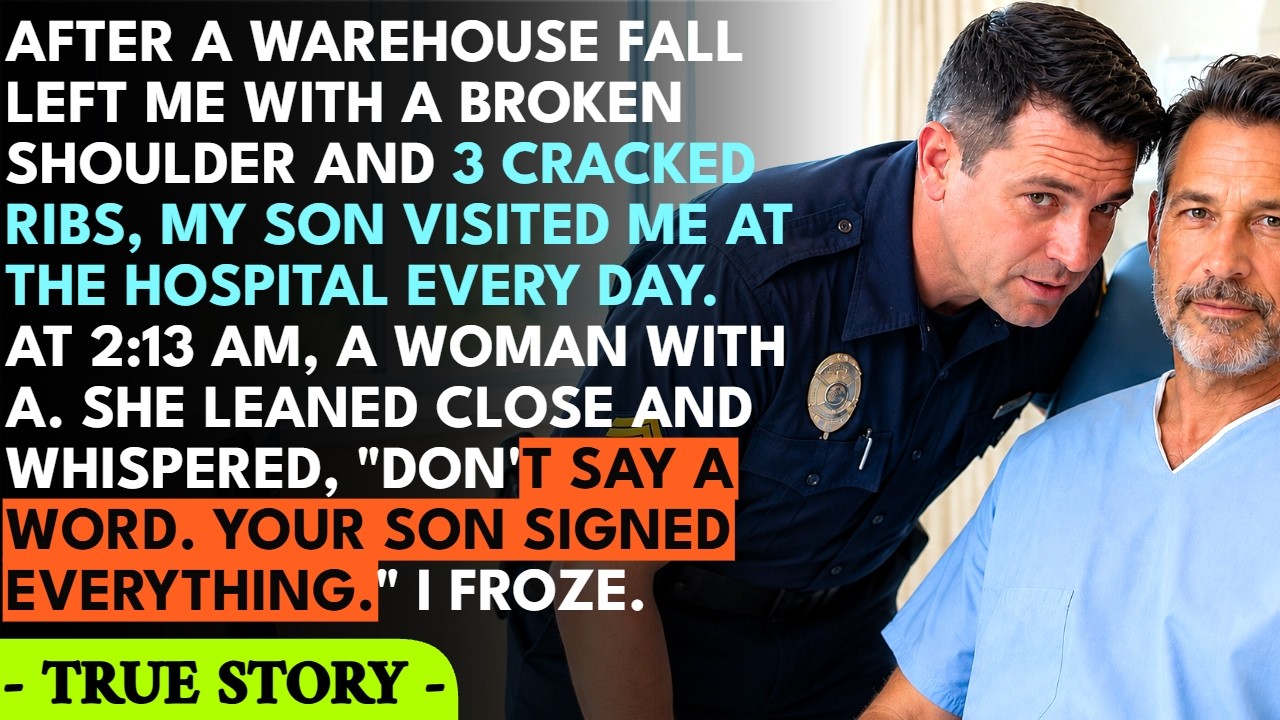
It wasn’t a nurse. I knew the nurses by then. This was slower, more deliberate, the way a door moves when someone doesn’t want to be heard. A woman stepped inside, 50-something, gray blazer over dark slacks, a lanyard around her neck turned face-in.
She sat in the chair beside the bed and leaned close. “Don’t make a sound,” she said, barely above a whisper. “I’m not here to hurt you. I need you to listen to me.
”
Before I tell you what she said, I have to go back to the beginning. I started Desert Ridge Supply in 1991 with a used flatbed and a storage unit off the I-10 in Tempe. I’d spent a decade watching someone else do something I knew I could do better. They paid me fairly, treated me decently, and had no intention of ever making me a partner.
So I thanked them and left. My wife told me the morning I filed the LLC paperwork that she didn’t know whether I was brilliant or foolish, and she’d decided she didn’t care because she was going to be standing next to me either way. In 31 years of marriage, I never gave her a reason to revise that. Desert Ridge Supply grew the way honest businesses grow.
Slowly for a long time, then all at once. By our 10th year, we were supplying commercial roofing materials to contractors across Arizona, New Mexico, Nevada, and Southern Utah. Two warehouses, 16 trucks, 41 employees who knew their paycheck would clear on Friday. My wife died in the spring of 2020.
Pancreatic cancer. Eleven weeks from diagnosis to the end, which wasn’t enough time to prepare for anything except the specific quality of silence that fills a house when the person who gave it its sound is gone. Our son was 31 then. He’d been working in commercial real estate in Scottsdale.
He came home for two weeks after the funeral, and on his last night, he sat across from me at the kitchen table and said he wanted to come work at Desert Ridge. I told him to take six months, make sure it wasn’t grief talking. He came back in January 2021, and he was better at the work than I’d expected. I didn’t see what was coming.
I want to say that plainly, without softening it. The morning of the fall was a Wednesday in late September. I was doing a routine inspection at the Albuquerque warehouse, checking new racking along the north wall. The third-level walkway had a safety rail our maintenance log showed had been flagged, checked, and cleared two weeks prior.
I went up anyway because 30 years of running warehouses had given me the habit of verifying things myself. The rail gave way when I put my weight against it. I remember falling — not pain, just the sensation of the ground no longer being where I expected. Then nothing, until I woke up in room 214.
The fall investigator called it a fastener failure. The bolts securing the rail bracket showed signs of improper torque during installation. The installation had been signed off by our facilities coordinator, a man who’d been with Desert Ridge for seven years and had never signed off incorrectly on anything. I filed that detail away in the part of my mind where I kept things I didn’t have the energy to look at yet.
My son arrived at the hospital four hours after I was admitted. He looked the way a person looks who’s been driving fast with fear in the passenger seat. He sat beside me, took my left hand, careful of the IV. “The doctor says you’re going to be fine,” he said.
“I spoke with him,” I said. “You have to stop going up on those walkways yourself. You’ve got people for that. ”
“I’ve got people who signed off on a rail that wasn’t safe,” I said.
His jaw moved. He looked at the window. “The insurance team is handling it. Don’t worry about the company right now.
I have everything covered. ”
I nodded and let it sit. I trusted my son with the things that mattered. But something small and alert had started running in the back of my mind — the particular attention of a man who has spent three decades reading the difference between a problem that happened and a problem that was made.
The woman who came to my room on the third night told me her name was Carla. She showed me a badge from the Arizona Department of Revenue Commercial Fraud Division. She said she’d been monitoring a man named Archer Bellows for 14 months. Archer Bellows ran a commercial real estate investment firm out of a glass building near Tempe Town Lake.
On paper, he was a legitimate developer. According to Carla, he was in the business of identifying well-established regional companies with solid reputations, reliable cash flow, and owners who were distracted or approaching the end of their working years — and systematically acquiring their most valuable contracts through fraudulent paperwork and manipulated insider relationships. He’d done it twice before. A landscaping supply operation in Tucson.
A medical equipment distributor in Las Vegas. Both times the mechanism was the same. He identified someone close to the owner, spent months cultivating that relationship, and used it to route the company’s most valuable assets to shell entities he controlled before the owner realized what was happening. My son had met Archer Bellows at a charity golf tournament in Scottsdale the previous April.
I closed my eyes when Carla said that. My son was a good man. I believe that the way I believe in things I’ve watched accumulate as evidence over a long period of time. But good men make poor judgments, especially when someone patient and knowledgeable is working deliberately over months to move those judgments in a particular direction.
I had to hold both things at the same time and not let either one knock the other out. Carla told me she had a warrant to examine records connected to a shell company called Southwest Resource Partners LLC, which appeared connected to contracts signed under Desert Ridge Supply letterhead in the previous six weeks. She needed to know whether there were company documents in this room. A laptop.
A drive. Anything. Her eyes moved to the nightstand, then to the rolling bag my son had brought from my house two days after I was admitted. I understood what she was actually there to find — and I understood that whatever she expected to find wasn’t here, because the one person who would have placed it here was the same person I couldn’t let know I was watching.
“My son handles the digital records,” I said. My voice was flat and tired, exactly what it should be. “I’m old-fashioned. I work off printed summaries.
”
She studied my face. She was good at reading people. I gave her nothing to read except a man who was confused and sore and grateful someone had come to warn him. She left a card on the nightstand.
After she left, I lay in the dark and thought about a safety rail that had been checked and cleared and then gave way. About a man named Bellows who found people close to the owner. About a golf tournament in Scottsdale in April. Then I picked up my phone and called the one person who could move without being noticed.
Her name was Gina. She’d been Desert Ridge Supply’s office manager since 2004. She answered on the second ring in a voice that was fully awake at nearly 3:00 in the morning. “I figured you’d call eventually,” she said.
“How long have you known? ” I said. A pause. “Six weeks.
The routing authorizations started changing, and the new contract templates didn’t match our standard vendor agreements. I thought it was a compliance update at first. ” A breath. “It wasn’t.
”
I’d hired Gina in 2004 because she caught an accounting error during her interview that the three previous candidates had walked right past. In 20 years, she’d given me no reason to regret it. “What do you have? ” I said.
“Everything. I’ve been documenting since I understood what I was looking at. Printed copies, backups stored offsite. Fourteen contracts through Southwest Resource Partners.
The routing change logs. The client transfer memos that went under our letterhead without going through standard approval. They used the company email system. The headers are still intact.
”
She had been sitting alone in that office for six weeks carrying something no one should carry alone, because no one with the power to stop it had been available to tell. “Gina,” I stopped for a moment. “You should not have had to do this by yourself. ”
“You weren’t available,” she said simply.
“And someone had to. ”
I told her to stay away from the building, keep the copies safe, tell no one. Then I called Doyle. I’d known Doyle for 26 years.
We’d met on a job site in 1998. He was a state inspector with the Arizona Attorney General’s commercial division, and he’d retired four years ago to restore a 1967 Ford pickup in a garage in Mesa and consult on financial fraud cases. He answered on the third ring at 3:00 in the morning, which meant he’d been awake, seen my name, and taken a moment to decide what kind of call this was. “I heard about the fall,” he said.
“Figured you’d reach out when you were ready. ”
I kept it short. I told him about Carla, about Southwest Resource Partners, about the 14 contracts Gina had identified. I didn’t tell him yet about the safety rail.
Some pieces you hold back until you understand the full architecture. “72 hours,” he said. No questions. My son came the next morning with coffee and a folder of papers.
He sat in the chair with the same posture he’d had at 17 when working through something he wasn’t sure how to explain, and walked me through what he called a restructuring conversation he’d been having with a new logistics partner. “Streamlining,” he said. “Freeing up capacity on the core accounts. ”
I asked which routes.
“The northern Arizona feeders. The smaller secondary ones. ”
I knew those were not secondary routes. The northern Arizona feeders supplied 11 mid-size contractors who together represented 22% of our annual revenue.
They were load-bearing. But I looked at my coffee and nodded slowly and said it sounded like he was handling things well. Because that was what a tired, injured man who trusted his son completely would say — and I needed my son to believe I was that man for a little while longer. Doyle called back in 60 hours.
His voice had the compression of a man delivering something he wishes he could set down without passing it along. Southwest Resource Partners, registered in Nevada. Beneficial owner traced through a Wyoming holding company and a Delaware trust. Archer Conrad Bellows.
The 14 contracts had all been signed on three specific days — and all three days corresponded to meetings between my son and Bellows, confirmed through the company calendar system. Then Doyle said the part I needed to sit with. My son’s girlfriend. A woman he’d been seeing since June.
A freelance marketing consultant out of Scottsdale named Celine Roe. She had contracted with Archer Bellows’s firm 18 months ago — 14 months before she met my son at a dinner party in May. The room went the particular kind of quiet that falls when you understand something you’d been hoping not to understand. “She was positioned,” Doyle said.
“Bellows connected with your son first, spent two months building that relationship. Then Celine came in. By the time your son started signing those contracts, he believed he was making his own business decisions with the guidance of people who understood the market. ” A pause.
“He’s not clean, but he’s not the origin of this, either. ”
I set the phone on the mattress and looked at my hands. The left one first — wide palm, a scar on the index finger from a box cutter in 1994. The right one, still in the sling.
Thirty years of work recorded in both of them. I picked the phone back up. “What does it take to build a case? ”
“Gina’s records are the backbone,” Doyle said.
“But I need to know what was actually moving on those routes. ”
He called back in 36 hours. Eleven of the 14 rerouted shipments had stopped at locations that didn’t exist in any Desert Ridge client file. Three storage facilities in Flagstaff and Kingman.
Two commercial addresses in El Paso. The bills of lading had been altered. The cargo manifest Gina had photographed listed chemical compounds requiring federal transportation permits. What those compounds were used for isn’t something I need to describe in detail.
What I need you to understand is that my son’s signature was on 14 contracts connecting Desert Ridge Supply to an ongoing federal investigation that had been running for 11 months before I fell off a walkway in Albuquerque. My son had not known what was moving on those trucks. I held on to that. But the law does not make the distinction a father has to make — and I knew by then that protecting him from consequences was not the same as protecting him.
Doyle made contact with the FBI’s Phoenix field office on a Thursday. By Wednesday of the following week, there was a federal warrant. Archer Bellows was taken into custody at Sky Harbor International Airport while attempting to board a flight to Cancun. Two carry-on bags, a checked case containing four portable drives and a laptop, and approximately $180,000 in bearer bonds.
Celine Roe was arrested at her Scottsdale apartment 40 minutes later. Her attorney did the talking, and none of it helped. My son walked into the FBI’s field office on Camelback Road voluntarily two days before any of that, with his attorney, and spent six hours answering questions. The federal prosecutor used the word “substantial” to describe his cooperation.
I understood what that meant in practical terms. It wasn’t a pardon. But it was the difference between a man who made a terrible mistake inside a trap someone built around him — and a man who let it close around him without a word. He came to the hospital the night before he went to the FBI.
He sat in the chair beside my bed and talked for a long time. He told me about the golf tournament, about Bellows, about how the restructuring had been presented as an opportunity to modernize Desert Ridge before he eventually took full ownership. He told me about Celine, about how natural it had felt to trust her perspective because she always seemed to know exactly the right question to ask. He told me he hadn’t understood what the routes were being used for.
He told me he was sorry. I listened to all of it without interrupting. My shoulder ached, my ribs ached, and underneath both of those things, something else was aching that I didn’t have a clean word for. “I know,” I said when he finished.
He looked up. His eyes were red at the edges in a way I hadn’t seen since his mother’s funeral. “What happens now? ” he said.
“You call the FBI tonight,” I said. “You walk in tomorrow with your attorney and you tell them everything. Every conversation with Bellows. Every conversation with Celine.
Every document you signed. You do it voluntarily before they come to you, because that is the only version of this where you have any standing at all. ” I looked at him. “And you tell the truth, all of it, without protecting anyone.
”
He nodded once, jaw tight. “Dad,” he said, and his voice cracked on that single word the way it had when he was 12 years old and broke something in the garage and came to tell me about it before I could find it myself. That impulse to come forward rather than wait to be caught was the thing about him I’d always been most proud of. “Go,” I said.
“Make the call tonight. ”
I was discharged three weeks later, on a Thursday morning in late October. I dressed slowly in the gray wool sport coat Doyle had brought from my house. The shoulder was still healing.
The ribs were manageable. I stood in room 214 for a moment before I left. The Phoenix morning was doing what October mornings do there, burning off the night cold quickly, the sky moving from flat pre-dawn blue to something wider and brighter than you can quite name unless you’ve lived in that desert long enough to stop taking it for granted. I’d lived there for 31 years.
I’d never managed to take it for granted. Doyle was in the parking lot with the truck running and the heater going. He handed me a thermos of coffee without being asked. We didn’t talk much on the drive to the warehouse district.
That was fine. Some mornings are not for talking. Gina was standing beside the entrance when we pulled in. She’d seen the truck through her office window and come out.
She looked at me for a moment, jaw tight, eyes bright in the way of someone who’s been carrying something for a very long time and is only just now setting it down. “You didn’t have to do any of what you did,” I said. “Yes, I did,” she said simply. “My name is on those filing systems, too.
”
We went inside. The warehouse was already running. I could hear the forklifts on the north side, a radio near the loading dock. Thirty years of showing up, still standing.
On my desk was a stack of mail. On top, a handwritten envelope with no return address. I opened it. A single sheet of paper, folded once, three sentences.
“I didn’t understand what I was agreeing to. I want you to know that. I’m sorry, Dad. ”
I sat at my desk for a while after I read it.
The October light came through the east window, flat and clean and indifferent to whatever arrangements human beings had made or unmade in the rooms below it. I folded the letter carefully and put it in the drawer where I keep the things that matter most and say nothing about. Then I got back to work. There is something I’ve thought about often since October.
It isn’t the fraud, or the contracts, or the federal proceedings still making their way through the courts. It’s something smaller and somehow larger than all of that. My wife used to say the most dangerous kind of trust was the kind extended without attention. She didn’t mean suspicion.
She believed in people deeply and specifically. What she meant was that trust without watchfulness is not really trust. It’s assumption wearing the language of faith. I assumed that because my son was good, the people he trusted were trustworthy.
I assumed that because the company had always been solid, it would stay that way on its own. I assumed our shared grief after his mother died had drawn us close enough that I could read him clearly across any distance. I was wrong about the last one in particular. The most dangerous threat to what you built is never the stranger standing at the gate.
It’s the stranger who got close enough to the people you love that you stopped seeing them as a stranger. Watch for that. Not with fear.
With the same attention you’d give to anything else worth protecting.