I stood in the cold outside the hospital, my three-day-old daughter strapped to my chest, and waited for my husband. He never showed. When I called, he answered on the third ring. “Hey, yeah, something came up at the office.
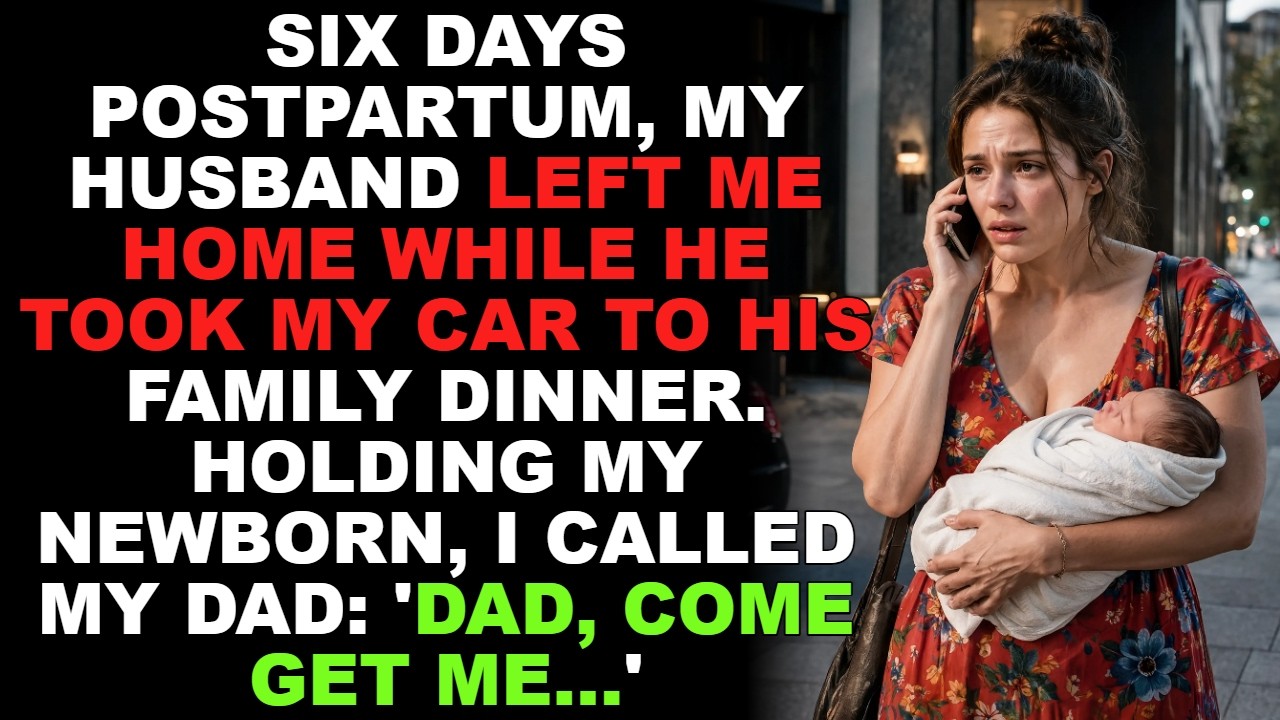
You can grab an Uber, right? It’s like 20 minutes. ”
I looked down at our baby, then at the kind nurse who had held my hand through delivery. “She’s three days old,” I said.
“I know, I know, I’m sorry. It’s just this thing with Harrington. It’s a mess. I’ll explain tonight.
Just get an Uber. ”
The nurse called me a car herself. A college student with a pine tree air freshener drove us home and didn’t charge me. I didn’t have the energy to feel grateful.
I just stared out the window while our daughter slept, and I kept coming back to that moment: a cold parking lot, a phone call, the look on the nurse’s face. That was the beginning of the end. My name is Simone Caldwell. Well, my husband Roland knew me as Simone Tran, my mother’s maiden name.
He didn’t know about the Caldwells—about Caldwell Properties Group, about the real estate empire my father had built across the Southeast, about the house in Buckhead with eight bedrooms, about the trust fund I’d never touched. I kept it from him on purpose at first. I was tired of being looked at the way men look at you when they know your father’s name. I wanted someone to love me for me, not for what my last name could do.
So when I met Roland at a coffee shop, I gave him my middle name and my mother’s name. I told myself it was just for a while, just until I was sure. Then years passed, and I got pregnant, and it felt too late and too strange. So I kept waiting for the right moment that never came.
He loved me—I believe that. But he also lived in a world where his mother Mimi had never liked me, and his sister Faye tolerated me like a co-worker she hadn’t chosen. They thought I was a school teacher with a seven-year-old car and three pairs of shoes. They didn’t know about the summer home, the pool house, or the name that opens doors in Georgia the way a master key opens a hotel.
Quietly. Completely. Then our daughter was born. I named her Ren.
Roland didn’t show up for the birth because of a client dinner. He arrived at midnight smelling like bourbon and steak, looked at her, said she looked like me, and went to sleep. Six days after I came home, I was in the kitchen trying to heat up soup, moving slowly because everything still hurt. Roland came in.
He didn’t look up from his phone. “My mom needs to get back to Savannah by Friday,” he said. “And Faye was thinking this weekend would be a good time for a family dinner at her place. ”
I stirred the soup.
“Okay. What time? ”
He paused. “It’d probably be easier if you didn’t come.
Ren is so little still, and the drive is forty minutes. And Faye doesn’t really have space for the car seat setup. ”
“Roland,” I said, turning around. “She’s nine days old.
”
“I know. I just think it’d be less stressful for everyone if you stayed home. My mom can stay with you while we—”
“Your mother is going to the dinner, too? ”
Another pause.
The kind that told me everything. “It’s a family thing. ”
And there it was. The feeling of a door closing that I hadn’t known was open.
Not anger. Not sadness. Something older, quieter. I was his wife, the mother of his child, and I wasn’t family.
I called my father the next morning. He picked up on the second ring. “I need to come home for a while,” I said. He didn’t hesitate.
“I’ll send Raymond. ”
Raymond arrived thirteen minutes early in a black Cadillac Escalade with tinted windows. He carried my bags without being asked. He installed Ren’s car seat with the expertise of someone who has done it many times.
I left Roland a note: *“I’ve gone to my family’s home. When you’re ready to have an honest conversation, you know how to reach me. Ren and I are safe. ”* I didn’t leave an address.
My father’s house was in Buckhead. My childhood bedroom still had the window seat I used to read in, and he had the attached room converted into a nursery months ago—soft yellow walls, a crib from Vermont that took twelve weeks to arrive, a rocking chair by the window, fresh white flowers on the dresser. He had been expecting this visit the way parents sometimes expect things. Not with certainty, but with quiet readiness.
I sat in that rocking chair at two in the morning with Ren and cried in a way I hadn’t let myself cry since before the hospital. Just the release of something very large that had been held for a very long time. Roland called. I let it ring.
The fifth time, I answered. “Where are you? ” He didn’t sound panicked, exactly. More like someone who walked into a room and found the furniture rearranged.
“I told you in the note. I’m with family. ”
“Your parents are…” He stopped. “You told me your parents were in Tennessee.
”
“I’m safe,” I said. “Ren is safe. When you’re ready to talk about why your mother is family and I’m apparently not, I’ll be here. ”
“You can’t just take her, Simone.
”
I spoke very quietly. “I am her mother. I am at a safe home with people who love me. This is not a legal issue, it’s a marriage issue, and right now, in the middle of the night, it’s not a conversation I’m willing to have.
Good night. ”
My hands were steady. That surprised me. The unraveling from Roland’s side took about seventy-two hours.
He called my cell. He called the landline and got our butler, Gregory, who told him politely that Miss Caldwell was unavailable and took a message. Roland apparently needed a moment. The message he left, I did not return.
On a Saturday afternoon, Roland arrived at my father’s gate. He didn’t come alone. He came with his mother and sister, which told me they had been strategizing together. My father instructed the guard to let them in—he is gracious that way—and then made them wait in the formal parlor, the kind of room filled with old, considered things that makes you quietly recalculate everything you thought you knew.
Faye even whispered, not quite quietly enough, “Is this… whose house is this? ”
My father walked in alone. He is seventy-one and carries himself with a settled gravity. “I understand you’re looking for my daughter.
”
Roland needed a moment. “Your daughter? ”
“Simone Caldwell. Yes, she goes by Simone Tran professionally—her mother’s name.
I assume you knew that. ”
Roland’s mother recovered fastest. Something about a misunderstanding, about hoping they could all speak with me, about how sure she was there was a way forward. My father looked at her, unhurried.
“My daughter is resting. She is six days postpartum. When she is ready to speak with anyone, she will reach out. ” He paused.
“I’d like to offer you coffee before your drive back. ”
They did not stay for coffee. Weeks passed. My body healed.
My father hired a postpartum nurse, a calm woman named Greta who had the household running with quiet efficiency within forty-eight hours. When I was ready, Roland and I talked properly. He came to Atlanta on a Tuesday in October, and we sat in my father’s study, surrounded by books and honesty. I told him the whole truth.
The trust fund. The property group. The name. Why I’d kept it from him, and why I understood it was a breach of trust even if my reasons made sense at the time.
I apologized, and I meant it. He told me, and I think it cost him something, that he had known for a long time that something was off. Too many small things. The ease with which I handled money stress.
The too-old car for someone who kept her nails so nice. He had told himself stories because it was easier, and he had let me be whoever I presented myself as without asking. He said the dinner—the one where I wasn’t invited—had been his mother’s suggestion. He knew it was wrong, and he did it anyway because disagreeing with her was harder.
“That’s the part I can’t walk back,” he said. “I know,” I said. We didn’t save the marriage. I want to be clear about that.
We had loved each other, genuinely, in the way young people love before they know themselves fully. But we had built a life on a foundation with missing pieces, and you can acknowledge the love and the mistake at the same time. The paperwork was filed in November. It was civil, not easy, but civil.
His mother made one call to my father’s attorney, who handled it in about seven minutes and never mentioned it again. So here I am. I’m thirty-one. I’m the daughter of Herschel and Lee Caldwell.
I’m the mother of Ren Simone, who was born on a Tuesday in a hospital in Cobb County while her father was at a business dinner, who came home in a Honda Civic driven by a kind stranger, and who has been changing everything steadily and completely ever since. I went back to teaching in January. Third grade. I drive a different car now—nothing like my father’s, just something newer with a working rear bumper and a backseat configured entirely for one small, opinionated passenger.
My father comes over every Tuesday for dinner. He holds Ren against his chest and reads to her from whatever he’s currently reading. She grabs his thumb with her whole fist and doesn’t let go. People always want to know about the money, about whether Roland got what he deserved.
My father made some calls. Doors that had been open to Roland’s firm closed quietly, the way things close in the world of Southern real estate when the Caldwell name is on the other side. I didn’t ask him to do it. I didn’t stop him either.
And I’ve made my peace with that. But the thing that actually changed everything wasn’t the doors closing. It was my daughter’s face at dawn, before she’s fully conscious, smiling at me just because I’m there. A pure, unconditional recognition.
I called my father from a cold parking lot. He sent a car. And everything else—the house, the name, the weight of what I’d been carrying—was just context for the only thing that was really happening: a woman who needed to go home, and a father who made sure she could.