The strip of light under the door wasn’t supposed to be there. Elena knew she’d made a mistake. She’d turned off the main light, but the bathroom light was still on, and that thin line was now spilling out into the hallway of a motel that should have been empty. Outside, Lake Michigan wind pushed hard against the windows.
Snow had started falling, small dry flakes that stung the skin. In room number 17, Elena stood frozen, her hand still resting on the light switch. She had nine hours left before this building was demolished. She had $27.
40 in her pocket, a car nearly out of gas, a child who hadn’t eaten dinner, and the correct understanding of what every dollar could do. $10 could help the car run two more days. $8 could buy bread, eggs, anda discounted box of soup. The remainder was enough for mother and daughter to sit in the laundromat until almost dawn, where there was at least some light and warmth.
But that night, Elena didn’t drive to the gas station. She took Sophia back to room 17. They walked behind the motel along the brick wall that had peeled in patches after many winters. Elena touched her staff card to the laundry room door.
The card should have been deactivated three days earlier, but the old reader still blinked green if she held it tilted left. Sophia knew to walk down the hallway without dragging her shoe soles, not to talk near the camera, and not to turn on the light until the door was fully closed behind them
Room 17 was no longer on the list of rentable rooms. The ceiling had a leaf-shaped stain. The carpet near the window had a corner cut off.
The heater only worked when Elena tapped twice on the right side of its metal casing with the handle of a spoon. But it was still the only place where Sophia could set her backpack down without having to hug it while she slept. On the table were two plastic containers, one holding half a portion of noodles from the day before, the other holding three slices of apple Elena had sprinkled with lemon juice so they wouldn’t turn brown. Elena didn’t call that place home.
She told Sophia they were only staying there temporarily until her wages were paid in full. That sentence had been repeated for nineteen nights, and each time Elena tried to keep her voice normal, as if the day of leaving were already marked on a calendar. Sophia never asked why a temporary place needed a toothbrush hidden inside a tissue box. Nor did she ask why every morning her mother folded the blanket into a small rectangle and tucked it behind the board under the bed
Sophia set her backpack on the chair and took out a brass keyfrom her pencil case.
It didn’t open room 17. It was older than the building itself, its teeth worn down, with the number 214 engraved on its head. Gabriel, her father, used to wear it on a cord inside his shirt. After he passed away, Elena intended to put it away with the documents, but Sophia kept it and said a person should have at least one thing that could open a door, even without knowing yet where that door was
Elena took the $27.
40 out of her jacket pocket and divided it into three portions on the table. She pushed $10 for gas, $8 for food. The remainder sat in the middle, too small to be called a plan. After a few seconds, she reached over and took back $5 from the gas money.
She folded it in half and tucked it into Sophia’s coat pocket
Tomorrow, you buy lunch with this
Sophia looked at the box of cookies in her backpack. I still have food
Inside were only two cookies, broken into small pieces. Elena didn’t expose that lie. She took a slice of apple, took a very small bite, then placed the rest into Sophia’s container, as if she was eating little only because she wasn’t hungry yet
Less than four minutes away from there, in the opposite direction, Adrien Cole was on the top floor of the building bearing his name.
He didn’t live there, but on the 68th floor, there was a private room to rest in between long meetings. Heated bathroom floor, three new shirts always hanging ready, a dining room where the corporation’s chef could prepare anything after just one phone call. That evening, a portion of roasted beef, mashed potatoes, anda bottle of wine from his private cellar sat before him. The walnut wood table had eight chairs.
Only one was pulled out
Below, his driver waited in a pre-warmed sedan. Another SUV followed on long trips, mostly to carry documents and luggage. Adrien didn’t know how much fuel was left in either car. He couldn’t remember the last time he stood at a gas pump himself.
Such things were resolved before he became aware they existed
His phone could open office doors in five cities. A control panel on his desk let him viewthe temperature, power, and security status of thousands of apartments. Some nights, he sat in a room kept at exactly twenty-two degrees, signing decisions concerning doors he had never once walked through. Lakeshore Motel was just one line among them.
Forty-eight rooms, an old laundry area, nearly two acres of land next to a road whose value was climbing. The cost of maintaining the building had exceeded its revenue three years earlier, and the replacement project promised a profit large enough that no one in the meeting needed to ask who this place once housed
Tomorrow at six thirty, the excavator would begin at the East Wing. Adrienne had signed that order three weeks earlier. He reached for his coat when his phone buzzed.
A message from the head of security contained one photo: a dark hallway at the far end, a thin strip of light seeping out from under a door. The attached report stated the building had been inspected twice and had no remaining occupants
He zoomed in on the photo. That strip of light didn’t make him think of an intruder. It reminded him of another night, long before his name sat atop buildings, when his mother rolled up a towel to block the gap under the door so the motel manager wouldn’t realize the three of them were still inside
He opened the drawer beneath his desk.
Behind leather-bound contracts was a small unlabeled wooden box. From it, he took out a brass key that had turned dull with age, its head engraved with the number 213. He gripped it in his palm as the elevator doors closed
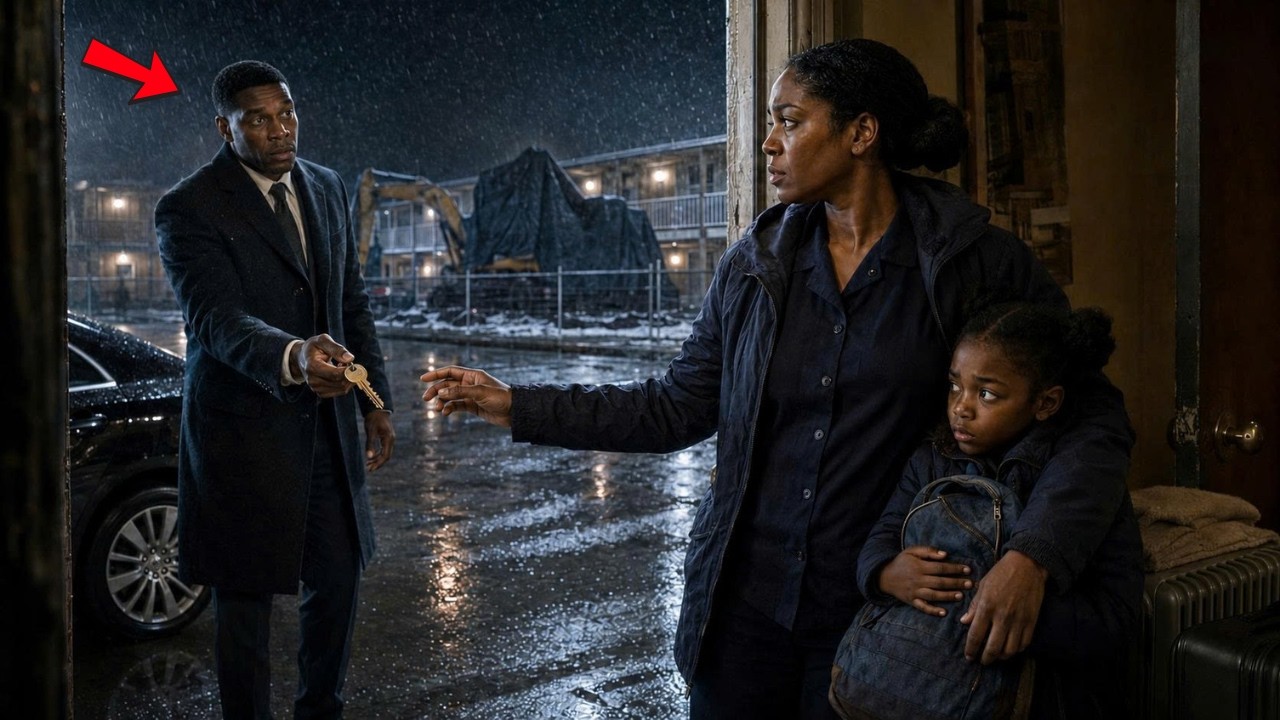
Seventeen minutes later, the black sedan stopped in front of Lakeshore Motel. The driver moved to open the door, but Adrien had already done it himself.
The wind off Lake Michigan hit his face directly, carrying small dry flakes of snow. Only three bulbs worked in the row of hallway lights, making the motel look more forgotten than the number recorded in the report. Behind a temporary fence, two excavators sat still under gray tarps. On the arm of the first machine, the Cole Urban Holdings logo was still new.
He stood looking at it for a few seconds. Tomorrow morning, his name would sit on both the demolition order and the remaining rubble
In the lobby, Curtis, the head of security, was waiting. He handed Adrien a thin file. The inspection team had gone through all the rooms three days earlier.
No personal belongings, no sign of occupancy. The strip of light under room 17’s door could just be electrical leakage, or a bulb not fully switched off
Adrien didn’t open the file. He asked who was holding the master key. Curtis held out a large ring, but Adrien didn’t take it.
He walked toward the east hallway where the carpet had been peeled up in sections, ready for tear down. The smell of dust, cleaning fluid, and damp wood mixed together. At the end, the door of room 17 looked no different from the others, except for that thin line of light lying close to the floor
Inside, Elena had already heard the car. She turned off the heater, pulled Sophia from the chair, and gatheredthe two food containers into a cloth bag.
These movements happened fast enough to be almost unthinking. The toothbrush was tucked into the tissue box. The blanket folded in three. Clothes from the bathroom hook pressed down into the bottom of the suitcase.
Over nineteen nights, she had trained herself to turn a room lived in by two people into an empty room in under four minutes
Sophia stood by the door, hugging her backpack to her chest. Is it Mr. Walter? Elena placed a finger on her daughter’s lips, then took one last look around.
On the table, coins still sat uncollected. A slice of apple lay in the plastic container. Under the chair leg was the paper house Sophia had folded from an advertisement flyer for Cole Urban Holdings, its roof colored yellow with a pencil. The sound of footsteps stopped outside.
Elena turned off the light. The room went dark, but the strip of light under the door gap remained, because the small bathroom light hadn’t been switched off in time. She realized this the moment metal touched the lock
Sophia pressed close against her, her small hand grippingthe brass key inside the pencil case so tightly that its teeth pressed marks into her skin
Adrienne raised his hand, stopping Curtis from opening the door. He knocked three times.
No answer. He knocked again, slower
I know someone is inside
Elena looked at Sophia. She had imagined this moment many times, but in every version, the person arriving was Walter. He’d stand outside, bring up the missing hours on the time sheet, remind her she had no official contract, then say that with one phone call, child protective services would know where Sophia had been sleeping for nearly three weeks
She opened the door just enough to stand blockingthe frame.
The man in front of her wasn’t wearing a security uniform. Dark wool coat. Shoes with no mud. And a stance that had never once had to ask permission to enter any place.
Behind him were Curtis and two staff members
Elena understood at once this wasn’t a routine inspection
We’ll be gone before morning
Adrienne looked past her shoulder. He could only see part of the room, but every detail was clearer than any report. A suitcase already zipped shut. Two paper cups washed clean and set upside down by the sink.
Children’s shoes tucked against the foot of the bed. A bag of food tied with a rubber band
Is there a child here? Elena shifted her body to the left. No
From behind her, Sophia coughed softly.
A very small sound, but enough to take the ground out from under her mother’s words
Curtis stepped forward, noting the building had been sealed and that residing inside was illegal
Adrienne didn’t turn to him. He kept his gaze on Elena’s hand, grippingthe door edge. Her knuckles were pale, but when her voice came, it stayed steady
I work here. The motel has been closed for three weeks.
I still work here
She didn’t explain further. She had learned that the more a poor person spoke in front of those who held power, theeasier it became to turn herself into a file full of contradictions. She opened the door a little further, enough for Sophia to step out if they were forced to leave. But the child didn’t step out
Adrienne saw the girl for the first time.
Sophia wore her coat even inside. One arm hugged her backpack; the other was hidden behind her back. Her face didn’t carry the drowsiness of a child woken in the night. It carried the alertness of someone already used to waiting for footsteps outside the door
Adrienne knew that look.
He had once seen it in a mirror at age eight
Does she have school tomorrow? Elena froze, but the surprise lasted only one breath before the wall in her eyes rebuilt itself
That is none of your business
From behind her mother, Sophia accidentally dropped the brass key. It hit the floor, spun twice, then stopped right in front of Adrienne’s shoe. The number 214 faced up under the hallway light.
The hand in his coat pocket closed tightly around the key marked 213. Elena bent to retrieve it, but he had already knelt, picking it up before she could
It sat resting in his palm, light enough that its weight didn’t match what had just settled onto his chest. He didn’t need to wipe the faint dust off the brass to see the number clearly. The engraved lines were old, the edge of the “2” slightly chipped at the right corner—exactly the type of key once used at the boarding house on West Walnut Street, more than thirty years ago.
He still remembered the old manager sitting outside the maintenance room, carving numbers onto key heads with a small chisel, smoking while he worked, ash falling onto concrete
Elena held out her hand
Give it back to her
Adrienne looked up. Under the yellow hallway light, the weariness on her face had shifted. It wasn’t only the fear of being driven out anymore. The way she looked at the key showed it belonged to a part of her life she didn’t want any stranger touching
He placed it in her palm without a word.
Sophia stepped forward quickly, took the key, and tucked it deep into her pocket. She didn’t know why the man had suddenly looked at her for so long. She only understood that adults usually paid attention to a child’s belonging when they intended to take it away, so her hand stayed tight on the fabric outside her pocket
Adrienne stood up. Behind him, Curtis began repeating site safety regulations, but that voice had grown distant.
He looked over the room once more. On the table, the money Elena had just divided still sat in three piles. Five ones folded in half. Coins lined at the edge.
One portion had somehow been moved from its place, into a child’s coat pocket
He asked whether the heater was working. Elena looked at him as if it were a trap
It’s enough
Adrienne stepped over the threshold after she moved back half a step. The heater under the window let out a dry rattling sound, then went silent. On its metal casing were two small dents in the same spot, markinga habit of being tapped many times.
He crouched, touched the weak stream of air, then looked at the blanket folded too neatly at the foot of the bed. No suitcase fully open. No item in the most convenient spot. Mother and daughter livedlike people always ready to vanish before being discovered.
Clean clothes behind the shower curtain. Food containers with no store name, only small paper scraps marked Monday, Tuesday, Wednesday. In the trash, a soup box cut in half to scrape out the last of its contents
Sophia bent down and picked up the paperhouse from under the chair leg. It was an advertisement from his own corporation.
The outer side printedimages of glass balconies, a fitness room, a line about an upscale living community soon to be built on this land. Sophia had folded it into a small house. The roof was colored yellow, and on the back were the construction cost figures Adrien had once approved in under two minutes
Did you make this? Sophia nodded but didn’t hand it to him
Elena zipped the suitcase shut and set it by the door.
That gesture showed she had already understood how this inspection would end. She didn’t cry, didn’t speak of her late husband or the months of underpaid work. She only took the wool hat from the bed, put it on Sophia’s head, pulled it down over both ears
We need ten minutes
Curtis looked at Adrienne, waiting for a nod. Outside, the wind made the tarp over the excavator flap.
A staff member had already opened his phone to call the night team while Sophia began stuffing her pencil case into her backpack. She moved very slowly, as if drawing out each motion could hold the room together a few seconds longer
Under the table, Adrienne saw a pair of women’s shoes worn down at the heel. Beside them, a grocery store receipt, a notice from school, anda time sheet folded into quarters. On it was the name Elena Ramirez, but many work days were crossed out in red pen.
At the bottom, one handwritten line: those hours not confirmed because employee did not appear in system
How long have you worked here? Elena placed a hand on Sophia’s shoulder. That doesn’t change the fact that we’re standing in a room that isn’t ours
How long? She smoothed the edge of the school notice before answering.
Eleven months
Adrienne looked at the time sheet. Eleven months cleaning rooms other people paid to sleep in. Then nineteen nights hiding her child in a room removed from the listings
He bent down to pick up the paper, but Elena stepped forward quickly, holdingthe other corner
That’s mine
Someone altered your hours. You don’t need to know
What’s the manager’s name?
Elena didn’t answer. Her hand gripped so tight the fold nearly tore
Adrienne let go first. He turned to Curtis. Who’s responsible for personnel at Lakeshore?
Curtis opened the file and read out a name. Walter Green
The moment that name was spoken, Sophia stopped zipping her backpack. Elena didn’t look at her daughter, but Adrienne had already seen the reaction. A silence too clear to still be called coincidence
He took out his phone, opened the demolition schedule, and canceled the six thirty confirmation.
Then he called the project lead, orderingthat all machinery remain stopped until further notice
Curtis stepped closer. Mr. Cole, the contract has—
Elena looked up at that name. Her gaze moved from Curtis to Adrianne, then settled on the small logo stitched inside his coat collar.
Then she looked at the paperhouse in Sophia’s hand, Cole Urban Holdings still visible under the fold. She finally understood. The man standing in the middle of room 17 was not a staff member sent to inspect. He was the owner.
Who had signed the order to tear it down
She pulled Sophia close against her
So, you decided this place had to disappear
Adrienne didn’t deny it. He looked at the paperhouse, where his corporation’s name had been folded inward, leaving only the yellow roof and one small window. Three weeks earlier, when he put pen to paper, he had seen only maintenance costs, land value, profit projections. No line in the file said a child slept here with her coat still on.
No box accounted for two containers divided by day
Yes, he said. I signed that order
Elena nodded very faintly, not acceptingthe confession, but because what she had suspected finally had a shape. This man had not stumbled by chance intotheir hardship. His name was on the fence, on the excavator, on the advertisement Sophia used to fold her paper house
So you’ve seen it now, Elena said.
We’ll go
She bent to lift the suitcase. One wheel had broken, tilting it sideways, dragginga dry scraping sound across the floor. That sound passed through Adrien like something sharp. He’d heard that exact sound in another hallway, in another winter, thirty-five years earlier, when his mother tried to pulltheir family’s only suitcase down the stairs without letting her two sons realize she was crying
Adrienne was eight then.
His mother, Miriam Cole, used to set two plates on the table even when the cupboard held enough only for one person. She divided the mashed potatoes, placed them in front of her sons, and said she had already eaten at work. Adrienne believed her until he saw her standing by the sink one night, drinking two cups of water in a row to fill the emptiness
They lived in room 213 of the boarding house on West Walnut Street. In winter, cold air leaked in around the window frame.
Miriam rolled up a towel to block the gap under the door, sayingit helped keep the room warmer. She didn’t saythat the towel also kept light from spilling into the hallway after hours
To reduce the rent, Miriam cleaned vacant rooms in the mornings before heading to the laundry factory. Room 214 had been empty for months. When its lock was replaced, the manager handed Miriam the old key, told her to throw it away.
She kept it. Poor people rarely discard an object still whole in shape, even when it can no longer open any door
Rent on room 213 was twelve days overdue. Miriam had asked for one more week. The manager gave her until the next morning.
That night, she placed two brass keys on the table. The one marked 213 was given to Adrien. The one marked 214 was hung around his younger brother’s neck on a brown shoelace. She didn’t call them keys to be discarded.
She said each of her sons should keep one, so that later when she found another place, they would know they still belonged to some door
The next morning, the lock on 213 was changed. Mother and sons stood in the hallway with a suitcase missing one wheel, two bags of clothes, anda tin box of papers. Miriam didn’t pound, didn’t beg in front of her children. She only bent down to fasten her younger son’s coat, then told Adrienne to hold his brother’s hand tightly while she went to find a phone
By noon, a social worker arrived.
Miriam no longer had enough for another room. No relative answered. The shelter had no beds. The woman holding the file saidthe boys might have to stay in two different places for a few days, only until Miriam got stable
Adrienne was sent to a family in the north
His brother was moved to another district
In the first week, Adrien slept grippingthe key marked 213.
He believed his mother would come for him if he kept hold of the thing that had once opened the old room’s door
Miriam tried. She found a second job and sent three letters to the welfare agency. Two returned, because the boys’ files had been separated under different surnames. Seven months later, on her way from night shift to morning shift, she was struck by a delivery truck at an ice-covered intersection
Miriam died before the final hearing
No one explained it to Adrien in a way a child could understand.
He was only told his mother would not be coming. A few days of separation stretched into thirty-five years. He kept the key marked 213 through every move. In his pocket the day he took his first loan.
In his desk drawer the day his company hired its hundredth employee. In a wooden box on the 68th floor, where no one knew a billionaire still kept the object that once opened a room that no longer existed
Now the key marked 214 was in a child’s pocket
Adrienne looked at the suitcase Elena was pulling. The broken wheel kept scraping in the exact rhythm of the sound he hadn’t been able to forget
Don’t take her out into the night, he said
Elena stopped but didn’t turn around
Tomorrow morning you’ll still tear this place down
No. You just said you signed the order yourself.
I just stopped it
Curtis stepped forward. Postponing the demolition would require paperwork, notice to the contractor, confirmation from legal
Adrienne took out his phone and sent a directive right in front of him. The machinery was to stop. No one to enter the east wing.
Lock changes forbidden until a new inspection
Elena still kept her hand on the suitcase handle
Seven days, Adrienne said. You and Sophia stay here seven days. No one touches this room
Elena turned around
In exchange for what? In exchange for nothing
She looked at him for a long moment, then bent down to pick up the time sheet.
As it unfolded, an old photograph slipped out, landing face down near his feet. He bent down and picked it up. A young man in a work site coat holding Sophia when she was still an infant. On the back, in blue ink now faded, one name.
Gabriel
Adrienne read the name once more, as though staring long enough could make the strokes assemble into an answer. The man in the photo was very young. Thin face, short cropped hair, a small scar near the left eyebrow. He held Sophia with both hands, careful enough that his elbows were tense while she slept in a yellow blanket
Adrienne didn’t recognize the face.
But he recognized the way the man tilted his head while looking at the child
His younger brother, as a boy, used to tilt his head the same way whenever he tried to hear a distant sound. Standing by the window of room 213, head slightly leaning left, waiting for Miriam’s footsteps in the hallway. A gesture too small to exist in any file
Elena took the photo out of his hand
My husband
She placed it backamong the folds of the time sheet
Adrienne didn’t ask right away. Gabriel wasn’t a rare name.
A key with a consecutive number could be coincidence. A familiar gesture could simply be the kind of memory a person invents when they’ve searched too long. But his hand still didn’t leave his pocket. Inside, the key marked 213 had warmed to his body temperature
Curtis stood near the door, waiting.
The two security men behind him began glancing at each other, unsure whether to leave
Adrienne ordered that no one enter room 17 without Elena’s consent. He told Curtis to have someone check the heating system and bring a new lock that same night
Elena looked up
A new lock for what? So only you have the key
She didn’t answer. Her gaze moved from Adrien to the door, then settled on Sophia.
The child still hugged her backpack, but her shoulders had eased down slightly. Nineteen nights of any footstep meaningthe room no longer belonged to them. A new lock wouldn’t turn this place into a home. But it could let a child know that tonight, once the door closed, no one outside would open it on their own
Adrienne stepped out into the hallway first.
He didn’t want Elena talking with four men standing in a room barely larger than a garage. Curtis followed, carryingthe unopened file. Once the door closed, Adrienne asked where the personnel files for Lakeshore were kept
Ground floor management office, Curtis said. Most moved to storage.
Payroll held by Walter Green until liquidation is complete
Adrienne checked his watch. Nearly ten
Call him in
Curtis hesitated. Walter had managed the motel close to seventeen years and had been kept on after closing to help hand over assets. In internal reports, described as someone who understood Lakeshore better than anyone.
No formal complaint open. No wage dispute recorded
Adrienne had read sentences like that a thousand times. A system looks cleanest on paper when the person harmed doesn’t feel safe enough to put their name on a complaint form
In room 17, Elena still stood by the door afterthe footsteps faded. She didn’t know why Adrienne had looked at Gabriel’s photo as though hearing a sound echo from the past.
Nor did she know whether the seven days were real, or would only last until the lawyers found a way to take it back
Sophia set the paperhouse on the table
Is he going to tear it down again? Elena checked the old lock once more, even though she knewthe latch was loose
Not tonight
That was as much as she could promise
Out in the hallway, a maintenance worker brought a new lock with two keys. Adrienne took them, placed both into Elena’s palm. She turned the latch three times to test it, not out of doubtbut toward the worker.
She’d lived too long in places where a door only meant something once her own hand confirmed it could lock
Twenty-eight minutes later, a pickup truck stopped in front of the lobby. Walter Green walked in, coat not fully buttoned, carryingthe irritation of a man pulled from home over a matter he believed long resolved. Around sixty, heavy set, gray hair combed back, glasses sliding down his nose. The moment he saw Adrienne, his tone changed, apologizing for not knowing the chairman would inspect in person
Adrienne set Elena’s time sheet on the front desk
Walter recognized it without needing to read the name.
A brief instant, but enoughto make his hand stop mid-glove
Ms. Ramirez says she’s worked here eleven months
Walter pushed his glasses up
Seasonal labor. Not on official payroll
Was she paid in full? Certainly
Adrienne opened the time sheet.
The crossed-out days sat between shifts signed off. Next to them, laundry access codes and room numbers cleaned. He placed a finger on one week: fifty-two hours worked, eighteen recorded
Walter looked at the paper longer than necessary
Could be a system error
At that moment, a door opened behindthe counter. Elena had come down, one hand holding Sophia, the other holding a brown envelope worn at the edges.
She set it on the counter and pulled out seventeen pay stubs anda small notebook recording dates, room numbers, towels changed per shift
Walter looked at the notebook, then at her. She smoothed flatthe first page, where his signature appeared right next to three shifts that had been erased
You said it was a system error, Elena said. Then explain why your signature falls exactly on the days my money disappeared
Walter didn’t look at her right away. He looked at the notebook, then the pay stubs arranged by date.
Each slip held only a few numbers, but side by side, they formed something harder to erase than data in a computer. Elena recorded room numbers, start times, end times, even ruined towels carried to the basement. She wrote them down because she stopped trustingthe time sheet. She kept them because a person who can’t afford a lawyer often has to become her own witness for her own life
Walter pulled the chair out but didn’t sit.
The signature only confirmed work was assigned, not the full amount of time she claimed. Some rooms redone. Shifts ran long because staff slow. The motel struggling for months, all seasonal workers knew hours only counted after manager review
Elena listened without interrupting.
She opened the notebook to October fourteenth. Room 22 torn sheet. Room 31 wine spill. Room 8 took nearly two hours, bathtub overflowed.
Besideeach line, the first letter of Walter’s name. The initial he required before moving on
That day I worked eleven hours, Elena said. The pay stub shows four
Walter gave a faint laugh, nothing amused in it. Anyone could write a notebook after the fact.
He also said she should be careful; staying secretly in a motel room could make statements look like retaliation
Sophia stood close. She didn’t understand the word retaliation. But she understood the way Walter lowered his voice when speaking about room 17. The same voice that used to send Elena back after each shift with trembling hands, only for her to smile when her daughter asked whether payday had come yet
Adrienne pulled the notebook toward himself.
He didn’t ask if she had more evidence. He turned to Curtis, requestedthe access card data for the past eleven months, including the laundry room, towel storage, every room assigned. Then he called the head of finance, waking her, requestinga full payroll backup before any account could be edited
Walter took off his glasses. The irritation gave wayto brief blankness.
No need to turn an administrative error into a companywide investigation. If Elena really had been shorted a few hours, he’d recalculate and pay it out this week
Elena looked at the stubs. Not a few hours. She added figures on Sophia’s school calculator.
Two hundred eighty-six hours over eleven months. Not counting times Walter asked her to come early to prep carts or stay late washing towels without clocking in. Enough for several months’ rent on a small apartment. Enough to fix the car.
Enough that Sophia wouldn’t have to learn to sleep in her coat
Adrienne didn’t say he’d hand her the money right away. The money taken from her wasn’t a gift for a billionaire to bestow. It was money earned standing night after night in the smell of bleach, wrists swollen from ringing towels, mornings taking her daughter to school after three hours of sleep. Giving it back wasn’t kindness.
It was correcting something that never should have happened
On the screen behind the counter, card access data began appearing. Every laundry door opening logged with a time. Some nights, card used at 11:48 p. m.
, payroll recorded endingat nine. Some mornings, entered room before seven, system logged start at ten. Rows stretched from one page to the next
Walter said she might have lent her card, but hallway cameras still had footage. In each frame, Elena pushedthe towel cart at exactly the times in her notebook.
Not one day, not one week, nearly the whole year. Adrienne recalled a Department of Labor report in the company’s legal files. In fiscal year twenty twenty-five, the agency had closed sixteen thousand nine hundred twenty-four investigation cases, recovering two hundred fifty-nine million, two hundred ninety-four thousand, seven hundred sixty-four in back wages for one hundred seventy-six thousand nine hundred fifty-seven workers nationwide. Numbers that large could easily become one row on a screen.
But themoney withheld from Elena didn’t live on a screen. It lived in the five dollars she’d taken from gas money to tuck into her daughter’s coat
Adrienne ordered Walter’s system access revoked immediately
Walter stepped back, voice rising. He’d saved Lakeshore from losses by cutting costs. Seasonal staff inflated hours.
Adrien chose to trust someone living illegallyin company property overthe man who managed the place seventeen years
Adrienne didn’t argue. He told Curtis to collect office keys, work phone, any device with personnel files
Walter set the key ring down hard enough that one key popped loose, slid across the wood, landed beside Elena’s notebook. As Curtis led him out, Sophia finally let go of her mother’s coat. Elena still stood upright, but her fingertips had whitened from grippingthe counter edge too long.
She looked at the total hours on the screen as though she still couldn’t believe months once lost could be acknowledged simply by appearing in black and white
The finance officer called back. In the old data archive was a file not in the current payroll system. A list of people hired to repair Lakeshore eight years earlier, before acquisition. One name appeared in steel structure records, along with address of old foster placement anda signature confirming receipt of utility room key.
Adrien opened it. Thirteenth line. Gabriel Cole
The slant of the signature, leaning left, reminded him of the way his younger brother wrote his own name with a short stub of a pencil on the floor of room 213. Beneath that name, an old case code, another address, a birth year matchingthe year his brother had been taken out of the city
He didn’t touch the screen.
He stood, both hands on the counter edge, while memories he’d thought worn smooth suddenly turned sharp enough to cut. A six-year-old boy whos hair always fell across his forehead. Who hid half a cookie in his pocket for Miriam. Who was led up into a pale blue car, twisting around to look back through the window until the street disappeared entirely
In the file, the name was Gabriel Cole.
But a note showedthat name only used after second placement transfer. The birth surname did not appear. Accessing the original foster record required legal request, proof of relation, consent from nearest next of kin
The nearest next of kin was standing three steps away
Elena was still looking at her total hours. She hadn’t seen the other screen opened.
Didn’t know the man in front of her had stopped thinking about withheld wages the moment her husband’s name appeared
Where was Gabriel born? Elena looked up. She closed the notebook, hand over the stubs, as if he’d stepped outside the one area she allowed him to enter
What does that have to do with my wages? There’s an old file bearing his name
She looked at the screen, but he’d already tilted it away before Sophia could read it.
He didn’t want a child seeing her father described as a line of data with a case number
He worked here once, Elena said. Many years ago
And before that, she fell silent. Gabriel rarely spoke of his childhood. He remembered many addresses but called none home.
Some nights waking, he’d check the front door twice, then touchthe key beneath his shirt. She’d asked once what it opened. He only said he was still trying to remember
He grew up in the foster system, she said. That’s all I know
Adrienne closed the file.
He could chase that secret later. Elena still had to wake the next morning to find money for her daughter’s lunch. He called Monica Vance, legal director. She listened to all of it.
Card data, time sheet, stubs. Asked three questions about backup, two about employment status, one about Elena’s residency. Once she learned Elena was living in company property, her tone turned careful. The wage dispute couldn’t be used as leverage to get her out, and the temporary right to stay couldn’t be traded for silence
He looked at Elena
You’ll have your own lawyer
I can’t afford one
You’re not paying me.
The corporation covers the fee for an independent office. The lawyer represents only you. Every choice—suing, negotiating, going public—belongs to you. I won’t hand you a check for a signed release.
Verified wages repaid separately. Other claims assessed by your lawyer
Elena looked at him a long moment. She’d been offered money before to overlook things that never should have been overlooked. Walter once left an envelope on the towel cart, callingit a private thank you for someone who knew how to keep things quiet.
Elena didn’t take it. The next week, sixty hours vanished
Can that lawyer sue your company? Yes. You’d still pay the fee
He nodded.
Elena asked that everything just said be put in writing before she signed anything. Adrienne told Monica to prepare it tonight
Nearly half an hour later, Sophia had fallen asleep in the chair by the counter, head resting on her backpack. Elena took off her scarf, rolled it, placed it under her cheek. Her movements slowed asthe tension drained, leaving exhausion postponed for months
Finance sent a preliminary calculation.
Total owed: six thousand seven hundred forty-nine dollars and thirty-two cents. Regular hours, night differentials, overtime, amounts logged but never appearing on stubs. Not yet including interest or penalties if authorities determined violation. Elena read it three times.
She didn’t think of new clothes. She thought of a car belt, a security deposit, Sophia’s winter shoes growing short. She thought of the five dollars she’d taken from gas money. Small enough he might not have noticed.
Large enough to decide whether her daughter ate lunch
Curtis’s phone buzzed. He listened, then looked at Adrien. Walter had just called the city inspector, reportinga minor living illegally in a condemned building. An inspection team anda social worker dispatched.
En route
Elena heard every word. Her hand landed on Sophia’s shoulder at once, waking her before he could speak. Outside, red and blue lights already reflected off snow in front of the lobby. Sophia, eyes barely open, asked in a drowsy voice
Are they here to take me away from you?
Elena didn’t answer right away. She pulled her close, hand on her shoulder, other reaching for suitcase handle. In her mind, plans rearranged in seconds. Told to leave, she’d grabthe blanket, documents, food container.
If asked where they’d sleep, she’d say the car still ran. She didn’t know whether a nearly empty tank counted as a plan. But poor people often had to call anything not yet fully collapsed a plan
No one is taking you anywhere, she said. For Sophia.
Not because certain
Lights swept across glass, stopped. Two inspectors stepped in first, followed by a woman in dark blue coat carryinga thin file. She introduced herself as Clare Bennett, night on-call family support worker. She didn’t look at Elena as at fault.
Her gaze moved quickly over suitcase, backpack, rolled blanket under chair
Adrienne stepped between them and the desk. He explained the report came from a manager whose access had just been suspended oversuspected wage violations. Lakeshore belonged to him. Demolition halted
Usually enough to change direction.
But the lead inspector only opened her tablet. Ownership doesn’t erase safety responsibility. Building not operational. Fire alarm east wing uninspected.
Pipes shut off pre-demolition. If room 17 didn’t meet minimum conditions, they couldn’t stay just because he permitted
Elena listened without looking at him. She knew money opened many doors, but not always the right one someone else needed. He could stop the excavator.
He couldn’t turn a deteriorating room into legal residence by saying it belonged to him
Clare crouched to Sophia’s eye level. Didn’t ask if she was afraid. Asked what she’d need for school tomorrow. Sophia looked at her mother, said math test, unfinished paper house model.
Clare noted it, asked whether she’d eaten tonight. Sophia said she still had cookies. Elena opened the food bag, set out noodle container and three apple slices, proof she hadn’t let her go hungry
Clare didn’t ask for explanation. Asked whether Elena had relatives
No.
One word. But it held six years since Gabriel died. Calls fewer. Friends gone.
Co-workers in apartments too cramped. Elena didn’t blame them. She simply had no name left
Inspectors went up with Curtis. Adrienne called Monica again.
Not asking her to force the city. Asked for a safe place near Sophia’s schoolwithout liability release, without making them look caught in the act. Monica was quiet, then said the corporation had three unused model apartments at Harbor Point, less than two miles. He told her to have one ready tonight
Elena shook her head immediately
I won’t take an apartment from you
Just for seven days
And after seven days?
He didn’t answer right away. She looked at him withthe eyes of someone who learned a promise with no eighth day was still just a way of postponing fear. She didn’t want Sophiato wake in a beautiful apartment, believe it home, then in a week fold the blanket back into a suitcase
Monica arrived just as inspectors came down. Laptop, contracts, housing report.
While waiting for safety conclusion, she sat on the counter a figure Adrienne viewed only as market data. Average rent, twelve hundred fifty a month. To avoid cost burden, household income roughly fifty thousand. Elena didn’t know how many apartments that figure drew from.
Only knew the nearest landlord asked over two thousand—deposit, application, first month—before handing over a key. Larger than she could set aside after food, gas, care. Why room 17 wasn’t the best option. It was the only option not demanding money at the door
Inspectors confirmedheater not to code, east exit blocked.
Mother and daughter couldn’t sleep there again
Sophia didn’t cry. She turned back toward the hallway wherethe paperhouse sat. Elena asked five minutes to gather things. Clare went but stopped outside to let them manage
Adrienne watchedthe suitcase pulled across lobby second time that night.
He pulled Monica aside. Lakeshore couldn’t be handled as empty lot. East wing needed reassessment as transitional housing
Monica raisedconstruction contract, late penalties, tomorrow’s investor meeting. He told her to put it all on the table, but propose only pilot phase before long-term commitment
Monica opened laptop.
In Gabriel’s public employment file, an older name once used for trade license. She couldn’t open sealed foster record, but that name enough to file request if Elena agreed. She read slow, letter by letter. Gabriel Elias Mercer
That surname belonged to a man Miriam had lived with briefly before second son born.
Gone before child turned two. Miriam never had name removed from birth certificate. Though inside room 213, she always called her two sons the same way: my boys
Adrienne didn’t say right away. The name in employment file was only a trace.
Didn’t give right to open record. Hadn’t yet proven that Elena’s late husband was trulythe child he searched for thirty-five years
Monica explained verification required consent. Gabriel’s documents, formal request from independent lawyer
Elena looked at screen, then him
Mercer was his old surname, she said. Gabriel hated that name
Sophia looked up.
Never heard it
Elena adjusted her hat, buying seconds. Gabriel once saidthe name belonged to a father who never came back. When old enough to change papers, he chose Cole after the mother he remembered through scattered images. A blue scarf.
Smell of laundry soap. Hands always cold
Does he remember his brother? Adrienne asked
Elena didn’t answer in words. She unlockedthe suitcase, reached beneath folded clothes, pulled a clear plastic envelope.
Inside werebirth certificate, death certificate, old pay stubs, anda childhood drawing yellowed. Two figures standing before a door. Taller held key marked 213. Smaller wore 214 around chest.
Bottom corner, two names in pencil: Adrien and Gabe
Adrienne reached, then stopped. He saw tremorat his own fingertips. Since meeting, he’d watched him order excavators stopped, revoke Walter’s access, lawyer at midnight—voice never changing. But before a wrinkled drawing made by a child, he seemed to no longer know where to place his hands
Gabriel drew this at six, Elena said.
Kept it through every move
Adrienne looked at taller figure, hair colored black, one arm stretched long. In memory, brother sat on floor of 213 with pencil so short he pinched between fingertips. Drew Adrien taller than adults because he believed his brother could reach any shelf. But Adrien hadn’t been able to reach the car that took his brother away
Sophia stepped closer, studying his face
Did you know my dad?
Adrienne knelt but didn’t touch her. Distance no more than length of paper house she still held
When your father was little, he said, I might have been his older brother
She looked at her mother. Elena didn’t deny, didn’t nod. A name, a drawing, two keys could tell same story.
Still didn’t give him right to step into her life as if thirty-five years absence never happened
Monica prepared consent form. Elena didn’t sign right away. Called independent office, read each line, asked clause allowing family control of copies. Only once lawyer confirmed data under family control did she sign.
Request sent just before three a. m
No sealed record openedthat night
Mother and daughter left Lakeshore for Harbor Point. Temporary residence agreement revised under Elena’s name. Adrienne didn’t go.
Stayed lobby, watched car disappear, then returned to room 17. On table still three money piles, uneaten apple slice, pillow not fitting suitcase
Four days later, Elena’s lawyer received confirmation. Gabriel Elias Mercer’s case code linked to Miriam Anne Cole. Family notes stated boy had maternal half-brother Adrien Cole, eight years old at separation.
Addresses, dates, numbers all matched. Full record authenticating, little room for coincidence
Elena read documentin Harbor Point kitchen. Sophia did homework at table. Adrienne stood outside door, not entering until allowed.
He carried 213 in pocket but didn’t take out
Sorting Gabriel’s papers, a small folded slip slid from sleeve. Folded in four. Handwriting dark at start, fading, written when pen near empty. Elena had never seen it.
Sophia picked it first. Read name, turned to Adrienne
This one says’ it’s for you
Below his name, old Chicago address. First office, left fourteen years ago. Flap unsealed, unstamped
Adrienne unfolded crease.
First line under kitchen light
If you still have the two thirteen key, then maybe you still remember me
He read slow, each word traveling far. Gabriel’s ink uneven. Heavy lines, faded, writer pausing long between thoughts. Letter didn’t open with reproach.
Gabriel wrote four foster families by twelve, three surnames, unsure whether brother real or invented to feel less afraid. Still remembered 213. Miriam placing keys. Adrien retying shoelace.
Brother’s hand gripping so tight it hurtwhen social worker said only a few days
Gabriel wrote years believing Adrien let go first. Only as adult understood an eight-year-old had no say which car took brother away
Adrienne stopped. Sophia stood near, unurging. Elena didn’t ask.
Only watched shoulders lower as though man stood before thousands had to relearn breathing inside kitchen not his own
Next part told of searching. An address gone. An office closed three months before arrival. An article mentioning first hotel, not saying where lived.
Gabriel once stood outside building bearing brother’s name, holding 214, turned before stepping in. Feared wrong person. Feared brother had another family. Feared door openingto a man looking at him like someone asking money
Bottom first page, met Elena.
Then fewer lines about past. First apartment, stove one burner, Elena always savinglast rice while claiming eaten at work. When Sophia born, Gabriel took key from neck, placed in daughter’s palm, put away again. Wanted wait until found Adrien before telling about missing half of family
Never sent letter.
Dated three weeks before accident
Adrienne folded paper, hands unable to align edges. He believed himself only one searching. Blamed himself arriving late at each address, never knowing Gabriel also stood before doors bearing his name, turning away out of same fear
Was my dad angry at you? Adrienne looked at her.
Didn’t choose easier answer
Maybe he was
Sophia looked down at paperhouse, still kept key
He took 213 from pocket, set on table, small distance from 214 in her hand. Two keys lay side by side first time in thirty-five years. Dulled differently, but heads, edges, carved numbers identical. She slid 214 closer.
Brass edges touched, faint sound
Week later, archive sent full authentication. All matched. No rushed test needed. Adrienne and Gabriel half brothers.
Sophia his niece
Elena received newsin living room. Didn’t step to embrace. Looked at Sophia beside keys, then man with enough money, lawyers, power to changewhere they slept with one phone call
She’s your niece, Elena said
Adrienne nodded
That doesn’t mean you get to choose for us
He understood. People with power call control protection, then use gratitude lock others into nicer room.
He could rent apartment, pay tuition, buy house, all looklike kindness. But if she couldn’t say no, all of it just another door closing from outside
I’m not going to take Sophia from you
You wouldn’t need to take her, she said. One lawyer saying housing unsafe would do it
He didn’t argue. Picked 213, placed in Sophia’s palm, closed fingers
Keep both
She looked confused.
He turned to Elena. Temporary apartment remains under her name. No clause touching custody. No requirement for silence.
No right for corporation to enter without permission. Her independent lawyer reviews any change. Then from table. No embrace.
No ask trust. No open last fold, though one crease remained
Elena saw. Reached, opened final section. Single line, hand smaller, slanting left
If you find my daughter before you find me, please don’t save her in a way that makes her mother afraid of you
She read once more.
Gabriel hadn’t asked house, tuition, account, or thirty-five years made up with things money can buy. Feared not Sophia going without. Feared man with too much power stepping in at weakest moment, calling decisions made in her placea rescue
Elena folded letter along old creases. He still stood few steps.
Didn’t ask what else written. Perhaps already saw answerin way she held paper close, protecting last words from becoming another order
Next morning, investor meeting began eight. Fourteen people around long table 68th floor. Screen rendering new complex: glass balconies, rooftop gardens, profit figures green.
No unit for anyone can’t prove income three times rent. No place in design for mother needing seven days before paycheck
Monica presented pause decision, east wing reassessment. Late penalties accrued. Costs could rise re-signing.
One investor: can’t change project fortwo-year plan for family living illegally. Another: unfortunate exception, not enough reverse plan
Adrienne listened. Before him, latest homelessness report research division compiled. Point-in-time count January twenty twenty-five, HUD recorded exactly two hundred thirty thousand three hundred sixty-six people in families with children experiencing homelessness nationwide.
Single night. Not everyone who slept car, stayed somewhere, hidden life behind door they had no right to lock
He set report down
Two hundred thirty thousand people aren’t an exception
Room silent. He didn’t mention one child sleeping under roof corporation owned, reported vacant. Didn’t use blood relation to Sophia as reason.
If Lakeshore kept only because niece, every other child without billionaire uncle still left standing outside door
He requested demolition halt extended ninety days. Engineering team assess retaining east wing, repair fire alarms, pipes, exits. First phase eight rooms, test model. Personally guaranteed assessment costs, initial penalties, using own equity.
Long-term conversion decided only after engineering report, operating budget, legal review
Board member asked who decide families, how long stay, what stops program being decent three months then bureaucratic system. Adrienne looked at empty chair. He invited Elena, didn’t know if coming. Sent through lawyer, no requirement agree.
After Lakeshore, understood inviting someone into room didn’t automatically give right to speak
Vote set ten. By nine fifty-two, chair empty. Investor gathering papers,believing not enough votes. Monica closed financial report, left screen.
He checked clock then door, trying not turn absence into obligation
At nine fifty-eight, door opened. Elena walked in, still cleaning uniform. No time change. Sophia not with her.
No suitcase, no letter, no keys. Only hours notebook and four stapled pages
She didn’t sit. Stood head table, placed proposal atop rendering
If truly want keep Lakeshore, three conditions before vote recorded
First: those who once lost home hold voting seat on operating board. Not invited to tell circumstances before sent away.
She placed finger on page. Didn’t look at him. Gaze went around table, each with file, water glass, enough time weigh lives of families never met
Not advisory. Voting
Board member began ask whether unstable personexperience managing budget, but Monica looked before question finished.
Elena still heard unspoken. Met it in landlords, tellers, manager altered hours. Assumption lacking money also lacking ability understand decisions involving it
Second: no family recount most painful part in front camera, donor, crowded room to prove deserve place. Paperwork still exist: income, documents, length, transition plan.
But no mother made to turn shame into promotional content. No logo inside. No reporters move-in day. No one required thank you public
Far end asked how donors know money used properly.
Elena pushed third page
Financial reports public: rooms repaired, average stay, rate stable housing, every expense audited. What cannot public: face of child sleeping in car so someone feels donation mattered
Third: no one removed for missing appointment, losing shift, not finding housing within exact days on form. Every end-of-stay reviewed by independent panel including at least one person once experienced homelessness. Families notified writing, right explain, time prepare.
No changing locks while at work. No belongings in hallway. No using children to scare leaving
Hands on notebook. Nails chipped from bleach.
Uniform damp near wrist. No one needed told why written
Adrienne first agreed. Monica second. Rest didn’t follow immediately.
Asked liability, cost extending stays, possibility taking advantage. Elena didn’t argue with story. Opened budget: amount corporation spent replacing lobby flooring another hotel, exceeding six months operating budget for eight pilot rooms. Compared cancellation fee against retaining frame.
Barely slept, but every figure landed
Vote closed ten twenty-three. Nine favor, three opposed, two abstain. Approved halt extension, emergency funding, renovation first eight rooms if structure passed safety. No applause.
Elena gathered pages
I haven’t accepted any job. If board wants involvement, written description duties, pay, hours, authority. Can’t live on gratitude. Can’t pay rent with title invented make project look kinder
You’ll get real offer
And I have right say no
Yes
First time looked directly without checking nearest exit
Six months later, first eight rooms Lake Shore House opened.
East wing new alarm, pipes, widened exit. Room 17 became night intake. Small wooden table kept near window. Sophia suggested painting paperhouse roof yellowonto sign, but Elena wouldn’t allow family name hung there.
Door only one line
No one is left locked out on their first night
Elena took coordinator position after two rounds interviews, contract reviewed lawyer. Didn’t work for Adrien. Worked independent board, two of seven seats held people once lost homes. Old notebook stayed desk drawer, not reminding her suffering, but so each time reviewing someone’s pay stub, remember look closely what crossed out
Withheld wages repaid following formal investigation.
Walter lost position, records other workers reopened. No one called gift. Transfer receipt stated only what should’ve been from start: wages and compensation under legal settlement
Sophia returned school. No longer kept both keys daily.
Sat wooden box under intake counter beside paperhouse yellow roof. Every weekend Adrienne came, never let himself in. Stood outside, knocked three times, waited Sophia or Elena invite. First family arrived close midnight opening night.
Young woman, two small boys, black bag clothes under arm. Didn’t cry. Asked whether leave morning before boys woke
Elena pulled chair, glass water, single-page form
No, she said. Tomorrow you’ll still have key
Sophia opened wooden box.
Looked 213, 214 lying side by side, then took new key room 8 from compartment below. Adrienne stood door, not stepping forward. Sophia placed key in palm. Woman closed fingers slowly, unused to door handed over without warning.
Boys asleep chairs. Elena brought blanket. Adrienne bent lift bag. Sophia walked ahead, leading down newly lit hallway.
Door room 8 opened. Woman stood few seconds, looking bed, table, new lock inside. Then stepped threshold.
This time, no one behind to close it for her
And perhaps sometimes what a person needs is not rescued in their place, but given back right to open door of their own life


:max_bytes(150000):strip_icc():focal(734x320:736x322):format(webp)/lauren-boebert-tyler-081026-77fa0d7c1b634dd5b555dbe8886a483a.jpg)