The call came through Eastwood’s secretary, not from Eastwood himself. Fritz Manes had spent decades as his closest friend, producing movies alongside him. Now, without even the courtesy of a face-to-face conversation, Eastwood fired him while they were still working together on *Heartbreak Ridge*. It was the first sign that Clint Eastwood could erase anyone from his life when it suited him.
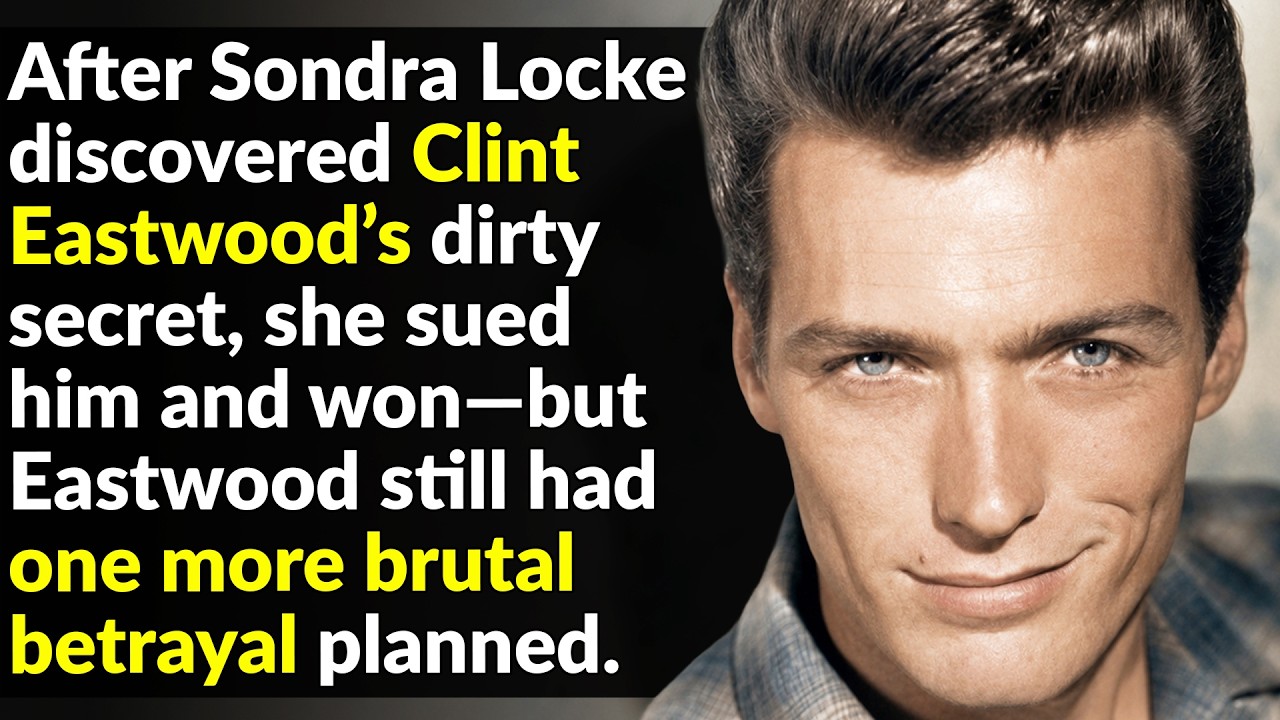
But Manes was just a friend. The woman who would face the worst of Eastwood’s ruthlessness was Sondra Locke. Clint Eastwood had been a Hollywood star long before Locke entered his life. Born in San Francisco in 1931, he liked to tell stories of a Depression-era childhood filled with hardship.
But Locke, who would become his long-time partner, later scoffed at those tales. By her account, Eastwood grew up on the rich side of town, with a swimming pool in the yard and a country club membership. He was a handsome young man, and things had a way of simply working out for him. When Universal Pictures came to shoot at Fort Ord, a cameraman spotted Eastwood and thought he belonged on screen.
He introduced the young man to director Arthur Lubin, who was instantly impressed by his movie-star quality. That impression lasted only until Eastwood auditioned. His acting was so bad that Lubin could only suggest he take some classes. Still, Universal signed him for one hundred dollars a week.
Rejections piled up. Directors thought he was terrible. His first major role for the studio was playing the scarecrow in a Christmas musical put on for employees’ children. But Eastwood knew he needed to improve, and he worked at it.
He discovered he could play anger better than most. In one improvised scene, his rage was so convincing that he reduced his young female acting partner to tears. The role that changed everything was Rowdy Yates on the television Western *Rawhide*. It brought him into millions of homes and made him a star.
It also revealed his dark side. Eastwood gained a reputation for laziness, rarely showing up on time. The crew learned to schedule his scenes late in the day, because he would stumble in exhausted and unmotivated. It wasn’t just exhaustion.
Everyone on set saw him take women into his trailer. He had married his first wife, Maggie Johnson, but cheating was a constant from the beginning. One affair, however, became far more serious than the rest. Roxanne Tunis, a stuntwoman on *Rawhide*, gave birth to his daughter Kimber in 1964.
The child’s existence was kept quiet. Meanwhile, *Rawhide* made Eastwood miserable, especially as his co-stars began landing movie offers. He heard about a strange Western shooting in rural Spain, directed by an unknown Italian named Sergio Leone. The lead had been offered to his co-star, Eric Fleming, who laughed at the idea.
Eastwood took the job. He earned fifteen thousand dollars for eleven weeks of work, plus a Mercedes-Benz as a bonus. The movie was *A Fistful of Dollars*. Few would have imagined what it would become.
The three spaghetti Westerns Eastwood made with Leone became some of the most iconic films in history, and by the end of the 1960s, Eastwood had finally eclipsed Rowdy Yates. Then came *Dirty Harry*. He was no longer a pretty boy cowboy. He was Clint Eastwood.
In his personal life, he seemed to turn a new leaf. He and Maggie had separated for a time but reconciled and decided to start a family. Their son Kyle was born in 1968, fifteen years after their wedding. A daughter, Alison, followed in 1972.
But even in 1971, Eastwood gave an interview in which he described his marriage as somewhat open. He meant one thing: he was still married, but that didn’t stop him from sleeping with whoever he wanted. Maggie put up with it, probably assuming his lovers were harmless fun. Then he met the woman who would change everything.
A young actress named Sondra Locke entered his life around the time of Alison’s birth. By 1975, the two were living together. Eastwood told her his marriage was essentially over, and she believed him. During those early years, their relationship was full of passion.
Locke later recalled that Eastwood seemed astonished at his need for her, admitting he’d never been faithful to one woman because he’d never been in love before. Locke moved into the Sherman Oaks house Eastwood had bought with his wife. Maggie had long since relocated to their Pebble Beach estate, but Locke could never feel comfortable there. She knew the house would always be Maggie’s.
Even after they moved, the spectre of Eastwood’s wife haunted them. Maggie Johnson quickly understood that the situation was different this time. She made her hatred plain, imposing strict rules on how often Locke could see Eastwood’s children and forbidding her from ever setting foot on the Pebble Beach property. In 1978, Maggie filed for legal separation after twenty-five years of marriage.
With all of Eastwood’s previous affairs, she could tell herself she was still the most important woman in his life. With Locke, that was clearly no longer true. The divorce took years to finalize, and Johnson reportedly walked away with a settlement of twenty-five to thirty million dollars. Meanwhile, Locke had a secret of her own.
She was married the entire time she lived with Eastwood, but it was not a traditional marriage. Her husband was Gordon Anderson, a gay man and her best friend since childhood. They were so close that they knew people would talk if they lived together. So they married and pretended to be a normal couple.
Eastwood knew the truth, and he even bought Anderson a house in West Hollywood. Both Eastwood and Locke claimed they didn’t need a piece of paper to prove their commitment to each other. In hindsight, that may have been the first red flag. Eastwood’s friends could see how devoted he was to Locke.
His long-time pal Fritz Manes said Eastwood was utterly devoted to her from at least 1976 to 1980. But “utterly devoted” meant something different to Eastwood. Locke was his heart, but he kept several other relationships going during those years without her knowledge. After Maggie filed for divorce, Eastwood wanted to marry Locke.
But Locke refused to divorce Anderson. She was in love, but she wasn’t stupid. Eastwood was a hard man to tie down, and she didn’t want to rush into a marriage that would blow up in her face. She put up with his mistreatment for years.
Then in 1989, she decided she had finally had enough. She ended their relationship. Since they had never married, she thought that would be the end of it. It quickly got messier.
Locke had been balancing her crumbling personal life with a rising career. Beyond acting, she was one of the few working female directors in Hollywood. After the split, she went to make her second film, *Impulse*. One day, she returned home from shooting to discover that Eastwood had changed the locks on their house and moved all of her belongings into storage.
She dropped any pretense of an amicable ending and went for the jugular. She sued Eastwood for palimony. She wanted revenge, but she didn’t realize what the fight would cost her. She faced the indignity of Eastwood describing her as nothing more than a part-time roommate, completely ineligible for palimony.
The legal battle dragged on for over a year. Then Locke received devastating news: she had breast cancer. She went through treatment, and the fight drained out of her. She agreed to a settlement that included a lump sum, monthly payments, and a directing deal at Warner Brothers.
Locke had been through hell, but at least she had something. Or so she thought. The directing deal turned out to be a dud. Many speculated that it was nothing more than lip service, and that Eastwood had allegedly sabotaged it behind the scenes.
Around the time the settlement was reached, Eastwood had already moved on. He had met Frances Fisher in 1998, before his split with Locke was even finalized. They started an affair on the set of his comedy *Pink Cadillac* and went public around the time he settled with Locke. Fisher later admitted she believed their relationship was the real thing, saying she had no idea that every woman he met probably felt exactly the same way.
Eastwood and Fisher had a child together, Francesca. Her birth marked the first time Eastwood had been present at the birth of one of his children. It was a miracle the relationship lasted five years. Fisher hadn’t even moved out of his home before Eastwood started dating Dina Ruiz, a news anchor thirty-five years his junior.
In a classic Eastwood move, he brought Ruiz to public events before he’d even announced the breakup with Fisher, the mother of his latest child. Eastwood and Ruiz married in 1996. They stayed together for nearly twenty years before that marriage, too, fell apart.