Iris Reynolds counted her tips for the third time. Eleven dollars. She needed forty-eight hundred by morning, or she would lose the only thing her late husband left her. The rain hammered the windows of Rosy’s Diner, and she tucked the money into her apron pocket, next to the creased photograph of Tommy she carried every shift.
“I’m trying, Tommy,” she whispered. “I’m still trying. ”
She pulled on a thin coat that hadn’t been waterproof in years and walked out into the storm. Colton, Alabama looked good on postcards, but underneath the polish, it ran on one simple rule.
Know your place. Iris knew hers. A thirty-year-old widow, a waitress, working sixteen hours a day, six days a week. Her shoes had holes she covered with duct tape, and she walked everywhere because she couldn’t afford the bus.
The house at the end of Oak Street had peeling paint and a leaning porch. The roof leaked. But it was hers. Or rather, it was Tommy’s.
Sergeant Tommy Reynolds, who died three years ago on a rescue mission. He went back into fire for two trapped soldiers. He pulled one out. Then he went back for the second.
He never came back a third time. They gave her a medal and a folded flag, then everyone left. The casseroles stopped coming after a week. The pastor stopped visiting after two.
And the survivor benefits, the money owed to every fallen soldier’s spouse, never arrived. She submitted the forms twelve times over three years. Twelve times the system told her the file didn’t exist. She had a feeling it wasn’t bad luck.
The county clerk who processed her file had lunch with Carlton Briggs every Tuesday. Carlton owned half of Colton, and he wanted her land for a shopping plaza. He’d bought out every neighbor except her. He’d made her offers.
She said no. He’d raised her interest rate. She scraped together payments. He shortened deadlines.
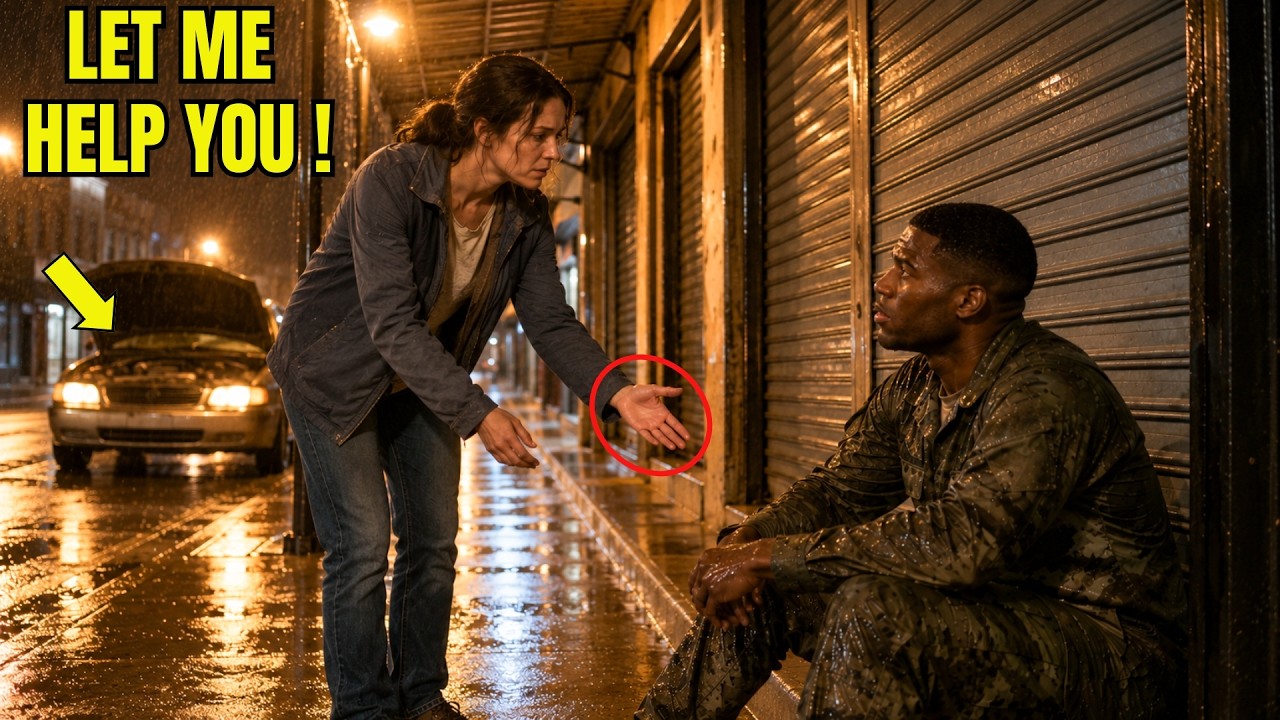
She picked up extra shifts. And now, with the final deadline at eight in the morning, she had eleven dollars and no more time. She was almost home when she saw him. A soldier sitting under the awning of Grayson’s General Store.
Uniform soaked through, hands shaking from cold, not fear. He had knocked on six doors that night, six houses with lights on and cars in the driveways, and every single one shut in his face. One woman looked at him through the screen, said, “Lord, no,” and spat on the ground. A man in a pickup slowed down just long enough to shout something about the color of his skin and the direction he should go.
Iris stopped. She looked at his uniform, the creases, the patches, the way the fabric clung to his shoulders. She’d seen that uniform before. She’d ironed it.
She’d folded it. She’d buried the man who wore it. She stepped closer. “Come on,” she said.
The soldier stared at her. “Ma’am, you really don’t have to do this. ”
“I know. ”
“People around here, they won’t like it.
”
Iris thought about the eleven dollars in her pocket, the house she’d lose in the morning, the town that had watched her drown for three years and never once thrown a rope. “I stopped caring what people around here like a long time ago. ”
She held out her hand. He looked at it for a long moment, then stood.
They walked two blocks down Oak Street, a white woman and a black soldier, past houses with closed curtains and turned-off porch lights. Everyone saw them. They just watched from behind their windows and said nothing. She gave him towels, then opened the closet she hadn’t opened in years.
Tommy’s clothes, folded the way she’d folded them when he first shipped out. She ran her fingers across the name stitched above the left chest, then held the sweatshirt and jeans out to him. “These should fit. ”
He looked at the name, then at her.
“Your husband’s. ”
She didn’t answer. She just held the clothes steady until he took them. In the kitchen, she heated a pan on a stove that took three tries to light.
She measured out the last cup of rice, cracked the last three eggs, opened the last can of beans. Everything she had left. She set the plate in front of him and sat across with a glass of water. “You’re not eating,” he said.
“I ate at work. ”
She hadn’t. He knew she hadn’t. But he also knew not to push it.
He ate every bite. The phone rang. She listened without saying much. When she hung up, her hand was still tight on the receiver.
“Everything okay? ” he asked. “That was my landlord. Carlton Briggs.
He owns most of this town. He’s been after this land for years. ” She paused. “He also heard you’re here.
”
“What did he say? ”
“He said, ‘You just made the biggest mistake of your life, bringing them into the neighborhood. ’”
The word *them* sat in the room like something sharp dropped on the floor. Nathan didn’t react.
He’d heard it before. “I should go,” he said. “I’ve caused you enough. ”
“No.
” The word came out fast and firm. “You haven’t caused me anything. Carlton has been trying to take this house for three years. The only difference is now he has something new to be ugly about.
” She picked up his empty plate. “I’m not going to put a soldier out in the rain because a man like Carlton Briggs doesn’t like the color of his skin. That’s not who I am. And that’s not what this house is for.
”
She made him take her bed. She slept on the couch with a crocheted blanket pulled up to her chin, staring at the ceiling. Sleep hadn’t come easily in three years. Then she heard the bedroom door open.
He appeared in the doorway, Tommy’s sweatshirt loose on his frame. “Can’t sleep,” she said. “No, ma’am. ”
She made them tea with her last two tea bags.
He wrapped his hands around the warm mug, the first real warmth he’d felt all night. “Why did you help me tonight? ” he asked. “You’ve got all this hanging over your head.
Tomorrow you might lose everything. Why stop for a stranger in the rain? ”
“Because my husband would have. He went back into fire for men he barely knew.
If Tommy could do that, I can open my front door. And because I know what it feels like to need help and have no one show up. ”
He looked at her for a long time. Then he told her about himself.
His father was a career soldier, a general. Nathan enlisted at eighteen, earned every promotion himself, never dropped his father’s name. But no matter how sharp his salute, how fast he ran, how straight he shot, there was always someone who saw the color first and the soldier second. Small things.
Wrong names. Worst details. Comments about natural athleticism or affirmative action. Never big enough to report.
Just big enough to let him know exactly where he stood. “I serve this country,” he said quietly. “I die for it. I almost have twice.
But tonight, this country wouldn’t even let me stand somewhere dry. ”
Iris’s jaw tightened. “My husband said something like that once. Two weeks before he died, he said, ‘Iris, I love what I do, but sometimes I wonder if the country I’m fighting for would fight for me if I needed it.
’”
Then she told him about the file. Twelve submissions. Three years. How Carlton Briggs had connections at the county clerk’s office, and how the benefits kept vanishing.
“Tomorrow at eight,” she finished, “Carlton is coming with the sheriff and paperwork to take this house. I owe forty-eight hundred. I have sixteen hundred. And there’s nothing I can do about it.
”
The phone buzzed. A text from Carlton. “8:00 a. m.
, Sheriff. Pack your things. ”
She set the phone face down. “I’ve been expecting that message for three years.
Tonight’s not going to be the night I fall apart over it. ”
At 5:15, the rain stopped. Nathan got up, folded the sheets the way the army had taught him, and left the room exactly as he’d found it. He draped the fallen blanket back over Iris.
Then he wrote a note on the back of a grocery receipt, set it on the kitchen table, and walked out without a sound. He called his father. General Harold Brooks, four stars, thirty-eight years in the army. Nathan told him everything.
The rain. The six doors. The insults. And Iris.
The woman who stopped. The dead husband’s clothes. The last meal. The landlord’s threats.
The town that called her trash for helping a black man. “Dad, her husband was a soldier. Sergeant Tommy Reynolds died three years ago saving his unit. She never got his benefits.
The file keeps disappearing. There’s a guy named Carlton Briggs who owns half the town, squeezing her for years. He’s coming to take her house this morning. Eight o’clock.
”
The line went quiet. The kind of quiet that means someone has already decided what to do. “A soldier’s widow, no benefits, and she gave her last meal to a stranger. Yes, sir.
Give me the address. ”
Within fifteen minutes, the general had his legal counsel pulling Sergeant Tommy Reynolds’s benefits file from the VA’s national database. What they found took less than an hour. The file existed.
It had always existed. Submitted, received, logged, processed through the first three stages. Then, at the local level, flagged, rerouted, and buried deliberately. The authorization code traced back to one office.
The Colton County Clerk. The same office where Phil Avery worked. The same Phil Avery who had lunch with Carlton Briggs every Tuesday. General Brooks put on his dress uniform with every medal and ribbon, and called for his car.
Iris woke to silence. The blanket was tucked around her, though she didn’t remember pulling it up. Nathan was gone. She found the note on the kitchen table.
*Iris, thank you not just for the food or the dry clothes. Thank you for seeing a soldier, not a skin color. I won’t forget this night. Nathan.
*
Below his name, a phone number. She looked at the clock. 7:45. Fifteen minutes.
She washed her face, combed her hair with her fingers, put on her cleanest shirt. She didn’t have forty-eight hundred dollars. She didn’t have a plan. But she would not let Carlton Briggs see her break.
At exactly eight, she heard engines. Not one engine. Several. Low, heavy rumbling.
The kind of sound that doesn’t come from a county sheriff’s sedan. She opened the door. Carlton Briggs was at the bottom of her porch steps, gray suit, leather folder in his hand. The sheriff stood behind him, arms crossed, looking like he’d rather be anywhere else.
But they weren’t alone. Three black SUVs were parked along Oak Street in a line so straight it looked measured. Two men in military police uniforms stood at the front vehicle. An American flag mounted on the lead car caught the morning sun and held it.
The door of the middle SUV opened. A man stepped out, tall, broad-shouldered, silver hair cut close. His dress uniform was pressed to a razor’s edge, and across his chest, row after row of ribbons and medals caught the light like small fires. Four stars on each shoulder.
General Harold Brooks walked across Iris’s front yard the way a man walks when he has spent forty years entering rooms where everyone stands up. Behind him, from the third vehicle, Nathan stepped out in full dress uniform. He didn’t move toward the porch. He stood by the car and watched.
The general stopped at the bottom of the steps. He looked up at her, and his dark eyes held something she hadn’t seen directed at her in a very long time. Respect. “Mrs.
Reynolds. My name is General Harold Brooks, United States Army. Nathan is my son. He told me what you did for him last night, and he told me what you’ve been through.
” He paused. “Your husband, Sergeant Tommy Reynolds, gave his life for this country. You deserved far better than what this town gave you. ”
Carlton stepped forward.
“Now, hold on just a minute. This is a private property matter. She owes—”
General Brooks turned his head. Just his head.
The rest of his body didn’t move. “Mr. Briggs. My legal team has spent the last three hours reviewing the benefits file for Sergeant Tommy Reynolds.
That file was submitted twelve times over three years. Each time it was received, logged, and processed, then flagged and buried at the local administrative level. The authorization codes trace back to the Colton County Clerk’s Office, to a man named Phil Avery, who I understand has lunch with you every Tuesday. ”
Carlton’s face went white.
“That’s—that’s not—I don’t know what you’re—”
“I’m not asking you a question, Mr. Briggs. I’m telling you what we found and what we’ve already forwarded to federal investigators. ”
Sheriff Boyd took a step backward, then another.
He looked at Carlton, then at the general, then at the ground. He chose the ground. The general turned back to Iris. His voice softened, the way a father speaks, not a general.
“Mrs. Reynolds, your husband’s benefits file has been restored. Three years of back pay will be processed within the month. And I’d like to help you with the mortgage.
Settle the balance. Get you clear of this. ”
Iris shook her head. “General, I appreciate what you’re doing more than I can say.
But I don’t take charity. I’ve been on my own for three years. I’m not going to start owing someone now. ”
The general looked at her, and for the first time that morning, he smiled.
A real smile. Small, warm, full of recognition. “I’m not offering charity, Mrs. Reynolds.
I’m offering a job. The Brooks Veterans Foundation works with military families across eleven states. Families who’ve lost someone in service and fallen through the cracks of a system that was supposed to catch them. We need someone who understands what that feels like.
Not from a textbook. From life. ”
He paused. “You work, you earn, you pay it back on your terms.
No interest. No timeline. No strings. ”
Iris looked at him, then at Nathan, still standing by the SUV.
She looked behind her at the open door of the house Tommy had left her. The house she’d fought for, scraped for, starved for. The house she’d almost lost, and the house she’d opened to a stranger because it was the right thing to do. She turned back to the general.
“Okay. But I pay back every cent. ”
“I wouldn’t expect anything less. ”
Carlton took a step forward.
“You can’t just—this is my town. I have rights. ”
General Brooks was already walking back toward his car. “Mr.
Briggs,” he said without breaking stride, “I suggest you find yourself a very good lawyer. You’re going to need one. ”
Carlton looked around. The neighbors had come out.
Standing on porches, watching from driveways. Not one of them looked at him. Not one said a word in his defense. Sheriff Boyd was already in his car, engine running.
Carlton Briggs stood alone on Oak Street, holding a leather folder full of paperwork that no longer meant anything. The weeks that followed were quiet in the way that healing is quiet. The mortgage was settled. The house was hers.
Tommy’s back pay arrived. Iris sat at the kitchen table, closed the laptop, walked to Tommy’s photograph, and whispered, “We made it. ”
She started at the foundation the following Monday, helping military families who had fallen through the same cracks she had. Widows drowning in paperwork.
Spouses who couldn’t get anyone on the phone. She was good at it, not because of training, but because she’d lived it. She paid back the general monthly, on time, every cent. He never mentioned it.
Carlton didn’t fare as well. Phil Avery cooperated with investigators within the first week. The trail was documented. Carlton had buried Tommy’s file to starve Iris into selling.
Fraud. Obstruction. He lost his seat on the board, his reputation, his tenants. The shopping plaza was never built.
And then there was Nathan. He called the next day just to check in. Then again two days later. They talked until her tea went cold and his voice went soft, and neither wanted to hang up.
His weekend visits started in October. He’d drive down from Fort Liberty on Friday evenings, park outside the house on Oak Street, and knock on the same front door that had been the only one to open for him that night. They’d cook together in the small kitchen, real meals now. They’d sit on the porch and watch the street go dark.
They’d walk the same route through the rain, except now the street lights worked and the air smelled like cut grass instead of storm. They didn’t rush. Both carried weight. Both knew that trust built slowly was the only kind that held.
But every week the distance grew a little shorter. Mrs. Henson knocked on Iris’s door one Tuesday afternoon. She stood on the porch, hands folded, eyes down.
“I should have opened my door that night,” she said. “I’m sorry I didn’t. ”
Iris looked at her, nodded once, and invited her in for tea. One year later, Iris Reynolds married Nathan Brooks in the backyard of the house on Oak Street.
A small ceremony. Wild flowers picked from the roadside. The same stretch of road where she’d found him in the rain. No fuss, just the people who mattered.
General Harold Brooks sat in the front row, four stars, hands folded. When Iris walked down the garden path in a simple white dress, he stood, and so did everyone. On a table beside where they stood was a framed photograph of Sergeant Tommy Reynolds, smiling in uniform, a single wild flower across the frame. He was still there.
He would always be there. Nathan took her hand. The man who had knocked on six doors and been turned away from all of them. The man who sat in the rain until a stranger with nothing decided he was worth everything.
Kindness doesn’t ask what color you are. It just shows up.