The pie was still warm when my mother tapped her wine glass with a spoon and announced we were having a family accountability meeting. She had an agenda, handwritten on her monogrammed notepad, propped against the gravy boat like a hymn board. I was the only one at that table who didn’t know what the meeting was about, which meant the meeting was about me. “This family runs on contribution,” she said, in the sweet, level voice she used for reading church minutes.
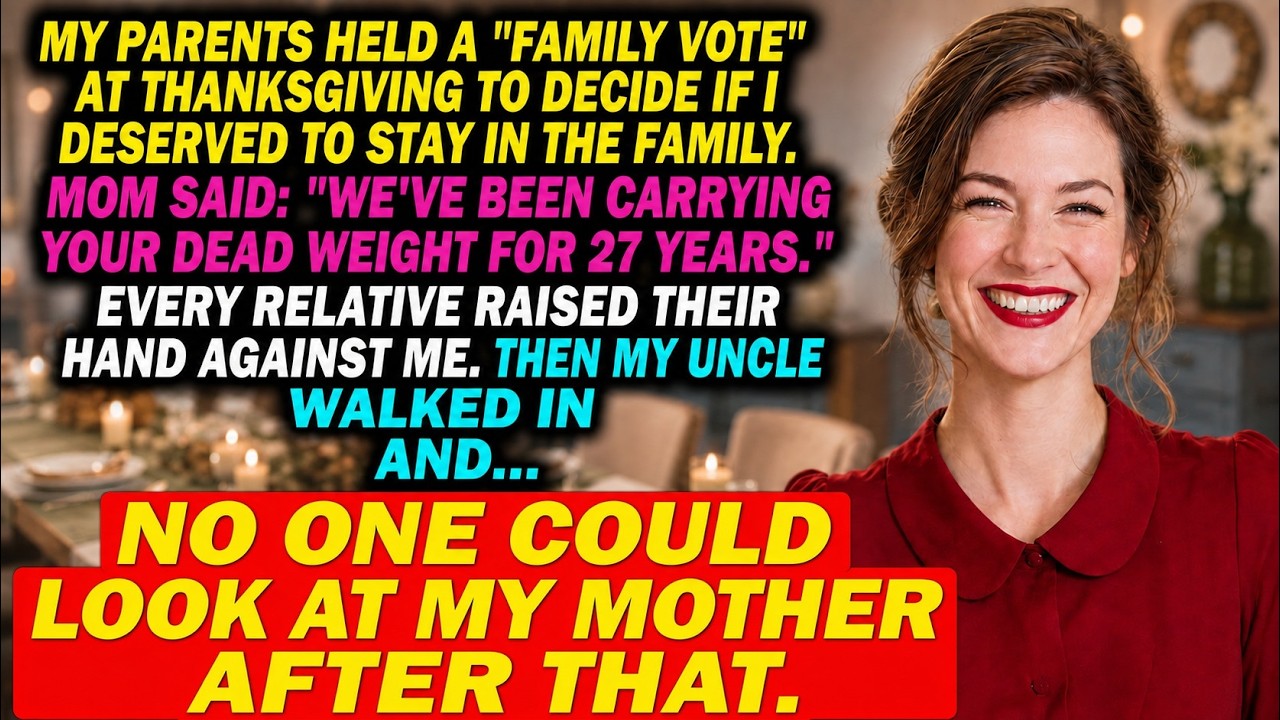
“Some people give. Some people take. And it’s time we stopped pretending not to notice. ”
Then she reached into her cardigan pocket and set down her evidence.
My grandmother’s wedding ring was missing from Birchwood, she said. It had been missing for weeks, and everyone knew who visited her the most. Every face turned toward me, slow and synchronized. I opened my mouth to answer, but Mom raised one finger, the way you quiet a child.
“You’ll get your turn, Vonda. First, the family deserves the full picture. ”
The full picture took four minutes. I was the daughter who flunked out and wasted tuition money.
The one who never chipped in. The one who showed up with a pie and a smile while everyone else bled for this family. She saved the closer, looking straight at me. “We’ve been carrying your dead weight for 27 years.
”
Twenty-seven. My exact age. She’d rounded my entire life into a debt. “All in favor of Vonda taking a step back from this family until she learns what it means to contribute, raise your hand.
”
Aunt Carol’s hand went up first, fast. Dale followed. Britney raised hers without looking up from her lap. Travis rubbed his jaw, glanced at Mom, and lifted his hand halfway.
Then my dad, the man who once drove four hours in a snowstorm to fix my water heater, put his hand in the air and couldn’t put his eyes anywhere near me. Hospice work teaches your face to stay still while your chest caves in. I used every hour of that training. I stood, folded the folding chair they always gave me, and leaned it against the wall.
“Keep the chair,” I said. Nobody spoke. I made it to the front hallway before my hands started shaking. And here’s what none of them knew that night.
My uncle would walk through that door twenty minutes later with one question in his coat pocket. And by Christmas, somebody at that table would be under investigation. It wasn’t me. But let me tell you why my father’s hand went up that night.
The answer starts eight years earlier with a phone call from a hospital. I was nineteen, a sophomore at Kent State, when my dad had his stroke. He survived, thank God, but the right side of his body came back slow. Somebody had to be there for the shower rails, the physical therapy, the pills sorted into little plastic mornings and nights.
My mom kept working. “Somebody has to keep the insurance,” she said. Which was true. And also very convenient, because it meant the somebody in the house was me.
I withdrew from the semester. I told myself it was one semester. It was seven months of driving Dad to therapy, learning to cook low sodium, and sleeping with one ear open. My scholarship didn’t survive the withdrawal.
I have never once regretted those seven months. My dad got most of himself back, and I would do it again tomorrow. Here’s what I didn’t see coming. The story that got written about it.
By the time Dad could drive again, the version circulating at family dinners was that Vonda flunked out and threw away the tuition her parents had scraped together. Mom never said it to me directly. She said it near me. Over coffee.
To the church ladies. Once, memorably, to a checkout girl at Kroger who asked how I was doing. “She’s finding herself,” Mom said, with a little laugh that did all the work. I corrected the record exactly once.
And Mom sighed and said, “Honey, nobody likes a martyr. ”
That was the first entry in the family ledger written in my name, and I didn’t fight it. Every entry after that got easier for her to write. Every family has an economy.
Ours had an accountant. My mother tracked contribution the way the IRS tracks income, but only the kind you could see from the head of the table. When Travis paid for the new roof, it got announced at Easter with a toast. When Carol chipped in for a wedding, it was mentioned for six straight years.
Money counted. Roofs counted. Anything with a receipt counted. What didn’t count?
Rides. Casseroles. Seven months of a sophomore year. Any hours spent keeping a human being alive.
That work was invisible. And in my mother’s economy, invisible meant free. And free meant worthless. My assigned seat told the whole story.
From the year I was nineteen, my place at every holiday was the folding chair from the garage, wedged at the corner between the table leg and the china hutch. “You’re flexible, sweetheart. ” That’s what she said the first time, and the chair simply became mine, the way a nickname becomes yours. Travis got a chair with arms.
I got the one that pinched. My dad knew better, I think. He’d been the one holding my arm through those seven months. But Dad had learned a long time ago that contradicting Denise in public cost more than it paid.
A ledger only works if everyone believes the bookkeeper. And everyone did. Including, for longer than I want to admit, me. Here’s the part of my story my mother never told anyone.
After Dad recovered, I didn’t go back to Kent State. The money was gone. So I took the long way. I worked front desk at a dental office, got my LPN through night classes, and passed my RN boards at twenty-four.
I chose hospice, which people assume is depressing. It isn’t. Hospice is the department of last honest conversations. It’s the job where you stay when everyone else finds a reason to be in the hallway.
I had my own apartment, a Corolla with a lot of miles and a lot of loyalty, and a savings account I was quietly proud of. $7,500, built fifty dollars at a time, labeled “house” in my banking app. First house. Mine.
Nobody’s folding chair. The only reason I still went home for every holiday had a name. My Grandma Pearl. She was the only person in that family who ever asked me what those seven months had cost me.
Everyone else just counted what I owed. Pearl kept a garden that fed half the street, wore the same thin gold wedding band for sixty-three years, and could end an argument with one raised eyebrow. When I got my nursing license, she framed a copy. Framed it.
Hung it in her hallway between her wedding photo and a picture of Jesus, which in Pearl’s house was the highest real estate there was. So when Pearl started slipping, I noticed before anyone else did. Noticing was my profession. It was about to become my burden.
It started the year I was twenty-two with a pot of green beans scorched black and a smoke smell she blamed on the neighbors. Then the same question three times in one phone call. Then her Buick found parked on the shoulder of Quarry Road, a half mile past her own driveway, with Pearl insisting she just wanted to look at the pasture. I’m a nurse.
I knew what I was looking at. I said so, carefully, at Sunday dinner. My mother waved it off with a fork. “Mom’s just tired.
She’s been tired for eighty years. ”
I didn’t let it go. I drove Pearl to her doctor myself, sat in on the appointment, started a medication list, put whiteboard reminders on her fridge. But you can’t be there at two in the morning when she puts a kettle on and forgets it.
That January, Pearl walked out to get the mail in fourteen-degree weather in her house slippers and was found two streets over by a man walking his dog. At the hospital, while I was talking discharge planning with the social worker, my mother arrived carrying a folder. Inside was a power of attorney, financial and medical, naming Denise Thatcher as agent, signed by Pearl on one of her good days two months earlier. I never found out what Pearl understood she was signing.
“Don’t look so surprised,” Mom said, clicking her pen. “Somebody has to be the grown-up, and we all know it can’t be you. ” She squeezed my shoulder on the way past. “I’ll handle everything from here.
”
Those words should have been a comfort. They were a door closing. Birchwood Memory Care sat twenty minutes from my apartment. It was good.
Good costs money. $3,700 a month. At the family meeting in my parents’ living room, Mom ran the numbers like a treasurer. Pearl’s house would be kept for the family.
Her savings were spoken for. Mom’s brother Gene would cover half. Mom and Dad would manage the rest. I raised my hand and offered to contribute.
I had a nursing salary. I had standing, or thought I did. My mother laughed in front of everyone. The laugh she saved for making a person smaller.
“Sweetheart, you can barely manage yourself. ”
But in the kitchen afterward, while I rinsed plates, she appeared at my elbow with a different voice entirely. Flat, quick, no audience. “If you actually want to be useful for once, the shortfall is eighteen fifty a month.
But you will not parade it around. This family doesn’t need a martyr. It needs discretion. ”
I said yes before she finished the sentence.
Of course I said yes. It was Pearl. The next morning, I set up an automatic payment from my checking account, made out directly to Birchwood, $1,850 on the first of every month. I told no one, exactly as instructed.
I thought I was buying my grandmother’s care. It took me four years to understand I was also buying my mother an alibi. Let me tell you what $1,850 a month looks like from the inside. It looks like picking up the Saturday overnight shift every week for four years because overnights pay a differential.
It looks like a Corolla that rolled past 180,000 miles while I patched her with YouTube videos. It looks like the house fund in my banking app frozen at $7,500 like a fly in amber because the first of the month always came around again. I’d sit with a dying stranger until dawn, holding a hand nobody else came to hold, then drive to Birchwood before sleep and read Pearl a chapter of the Louis L’Amour western she’d loved since 1962. Forty-eight payments.
Four years. And not one person at that Thanksgiving table knew my name was on a single one of them. That wasn’t an accident. Every statement, every invoice, every piece of mail from Birchwood went to the power of attorney on file, to my mother.
She was the only window into that building, and she decided what the family saw through it. What they saw was Denise and Roy heroically managing. Meanwhile, the story about me kept compounding interest. Still renting.
Still single. Still driving that sad little car. Bless her heart. Bless my heart.
I did try once to set the record straight. Thanksgiving, the year I was twenty-four. Britney, between bites of my pie, asked the question she’d clearly been sent in with. “So what do you actually contribute?
Everybody else pitches in. ”
I kept my voice level and said, “I help with Grandma’s facility. Every month. ” For about two seconds, it felt like stepping into sunlight.
Then my mother laughed, warm, indulgent, aimed at the whole table. “Oh, honey, we let her chip in a little. It teaches responsibility. Roy and I handle the real costs, obviously.
Obviously. ” Carol nodded. Dale nodded. Travis reached over and patted my shoulder.
I promise you no one has ever been patted smaller. And here’s the trap, the actual mechanical trap. Every bill went to her. Every statement, sealed behind a power of attorney I had no legal right to see around.
Birchwood’s staff were kind to me as a visitor and a fellow nurse, but kindness doesn’t override privacy law. To prove my payments existed, I’d have had to hand my bank statements around the gravy like a crazy person on trial at my own dinner, calling my mother a liar to her face with Pearl’s care hanging in the balance. She held the paper. She held the story.
She held my grandmother. So I did what I always did, what I had trained myself to call strength. I got quiet. And quiet, I would eventually learn, was the most expensive thing I ever gave that family.
You might wonder why grown adults let one woman run the whole family off a handwritten agenda. Simple. Every hand at that table was in her debt. When Travis’s heating and cooling business hit the rocks, it was Mom who slid a check across his kitchen table.
$25,000, with the reminder renewed at every holiday since. When Carol’s transmission died, the Bank of Denise covered it. When Dale got laid off, groceries appeared. She never called them loans.
Loans get paid off and closed. These were gifts. And gifts in my mother’s economy came with a lifetime of compounding gratitude, payable in loyalty, on demand. I watched it for years and called it generosity.
It took me embarrassingly long to do the simple math a stranger would do in a minute. My mother worked part-time keeping books for a granite countertop place. My father had a machinist’s pension. People like that do not have $25,000 lying around to rescue a son’s business, plus transmissions, plus groceries, plus half of Birchwood.
The money had to be coming from somewhere. I never asked where because the somewhere had always been dressed up as my parents’ sacrifice, and questioning sacrifice is sacrilege in a family like mine. The person who finally asked the question wasn’t me. It was the quiet man in the corner, and he asked it out loud.
One Sunday in October, Pearl had a clear day, sharper than I’d seen in a year. She worked the thin gold band off her finger. It fought her. Sixty-three years leaves a groove.
And pressed it into my palm. Then she folded my fingers over it, one at a time, deliberate as prayer. “Grandma, no,” I said. “That stays with you.
”
Her hands stayed over mine, stronger than they had any right to be. “Some things shouldn’t go in the ledger,” she said, clear, level, looking me dead in the eye. Then her eyes went to the window again, and she added softer, half to herself, “Hold on to it. The vultures circle when the pasture’s for sale.
”
I tried to give it back the next Sunday. She looked at the ring, looked at me, and raised the eyebrow. Conversation over. So I threaded it onto the chain around my neck, next to the little cross and behind my nurse badge, where it rested over my sternum every shift after.
Guarding it. Not keeping it. Three weeks later, my phone rang. It was my mother, whom I hadn’t heard from in months, and there was no hello.
“Vonda, where is your grandmother’s ring? ”
What my mother was really asking only makes sense next to the letter that had landed in mailboxes that same week. Birchwood was closing its memory care wing. Corporate restructuring.
All residents to be transitioned within ninety days. For most families, that letter was a headache. For me, it was a starting gun. I work in this world.
I know which buildings are good before the tour starts. Harbor Pines was smaller, better staffed, had a memory garden Pearl would love, and was ten minutes from my apartment instead of twenty. There was even a chance to soften the cost. Walt had been a Korea-era veteran, and there are aid programs for widows nobody tells families about.
All of it needed two things I didn’t have: the power of attorney’s signature and Pearl’s financial records for the application. I called my mother, kept it practical, laid it out. The closure. Harbor Pines.
The veterans program. The deadline. I offered to do every ounce of the paperwork myself. She let me finish.
Then, in the voice she used for waitresses, she said, “Your grandmother’s finances are none of your business. They never have been. Don’t call this number about this again. ”
Something four years deep in me finally shifted its weight.
“Fine,” I said. “Then I’ll ask the billing office myself. Ninety days, Mom. Someone has to move.
”
The silence on the line lasted three of my breaths. I remember thinking, in my innocence, that I’d finally gotten through to her. What I’d actually done was trip a wire. She hung up without a word, and the machinery began to turn.
The ring call came that Friday. “Vonda, where is your grandmother’s ring? ” I said Pearl had given it to me to hold, that I wore it on a chain, that she could see it anytime. “Interesting,” my mother said, and the word had edges.
“Grandma can’t consent to giving away assets, sweetheart. You of all people should know that. ”
Assets. Her mother’s wedding band was an asset now.
By Sunday, the family group chat had a new topic. Carol: “Has anyone else noticed things going missing at Birchwood? ” Britney: “Didn’t Grandma have a ring? ” Dale: “Sad.
You think you know people. ” Nobody named me. Nobody had to. I was the one who visited every week, which had somehow stopped being devotion and become opportunity.
The same week, Britney forwarded a real estate listing. Pearl’s place on Quarry Road. “Getting an appraisal,” Mom explained in the chat, breezy. “Just being responsible.
” And when I called Birchwood’s billing office like I’d promised, the kind woman there was suddenly very sorry. Records could only be discussed with the power of attorney. “There was a note on the account now,” she said, apologetic, and I could hear it was new. Every door I might walk through was being locked in order, quietly, while the group chat sharpened its opinion of me.
Then, Tuesday of Thanksgiving week, a text from my mother, sweet as pie filling. “Come home Thursday, sweetheart. We’ll sort everything out as a family. ”
I almost didn’t go.
I sat in my car in the hospice parking lot Wednesday night and talked it through with Rosa, the social worker on my unit, in that hypothetical way we all use. Asking for a friend. Family stuff. I asked what a person could do if a relative with power of attorney was stonewalling a needed facility transfer.
Rosa didn’t sugarcoat it. “With outstanding, not much. POA is a fortress. Unless something rises to the level of adult protective services, the agent holds the cards.
”
Adult protective services. I actually laughed and said we weren’t there. It was just family being family. Rosa gave me a look I’ve given other people a hundred times and said, “Okay, but write things down with dates.
”
Thursday I baked the pie because showing up empty-handed is an entry in the book, and I drove to my parents’ house with the radio off, rehearsing calm sentences about Harbor Pines and ninety days. One thing nagged at me. Gene wasn’t coming. Uncle Gene came every year, quiet in the corner.
But Mom had mentioned offhand that Gene had a thing, that he’d come Friday instead. Gene had never had a thing in his life. I filed it under mercies and kept driving. Then I turned onto my parents’ street and slowed.
Cars lined the driveway and spilled along the curb, more than any Thanksgiving I could remember. It looked less like a dinner and more like a quorum. It was one. So now you know what I knew, standing in that front hallway with my hands shaking.
The handwritten agenda wasn’t a quirky habit. It was a script. The missing ring wasn’t an accusation. It was insurance, because you don’t have to answer a witness’s questions if you’ve already made her a thief.
Dead weight wasn’t an insult. It was an eviction notice, read aloud for the record in front of the whole jury of people who owed her. She had rounded my life to zero in public so that if I ever stood up waving bank statements, the room would already know what I was. Unstable.
Ungrateful. Caught stealing from her own grandmother. Twenty-seven years of quiet cashed against me in four minutes, and the hands went up. Carol fast.
Dale steady. Britney hiding in her lap. Travis at half-mast with his $25,000 reasons. And my father last, my father slowest, my father not looking at me.
That’s the part I couldn’t file anywhere for the longest time. The hand that had held my arm through seven months of therapy hallways. I couldn’t spare that one. I stood in the hallway breathing like I teach dying men to breathe, in for four, out for six, my keys already in my fist.
And that’s when headlights swept the curtains and gravel popped in the driveway and I heard the particular slam of a pickup door that every person in that dining room knew by heart. Gene had not waited for Friday. My uncle Gene is sixty-two years old, a retired electrician, a widower, and the least dramatic human being God ever made. He entered the house the way he entered every house, without knocking, wiping his boots longer than necessary.
Then he stopped in the dining room doorway and took inventory. The untouched pie. The agenda against the gravy boat. Eleven guilty faces.
And me in the hallway with my coat half on. His hat was in his hands. I’d learn later that the hat in the hands was the tell. Gene holds his hat when he’s decided something.
“Am I late for dinner,” he said to no one in particular, “or for whatever this is? ”
You could hear the dishwasher change cycles. My mother recovered first. She always recovered first.
“Gene, we didn’t think you could make it until Friday. There’s plenty left. Let me fix you a plate. ”
“Yeah,” Gene said, not moving.
“About Friday. ” He set his hat on the sideboard, which he had never once done in my lifetime, and looked at his sister. “Funny thing happened this week, Denise. I called Birchwood’s billing office about the rate increase.
”
The room did not gasp. It did something quieter and worse. It went perfectly still. “Maybe the family,” Gene said, pulling out the chair nobody sits in, “should hear about my phone call before anybody votes on anything.
”
He sat down like it was a work site and he had all day. “Rate increase notice comes. I called to ask what the new number is going to be, since I pay half. Nice girl in billing pulls up the account.
She thanks me for being such a reliable family. Says, and I’m quoting as best I can, ‘Between you and the granddaughter, this is one of our smoothest accounts. Four years of auto pay and she’s never missed a month. ’ So I ask her.
‘Which granddaughter? ’”
Every head at that table turned toward me for the second time that night. But the current had reversed. Sunflowers again.
Different sun. I hadn’t moved from the hallway doorway. I couldn’t have moved if my house were burning. My mother laughed, a small bright thing with nothing under it.
“Gene, honey, there’s obviously a mix-up. Vonda chips in a little something. We’ve never hidden that. ”
“Eighteen hundred and fifty dollars?
” Gene said. “A month. ” He said it the way he’d read a meter, no flourish. “Same as mine.
To the dollar. Which is funny, Denise, because eighteen fifty plus eighteen fifty is the whole bill. ”
Nobody breathed. Travis’s face was doing slow arithmetic.
Carol’s hand had found her necklace. “So, here’s my first question,” Gene said, and finally looked straight at his sister. “For four years you’ve told me you and Roy were covering the other half of Mom’s care. The girl’s auto pay is the other half.
So what exactly have you been covering? ”
The dishwasher clicked off. The silence it left behind had a texture, like the air after a lightning strike. My mother straightened the agenda against the gravy boat, a bookkeeper squaring her papers.
“That is a gross oversimplification. ”
Gene nodded slowly. “Then let’s un-simplify it. Before I drove up here, I stopped by the bank.
Our names are both on Mom’s old accounts from when Dad died. Denise had me sign on to everything years back. Said it was easier. ” He rubbed his jaw.
“First time I’ve ever looked. My mistake, and I’ll carry that. ”
He laid it out in his flat electrician’s voice, a man reading a panel that someone had wired wrong on purpose. Pearl’s pension and her social security, $2,300 a month, had been direct deposited every month for four years into an account meant for Pearl’s expenses.
Not one dollar of it had ever reached Birchwood, because Birchwood was already paid in full by me and by Gene, neither of us knowing about the other. “Two thousand three hundred a month, forty-eight months,” Gene said. “That’s one hundred and ten thousand dollars, give or take, sitting somewhere, spent on something. ” He looked at his sister with something worse than anger.
It was grief with its sleeves rolled up. “Who’s been carrying whom, Denise? ”
No one could look at my mother. In a family where looking at Denise for permission, for approval, for the weather report was our whole religion, no one could look at her.
Carol studied her plate. Dale studied Carol. Britney had gone the color of the tablecloth. My father sat with his eyes shut like a man in a falling elevator.
Travis was the one who broke, his voice coming out young. “Mom, the twenty-five grand for my shop. ” Not a question. Barely even words.
My mother did not answer him. Here is the part I didn’t expect. My mother did not deny it. She stood up, smoothed her cardigan, and defended it.
“Fine,” she said, calm as a closing statement. “Let’s talk about carrying. ” And she took us to 1979, her father dead in March, a machinist’s widow with two kids, and Denise, twelve years old, at the kitchen table every Sunday night with a composition book, doing the grocery math so her mother wouldn’t cry in front of the milkman. Who found the money when the furnace went?
Who organized every funeral, every wedding, every Christmas? Who drove Mom to every appointment for thirty years? Her voice never rose. It crystallized.
“You think care is free? I have been this family’s bank since I was a child, and a bank collects. That money is my wages, forty years of wages. I just collected them myself.
”
For one terrible second, I saw her whole. The girl with the composition book who learned that the only person who never gets thrown away is the one holding the ledger, and who grew up to make sure of it. My chest actually ached for her, and I hated that it did. Then she turned to me, and the softness she’d never once spent on me came out for the kill.
“You of all people should understand invisible work, Vonda. ”
The room waited. Four years of quiet stood up in me and for once said something short. “I do understand it, Mom.
I just never send Grandma the bill. ”
I watched the sentence land. Watched her flinch like the words had mass. And my father, who had not said a thing since his hand went up, pushed back his chair, stood, and walked out of the dining room.
We heard the bedroom door click shut, gentle as an apology, and somehow that small sound ended the evening. A family can take years to build and twenty minutes to empty. Carol left first, murmuring, “We didn’t know,” to a point on the wall between Gene and me. Which was true and also useless, since not knowing had been the whole design.
Britney was doing something urgent on her phone, and I’d bet my license she was scrubbing the group chat. Travis stayed in his seat the longest, staring at the table like the wood owed him an explanation. When he finally passed me in the hallway, he stopped, opened his mouth, and settled for “Vonnie” before his voice quit on him. He hadn’t called me Vonnie since middle school.
Nobody apologized. I need you to hear that. Nobody apologized. And some of them, I could already tell, were quietly furious at me because the truth had made accomplices of them all, and it’s easier to resent the witness than to refund the loyalty.
My mother cleared dessert plates alone, spine straight, a treasurer after the audit, already redrafting. I collected my pie, untouched, still in its carrier, because leaving it felt like tithing to a church I’d just quit. Gene followed me out to the cold driveway and stood by my car the way he stands at gravesides. “You should have told me, kid,” he said at last.
I looked at this good, quiet man, and I was too hollowed out to be gentle. “You should have asked. ”
He took that like a man checking his own wiring and nodding at the fault. Then I drove the fifteen minutes back to my apartment, sat in the parking lot, and let my hands shake.
I believed the worst night was behind me. My mother was just getting started. Five days. That’s how long it took her to remind everyone who still held the paper.
Monday after Thanksgiving, I drove to Birchwood for my usual visit and was met in the lobby by the director who could not look at me either. It was becoming a theme. Pearl had been checked out that morning, transferred. The power of attorney had signed her out to a facility called Crestline Manor, two and a half hours south.
A name I knew from professional gossip the way you know a restaurant with a C rating. Cheaper by a lot. Staffing ratios you could read from the parking lot. And the new resident file included a visitor list drawn up by the agent under her authority.
My name was not on it. Neither was Gene’s. My mother had taken a hundred and ten thousand dollars from her own mother, been caught in front of the family she ruled, and her answer was to move the evidence. To move my grandmother beyond my reach.
And to lock the door with the same laminated document she’d carried into that hospital four years ago. The Quarry Road listing went from appraisal to a red “sold pending” banner that same week. She needed to fill the hole in the money before anyone with authority came looking, and the house was the plug. I did the thing I had spent my whole life not doing.
I looked up probate attorneys, picked the one two towns over with the elder law certification, and sat in a parking lot saying my own family’s story out loud to a stranger on the phone, which is a kind of dying if you’ve never done it. The consultation was free. The retainer was not. $7,500.
The exact size of my first house fund, to the dollar. The universe keeps a ledger, too, apparently, and it has a sense of humor. The attorney’s name was Marjorie Okafor, and she had no patience for softening things. She walked me through it in an hour.
A power of attorney is not a crown. It’s a duty, and an agent who diverts the principal’s funds for her own use has broken it. That’s called financial exploitation, and it has remedies with teeth. Remedy one: a report to adult protective services.
Remedy two: a petition for emergency guardianship asking the probate court to suspend the POA and appoint someone else, me, to make Pearl’s decisions until the dust settled. Both at once was the strong play, especially with Gene’s bank records, his testimony, and the dated notes I’d been keeping since Rosa told me to write things down. Then she folded her hands. “You’re a nurse, Vonda?
Licensed in Ohio? ” I said yes. “Then I’ll tell you what you already know. With what you’ve seen, you may not have the luxury of staying neutral.
You’re a mandated reporter. Family doesn’t exempt you. ”
I looked at the petition on her desk, my name typed above a signature line. In the matter of Pearl Prescott, an alleged incompetent, the law’s tender vocabulary.
And I’ll tell you the truth I’m not proud of. I asked for time. “There’s no version of this where your family stays intact,” Marjorie had said gently, like a diagnosis. And the oldest muscle in me was still flexing.
Handle it quietly. Carry it privately. Don’t make the family choose. Because some part of me still believed that if I just carried enough, someday somebody would look up and see me doing it.
The petition sat unsigned on her desk when I left. It sat unsigned for six days. On the seventh day, my phone rang at work. An area code from two and a half hours south, and a voice said, “Is this the granddaughter?
” Crestline Manor was calling me because I was listed in Pearl’s old Birchwood chart as an emergency medical contact. A leftover nobody had thought to scrub. Pearl was in the hospital. Dehydration.
A urinary tract infection gone systemic enough to scramble her worse than baseline. Several days of missed medications. “We’ve been a bit short-staffed,” the voice said, which is the eleven o’clock news of nursing homes. It means exactly what you fear.
I drove two and a half hours through December rain with my wipers on the fast setting and my mind on the flat, factual setting I keep for the worst shifts. I knew precisely how this happened. Not villains. Arithmetic.
One aide to too many residents. A woman who can’t ask for water because the fog took the asking. A med cart that runs late until late becomes never. My mother had parked her own mother inside that arithmetic to save money that was never hers to save.
The hospital was small and clean and trying. Pearl looked like a rough draft of herself against those pillows, and I did the thing I do for strangers and had never once needed to do for her. Checked the IV site. Read the bag.
Counted her breaths against my watch. Then her eyes opened, and the fog was thin. God knows how. Her hand came up off the blanket, slow as a lift bridge, and found the chain at my neck.
The cross. The badge. The ring. Her fingers closed around the ring and she held on, and she looked at me.
She didn’t say anything. She didn’t have to. There was a knock behind me. Knuckles soft on the doorframe.
My father stood there holding his hat, saying, “Your mother sent me. ”
My dad is not a talker, so I knew every sentence had been packed for him like a lunch. He stood at the foot of Pearl’s bed and delivered them in order. The family had met.
Another meeting, imagine. And everyone agreed things had gotten out of hand. The vote was rescinded. “It’s like it never happened, Vonda.
Your mother is prepared to pay back every cent, on a schedule, handled inside the family, the way family should handle things. Come home for Christmas. Your chair is at the table. A real chair.
” He actually said that. I could hear my mother’s drafting in it, the way you taste when someone else salted a dish. And then the closer, delivered with his eyes down. “Mom even says she’ll put your name on Grandma’s house, the Quarry Road place.
It’d have come to you someday anyway. She knows what your next phone call could be, honey, and she’s scared it’ll ruin her. No investigators. No courts.
Family handles family. ”
He finally looked up at me, and his eyes were wet, and his voice cracked out of the script into something real. “You’d have everything back, honey. Everything you ever wanted from us.
”
And God help me, he was right. That was the precise engineering of it. Twenty-seven years of wanting exactly this. The seat.
The name. The house with the garden. My father’s eyes on me instead of on the tablecloth. Dangling in a hospital room with the price tag turned discreetly over.
All I had to do was keep the one skill I’d been perfecting my whole life. All I had to do was stay quiet. Behind me, Pearl’s monitor kept its small green time, steady, patient. For a second, the beeping sounded like a metronome.
Like something counting. I looked at the woman in the bed who had never once in her life asked me to earn her. Then I looked at my father, and I heard myself exhale, and it sounded like the end of something. “Sit down, Dad,” I said.
And he sat, because the chair was there, and his knees were tired, and his daughter used her nurse voice. I held the ring on its chain where he could see it. “You know what Grandma told me when she gave me this? She said, ‘Some things shouldn’t go in the ledger.
’”
His face moved. “Mom’s offer is a ledger, Dad. It’s the nicest page anyone’s ever written me in it. My chair.
My name. My inheritance. Line items. Price to move.
And the price is that I never say out loud what happened to Grandma. I’ve been paying into that book my whole life, waiting for it to balance. It never balances, because the bookkeeper needs me in debt. The vote was her collecting.
This offer is just her lending. ”
I looked at Pearl. The fog had taken her somewhere else again. Her hand had gone soft around the ring, trusting it to me.
“She’s got maybe a good year left, Dad. Whatever’s left of her is not going to be spent as leverage in a settlement between her daughter and a courtroom. Not while I’m licensed and breathing. ”
My father, very quietly, “She’s your mother, Vonda.
”
“I know,” I said. “And Pearl is hers. Tell her I’m not voting on this. I’m done with votes.
”
Then I walked past him into the hallway, under the fluorescent hum, past the vending machine with its tired glow, and I did the thing that ends the old life and starts whatever this one is. I called the county’s adult protective services line, gave my name, my license number, my relationship to the victim, and said the sentence out loud for the first time. “I’m calling in a mandated report of financial exploitation of an elder. The suspected party is my mother.
”
My voice held. It held the way it holds at three a. m. bedsides, which is to say, because it has to.
Then I called Marjorie Okafor’s after-hours line and said, “File it tonight. ”
Through the wire glass window of the family lounge, I could see my father sitting with his elbows on his knees and his face in his hands. And I understood with perfect clarity what I had just spent. Not the $7,500, though that was gone, too.
My little white house with the porch, traded for a retainer and a courtroom. No. I had spent the family. The door I’d been knocking on for twenty-seven years, I’d just taken my hand off it forever.
And the hand felt light. And the lightness felt like grief. And grief, it turns out, is just love with the invoice finally torn up. I stood in that hallway and let both be true.
I would do it again before breakfast. The emergency hearing came the following week in a courtroom the size of a Sunday school room. Gene testified for eleven minutes in his meter-reading voice and repeated his question exactly once, under oath, where it belonged. The judge granted temporary guardianship to me, suspended the power of attorney the same afternoon, and froze the Quarry Road sale while the investigation ran.
APS substantiated the finding. Financial exploitation. $110,000 and change. There is always change.
My mother, through a lawyer from two counties over, signed a restitution agreement. Every dollar returning to Pearl’s estate on a schedule. The prosecutor, weighing an eighty-four-year-old witness who couldn’t testify and a family drowning quietly, accepted it in lieu of charges. No handcuffs.
Real life is smaller than television and harder. Pearl came back north to Harbor Pines, ten minutes from my apartment, into a room that looks out on the memory garden. Half the family stopped speaking to me. “You don’t call the government on your own mother,” Carol told Britney, who made sure it reached me.
The Christmas cards that year came to about a third of the usual. Travis started repaying the $25,000 into Pearl’s account, unasked, in small monthly amounts, which is how a man like my brother apologizes. And one night in January, my father sent me a single text. No greeting.
No punctuation. “I should have kept my hand down. ”
I haven’t answered it yet. Not never.
Just not yet. This Thanksgiving, one year almost to the night, there were six of us in my apartment, which is five more than I expected and exactly the right amount. Gene brought a turkey he smoked in a converted filing cabinet, because retired electricians are like that. Rosa came, and two nurses from my unit, and my widowed neighbor who otherwise eats over the sink.
I spent October collecting chairs from the second-hand store. A spindle back. A church pew stub. A green vinyl diner chair.
No two matching, like the people. Every one of them a real chair. In the afternoon, we drove to Harbor Pines, and in the good light by the window, I took the chain off my neck and worked the thin gold band back onto my grandmother’s finger, where sixty-four years had worn the groove that fit it. It was never mine to keep.
It was only mine to guard, and the guarding was over. Pearl looked at the ring a long time. Then she patted my hand twice. Like I was the one who needed comforting.
Which, fair. At dusk, my doorbell rang, and my brother stood on the mat holding a chair. An actual chair from his own kitchen. “Heard you don’t do folding chairs anymore,” Travis said.
I opened the door the rest of the way. For twenty-seven years, I thought I was the dead weight. Turns out I was the floor. I put the weight down, and I kept the people who never asked me to carry it.
Here is what I know now. A family that makes you vote for your place at the table was never offering you a seat. It was renting you one, and the rent always goes up. Love doesn’t keep books, and anyone who tells you otherwise is charging you interest.
That’s my story. One vote. One open door.
And one ring that finally went home.