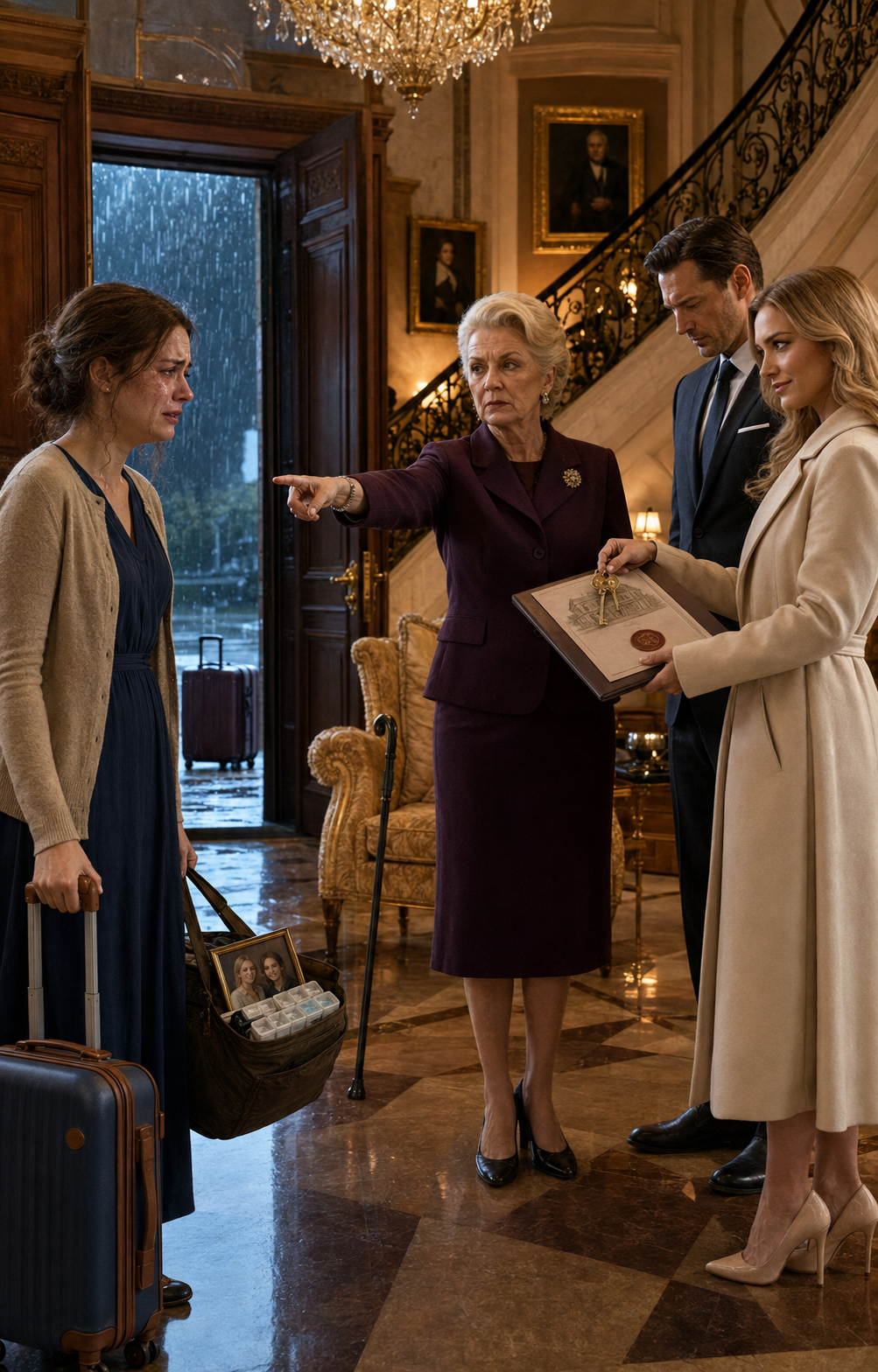
I found my little sister locked in a closet under my parents’ stairs at my grandmother’s funeral reception. The latch was on the outside, solid brass, mounted where no hand inside could ever reach it. Someone had started the dryer in the next room so the guests wouldn’t hear her knocking. I’m a paramedic.

I’ve spent nine years walking into the worst moments of strangers’ lives, and nothing prepared me for my own family’s hallway. I thought getting her out of that closet was the rescue. It wasn’t. What I pulled her into was worse.
And what I found buried in my family’s past was darker than both. I grew up in Milbrook, Ohio, where your last name is a storefront. Austin Hardware had been on Main Street for three generations. My dad, Gerald, ran the register and passed the collection plate on Sundays.
My mom, Patricia, ran everything else, including how we were seen. Sadi was born when I was 10. She lined up spoons by color before she could walk steady. She loved birds, flapping her hands when the finches hit the feeder like she might lift off with them.
When she was four, a specialist in Columbus said the word autism. My mother’s first question was, “Who else would have access to the file? ”
There was no early intervention, no speech therapy, no school. There was a tutor who came through the back door and got paid in cash, and a story for church about a delicate immune system.
And there was the closet under the stairs. My mother cleared it out the summer Sadi turned 5. A pillow, a flashlight, a basket of coloring books. She called it the quiet room.
Sometimes Sadi did choose it—loud rooms hurt her. But you don’t put a latch on the outside of a door your child chose. The latch went up right before the church potluck that fall. I stood in the hallway and watched my father drive the screws.
I remember the sound the latch made when my mother tested it. A small brass click, neat and final, like a period at the end of a sentence nobody would ever be allowed to read. I was 15. I’ve hated that sound every day since.
The Christmas I was 18, half the congregation came through our front door. Sadi was 8 and had a good morning. Then the house filled with voices and perfume, and she started rocking. My mother walked her down the hall with a plate of cookies and slid the latch.
Twenty minutes into dinner, I could hear her under the carols—not crying, knocking. A steady, patient knock, like a person being polite about drowning. I got up in the middle of my father’s toast, opened the door, and carried her out in front of everyone. My father walked me onto the porch by the arm and told me the quiet room was a family decision.
I told him a lock is not a decision. It’s a cage. He shoved me. I shoved back harder, and he went through the screen door.
The neighbors called the police. My father stood in the red and blue lights bleeding from one eyebrow and told them his daughter was out of control. I took a misdemeanor plea because a trial would embarrass the family. Those were my mother’s words.
She swept up the glass that night and said, “Family means nobody has to know. ”
I packed a duffel bag that week. The last thing I did in that house was kneel by the closet door and knock twice. Soft.
Two knocks was our signal. It’s me. You’re safe. She knocked back.
I told her through the wood that I’d come back for her. It took me 14 years. That’s the part I can’t fix. Columbus is two hours from Milbrook, but for 14 years it might as well have been another country.
I took the EMT course because it was fast and it was work, and it turned out I was built for it. I sent Sadi a present every birthday. For three years, the packages disappeared into that house. The fourth year, the box came back stamped “returned to sender” in my mother’s handwriting.
When I called, Mom answered like a woman reading a statement to the press. Sadi is fine. Sadi is thriving. Sadi doesn’t need to be confused.
My father got on the line exactly once. He kept it short. I still had a record. He still had a lawyer.
If I came around Sadi again, he’d call it stalking and let a judge admire the pattern. I drove down twice anyway. Both times I sat in my truck across from Austin Hardware, watched my dad flip the sign to closed, and drove back to Columbus with my hands aching on the wheel. A woman with a record who forces her way past a legal warning doesn’t rescue anybody.
She hands them a villain with her own face on it. Then one gray Tuesday in February, my grandmother’s lawyer called the station asking for me by name. Ruth Austin was gone. Heart failure in her sleep at 84.
Then he said the strange part. She’d left instructions about the funeral. He told me she wanted to make sure Myra comes. The funeral was beautiful the way a store window is beautiful.
White lilies matched to the ribbon, a printed program on heavy paper. My family filled the front pew in coordinated navy. The pastor called us a family that holds together. I sat three rows back.
Nobody saved me a seat. At the reception in my parents’ house, a small man in a brown suit found me by the coat rack. Bill Hartman, my grandmother’s lawyer for 40 years. He told me Grandma Ruth had left a special needs trust for Sadi—just over $200,000—meant to fund care, therapy, a real life.
The temporary trustee was my aunt Karen, my father’s older sister. Then Hartman leaned closer and lowered his voice. Ruth had said something when she signed the papers. She’d tapped the trust documents and said, “So it never happens again.
” He asked me if I knew what that meant. I didn’t. Not then. I was only half listening anyway, because I’d started doing the thing I do at a scene—counting heads without deciding to.
Everyone accounted for except the one person the money was for. My sister wasn’t in the living room. She wasn’t in the kitchen or the yard. And underneath the murmur of 50 polite voices from the back hallway of my parents’ house, I heard a sound that made no sense at a funeral.
The dryer was running. Nobody does laundry at a funeral. I followed the sound down the hallway I grew up in. Past the laundry room door, under the stairs, the closet.
The old latch was gone. In its place sat a new one, solid brass, bright against 14 years of paint—and it was slid shut. Under the dryer’s rhythm, I caught it. Faint and steady, a knock.
Patient. Polite about drowning. I did the only version of announcing myself that I know. I knocked twice, soft.
The knocking inside stopped. Then two knocks came back. I opened the door. There was my sister, 22 years old, sitting on a beanbag between the winter coats, headphones over her ears, a coloring book on her knees.
Thinner than any photo I’d seen. Pale the way people get when their world has a ceiling. She looked at me for a long moment, placing me. Then she reached out and knocked her knuckles twice against the floor.
It’s me. You’re safe. I was still on my knees when my mother’s shadow fell across us both. “She likes it in there,” Mom said, keeping her voice down.
“It’s her safe space, Myra. She asked to go in. ”
My father appeared behind her, jaw set. “Don’t make a scene at your grandmother’s funeral.
”
A scene. There it was, the family religion. I looked at the shining new latch, screwed in at adult height on the outside, and one thought arrived very calm and very clear. Quiet is not the same as peace.
I took my phone out and photographed the latch while my parents watched. Then I helped my sister up into the light. I had it all mapped in my head inside a minute. Sadi in my truck, a hotel in Columbus, calls in the morning.
My father watched me do the math like he’d been waiting for it. Then he went to the study and came back with a folder. He laid it on the kitchen counter between us the way you’d lay down a winning hand. Letters of guardianship from county probate court, with a raised seal.
Gerald and Patricia Austin, co-guardians of the person of Sadi Ruth Austin, an incapacitated adult. Signed the summer she turned 18. Four years, and I never knew, because the hearing notice went to family, and I’d stopped being family the night I went through a screen door. “You take her out that door,” my father said quietly, “and it’s abduction of a ward.
Your word against ours. A woman with a record. ”
He wasn’t wrong, and we both knew it. I hated him with a completeness I have never felt for another human being, before or since.
Walking out of that house without my sister was the hardest correct decision of my life. You don’t beat a locked door by breaking it. You beat it by getting the key legally, permanently, in a way nobody can ever slide shut again. Aunt Karen was standing on the porch when I came out.
“You always did like kicking doors open, Myra,” she said. “Some doors are closed for a reason. ”
I’d remember that sentence later, holding a photograph of two little boys. Monday morning, I called adult protective services from the station parking lot and gave them everything.
The latch, the photograph, the guardianship, the four missing years of medical records I suspected but couldn’t prove. The system knocks before it comes in. A guardianship welfare check gets scheduled. Scheduled means warned.
By the time a caseworker named Ms. Cho stood in my parents’ hallway, the closet held a vacuum cleaner and folded card tables. The latch was gone with four neat holes puttied over. Sadi sat in the good armchair, scrubbed and brushed like an exhibit.
My mother served coffee cake. My father quoted scripture gently. The preliminary finding came back in careful language: “Unable to substantiate. ”
But two things happened underneath that finding.
Ms. Cho didn’t close the file. A 22-year-old woman with no physician of record for four years had snagged in her, and she flagged the case for a full guardianship review—which meant a courtroom, which meant a judge, which meant sworn answers. And my photograph of the latch went into that file.
The guardianship review came with one order my parents couldn’t charm their way around: an independent medical evaluation by a physician chosen from the court’s list. The name that came up was Dr. Naomi Bennett—the specialist who’d seen Sadi as a little girl, right up until my parents decided her follow-up appointments were becoming a topic at church. Her report was four pages of quiet devastation.
No physician of record in four years. No dental care anyone could document. Skills regression across the board. And then the part that put a lump in my throat in a courthouse hallway.
As part of the evaluation, Dr. Bennett set a basic communication tablet on the table—the kind with picture buttons and a keyboard—the kind Sadi had never once been offered. It took my sister a while to touch it. Then she pecked out one letter at a time.
The first word anyone had gotten from her in years. “Myra. ” Not mom. Not help.
My name. Dr. Bennett wrote that the ward demonstrated communicative capacity that had gone unsupported for years, and that this constituted neglect of care in her professional opinion. The morning of the hearing, my parents’ lawyer stood up and announced they were voluntarily resigning as guardians for health reasons.
No finding of neglect. No finding of anything. Just a graceful step to the side. Suddenly the courtroom’s only question was who steps in.
There were two petitions on the desk of Judge Carol Maddox. Mine. And my aunt Karen’s. Their lawyer, a smooth operator named Prescott, read my life out loud like a rap sheet.
A misdemeanor for assaulting the ward’s own father. Fourteen years of absence. A one-bedroom apartment two hours away. A job that runs on 24-hour shifts.
“What happens to a vulnerable woman alone in an apartment in Columbus while her sister works a full day and night on an ambulance? ”
Then Karen took the stand, and she was magnificent. A big farmhouse ten minutes from everything Sadi knows. A husband, retired, home all day.
Letters of support from the pastor and half the congregation. “Family that steps up,” Prescott said, “instead of family that shows up angry at funerals. ”
The ruling took Judge Maddox 20 minutes. Guardianship of the person and temporary control of the trust to Karen Fletcher.
Scheduled visitation for the sister, review in one year. On the courthouse steps, my aunt hugged me in front of everyone and put her mouth next to my ear. “We keep our own, Myra,” she said. “You’ll see.
”
It took me three weeks to understand what “keeping” meant to my aunt. The first visit, I wanted to believe. Karen and Wade had a farmhouse on Route 9, past their little motel—the Hillside Motor Lodge, 12 rooms. Karen showed me a bedroom painted yellow, because somebody had told her Sadi liked yellow.
There were fresh cookies. Wade had screwed a birdhouse to the window frame, level and solid. Sadi sat at the kitchen table with a puzzle, calm, fed. But two things from that kitchen followed me home.
The first was how Karen talked. Every sentence about Sadi went past Sadi, over her head, in the third person. “She eats good now. She doesn’t need all that screen nonsense.
She’s better off with routine. ” Sadi’s picture schedule—the little hand-drawn week she’d kept since Dr. Bennett’s visit—was gone from the wall. In its place hung a chore list in Karen’s handwriting.
Towels. Sweeping. Rooms. The second thing was on the stairway wall—a line of family photos marching up the steps, and in the middle, a blank rectangle of wallpaper brighter than everything around it.
The shape of a small picture frame. Something had hung there for decades, long enough to shadow the paper, and someone had taken it down. I didn’t ask. I should have asked.
The call came from Rachel Alvarez, who ran the Bright Path Adult Day program in Milbrook. Dr. Bennett’s report had gotten Sadi enrolled there three days a week. Rachel wasn’t smiling.
Karen had pulled Sadi out effective immediately with a form letter citing cost—preserving the ward’s assets. The same week, a change-of-provider form moved Sadi’s medical care from Dr. Bennett’s clinic to a telehealth service. More convenient, the paperwork said.
For whom, it didn’t say. “When a new guardian’s first three moves are cancel the program, switch the doctor to a screen, and shorten the visits,” Rachel told me, “that’s not budgeting. That’s turning off the eyes. ”
Through Hartman, I filed a request for the trust accounting—which any interested family member can ask the court to compel.
Karen had been trustee ever since Grandma died. She now owed a judge the receipts. The accounting came back three weeks later. Hartman called before I’d even finished my shift.
“The accounting they filed is one page long,” he said. While the lawyers fought about that single page, I kept my scheduled visits, and the visits kept shrinking. On the third one, I noticed what was missing before I got my coat off. The communication tablet, the one from Dr.
Bennett’s clinic, was gone from Sadi’s room. Karen didn’t even pretend. “She was hiding behind that thing,” she said, wiping a counter that didn’t need wiping. “In this house, we talk like people.
”
When I hugged my sister goodbye, she grabbed my jacket sleeve in her fist and held on, and she made a sound low in her throat. One long “M” pressed out, like something lifted from under a door. Nine years on a truck, I have carried people out of car wrecks. That sound is the thing I still hear at night.
I complained through Hartman about the tablet. Karen’s answer came back through the court—a masterpiece. A behavior journal documenting that after every visit from the sister, the ward was agitated, didn’t sleep, refused tasks. Her recommendation, regretfully, as guardian: shorter visits, supervised, for Sadi’s own stability.
I sat in my truck on the shoulder of Route 9 with that letter and finally understood the game. My aunt didn’t need to prove she was good. She controlled every scrap of paper coming out of that farmhouse, and paper was all the court could see. She didn’t need to be right.
She just needed me to look wrong. So we got smarter. Dr. Bennett was still on paper part of the telehealth transition file.
And she read Karen’s own paperwork against her. If care was moving to a screen, then the patient needed a device with communication software, prescribed pursuant to the evaluation the court itself had ordered. Karen had chosen telehealth. Telehealth needs a tablet.
Refusing the tablet meant refusing the doctor she’d picked on the record. Checkmate, politely, in triplicate. Rachel built it—a backup tablet, the same communication app Sadi had learned, her old picture vocabulary restored. And I got to be the delivery woman, because the handoff happened at the one place Karen couldn’t control or decline: the church picnic, in front of the pastor and everybody whose good opinion my family had been buying for 50 years.
I set the tablet in front of my sister like it was any other Tuesday. “Medical equipment,” I told Karen, loud enough for the deacons. “Court-ordered evaluation follow-up. Feel free to call Dr.
Bennett. ”
Sadi’s hands hovered over it for a few seconds. Then she found her rhythm like she’d never lost it. Icons, keyboard, home screen.
And then my sister did something neither Rachel nor I had imagined. She opened the button editor herself, typed one letter at a time, picked the biggest button size, picked yellow, and saved her own sentence to the front page of her voice. “I am not a secret. ”
She pressed it once, and the tablet said it out loud in its flat little voice, right there over the potato salad.
I expected fury from my aunt. What was on her face was worse. Karen had gone white as paper, like a woman seeing a ghost. The one-page accounting didn’t survive contact with Judge Maddox.
The court ordered a full amended filing, and when it landed, Hartman spread it across his desk like a wreck. Line by line, in 14 months as trustee, my aunt had moved almost $70,000 of my sister’s money into the gravity of that motel. Reimbursements to herself. A commercial roofer—for the motel.
A used pickup titled to Wade. My grandmother, so it never happens again, had been buying shingles. Hartman filed for a review of the guardianship itself before the week was out. Karen answered with paper and pedigree—receipts for everything, explanations threaded through with the ward’s benefits from a stable family property, another warm letter from the pastor.
And then she counterpunched. Emotionally, she filed regarding my visitation, citing the behavior journal, citing the scene at the picnic. That word again. Pending the review, my visits were suspended entirely.
The town picked its side the way small towns do, quietly at the register and the gas pump. I’d moved into a rented apartment in Milbrook to be ten minutes away instead of two hours. I felt the temperature everywhere I went. The Austin girl with the record, back and stirring up money trouble against the family that stepped up.
My mother sent word through a church friend, a folded note left under my wiper like a parking ticket. “Look what you’re doing to this family. ” No signature. Then Wade called me.
Forty seconds, one time. My uncle, 66 years old, talking fast and low like a man in a house where the floorboards report to somebody. “She’s moved the girl to the motel,” he said. “Room 14.
Says it’s while the bedroom gets repainted. Myra, she keeps the key on her ring. ”
Then he hung up. On paper, Sadi lived in a yellow bedroom with a birdhouse at the window.
In fact, my 22-year-old sister was sleeping in room 14 of a roadside motel at the far end of the lot, past the ice machine, where no caseworker was ever going to knock because no caseworker had a reason to. Dr. Bennett caught the next thread, because pharmacists see what courtrooms don’t. Sadi’s refill history crossed her desk as part of the review file.
A sedating medication—started small right after Karen took over, stepped up twice since, refilled like clockwork, prescribed by a telehealth doctor who had never once seen my sister in person. There are legitimate uses for that medication. There is no legitimate version of the dose climbing while the patient gets seen by nobody. Bennett filed a report with APS herself and pushed the telehealth service hard enough that they flagged the account for an in-person visit before the next refill.
APS went to the farmhouse—the address in the file. The house was clean. The yellow room was staged like a catalog page. Karen, warm as pie, explained that Sadi was spending a few days with a cousin.
A follow-up was calendared. Ten days. My job measures emergencies in minutes. The system measures them in appointments.
Ten days was 240 hours of my sister behind a door I legally could not approach, sedated on a stranger’s signature. And the forecast said the first real heat of the summer was coming—mid-90s by Sunday. The kind of heat that turns the last room by the ice machine into a kiln. Saturday night, my mother knocked on the door of my rented apartment.
First time in 14 years we’d been alone in a room together. She’d brought a casserole. She didn’t deny any of it. Not the closet, not the latch, not the money.
Denial was for people without options. My mother negotiated. “Drop the money business,” she said, smoothing a wrinkle out of my dish towel. “It’s ugly and it’s beneath us.
Karen will soften once she’s not being attacked. Come home. Sit with us at church in a year. This is a story nobody tells.
We can be a family again, Myra. Family means nobody has to know. ”
The same sentence, word for word, she’d said over a dustpan of broken glass 14 years ago. I finally heard it for what it had always been.
Not a rule about privacy. A price list. Everything in that house had always been for sale, and the currency was silence. The people who paid were the ones who couldn’t argue.
She was at the door when she fired the last shot. “You think you’re the first person in this family to make noise about how we do things? ” she said. “You have no idea what your grandmother buried to keep this family standing.
Ask yourself why that trust exists at all. ”
People ask why I didn’t just take my sister and run. A woman with a record who steals a ward hands the family the only ending they ever wanted. Myra the danger.
Sadi the secret forever. At 4 the next morning, my pager went off. The address was the Hillside Motor Lodge. Dispatch read out: female, 20s, found wandering, possible altered mental status.
My partner Dana Reyes was driving. I told her before we cleared the first light, “That’s my sister’s placement. ” Dana just nodded and pushed the pedal down. There was Sadi in the gravel lot, barefoot on stones already warm, in yesterday’s clothes, swaying like a sapling.
A trucker who’d stopped for ice had found her and had the sense to call. Her lips were cracked. Dehydration you could see from six feet out. Her eyes were swimming, pupils sluggish—a sedation fog you don’t get from one bad night.
She flinched from the rig’s lights until I killed everything but the low beams. I announced myself the only way that has ever worked. Two knocks, soft, on the side of the stretcher. Her head came around, and her hand came out, and she knocked twice on my forearm.
Room 14’s door stood open where the trucker had found it swinging. On the outside, screwed into the frame at adult height, a padlock—the latch’s ugly cousin. And the bathroom window at the back stood open, the screen pushed out from inside. My sister, sedated and cooking in a shut room as the heat came in, had climbed out a window not much bigger than a suitcase.
She hadn’t wandered off. She had rescued herself. We were loading her when Karen crossed the lot in her robe, guardianship letters literally in hand, saying there was no need for the hospital. Family handles family.
Dana, lead medic, didn’t even look up. “Ma’am, your paperwork can meet us at County General. ”
In the ambient light, I saw what Sadi had clamped under her arm. The tablet.
Screen cracked in one corner. She’d gone out the window holding her voice. A hospital is the one building in America where paper meets its match, because hospitals generate more of it than anybody. The chart said all the knives, no adjectives.
Dehydration requiring fluids. Sedative level above the therapeutic range for the listed prescription. Weight well below her documented weight from a year before. Old marks at the wrists, which the attending photographed for the record.
By 7 that morning, the hospital had called APS. By 9, Ms. Cho was in the hallway. And this time nothing was staged.
The finding wrote itself: substantiated. When Karen arrived with her letters, the hospital refused discharge. Unsafe environment pending investigation. I was in the waiting room when they let me back.
Sadi was rehydrated, propped up, tablet on her lap, cracked corner and all. She pressed her yellow button, and the flat little voice said, “I am not a secret. ” Then she typed and pressed again. “Don’t go.
”
So I didn’t. That afternoon, from a chair beside her bed, I signed a sworn statement laying out everything. The funeral, the latch, the closet I grew up watching, my parents, my aunt, dates, photographs, all of it. Hartman filed an emergency petition to suspend Karen that same day.
The court named a guardian ad litem for Sadi before the week was out. My mother reached the ward’s hallway around dinner, and a social worker turned her around. Mom looked at me over that woman’s shoulder and didn’t raise her voice. “You didn’t save this family,” she said.
“You ended it. ”
Two days later, Hartman called me to his office. There was a banker’s box on his desk with a dead woman’s handwriting on the lid. When Ruth signed the trust, he said, she also left this sealed, with instructions to open it only if the trust ever ended up in a fight.
He looked tired. “I’d say this qualifies,” he said, and cut the tape. On top, a photograph, black and white. Two little boys in front of Austin Hardware.
The taller one, unmistakably my father at about 8, grinning, his arm around a smaller boy with a crooked collar and eyes that didn’t meet the camera. I turned it over. In pencil, in my grandmother’s hand, two names. Gerald and Tommy.
Under the photo, a folder. An admission record from Ridgeway State School, hours away, for Thomas Austin, age six. The intake form’s reason for placement, typed by some clerk more than 50 years ago: “The family is unable to manage the child’s condition in the community. ” Receipts—monthly, three years of them, my grandmother’s checks to an institution.
Then a death certificate. Thomas Austin, age nine, pneumonia. And a single line from the school’s office, matter-of-fact as a receipt for shingles. Burial on facility grounds, marker 114.
My father had a little brother. Karen had a little brother. He was six and he was different the way Sadi is different. And this family put him in a car, told the town he’d gone to live with relatives, and sanded him out of every story for half a century.
The blank rectangle on Karen’s stairway wall finally had a name. So did my grandmother’s sentence. “So it never happens again. ” The trust wasn’t estate planning.
It was a confession in the only currency my family ever used. I put the photograph in my jacket. There was one person left alive who had watched that car drive away, and I needed to look her in the eye. Karen came to the hospital that week to try to see Sadi and got stopped at the desk.
Instead of letting security walk her out, I asked her to sit with me in the chapel. I had a photograph in my pocket. I set the picture of the two boys on the seat between us. My aunt looked at it the way you’d look at a wound reopening.
Then, in a voice like gravel, she gave me the only unguarded minutes of her life I ever got. She was 10 when their mother dressed Tommy in his church clothes on an ordinary Tuesday. They visited twice, and the doctors said visits unsettle the residents. Better to let him adjust.
Their parents obeyed, because doctors were like pastors then, and shame was like gravity. She was 13 when the box of ashes came. There was no funeral. Her mother ironed sheets that whole afternoon, like the iron was the only thing keeping the house from lifting off the earth.
Then my aunt looked at me dry-eyed and doubled down. “You don’t hand family to the state, Myra. The state sent Tommy home in a box. Every single thing I did, I did to keep that girl out of a place like Ridgeway.
You’d have done the same if you’d carried it as long as I have. ”
“Fear didn’t sign those reimbursement checks, Aunt Karen,” I said. “You rebuilt Tommy’s room with the lock on the outside and told yourself it was rescue. ”
In the parking garage, Prescott was waiting beside my truck.
The deal came typed on heavy letterhead. Karen resigns as guardian and trustee, effective immediately. My parents support my petition on the record. Sadi comes home with me inside a week.
No contest, no trial. In exchange, the amended trust accounting gets sealed by agreement. No referral to the county prosecutor. Both sides sign a statement calling the whole year a family misunderstanding, resolved privately.
Hartman walked me through it twice, then did the thing honest lawyers do and argued against himself. “Take it. That’s my advice with both hands. A contested hearing means your record read out loud again.
You could win the war and watch her go to a group home with a waiting list and shift staff. ” Then he took his glasses off. “And as Ruth’s lawyer for 40 years, I’ll tell you—she did not leave that box sealed for it to stay sealed. ”
I drove to the hospital and laid it out for the one person every deal in this family had always been made around, never with.
I used plain words and the tablet between us. Go home with me now, and it stays quiet. Or we fight, and everybody will know everything. My sister listened with her whole stillness.
Then she typed, and the flat little voice said, “No more secrets. ”
I said no on a Wednesday. Then I spent three weeks making the no survivable. I took an instructor job at the community college, teaching EMT students mornings, home by 3, weekends free—a schedule a judge could set a watch by.
Turning in my truck keys at the station hurt in a place I don’t have clean words for. Dana hugged me in the bay and said, “You’re the best medic I ever ran with. ” I said, “I know. That’s the price.
”
Sadi spent those weeks in a temporary respite placement while Karen stood suspended. I signed a lease on a two-bedroom house four blocks from Bright Path. Rachel walked the rooms with me, moving a lamp Sadi would hate, flagging the strobing porch light, building a support plan page by page. Dr.
Bennett wrote a capacity evaluation for the court, concluding that with her device, Sadi could express preferences reliably, and petitioned for her to be heard at the hearing through it. And Hartman, on my written instruction, delivered the complete amended accounting, the pharmacy records, and copies of everything in my grandmother’s box to the county prosecutor’s office. The deal’s whole engine was silence for safety. We drove it off a cliff on purpose.
There was no version left where anyone could offer me my sister in exchange for quiet, because quiet no longer existed to sell. The hearing fell on a Tuesday. My family arrived in church clothes. They had spent 50 years rehearsing how to look.
None of them had ever rehearsed being heard. Prescott went first, and he was worth whatever they were paying him. He didn’t rant. He regretted.
He regretted that a troubled young woman who once put her own father through a door now sought control of a vulnerable woman and, coincidentally, her substantial trust. He walked the judge through me quitting a nine-year career framed as instability. And then he pulled the pin on the one I hadn’t seen coming. “Your honor,” he said, “my clients offered this woman everything she claims to want—her sister, placed with her within days—and she refused, because the offer asked one thing of her.
Discretion. Ask yourself what kind of rescuer turns down the rescue unless she’s allowed to burn the family down with it. ”
I felt the benches believe it behind me, the little shift of 50 spines at once. He finished by offering the court an off-ramp painted in reasonableness.
If not Karen, then a neutral professional guardian and an appropriate residential placement. Structured. Staffed. Safe.
A group home wearing the nicest possible words. Judge Maddox looked over her glasses at our table. “Ms. Austin, I’ll hear from you.
”
Hartman leaned into me. “Now or never. You sure? ”
I used the one thing I’d learned from watching my family operate for 30 years.
I used it against them. Whoever controls the worst version of the story controls the room. So I told the worst version of mine before Prescott could. Under oath, I gave the court my record.
The screen door, the plea, no varnish. I gave them the 14 years—the returned packages, the two trips where I sat across from the store and drove away. I did not dress a single one of those years up as anything but failure. “I failed her first,” I told Judge Maddox.
“Everyone in this courtroom with my last name failed her. The difference is that I am done doing it quietly. ”
Then I answered the deal. “It’s true.
Last week, I was offered my sister back in a matter of days, and the condition was that everything stay what my family calls private. Your honor, my family has a saying. Family means nobody has to know. I heard my mother say it over broken glass when I was 18, and I heard her say it in my kitchen a month ago.
I want the record to show what that sentence has cost. It cost my sister four years behind a signature, sedated for convenience, sleeping in a motel room with a lock on the wrong side of the door. And more than 50 years ago, it cost a six-year-old boy named Thomas Austin his whole life. He was my father’s brother.
This family told the town he went to live with cousins. He died at 9 in a state institution, and he has been lying under a stone that says 114 ever since—because a number can’t embarrass anybody. ”
The benches behind me had gone so quiet I could hear the fan click. My father was staring at his hands.
I looked at the judge and put down the last of it. “My parents will tell you Sadi was calm in that closet. Calm was the whole problem. Quiet is not the same as peace.
”
Then I asked for the thing nobody in that courtroom expected, least of all the woman asking. Not full guardianship. Limited guardianship—health and safety only, with a supported decision-making plan, her day program, her own doctor, and a standing yearly review. “I’m not asking to own my sister’s life.
I’m asking to stand next to it. She’s had enough owners. ”
Judge Maddox let the room settle. Then she said the sentence I will be grateful for until I die.
“There is one person this court has not heard from. Sadi, would you like to answer? ”
Prescott objected. Coached testimony.
Unreliable modality. The ward’s documented suggestibility. Maddox heard him out, then noted that the court had ordered Dr. Bennett’s capacity evaluation precisely for this question.
Overruled. The clerk patched the tablet’s little speaker through the courtroom sound. My sister came forward with Rachel beside her, cracked screen and all. It is a particular kind of silence, 50 people listening to someone type.
Each letter was a soft tap. The fan clicked. Nobody breathed. She pressed her yellow button first—the one she built herself at a church picnic—and the flat voice said it to the rafters.
“I am not a secret. ”
Then, tap by tap, her own words, no prompt, no menu, while the county watched her do the thing her family had spent 22 years saying she couldn’t. “I want to live with my sister. She knocks before she opens the door.
”
I watched a bailiff—a big man with a face like a cinder block—blink hard and study the ceiling. Prescott rose again, gamely asked whether anyone could verify these were her words. That’s when Maddox opened the sealed report from the guardian ad litem and read the summary aloud. Three independent interviews.
Consistent expressed preference. The ward asks for her sister by name in every session. Recommendation: placement with the sister under limited guardianship. Same answer, three times, to a stranger, with nobody from either family in the room.
Somewhere behind me, I heard my mother make a small sound and go still. And Karen—my aunt, the keeper of every gate—stood up in the middle of the benches, gripped the rail in front of her, looked at the yellow button glowing on that cracked screen for one long second, and walked out of the courtroom before the ruling. Her heels very loud. Her back very straight.
She never said a word. Judge Maddox squared the papers on her bench. “I’m prepared to rule. ”
Karen Fletcher removed as guardian and trustee, effective immediately.
The trust transferred to a corporate trustee, with instructions to review every disbursement my aunt had made. Limited guardianship of Sadi Ruth Austin granted to Myra Austin, with a supported decision-making plan to be filed within 60 days. Bright Path enrollment restored. Dr.
Naomi Bennett confirmed as physician of record. Annual review calendared. And then Judge Maddox looked at Prescott over her glasses with something almost like dry humor. “As to the financial matters, I’m informed a referral is already with the county prosecutor, so that is out of this court’s hands—and I suspect that is exactly where the petitioner intended it to be.
”
Court adjourned. The gavel came down, one clean knock. I thought, of course—even the courtroom knocks. In the hallway, my parents came out last.
My father walked past me the way you walk past weather. My mother stopped. One second, maybe two. She looked at me, and there was nothing left in her face to negotiate with.
“You didn’t save this family,” she said quietly, like a diagnosis. Then she followed my father down the marble steps. She kept saying family like it meant the house, the name on the storefront, the pew with our brass plate on it. I didn’t save that, and I never will.
The loss of it is real, and it aches like a pulled tooth aches—honestly and permanently. I saved the people who lived inside the word. Both of them. The one holding a cracked tablet by the courtroom door, and a little boy under a numbered stone who was finally spoken of out loud, by name, in a public room, after more than 50 years.
Sadi touched my elbow at the door. She knocked twice on my forearm. I knocked twice back. Fourteen years late.
Right on time. Eight months now. Here’s the accounting, since my family taught me the importance of a clean one. Karen took a plea—financial exploitation of a protected person.
Probation, full restitution to the trust, and a permanent bar from ever serving as anyone’s fiduciary again. For a woman built entirely out of being trusted, that is the harshest sentence on the books. The Hillside Motor Lodge has a for-sale sign leaning in the gravel. Wade moved into his brother’s place across the county.
Every few weeks, my phone gets a photo of a birdhouse from a number that never calls. I always answer with a thumbs-up. People can be weak and still want to be kind. I’ve decided that counts for something.
My parents sold Austin Hardware to a chain and moved out of state with their version of events. No, they haven’t called. No, nobody apologized. Some pew in some new town has a couple in coordinated navy telling a story about ungrateful children.
The town split about even. Half of Milbrook thinks I did right. The other half still says family business should stay family business. One hearing was never going to fix that.
What got fixed is smaller and better. A rented house with the curtains open. Sadi’s picture schedule back on the refrigerator, drawn in her own hand. Bright Path five days a week, where Rachel reports my sister has opinions about everything.
On Wednesdays, Sadi picks dinner on her tablet. It is tacos. It has been tacos for 30-some Wednesdays straight, and God willing, it will be tacos forever. Dr.
Bennett sees her every quarter. The sedative is gone, replaced by sleep, a backyard feeder, and a laminated bird checklist with a truly aggressive number of check marks. I teach mornings. I’m home by 3.
Last month, we made a drive, the two of us, out to what used to be Ridgeway State School, where a meadow holds rows of small numbered stones. The trust paid for one item there without any objection from the new trustee. Where marker 114 used to sit, there’s granite now, with a name on it. Thomas Austin.
Brother. Son. Seen at last. Sadi stood over it a while, flapping her hands soft and slow, the way she does when the finches come in.
Then she bent down and laid a laminated card from her tablet against the base of the stone. It said, “You are not a secret anymore. ”
Then she knocked on the granite twice, gently. That was the whole ceremony.
It was enough. I used to think family was the thing you protect at any cost. Now I know family is the people you refuse to hide. Because quiet is not the same as peace.
And any love that has to be kept behind a latch was never love at all. Just shame, wearing love’s clothes. One brass latch. One yellow button on a cracked screen.
Two knocks, answered 14 years late.