The final piece appeared that evening, just before sunset, when Sophie came downstairs carrying a second flash drive taped beneath the cover of her sketchbook. The little girl stood in the doorway of Evelyn’s study wearing the same silver-star pajamas she had worn the night before, her hair still tangled from sleep and her fingers wrapped so tightly around the sketchbook that her knuckles had turned white.
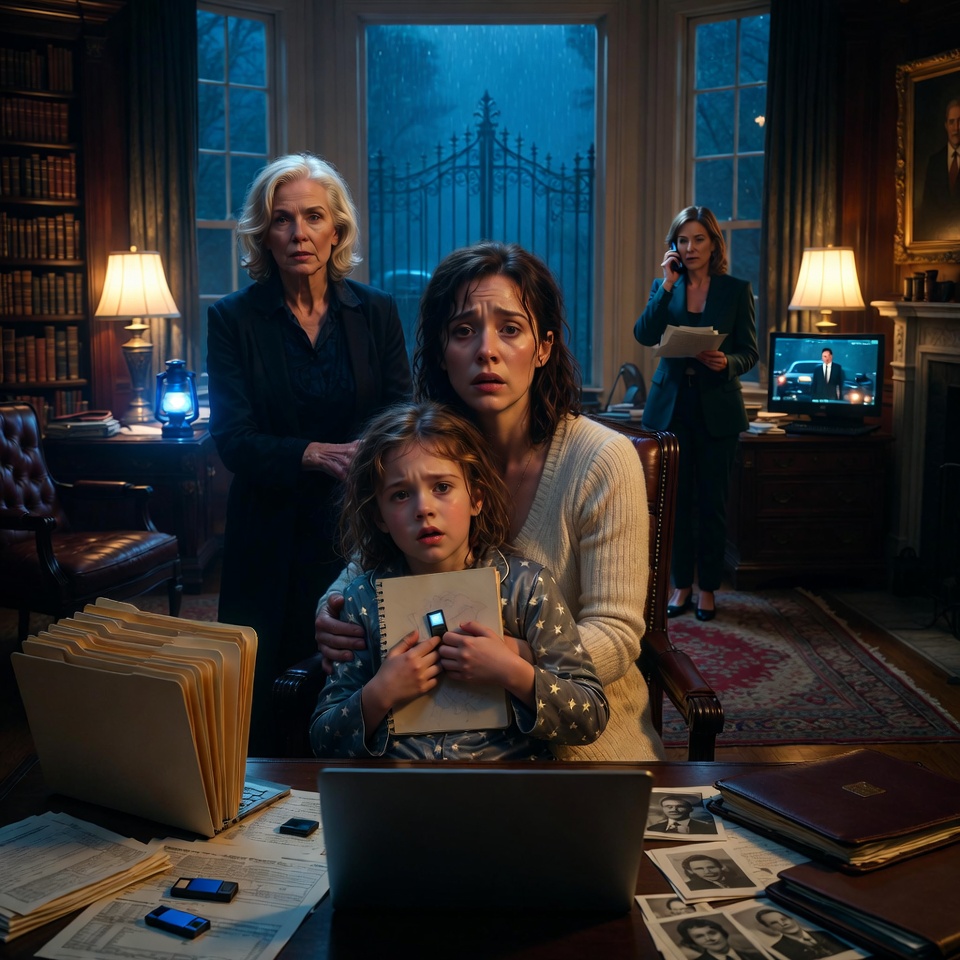
“Daddy said I was never supposed to touch this one,” she whispered.
Claire immediately stood. “Sophie, where did you get it?”
“It was inside the locked drawer in his office. I saw him put it there after he yelled at you last week.”
Evelyn crossed the room slowly and knelt in front of her granddaughter. “How did you open the drawer?”
Sophie looked ashamed. “The key was taped under his desk.”
Rachel Monroe exchanged a glance with Daniel. Neither of them spoke until Sophie had been taken upstairs by Evelyn’s housekeeper and settled in front of a movie with a bowl of popcorn. Then Rachel inserted the drive into a separate laptop Daniel had brought specifically for preserving evidence.
The first folder was labeled CUSTODY STRATEGY.
The second was labeled CLAIRE INSTABILITY.
The third carried Sophie’s full name.
Claire stopped breathing for a moment.
Inside were draft affidavits, unsigned statements, emails between Grant and a private family evaluator, and a calendar showing the exact dates on which he planned to provoke arguments before medical appointments, school meetings, and family gatherings. There were notes about Claire’s medication, comments about her grief after a miscarriage, and instructions to photograph the house whenever toys were left on the floor.
One document was titled Emergency Petition for Sole Custody.
Rachel opened it.
Grant had already written the story he intended to tell the court. Claire was unstable. Claire was addicted to medication. Claire was emotionally unpredictable. Claire had threatened to disappear with Sophie. Claire had neglected meals, failed to maintain the home, and created a dangerous environment.
Every accusation was false.
Every one was supported by a carefully selected fragment of truth.
Claire had taken sleep medication after Grant kept her awake for three nights during an argument. She had screamed once after he hid her phone and blocked the bedroom door. She had forgotten to pack Sophie’s lunch on the morning after he pushed her against the stairs. She had told Evelyn she wanted to disappear, meaning only that she wanted one day without fear.
Grant had recorded each fragment.
He had removed the cause and preserved the reaction.
Daniel opened another file and leaned toward the screen.
“This is worse.”
It was a draft email addressed to Vanessa Cole.
The message had never been sent, but Grant had saved it.
Once Claire signs the refinancing papers, everything moves into the holding company. After that, she can leave or be removed. The evaluator is ready. My mother will confirm Claire has always been unstable. Sophie is old enough to repeat what she hears if it is presented correctly.
Claire made a sound that did not resemble a word.
Evelyn reached for her, but Claire stepped away from the desk as though the room itself had become unsafe.
“He was going to teach Sophie to lie about me.”
Rachel closed the laptop.
“He was going to pressure a child into repeating his version of events.”
“My daughter.”
“Yes.”
“He was going to take my daughter.”
“He was preparing to try.”
Claire pressed both hands against her mouth. Her entire body began to shake.
For five years, Grant had trained her to distrust her instincts. Whenever she noticed inconsistencies, he called her paranoid. When she questioned the money, he accused her of being incapable of understanding business. When she asked about Vanessa, he told her that jealousy was another symptom of her emotional instability.
Now the evidence sat on the desk in clean folders, organized with the precision of someone who had mistaken cruelty for strategy.
Evelyn moved in front of her daughter.
“Look at me.”
Claire could not.
“Claire.”
Her eyes finally lifted.
“He did not discover that you were weak,” Evelyn said. “He created situations designed to make you look weak. There is a difference.”
Claire’s voice broke. “But I let him.”
“No.”
“I signed the papers.”
“Under pressure.”
“I stayed.”
“Because he isolated you, frightened you, controlled your money, and used Sophie as a weapon.”
“I should have left sooner.”
“You survived until you could leave safely.”
Claire looked toward the staircase where Sophie slept.
“What if the court believes him?”
Rachel stood.
“The court is going to see the full recordings, the bank transfers, the threats, the hidden files, the coercive documents, and his plan to manipulate a child. More importantly, we will not wait for him to act first.”
That night, Rachel filed an emergency petition requesting temporary custody, exclusive use of the marital home, financial restraints, and a protective order. Daniel arranged for the flash drives to be copied, documented, and delivered to an independent forensic examiner. Evelyn contacted the physician who had treated Claire’s bruised ribs and asked for complete medical records. Every photograph, message, transaction, and recording was preserved.
Grant received the first notice at 7:12 the following morning.
His reaction arrived less than two minutes later.
Claire’s phone rang repeatedly.
She did not answer.
Then came the messages.
You are making a catastrophic mistake.
Your mother is using you.
Bring Sophie home before this becomes permanent.
Rachel instructed Claire not to reply.
Grant changed tactics.
I am sorry. I was angry. I never meant to frighten you.
Then:
We can fix this without attorneys.
Then:
If you keep my daughter from me, I will make sure you never see her again.
The final message was the one Rachel had expected.
You have no idea what I have on you.
Claire stared at the screen.
For the first time, the threat did not feel mysterious.
They knew exactly what he had.
They had the complete version.
At ten that morning, Grant arrived at Evelyn’s gate.
He drove the black luxury SUV Claire once believed they could barely afford and stopped inches from the security camera. His hair was neatly combed. He wore a dark suit, a pale blue tie, and the expression of a husband arriving to resolve a private misunderstanding.
He pressed the intercom.
“Claire, open the gate.”
No one answered.
He pressed again.
“Evelyn, I know you are listening.”
Inside the house, Claire stood in the hallway with Sophie behind her. Evelyn had already instructed the staff to keep every door locked. Daniel watched the camera feed from the study while Rachel remained on the phone with local police.
Grant smiled toward the lens.
“This is unnecessary. I came to see my wife and daughter.”
Evelyn stepped toward the intercom.
Rachel stopped her. “Let him speak.”
Grant’s smile disappeared.
“Claire, your behavior is proving everything I told you. You are acting irrationally. You are allowing your mother to interfere with your marriage, and you are traumatizing Sophie.”
Sophie lowered her head.
Claire immediately knelt.
“None of this is your fault.”
“Daddy sounds mad.”
“He is angry because he cannot control what happens next.”
“Will he take me?”
“No.”
Claire said the word before she had time to doubt it.
Evelyn placed one hand on her daughter’s shoulder.
Outside, Grant continued.
“If you do not open this gate, I will contact the school, the court, and every doctor who has treated you. I will tell them exactly what kind of condition you are in.”
Daniel saved the recording.
Police arrived seven minutes later.
Grant’s performance changed the moment the patrol car appeared. He stepped away from the intercom, raised both hands, and explained that his emotionally unstable wife had taken their daughter after a minor disagreement. He said Evelyn had always resented him and was exploiting Claire’s fragile mental health.
The officers listened.
Then one of them handed him the temporary protective order Rachel had obtained less than an hour earlier.
Grant read the first page.
His face changed.
“This is based on lies.”
“You may challenge it at the hearing,” the officer said.
“My daughter is inside.”
“You are prohibited from approaching the residence or contacting your wife directly.”
“I am her husband.”
“That does not override the order.”
Grant looked past the gate toward the house.
For one second, the polished expression vanished. Claire saw the man she knew: furious, calculating, and terrified of losing control.
Then he noticed the camera.
The smile returned.
He folded the order carefully, placed it inside his jacket, and walked back to the SUV.
Before leaving, he looked directly into the lens.
“This is not over.”
Daniel watched the vehicle disappear.
“No,” he said quietly. “It has finally started.”
The emergency custody hearing was scheduled for three days later. Grant’s attorney arrived with an organized binder containing medical records, photographs, messages, and statements from his mother, two neighbors, and the private evaluator he had been paying. The argument was simple: Claire had a history of anxiety, relied on sleep medication, and had recently removed Sophie from the marital home without warning.
Grant wore a charcoal suit and sat with his hands folded on the table.
Claire sat beside Rachel in a navy dress Evelyn had chosen because it made her look like herself rather than someone preparing for battle. Her lip had begun to heal, but the bruise along her cheek remained faintly visible beneath makeup.
Grant’s mother testified first.
She told the judge Claire had always been nervous, emotionally fragile, and overly dependent on Evelyn. She claimed Grant handled most childcare responsibilities and described her son as patient, generous, and devoted.
Rachel asked whether she had witnessed Grant threaten Claire.
“No.”
“Did you ever witness him seize her phone?”
“No.”
“Control her finances?”
“No.”
“Did you visit the home regularly?”
“Of course.”
“How regularly?”
The woman hesitated.
“Several times a year.”
Rachel returned to her seat.
The private evaluator was less comfortable. Under questioning, he admitted Grant had contacted him before any custody case existed. He admitted he had accepted payment for consultations but never interviewed Claire, Sophie, Evelyn, a teacher, or a physician. Every opinion he formed came from documents Grant selected.
Then Daniel’s forensic report was introduced.
Grant’s attorney objected.
The judge allowed a limited review.
Rachel began with the financial records. Sophie’s college account had been drained through transfers into a holding company partially controlled by Grant and Vanessa. The Manhattan apartment was paid using funds disguised as consulting expenses. Jewelry, travel, and hotel charges had been placed against Grant’s business.
Then came the custody folder.
The judge read in silence.
Grant stared straight ahead.
Rachel played one full audio recording.
It began with Grant refusing to let Claire leave a room. He accused her of failing as a mother, told her that Sophie would be better without her, and repeated the same phrases until Claire began crying. When Claire finally shouted for him to stop, the recording continued for another thirty seconds.
Then Rachel played the edited version found inside Grant’s custody folder.
It contained only Claire’s scream.
The courtroom became completely still.
Grant leaned toward his attorney.
Rachel opened the draft email to Vanessa.
She did not read the entire message aloud. She read one sentence.
“Sophie is old enough to repeat what she hears if it is presented correctly.”
Grant’s composure failed.
“That was never sent.”
The judge looked at him.
His attorney whispered for him to remain silent.
Grant continued.
“It was a private note written in anger.”
Rachel turned toward him.
“Was the emergency petition also written in anger?”
He did not answer.
The judge granted Claire temporary sole custody and ordered supervised visitation pending a full evaluation. Grant was barred from accessing Sophie’s school, medical files, and financial accounts. The court froze the holding company and ordered an independent review of the marital finances.
Outside the courthouse, reporters waited.
Grant had contacted them himself before the hearing, believing public attention would pressure Claire into surrender. He planned to appear as the father fighting to protect his daughter from an unstable mother.
Instead, the temporary ruling became public.
Grant stopped on the courthouse steps and told cameras he loved his wife, feared for her health, and looked forward to the truth emerging.
Claire watched from inside a tinted vehicle.
“He sounds believable,” she whispered.
Evelyn looked at her.
“He has practiced longer than you have.”
That evening, Grant’s company placed him on administrative leave after questions arose about false expenses and diverted funds. Vanessa’s employer opened a separate investigation. By morning, photographs of Grant and Vanessa at the Manhattan apartment had appeared online.
Vanessa called Claire.
Rachel recorded the call with Claire’s consent.
“I need you to understand that Grant lied to me too,” Vanessa said.
Claire sat at Evelyn’s kitchen table.
“What did he tell you?”
“That you were separated. That you were refusing to accept it.”
“He told me you were a client.”
There was silence.
Vanessa began crying.
“He said the college account belonged to him.”
“It belonged to Sophie.”
“I did not know.”
“You knew the money did not belong to you.”
Vanessa’s voice hardened. “Do not blame me for your marriage.”
Claire almost laughed.
Months earlier, the sentence would have injured her. Now it sounded like someone throwing stones from a sinking boat.
“You are not responsible for my marriage,” Claire said. “You are responsible for every document you signed and every dollar you accepted.”
She ended the call.
The forensic accountant uncovered more than an affair and stolen college money. Grant had used Claire’s electronic signature on refinancing agreements, shifted marital assets into the holding company, and created false debts owed to a consulting business controlled by Vanessa’s brother. If the divorce proceeded according to his plan, Claire would appear to own half the debt while Grant controlled nearly all the liquid assets.
The house in Westchester was heavily leveraged.
The luxury vehicles were leased.
The watches were collateral.
The wealth had been another performance.
Grant had not built a secure life.
He had built a stage and trapped Claire inside it.
The criminal investigation began quietly. Grant was questioned about forged signatures, fraudulent transfers, unauthorized recordings, and misuse of business funds. Vanessa hired her own attorney and began cooperating.
That was when Grant asked to speak with Claire privately.
Rachel refused.
He requested mediation.
Claire agreed only if Rachel remained present.
The meeting took place in a conference room four weeks after the night Evelyn received the Blue Lantern message. Grant entered wearing a simpler suit and no watch. His face looked thinner. For the first time since Claire met him, he seemed unsure of what version of himself would work.
“I want to see Sophie,” he said.
“You have supervised visits,” Rachel replied.
“She barely speaks to me.”
Claire looked at him.
“She is afraid.”
“I never hurt her.”
“You used her to threaten me.”
“I was angry.”
“You kept a folder with her name on it.”
“I was preparing for a custody dispute because your mother was poisoning you against me.”
Evelyn was not in the room, but Grant still needed her to be responsible.
Claire folded her hands.
“Why did you bend her bicycle wheel?”
His face changed.
“I did not.”
“Sophie said you threw it after she tried to ride to the security gate.”
“That is not what happened.”
“What happened?”
“She was having a tantrum.”
“She was trying to get help.”
Grant’s mouth tightened.
Rachel placed a photograph on the table showing the bent bicycle beside the driveway.
“You cannot prove I did that.”
Claire looked at him.
He had answered the question without realizing it.
“Did you ever love me?” she asked.
Grant leaned back.
“Of course.”
“What did you love?”
His expression softened, sensing an opening.
“You were kind. Beautiful. You believed in me.”
“Did you love that I believed you?”
“Yes.”
“Did you love me after I stopped?”
He did not answer.
Claire nodded slowly.
“That is what I thought.”
Grant leaned forward.
“We can still fix this. I will go to therapy. I will return the money. We can sell the house and start somewhere else.”
“You threatened to take Sophie.”
“I was trying to make you listen.”
“You made me afraid to speak.”
“I was under pressure.”
“You created the pressure.”
His voice rose.
“You think your mother is innocent? She has controlled you your entire life.”
Rachel watched him carefully.
Claire did not flinch.
“My mother gave me a code word when I was thirteen. You gave me a reason to use it.”
Grant stared at her.
For the first time, he understood that Claire had stopped debating whether his cruelty was real.
He changed tactics one final time.
“If you divorce me, everything becomes public. Sophie will read it one day. Her friends will know. She will carry this forever.”
Claire felt the old fear rise.
Then she pictured Sophie in silver-star pajamas holding a sketchbook like a shield.
“She already carries it,” Claire said. “The difference is that now she will also remember that someone came when we asked for help.”
The mediation ended.
Grant was later charged with financial fraud, forgery, unlawful surveillance, and several offenses connected to coercion and domestic violence. The criminal case did not produce a dramatic courtroom confession. Men like Grant rarely confessed when explanation remained available. He blamed stress, Vanessa, Claire’s anxiety, Evelyn’s interference, and attorneys who misunderstood private marital decisions.
The evidence remained stronger than his explanations.
Vanessa accepted a cooperation agreement and testified about the holding company, the apartment, and Grant’s custody plan. Grant’s mother withdrew her support after learning he had forged her signature on one loan guarantee.
The divorce was finalized fourteen months after Claire left the house.
The Westchester property was sold to satisfy debt. Claire received repayment of the stolen college funds, though much of the money came from liquidated business assets. She moved with Sophie into a smaller home near Evelyn, where the windows looked over a public park and no gate stood between the child and the street.
The first month was not peaceful.
Sophie woke at night whenever a car slowed outside. Claire checked locks repeatedly and apologized for ordinary mistakes. She still heard Grant’s voice whenever she spent money, rested, or disagreed with someone. Freedom had removed the danger. It did not immediately remove the training.
They both entered therapy.
Evelyn attended several sessions too.
One afternoon, Claire admitted she feared she had failed as a mother.
Sophie was sitting beside her, drawing a house with a bright blue lantern over the door.
“You came when I needed you,” the child said.
Claire looked at her.
“No. Grandma came.”
“You sent the message.”
That distinction mattered.
A year after the divorce, Claire returned to work as a project coordinator for a nonprofit serving women rebuilding their finances after abusive relationships. She did not tell clients what choices to make. She helped them find bank statements, understand contracts, create private email accounts, and recognize that confusion was often something another person had designed.
Sophie’s college account was restored under an independent trust Evelyn established for her. Claire served as co-trustee, but no single person could withdraw money without documentation.
On Sophie’s tenth birthday, Evelyn gave her a small blue lantern for her bedroom.
Sophie turned it over in her hands.
“Is this for emergencies?”
“No,” Evelyn said. “This one is for ordinary nights.”
They placed it beside the window.
That evening, after the guests left, Claire stood in the doorway watching her daughter sleep beneath its soft blue light. The room was messy. Books lay open on the floor. Birthday paper covered the desk. A plate with half a slice of cake rested beside the bed.
Grant would have called the disorder proof that Claire lacked control.
Claire saw something else.
A child who felt safe enough to leave things unfinished.
Evelyn joined her in the hallway.
“Do you still think I’m weak?” Claire asked.
Her mother looked surprised.
“You asked me that the first night.”
“I remember.”
Evelyn slipped one arm around her.
“I think you were taught that survival looked like obedience. Then you learned it could also look like leaving.”
Claire rested her head against her mother’s shoulder.
Inside the bedroom, the blue lantern continued glowing.
For eighteen years, those two words had existed as a promise between mother and daughter.
If you cannot speak freely, send them.
I will come.
Grant had spent five years convincing Claire that no one would believe her, no one would help her, and no one could protect Sophie except him.
He was wrong about all three.
The message had contained only two words.
But it opened every door he had tried to lock.