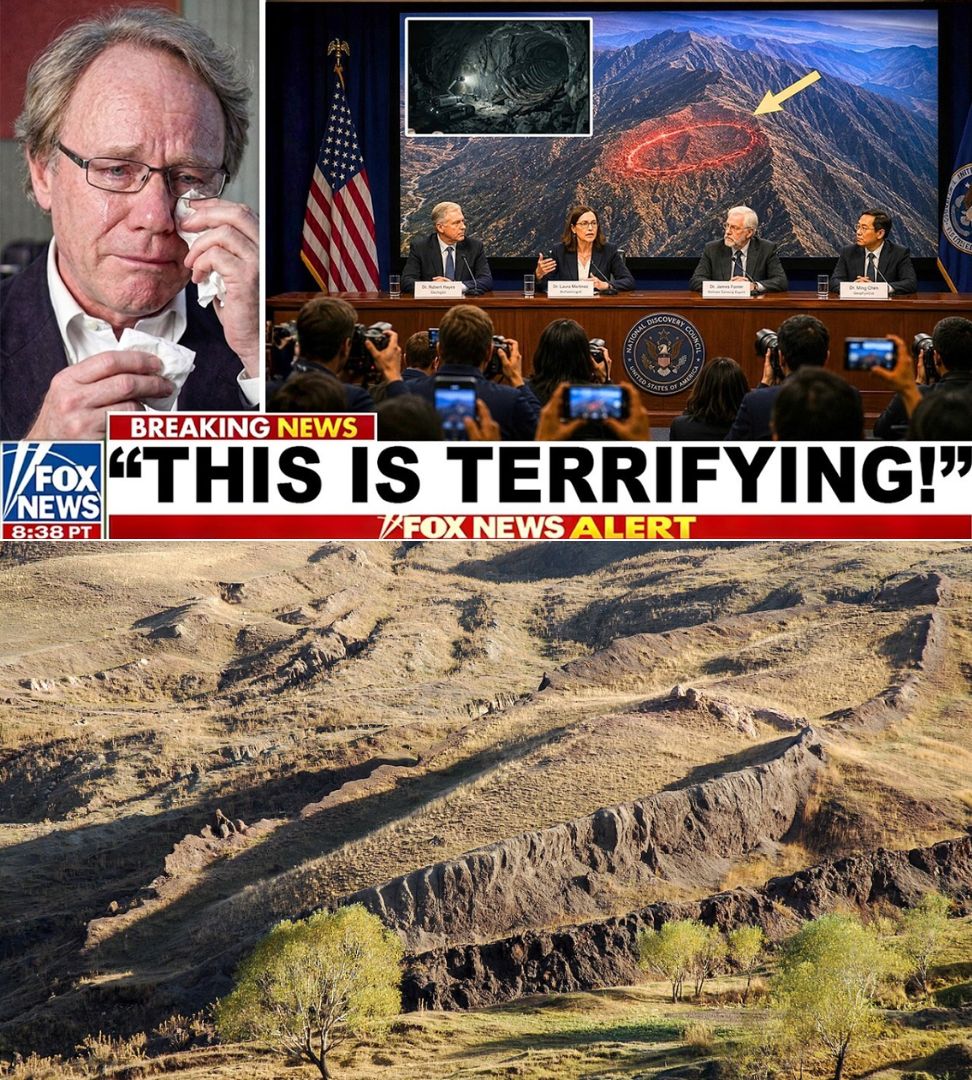

A groundbreaking discovery has emerged from the mysterious slopes of Mount Ararat, where an international team of researchers is reigniting the age-old debate about the existence of Noah’s Ark. Recent drone footage captured inside the enigmatic Durupınar formation has reportedly unveiled astonishing new evidence that could change everything we thought we knew about this biblical tale.
 The story begins in the summer of 1959 when Turkish army captain İlhan Durupınar stumbled upon a peculiar formation in aerial photographs of eastern Turkey. Nestled at an elevation of about 6,500 feet, this unusual structure, resembling a massive ship, caught his eye. Its dimensions closely mirrored those described in the Book of Genesis, which details the Ark’s specifications. Intrigued, Durupınar shared his findings, but caution surrounded the implications of his discovery.
Over the decades, the Durupınar site has attracted explorers, skeptics, and researchers, each offering their interpretations of the formation’s origins. Recently, the investigation took a dramatic turn when a remote-controlled robot was sent into a tunnel beneath the formation, capturing live footage that has reignited interest and speculation about what lies beneath.
 The Durupınar formation, located about 18 miles south of Mount Ararat’s peak, has long fascinated researchers due to its unique shape and dimensions. Measuring approximately 515 feet in length, 86 feet in width, and 52 feet in height, it aligns closely with the biblical Ark’s measurements when converted to modern units. However, the surrounding volcanic landscape and hardened mudflows have led to ongoing debates about the site’s true nature.
In 2024, a soil study conducted by Australian scientist Bill Crabtree and Turkish geologist Dr. Mehmet Salih Bayraktutan revealed unexpected findings. Soil samples taken from within the formation contained three times more organic material than those from the surrounding area, suggesting a potential connection to ancient biological materials. This discovery raised questions about the possibility of a large wooden structure having deteriorated over centuries, leaving behind a distinct chemical signature.

Andrew Jones, a key figure in the ongoing investigation, has been studying the site since 2019. His team employs non-invasive methods, including ground-penetrating radar, to analyze the formation without disturbing it. Recent advancements in imaging software have allowed them to revisit earlier data, revealing geometric patterns beneath the surface that some believe could correspond to man-made structures.
 The latest robotic exploration confirmed the existence of a tunnel-like passage within the formation, leading to a larger chamber dubbed the “atrium.” Initial observations suggest that the walls of this chamber contain layers of compressed organic material, raising further questions about its origins. Some researchers speculate that the findings could point to a constructed space, echoing the biblical description of the Ark’s organized interior.
As the team awaits laboratory analysis of the materials collected during the robotic survey, excitement and skepticism continue to swirl. While supporters of the Noah’s Ark hypothesis see compelling evidence, critics argue that extraordinary claims require extraordinary proof. The Turkish government’s recognition of the site as a protected cultural area adds another layer of intrigue to the ongoing debate.
With the laboratory results expected to be released soon, the conversation surrounding the Durupınar formation is bound to intensify. Will these findings finally provide clarity on one of history’s most enduring mysteries, or will they lead to even more questions? The world watches closely as the story unfolds.
https://www.youtube.com/embed/LQrHfWQb3Vg