The words sliced through the ballroom before the pastor could finish the vows. Every head turned. Margaret Caldwell rose slowly from the front row, wrapped in black silk and diamonds, her face calm, her posture perfect, as if she were not interrupting the most sacred moment of her son’s life, but correcting a minor inconvenience. “Ethan,” she said, her voice sharp enough to silence the room.
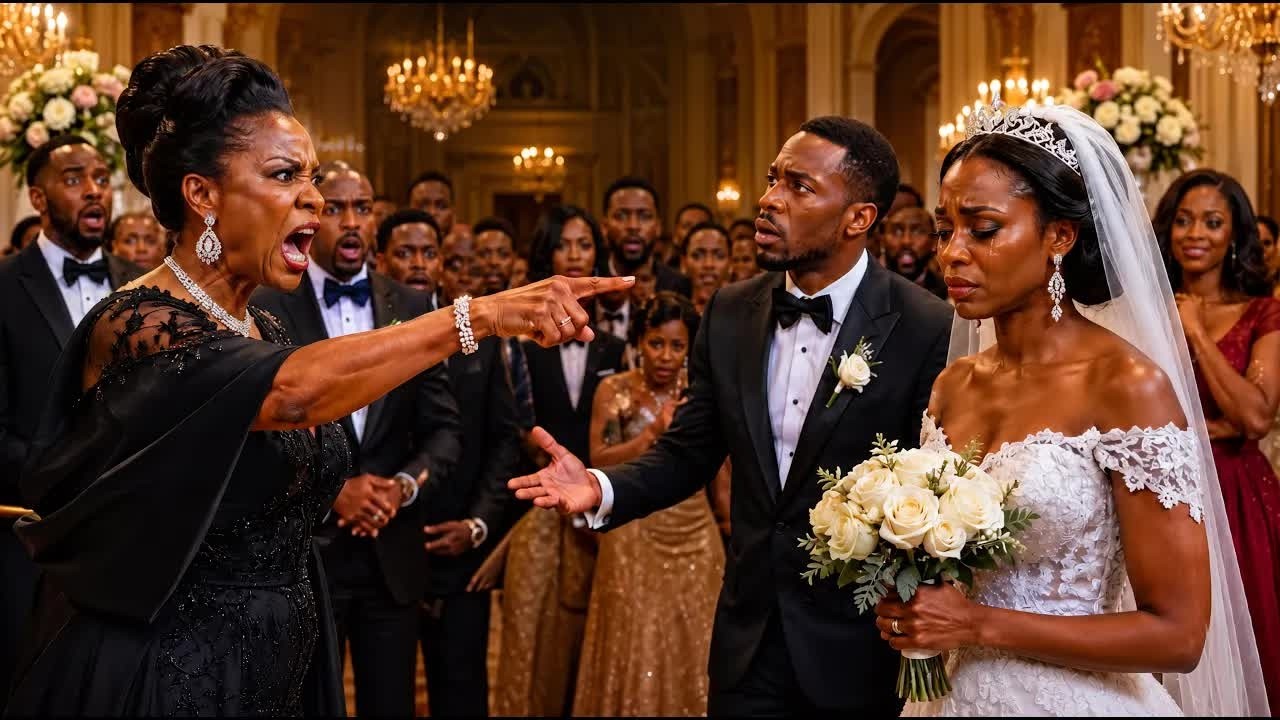
“You are not marrying this woman. ”
A ripple of shock moved through the guests. At the altar, Grace didn’t scream. She didn’t step back.
She didn’t drop her bouquet. She just stood there in a hand-beaded white gown, her fingers tightening around the roses, her face still and beautiful and suddenly too pale beneath the chandelier light. Ethan looked as if someone had struck him across the chest. “Mom.
”
Margaret took one step forward. “End it right now before you ruin your future. ”
The string quartet fell silent mid-note. Two hundred guests stared.
A champagne glass slipped from someone’s hand and shattered near the back of the ballroom. And in that terrible silence, standing a few rows behind Margaret, Vanessa lowered her eyes and smiled to herself. Not a cruel smile, not a dramatic one, just the quiet smile of a woman who believed she had already won. Grace finally turned to Ethan.
He loved her. Everyone there knew it. But love had never been the strongest force in Ethan Caldwell’s life. Fear was.
Fear of disappointing his mother. Fear of choosing conflict. Fear of becoming the son who finally said no. Margaret’s gaze locked onto him.
“Tell the pastor the ceremony is over. ”
The pastor stepped back. The photographers stopped shooting. Even the little flower girl at the end of the aisle froze, clutching her basket with both hands.
Ethan opened his mouth, but no words came out. And that hesitation told Grace everything. It said what no vow ever could. It said that when the moment came, he was still a son before he was a man.
A hush of disbelief swept through the ballroom. Grace swallowed hard, then lowered her bouquet onto the altar table with careful hands, as if even in heartbreak, she refused to break anything else. She looked stunning. But in that moment, what held the room wasn’t her beauty.
It was her dignity. Because every woman in that ballroom understood exactly what had just happened. She had not been rejected in private. She had been measured, judged, and humiliated in front of everyone she loved.
And still, she refused to fall apart where they could watch. But what none of them knew was this: the woman Margaret called unworthy had spent years quietly holding that entire family together. The woman being cast aside at the altar had carried secrets, sacrifices, and a legacy none of them had even imagined. And before this night was over, the same people who watched her stand there in silence would discover that Grace was never the one who came into that room with nothing.
Because sometimes the person everyone underestimates is the only one strong enough to survive the truth. Months before the wedding, Grace had been the first one awake and the last one asleep. Not because anyone demanded it, but because loving Ethan had always meant loving the broken corners of his life, too. When his younger sister Lauren went through a bitter custody battle and didn’t want the family to know she was drowning, Grace was the one who sat on the bathroom floor with her at 2:00 in the morning while she cried into a towel so her children wouldn’t hear.
When Ethan’s uncle missed rent after losing his job, Grace quietly transferred the money through a friend so no one would know it came from her. When Margaret had surgery and insisted she didn’t need help, Grace was the one who showed up anyway, bringing homemade soup, fresh linens, and a notebook full of medication schedules written in soft blue ink. Margaret criticized the soup for being too plain. She said the pillows were overstuffed.
She asked why Grace folded the towels the hotel way instead of the proper way. Grace just smiled and changed them. Not because she was weak, but because she was the kind of woman who understood that peace often requires strength nobody notices. On Naomi’s fifth birthday, when Ethan forgot to pick up the cake because he got trapped in a meeting, Grace baked one from scratch in less than an hour, decorated it with shaky pink frosting, and somehow turned a near disaster into Naomi’s favorite memory.
When Margaret later told guests the party looked elegant because she had taught Grace a few things, Grace said nothing. When Ethan’s business nearly collapsed in its second year, it was Grace who sold a bracelet her grandmother left her and told him she had just moved some savings around. He believed her. She let him, because protecting the man you love can sometimes look like silence.
She knew how to make people feel safe without reminding them they had been rescued. She remembered what people needed before they asked. She noticed when someone’s smile was fake. She knew Naomi needed songs to sleep.
Ethan needed quiet when he was ashamed. And Margaret, though Margaret would never admit it, needed someone patient enough not to fight her every time fear dressed itself up as authority. That was Margaret’s tragedy. She wasn’t a cartoon villain.
She was a woman who had grown up believing the world only respected what looked expensive, polished, and socially approved. She had clawed her own way into elite circles, protected her family name fiercely, and spent decades convincing herself that appearances kept people safe. To Margaret, character mattered, but only after the right address, the right school, the right friends, the right last name, and the right tax bracket. Grace had kindness, elegance, patience, and grace in abundance.
But she wore no visible empire. She didn’t brag. She didn’t flaunt. She moved like a woman who knew herself and had nothing to prove.
And to someone like Margaret, that kind of quiet confidence was easy to misread as smallness. Then there was Vanessa. Vanessa never needed to fight Grace openly. She didn’t roll her eyes or start scenes or throw insults in public.
That would have been too obvious. Vanessa was smarter than that. She simply belonged to the world Margaret trusted. She knew the right people, attended the right galas, wore the right designers, and understood how to speak in soft compliments that carried hidden meaning.
She would look at Grace’s dress and say, “You always make simple looks so lovely. ” She would admire Naomi and say, “She has your sweetness. I’m sure she’ll grow into more confidence. ” She would ask Ethan about work in front of investors, finishing his thoughts in a way that made Margaret beam with approval.
And the whole time, Grace saw it. Not jealousy, not panic, just clarity. Because Grace had never feared another woman. She only feared what happens when a good man keeps choosing comfort over courage.
Ethan loved Grace in all the real ways. He loved the way she touched Naomi’s hair while reading bedtime stories. He loved the way she sat beside him on hard nights without forcing him to speak. He loved the way she could walk into a tense room and bring everyone down to calm with one gentle sentence.
He loved that she never tried to impress anyone. He loved that she never had to. But Ethan had been raised in Margaret’s shadow. Every decision in his life had been filtered through one question: What will my mother think?
So when Margaret made small comments about Grace not being the right fit for the family brand, Ethan argued just enough to feel decent, then backed down before it became real conflict. When she suggested a prenuptial agreement drafted in language that felt cold and humiliating, Grace signed without complaint, because she had never wanted Ethan’s money. Margaret took that humility as proof that Grace had no leverage. When Ethan promised Grace “just give her time,” Grace believed him, because she loved him.
And because women like Grace always believe love will eventually grow a spine. The wedding planning became its own battlefield. Margaret overruled the florist Grace wanted because it wasn’t elevated enough. She trimmed Grace’s guest list, then expanded her own.
She insisted on a reception seating chart based on business value rather than actual relationships. And still, Grace stayed composed. She adjusted the flowers. She smiled through rehearsals.
She thanked people who barely concealed their pity. Only once did she let the pain show. Late one night, after Naomi had fallen asleep, curled against her shoulder, Grace sat alone in the kitchen with her late grandfather’s old leather folder in her lap. She didn’t open it.
She just ran her fingers over the worn edges. Naomi, half awake, looked up and whispered, “Is that Grandpa Elijah’s paper? ”
Grace kissed her forehead. “Yes, baby.
”
“Why do you never read it? ”
Grace stared at the folder for a long moment. “Because he told me I’d know when it was time. ”
Naomi blinked sleepily.
“Like treasure. ”
Grace smiled faintly, though her eyes were wet. “Maybe not treasure the way kids mean it. ”
“Then what kind?
”
“The kind people understand too late. ”
On the morning of the wedding, Grace helped Naomi into her tiny cream dress and fastened the little pearl clips in her curls. Naomi grinned into the mirror. “Do I look like a princess?
”
Grace smiled, but her throat tightened. “You look like a promise. ”
“What kind of promise? ”
“The kind I hope this family keeps.
” Then she turned away before Naomi could see the shadow that crossed her face. At the venue, the ballroom looked like a dream stitched from glass and candlelight. Tall white orchids rose from mirrored tables. A gospel trio had just finished singing.
The chandeliers spilled gold over satin, silver, and polished marble. It was the kind of wedding people talked about for years. And then Margaret stood up and shattered it in ten words: “Ethan, you are not marrying this woman. ”
Back in the present, Grace slowly lifted her left hand.
Every guest watched with extraordinary calm. She slid off the ring. A sound went through the room, part gasp, part heartbreak. Ethan stepped toward her.
“Grace, please don’t do this. ”
She looked at him then, and the tears that had refused to fall finally gathered in her eyes, though still she held them there. “Don’t do this? ” she asked softly.
“Ethan, I didn’t. ”
That landed harder than a scream ever could. Margaret stiffened. “This can still be corrected.
”
Grace turned to her. “Corrected? ” The entire ballroom seemed to lean in. “I stood by your son when he had nothing certain.
I stood by this family when it was inconvenient, embarrassing, exhausting, and lonely. I loved people here who never once bothered to understand me. If this is your idea of correction, Margaret, then maybe truth has been missing from this family for a very long time. ”
Margaret’s expression flickered, but pride held.
Vanessa looked away, pretending not to enjoy the moment. Naomi, confused and frightened, clutched the side of Grace’s gown. “Mommy. ”
Grace knelt instantly, ignoring every eye in the room, and smoothed Naomi’s little gloves.
“Sweetheart,” she said gently. “Can you bring mommy one thing from my bag? ”
Naomi sniffled. “What thing?
”
“The old leather folder. ”
Margaret exhaled through her nose, almost relieved. “Grace, please. This is not the time for sentimental gestures.
”
But Grace’s face changed then. Not harder. Stronger. “This isn’t sentiment,” she said quietly.
“It’s timing. ”
Naomi hurried down the aisle, her tiny shoes tapping against marble, and returned, holding the worn brown folder with both hands like it mattered, because somehow to her it did. She placed it into Grace’s palm and whispered in a small trembling voice that floated through the silence like a prayer: “Mommy, Grandpa’s paper. ”
A few guests exchanged puzzled looks.
One man near the back smirked. Vanessa’s confidence returned for half a second. A paper. That was all.
Grace held the folder close, her thumb resting against the crease in the leather, and then from outside, engines rolled across the venue driveway. One, then another, then another. Low, smooth, expensive. The sound was so synchronized it made the room pause.
Guests near the windows turned first. Three black luxury vehicles pulled under the front entrance canopy. Valets straightened. Security exchanged looks.
The ballroom doors opened. A distinguished older man stepped inside with two associates following several paces behind him. Silver hair, deep navy suit, elegant posture, the kind of presence that didn’t ask for attention because it had never needed to. He didn’t hurry.
He didn’t scan the room nervously. He walked like a man who belonged anywhere serious things were happening. And without asking permission from anyone, the room made space for him. He approached Grace directly.
Not Margaret, not Ethan, not the pastor, not the wealthy guests whispering behind folded programs. “Ms. Monroe,” he said in a calm, measured voice. “I came as quickly as I could.
”
Margaret frowned. “Excuse me, who exactly are you? ”
The man turned slightly. “Charles Whitmore, senior partner at Whitmore Bell and Sloan.
”
Three guests in the front row visibly reacted. One of the bridesmaids whispered, “The Whitmore firm. ” That changed the air instantly. This was not a family friend.
This was not a dramatic prop. This was a man called when the law had already arrived. Grace handed him the folder. Whitmore received it with both hands, careful, respectful, almost reverent.
He opened it slowly. Inside lay yellowed legal documents, old signatures, sealed copies, handwritten notes, and a folded letter worn thin from years of being carried, but never read aloud. Whitmore examined the first page, then the second. He adjusted his glasses.
“Did your grandfather ever explain when you were to use this? ” he asked. Grace shook her head. “He said, ‘If anyone ever tried to decide my worth before understanding my character, I should bring this to the truth.
‘”
Whitmore’s expression changed. Just slightly. Recognition, not surprise. Recognition.
He looked up at her, then back at the folder. “That sounds exactly like Elijah Monroe. ”
Ethan stepped forward, confused, shaken. “Grace, what is this?
Why didn’t you ever tell me? ”
Grace looked at him, and for a moment the entire room fell away. “Because I never thought I would need paper to prove what love should have recognized on its own. ”
That line hit the women in the room hardest.
You could feel it, because too many of them knew what it meant to give their heart where they were still expected to defend their worth. Whitmore laid the documents across a side table near the altar. “Did anyone here ever discuss the Monroe Legacy Trust with Ms. Monroe?
” he asked. Silence. Margaret crossed her arms. “I’ve never heard of such a thing.
”
Whitmore nodded once, as though her ignorance was merely another fact to log. Then he asked Grace, “Your grandfather passed 11 years ago? ”
“Yes. ”
“And you declined the first administrative briefing sent after his death.
”
Grace gave a small, almost embarrassed nod. “I did. I was trying to build a life of my own. I didn’t want to be carried by something I hadn’t earned.
”
Whitmore’s gaze softened. “He anticipated that. ” He lifted the old letter. “He left instructions for your office to preserve this in duplicate.
”
A murmur moved through the ballroom. Office. Preserve. Duplicate.
Now curiosity had replaced scandal. Who had Grace really been all this time? The flashbacks came gently, woven through Whitmore’s questions like threads of memory. Grace, at 12, sitting beside her grandfather, Elijah, in a library lined with dark wood and legal books she was too young to understand.
Elijah sliding a chess piece forward and saying, “Never chase people who only respect noise. Let them mistake silence for emptiness. ” Grace at 16, crying after a teacher humiliated her for not flaunting money like other girls. Elijah kneeling in front of her and saying, “A woman does not become valuable when a room notices her.
She is valuable before the room ever learns her name. ” Grace at 22, graduating, holding his arm as he slowly walked across a garden path. “Promise me something,” he told her. “If life ever gives you power, let it reveal your character, not replace it.
”
Now, in the wedding hall, Whitmore unfolded one handwritten page and read aloud: “Dear Grace, if this document ever finds you in a room full of judgment, let the room keep talking. They are only measuring what they understand. I built distance between you and these assets, not to deny you, but to protect you until your heart had become stronger than the weight of ownership. ”
Grace’s hand rose to her mouth.
Naomi looked up at her mother as if she somehow understood every word. Whitmore continued his questions, each answer opening another door. “Your mother was Elijah Monroe’s only child? ”
“Yes, she passed before he did.
”
“And you remained the sole lineal beneficiary under the amended succession schedule? ”
“Yes, I believe so. ”
“Did you ever execute a relinquishment? ”
“No.
”
“Did you ever transfer your beneficial rights? ”
“No. ”
Whitmore nodded, already knowing where this was going. Margaret’s face had gone still in that dangerous way people do when reality begins slipping beyond their control.
Vanessa now looked not amused, but alert. Ethan kept staring at Grace like he was trying to rewind years of conversations and hear everything he had missed. Whitmore opened a sealed envelope from the back of the folder and removed a formal document with attached schedules. “This,” he said, “is the controlling appointment instrument.
” He placed it flat on the table. “The Monroe Legacy Trust was established 28 years ago as an irrevocable succession and asset protection structure. Management authority was intentionally divided between professional trustees, operating entities, and external administrators. Public ownership was obscured by design.
Beneficial control remained dormant until Ms. Monroe reached the vesting age or executed early acceptance under the conditions outlined here. ”
A guest near the aisle whispered, “What does that even mean? ”
Whitmore answered without looking up.
“It means the person many of you assumed came here empty-handed may in fact be the one standing in the strongest legal position in this room. ”
No one spoke after that. Even the air felt different. Whitmore reviewed another page.
“Ms. Monroe, you turned 35 last month. ”
Grace nodded slowly. “Then the vesting would have occurred automatically.
” He drew a slow breath. “The only remaining question is scale. ”
Margaret’s voice cracked for the first time. “Scale of what?
”
Whitmore looked directly at her. “Of everything you failed to ask before humiliating this woman. ”
The silence that followed was brutal, because no one could deny it now. Something enormous was unfolding.
And yet Grace never once looked proud, only wounded, only composed, only tired in that quiet way women look when they have finally reached the end of carrying other people’s blindness. Whitmore stacked the documents, then spoke clearly so every guest could hear him. “Elijah Monroe’s trust currently holds controlling and supervisory interests with a consolidated appraised value slightly above $250 million. ”
A wave of disbelief swept the ballroom.
One guest sat down so abruptly her chair scraped across marble. Another covered her mouth. Vanessa’s face drained of color. Ethan blinked as though the sentence physically hurt.
Whitmore went on, precise and unhurried. “The trust includes commercial real estate holdings in Atlanta and Charlotte, minority positions in two hotel groups, managed investment portfolios, dividend-producing securities, municipal bond structures, privately held company shares, and long-term control rights arranged under layered governance agreements. All of it was designed to remain stable, low-profile, and professionally administered until Ms. Monroe assumed legal authority.
” He turned toward Grace. “The current legal controller and designated acting authority of the Monroe Legacy Trust is Grace Monroe. ”
No one moved. The chandeliers still glowed.
Candles still burned. The wedding flowers still smelled sweet, but the room was no longer the same room, because the truth had done what truth always does. It had stripped away costume. Vanessa lowered her eyes first, not dramatically, just quietly, as someone does when she realizes the ground beneath her confidence was built entirely on appearances.
She had thought she belonged in this world more than Grace did. But she suddenly understood that belonging and value are not the same thing. Ethan looked shattered. Not because Grace was wealthy.
That wasn’t the real wound. The real wound was realizing the woman he loved had never needed his name, his family, his approval, or his protection to stand tall. She had chosen him freely, and he had answered that gift with hesitation. Margaret stared at Grace as if seeing her for the first time.
Years of judgment, assumptions, and subtle cruelty were returning all at once, now sharpened by shame. She had believed she was preserving her son’s future, but her obsession with status had almost destroyed the very thing that could have healed her family. Whitmore stepped back. “Ms.
Monroe, all immediate authority rests with you. If you wish, we can suspend further discussion and move everything to a private setting. ”
The room waited for vengeance, for humiliation, for the satisfying cruelty people imagine when power changes hands. But Grace did not become someone else.
That was the miracle of her. She took a breath and looked at the people who had wounded her. At Margaret, who had measured her life by surfaces. At Ethan, who had loved her but not defended her.
At the guests, who had watched in silence. At Naomi, whose little face held confusion and fear. And then Grace spoke. “I don’t want revenge.
”
The sentence broke something open in the room. Margaret covered her mouth. Ethan’s eyes filled instantly. Grace went on, her voice soft but unwavering.
“I don’t need anyone here to feel small. Life does that well enough on its own. What I needed, what I deserved, was respect. Not because of this trust, not because of money, but because I stood in love and honesty before all of you.
And that should have been enough. ”
Margaret’s composure finally shattered. “Grace, I was wrong. ”
Grace looked at her quietly.
Margaret took a shaky step forward. “I thought I understood what security meant. I thought I was protecting my son from instability, from risk, from embarrassment. But all I did was confuse wealth with worth.
And the truth is, you were the one woman in this family who never used love as leverage. ” Tears slid down Margaret’s face now. And because they came too late, they felt real. “I saw how you cared for all of us,” she whispered.
“I saw it, and still I refused to honor it. I am ashamed of that. ”
Grace’s eyes shone, but she kept her voice steady. “Thank you for telling the truth.
”
Ethan stepped closer, every word breaking apart on the way out. “Grace, I love you. I have always loved you. ”
Grace nodded.
“I know. ”
“Then please. ” His voice dropped. “Please don’t let this be the end.
”
For a moment, all anyone could hear was Naomi’s tiny breathing. Grace turned fully toward him. “Ethan, loving me was never the question. Standing beside me was.
”
He closed his eyes, because there was nothing to defend, no excuse to hide behind, no convenient misunderstanding, just the unbearable simplicity of truth. “You’re right,” he whispered. Grace looked at him with the sadness of someone mourning what could have been. “You didn’t lose me tonight because your mother spoke,” she said.
“You lost me because when she did, you let silence speak for you. ”
That line settled over the room like a final bell. Vanessa picked up her clutch slowly. No outburst, no tears, no dramatic exit.
She had entered this story believing she understood the rules. Now she understood only the consequences. She looked once at Margaret, once at Ethan, then at Grace, and in that one quiet look was acknowledgment. Not friendship, not apology, just acceptance.
Then she turned and walked out of the ballroom alone. Whitmore waited respectfully as the family stood inside the wreckage of the moment. Then Grace did something no one expected. She knelt in front of Naomi and took both of her little hands.
“Baby, do you remember what Grandpa Elijah used to say? ”
Naomi sniffled. “Be gentle with people who are hurting. ”
Grace smiled through tears.
“Yes. ”
Naomi looked around the room. “Everybody’s hurting. ”
Grace kissed her forehead.
“That’s why we still choose gentleness. ”
Several women in the audience would cry there, because that was the true center of the story. Not the money, not the legal papers. A mother in pain teaching softness to her daughter.
Anyway, Grace stood and turned to Whitmore. “There is something I want done immediately. ”
“Of course. ”
“I want a charitable family care foundation established in my grandfather’s name.
Elder support, education grants for women rebuilding their lives, emergency legal assistance for single mothers, housing stabilization for families in crisis. ”
Whitmore gave a small nod. “That is entirely possible. ”
Grace glanced down at the folder, then back up.
“My grandfather didn’t preserve all this so I could make people feel inferior. He preserved it so I would never have to beg small minds for dignity. ”
Whitmore’s expression softened into respect. “He chose well.
”
The wedding did not continue that night. Some things cannot be mended beneath the same flowers that witnessed them break. Grace did not remarry under pressure. She did not offer instant forgiveness and call it healing.
She took Naomi home. She took the leather folder with her. And she let the silence that followed do the work no speech could. In the months that came after, Ethan began changing in ways that were finally visible.
Not through grand gestures, but through discipline, therapy, boundaries, honest fatherhood, apologies with no demand attached. He stopped asking Grace to make his healing easy. He stopped blaming Margaret for choices that had always belonged to him. He learned slowly and painfully that a man is not measured by how deeply he feels, but by whether he stands up when it costs him something.
Margaret changed too, not overnight, not perfectly, but sincerely. She resigned from two social committees that had become her false altar. She visited Grace quietly, without entourage, without excuses, sometimes only to drop off Naomi’s favorite muffins and leave. One afternoon, months later, she said the words she should have said years earlier.
“I raised my son to chase approval,” she admitted. “And then I punished him for becoming the kind of man who feared losing it. That is mine to grieve. ”
Grace listened, because maturity knows the difference between an excuse and a confession.
Trust did not return quickly, nor should it have. But truth had finally entered the family, and truth, however late, is the only ground real healing can stand on. As for Grace, she remained exactly who she had always been. Steady, compassionate, dignified.
She oversaw the trust with the same humility she once used to fold hospital blankets and bake midnight birthday cakes. She never flaunted wealth, never weaponized it, never rewrote herself to match what people now expected a powerful woman to look like. Because her grandfather had been right. Power had not changed her.
It had revealed her. And in the end, that became the story people remembered most. Not that a bride was stopped at the altar. Not that a hidden trust was worth $250 million.
Not even that black luxury cars once rolled up to a wedding and changed everything. What they remembered was this: a woman was publicly humiliated, privately underestimated, and quietly judged by people who mistook simplicity for weakness. Then truth entered the room. And when power finally rested in her hands, she chose dignity over revenge, wisdom over pride, and healing over spectacle.
Because true wealth was never the money. It was the integrity that survived humiliation. The compassion that remained after betrayal. The self-respect that did not need applause.
The character that stayed kind without staying blind. And that is why the people who tell this story now do not speak first about Grace Monroe’s fortune. They speak about the moment she had every reason to destroy people and chose to remain a woman her grandfather would have been proud of.