They called me the risk. If they called me anything at all. Invisible was my superpower, and I wore it like armor. It let me see everything: the whispered jokes, the sidelong glances, the way Tiffany’s voice dripped with honey while her words cut like glass.
She thought she was untouchable. She thought I was nothing. At the company gala, the lights were warm and the champagne flowed like a river of false goodwill. I stood near the back, nursing a drink I never touched, watching the spectacle unfold.
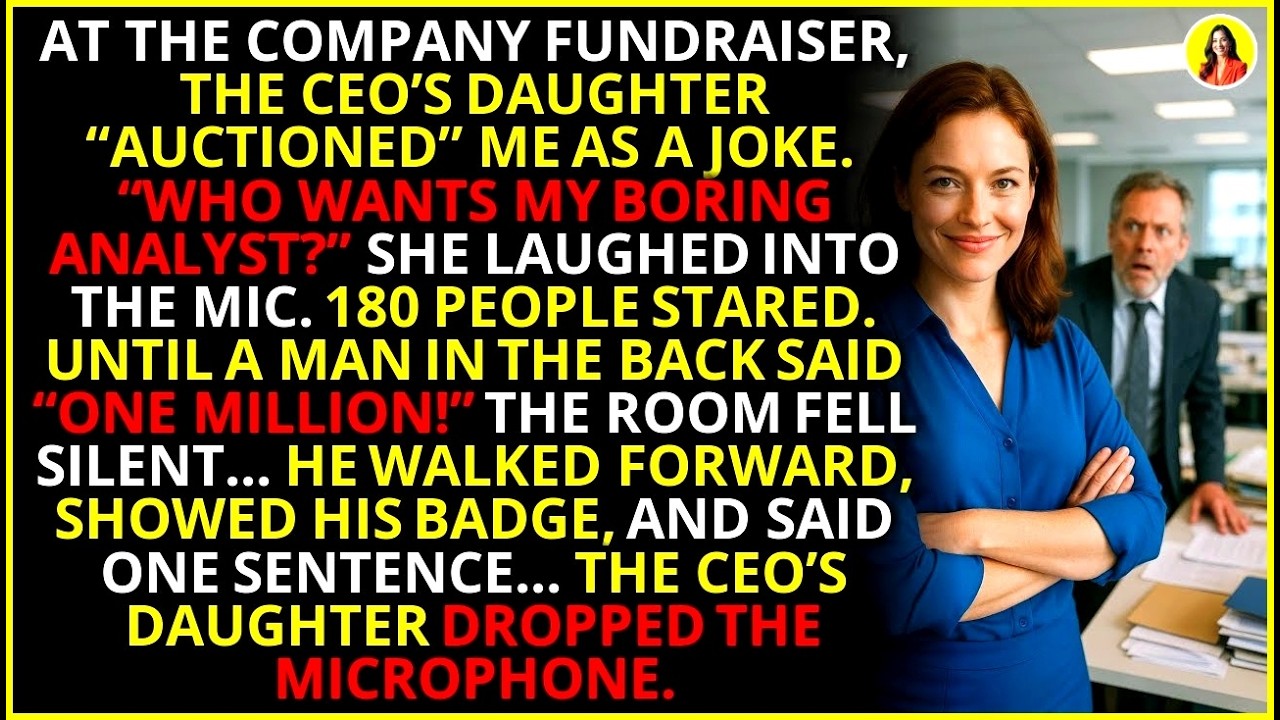
Tiffany tottered onto the stage, her silver gown slit up the thigh, a full glass in each hand, probably live-streaming to her twelve thousand followers who couldn’t care less about charitable tax write-offs. She held up her glass toward me and called my name out loud, her voice syrupy with fake affection. “Let’s give a round of applause for our little workhorse! ” she announced, her smile sharp as a blade.
“Come on, we all know she’s single, fabulous, and probably has a filing system for her dating life. ”
The laughter that followed was a wave of relief, everyone eager to be on the right side of the joke. Some part of me still thought maybe if I laughed too, they wouldn’t see how much it hurt. But I looked down instead, not out of shame, but because I knew what was coming next.
“Rise for the highest bidder! ” Tiffany said, still playing the auctioneer for the charity portion of the evening. “One night with me, ah, I mean, with the workhorse! Who’ll start the bidding?
”
Silence. Not because of deep respect. No, they didn’t bid because no one wanted to be the first to turn her cruelty into reality. Because then it wouldn’t just be Tiffany’s sin, it would be theirs too.
Tiffany, either oblivious or drunk enough not to care, made a mock pout and shrugged, slapping her hands together like a trained seal. The music started up again, a jarring blanket over the awkwardness. No one spoke to me afterward. My drink was still there, the one I hadn’t touched.
I was about to slip away when I noticed a man in a charcoal suit standing very still near the bar, his eyes fixed on me. He gave the smallest nod, and that’s when I knew I wasn’t the only one taking notes. Later that night, long after everyone had logged off and moved on to their charcuterie boards and Netflix escapes, I sat alone in my apartment, replaying every humiliation, every silent shrug. But instead of anger, I felt a strange sense of clarity.
I’d been invisible long enough. They saw nothing because they looked at nothing. But a long-held, compressed pressure was loosening its grip. Two days after the gala, the first sign that the tide was shifting came in the form of an email.
Subject line: “Urgent. ” Three paragraphs of vague panic and one spreadsheet with all the formatting of a ransom note. Apparently, two separate institutional investors, both with sizeable positions, had started asking very pointed questions. No one could figure out why.
But I knew the language. I knew the numbers. I forwarded the spreadsheet to my private server, annotated the inconsistencies, wrapped it all up in a bow of plausible deniability. Then I waited.
The next morning, an HR meeting appeared on my calendar. Conference room B. HR code for “we’re documenting this one. ” I walked in five minutes early, sat down, and placed my hands flat on the table.
Two suited people sat across from me, their smiles professionally neutral. They slid a form across the table. “This is just a check-in,” one of them said. “Just a few questions, for our own notes, you understand.
”
They asked about my role, my projects, my relationship with Tiffany. They asked if I felt supported. I answered every question with the calm precision of someone who had rehearsed this moment a hundred times. I said yes, I felt supported.
I said anything for the company. I smiled when they thanked me. But that night, I opened the encrypted app I kept buried behind fake folders. I tapped one name, texted three words: “It’s time.
”
Within seconds, one word came back: “Always. ”
I closed the app and let the darkness of my living room swallow the screen. I’d be the storm they’d never forecasted. Over the next week, I moved like a ghost through the corporate hallways.
I met Madison in a quiet coffee shop, a young analyst with sharp eyes and a slight tremor in her hands. She wanted out, but she didn’t know how. She didn’t realize that I wrote half the damn training documentation she’d been pretending to read. She told me everything about Tiffany’s little side deals, the padded invoices, the ghost vendors, the quiet funneling of company money into personal accounts.
I listened, noted every detail, and planted seeds. Then came the second meeting. Tiffany herself summoned me, her voice sugary on the phone, her invitation sounding more like a command. She sat in her corner office, a glass of wine in hand, her eyes glittering with malice.
“I heard you’ve been talking to HR,” she said, leaning back. “That’s cute. But I know everything, sweetheart. I know about your little notebooks, your little plans.
You think you’re clever? ”
I said nothing. I just looked at her, and in that silence, I felt something shift. She wasn’t used to being ignored.
“This is just a warning,” she continued, her voice losing its sweetness. “Keep your head down, or I’ll make your life a living hell. I have friends in places you can’t imagine. ”
I stood up, smoothed my skirt, and walked out without a word.
In the hallway, I allowed myself a small smile. She had already made my life a living hell. She just didn’t know I was going to return the favor. The first crack in her empire came quickly.
The institutional investors who’d asked pointed questions were now demanding a full audit. Tiffany tried to spin it, but the numbers didn’t lie. Then Madison found her moment: a missing payment of half a million that was supposed to go to a charity partner but ended up in a private account. The paper trail was damning.
Conference room B filled up again, but this time, it wasn’t for me. The room was packed with lawyers, board members, and a pale-faced Tiffany clutching her phone. She tried to laugh it off, tried to blame a misplaced decimal, but her voice cracked. The room went cold.
A man in a charcoal suit stepped forward. It was him, the one from the gala. He reached into the inside pocket of his suit and pulled out a leather folio. He addressed the board with quiet authority, his words cutting through the tense air like a scalpel.
“I’ve been watching this company for months,” he said. “I’ve seen everything. I have documents, records, and testimony that prove a systematic pattern of fraud. And I have a witness—someone who’s been on the inside, who knows every detail.
”
He turned to me. For the first time, the room looked at me, really looked at me. “She’s the only reason I bought in,” he said. “She’s the reason this company is worth saving.
”
Tiffany tried to speak, but nothing came out. She stood there, frozen behind the table, like she’d just summoned a demon without reading the fine print. Security escorted her out a few moments later. No one needed to say anything else.
The next morning, the company held an emergency board meeting. I walked in five minutes early, sat at the long mahogany table like I belonged there, because now I did. Two full slides detailed the extent of Tiffany’s schemes. No one spoke, not a single word.
The silence was heavy, but it wasn’t hostile. It was the silence of people recalibrating their understanding of the world. Then the chairman cleared his throat. “Effective immediately,” he said, “Ms.
Sarah will serve as special advisor to the board. ”
There was a collective exhale. I didn’t smile; I simply nodded. After the meeting, I gathered my notes and made my way to the elevator.
A young woman, one of the assistants who’d laughed at the gala, was holding the door for me, her eyes wide with something like awe. I stopped just long enough to meet her eyes and smiled. Then I stepped into the elevator without a word, rode it down to the lobby, and walked into a morning sun that felt like absolution. Later that day, I received a text from Madison: “They’ll never underestimate you again.
”
I typed back one sentence: “They never saw me coming. ”
I pocketed my phone and looked at the sky. The invisible had finally become undeniable.
And I knew, more than ever, that silence is only weakness until the moment it becomes a weapon.