The steamer *Maloyaroslavets* cut through the Baltic Sea, carrying roughly two hundred tons of luggage below its decks. Among the passengers was a woman whose story would outlive the empire that had defined her. Contemporary naval reports placed the passenger count between seventy and eighty-three, and the exact numbers remain disputed, but the accounts all agree on one thing: she had nearly not come at all. She almost stayed behind.
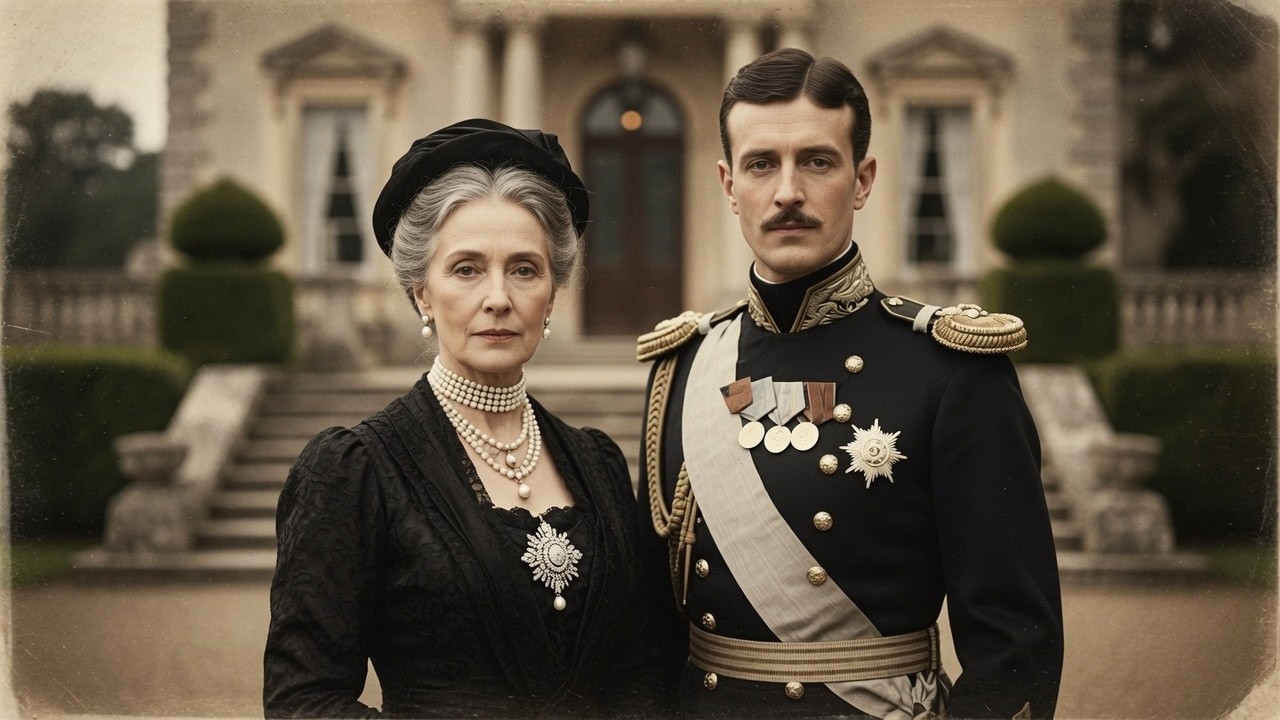
It was only at the last moment that she walked up the gangway, a dignified figure in black, standing very still while her country disappeared over the horizon. Most people carried a simple memory of her: a mourning widow scattered across Europe after 1918, quietly grieving her murdered family, fading into Paris apartments and taxi-driving legend. That picture was not a lie exactly—it was about a third of what actually happened. Within six years of the killings at Ekaterinburg, the survivors of that ship and the survivors who never made it onto it had split into rival courts issuing rival proclamations, waging a war of paper that would outlast every person who started it.
The two most important surviving Romanovs both got through the catastrophe the same way: by simply declining to accept the world as it was. The difference between them was only in which piece of reality they refused. Grand Duke Kirill Vladimirovich had a title worth pausing on: he was the Tsar’s first cousin and the senior male of the dynasty after the executions. It was the kind of sentence you could only write about a man whose life had a shape, and interpretation was all anyone could offer because nobody recorded the inside of his head.
He had done the one thing a Russian grand duke was genuinely not permitted to do: he married his first cousin, Victoria Melita, in 1905, a union the Orthodox Church did not sanction. Nicholas II stripped him of his imperial titles, but no letters patent were ever issued afterwards removing Kirill or his descendants from the succession. During the February Revolution, Kirill made a choice that would haunt him forever. He took the Guards’ Eccupage, the very unit that had guarded the imperial family, and led it to swear allegiance to the Duma, the body that was dismantling the Tsar’s government.
It appears in émigré memoirs, including those of Vladimir Voeikov, the Tsar’s palace commandant, who produced the single most quotable reaction in the entire story. Not in any official report, but whispered in drawing rooms and dining halls from Paris to Belgrade: Kirill had worn a red bow on his uniform while he did it. The accusation did not begin to circulate in earnest until after 1924, the year he claimed the throne. The revisionists who defended him were correct that no scrap of red silk could be proven; the ribbon was never photographed or documented.
But the underlying charge did not need a ribbon. You did not require a scrap of red silk to see how that looked to a family that would spend the next twenty years deciding what he was. That judgment, ribbon or no ribbon, was the atmosphere he would walk back into. By 1917, the world had collapsed around him.
Nicholas II abdicated, then his brother Michael Alexandrovich refused the throne, then Michael was murdered in 1918 in Perm. Kirill fled across Finland and eventually settled with his wife Victoria in a rented villa in Saint-Briac, France. On paper, he was the senior surviving Romanov male, and he knew it. In 1924, two things changed, and both of them were documents.
First, an English court declared Michael Alexandrovich legally dead, putting an end to any question of whether the Tsar’s brother might still be alive. Second, a criminal investigator’s file from the murder of the imperial family established that the Tsar, the Tsarina, and their children were gone. Now at last, they were dead on paper, with all the finality that English probate could supply. On September 8, 1924, Kirill issued his proclamation from his rented life in a German town, nine hundred miles from a country that had shot the last man to hold the title he was claiming.
The terms of that proclamation were precise and not in dispute; the text was published and has stayed published for over a hundred years. It stated that the fundamental laws of the Russian Empire did not permit the throne to remain vacant, and on that ground, it declared that the senior surviving male of the dynasty assumed the title of Emperor of All the Russias. There was no cathedral, no crowd, no crown, no anointing, no procession. It was a written proclamation issued from a rented life, and it did not purport to settle the form of government.
But there was a woman who stood in his way. The Dowager Empress Maria Feodorovna, the mother of the murdered Tsar, was still alive. She had escaped the revolution and was living in Denmark, first at the Amalienborg Palace and then permanently at Villa Hvidøre, a yellow stucco house at Klampenborg on the coast north of Copenhagen, which she and her sister Alexandra had bought together years before in another world as a holiday retreat. Maria refused to accept her sons’ deaths.
She had survived 1918 by refusing that piece of reality, and she would not validate anyone else’s claim on the throne while there was any doubt. When Kirill asked her to recognize his title, she declined to let him into the room at all. Not a scene, no shouting, no confrontation, no dramatic slamming of a box she never saw because she never saw it. She simply refused.
She remained convinced that her sons and her grandson might still be alive, and beyond that, only the fundamental laws in union with the church and with the Russian people could designate a sovereign—not a man with a printed letterhead. Her objection was that the chair he was claiming may not have been empty. She saw Kirill as a man who had sat out the civil war while other Romanovs were being shot, a man who had seized a fantasy title to repair his own standing after handing the emperor’s own guard unit to the men dismantling the emperor’s government. The image everybody keeps is devastating: Kirill had calling cards printed bearing the title “Emperor of All the Russias.
” A man who has cards printed has understood exactly how much of an emperor he is, which is to say none at all. Maria did not believe in him. She did not believe in anyone who claimed the throne before the fundamental laws and the church had spoken. She dismissed his claim in private correspondence and public statements alike, and she never wavered.
He had moved to the full title only after an English court had killed Michael on paper and after a criminal investigator’s file had killed the rest. That sequence mattered: he had not claimed the throne in 1918 or 1919 when the fate of the family was genuinely unknown. He had waited until the evidence was settled enough for his claim to stand, and Maria saw that calculation clearly. The two readings of the succession produced very different women.
In one reading, Maria was the last legitimate voice of the dynasty, the mother who refused to let her sons die twice. In the other, she was an obstacle, a grieving old woman whose obstinacy prolonged a legal fiction. Kirill and his descendants insisted that their claim was the only lawful one under the fundamental laws. Maria insisted that the throne’s vacancy could not be declared while any doubt remained, and she would not declare it.
Maria died on October 13, 1928, at Villa Hvidøre, around seven in the evening, after weeks of decline. Nine years later, most of what remained of the fight sat in one object: a heavy black iron strong box kept in her bedroom under the bed. The box contained her correspondence, her diaries, and the documents that anchored her refusal. The claim never converted into anything.
No Russian government ever recognized it, and no legal case has ever been settled in its favor. Thirty-four years passed between the wound and the death, and the rest of the survivors scattered across Europe, each carrying their own piece of the shattered story. The woman who spent a decade insisting she would return to Russia did return, eight decades late, in a coffin by diplomatic agreement from Denmark to St. Petersburg, where she was buried beside her husband, Alexander III.
The fight she refused to settle is still not settled as of August 1, 2026. There is no Russian government recognition of any claim, and no legal case pending anywhere. So the verdict cuts both ways against Kirill. He handed the emperor’s own guard unit to the men dismantling the emperor’s government and then spent twenty years demanding from his relatives the absolute loyalty he had not given.
He waited two years as guardian, waited for an English court to declare his cousin dead, and for a criminal investigator’s file to establish the rest, and then rested his claim on a clause that genuinely exists in the fundamental laws. His descendants continue to press that claim to this day, backed by a document that was never issued any formal revocation. He simply had nothing else. She had a sense of duty that outlived an empire.
The war of paper between them outlived everyone who started it, and the question in the title is what happened to all of them. Every single one of them survived 1918 by refusing a piece of reality, and the only difference between them was which piece they refused.