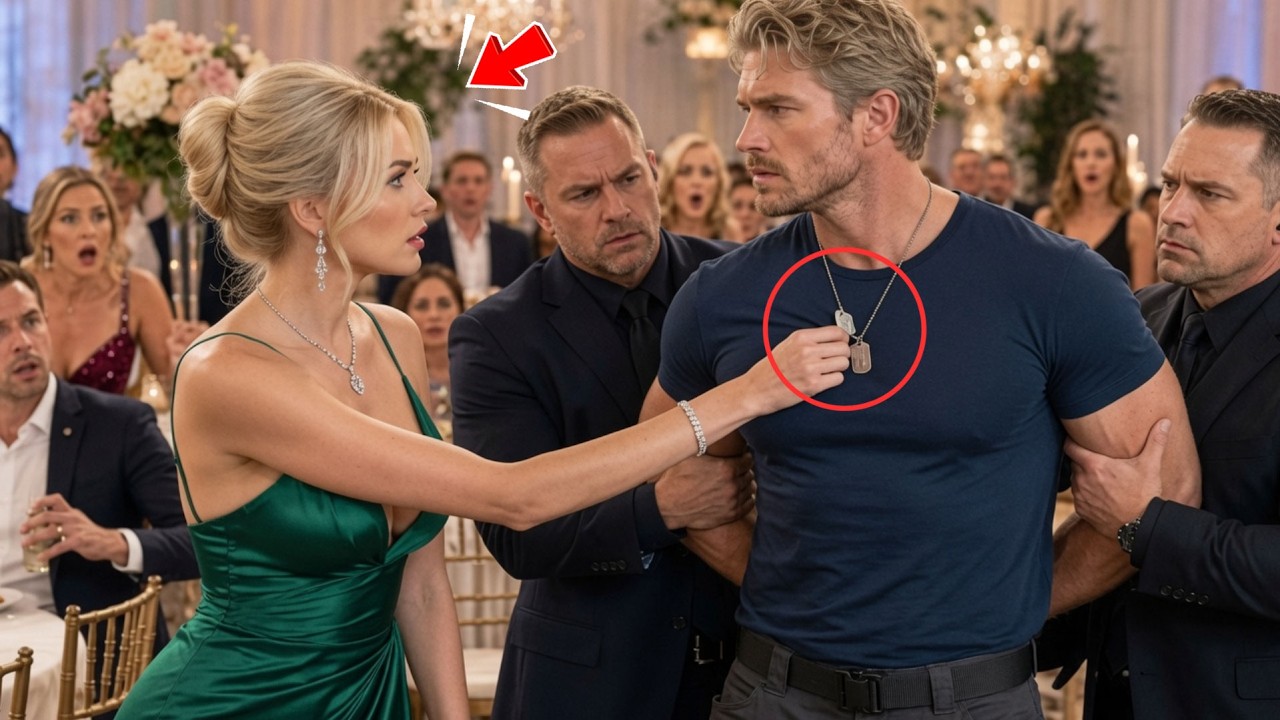
He held up two photos. My children’s faces, each stamped in black ink, “Do not admit. ” They didn’t know that by sunset, their celebration would turn into a reckoning—and I wouldn’t have to say a single word. I’m 34, married to Ethan, and we live in a small townhouse where towels never stay on their hooks and the shoe basket never has the pair you need.

We have two kids: Noah, 6, who carries a dinosaur flashlight everywhere, and Ella, 3, who calls strawberries red moons. Then there’s my family, the one that never felt like mine. My father used to tell me, “Family is everything,” which usually meant, “Don’t make things difficult. ” My stepmother, Kira, runs our family like a luxury brand.
And for years, being part of that brand felt like permission to use me. So when Kira called this past May and said, “We need to talk about the wedding,” I was at the studio wiping down mats, the air still warm from class. The same line she’d used since I was 15. My stepsister Maya was getting married, and Kira laid out the costs calmly: venue, catering, flowers, photography.
$30,000 total. My father sat beside her, silent. He didn’t say no, but his eyes did. I didn’t know then that peace in our family only existed when I was paying for it.
The weeks after that dinner blurred into a slow, familiar pattern. Every message from Kira had the same rhythm: deadlines, deposits, reminders. You’re the only one we can count on. At first I said no.
Then I said maybe. Then I said, “Fine. ” Each payment chipped away at something invisible—not just our savings account, but a sense of fairness I didn’t realize I still believed in. Ethan saw it.
“You’re letting them rewrite what family means,” he said one night. But I kept answering, “If I don’t help, who will? ”
The videographer needed a deposit before the next couple booked them. The content team needed $2,500 for a full weekend of coverage.
Every ask was urgent, and every “yes” cost a little more of myself. At yoga, I told my students to breathe, to let go of tension, to stay grounded. I never mentioned that I was drowning in my own family’s demands. Then came the rehearsal dinner.
Kira texted that morning: “Adults only, less chaos. ” Ethan offered to stay home with the kids, but I told him I’d be fine. At the venue, Maya pulled me aside and whispered, “I’m glad the kids aren’t here. Yeah, it’s not really kidproof.
” Something inside me went cold. No scene, no tears—just the long drive home with the car radio off. Ethan asked what was wrong. I told him I was tired.
But that night, I couldn’t sleep. I stared at the ceiling and thought, They don’t want my children there. Then maybe it’s time we ruined theirs. The next morning, Kira texted again: “Sweetheart, we need to lock in the content team today.
” I finally snapped. “Then maybe you should have planned better. ” I replied before hanging up. It was the first time I’d ever hung up on her.
She called back twice. I ignored them all. Ethan raised an eyebrow. “What was that?
” I said, “Then stop trying to explain it to them. ” That night, I opened my laptop and started a folder: every text, every request, every receipt. Each transfer, each payment. I documented everything.
She’d rewrite every story until you doubted your own memory—I wasn’t going to let her do that anymore. Kira texted: “That wasn’t okay, Rachel. ” I stared at the message, my thumb hovering over the keyboard. Then I typed back: “I’ve already paid more than anyone else.
” Her reply came fast: “Then don’t make this ugly, Rachel. ” I smiled for the first time in weeks. “That’s the sound of a boundary,” I said out loud. But boundaries don’t stay quiet in my family.
Two days later, Kira showed up at my studio. The room still smelled faintly of lavender spray and sweat. She smiled, all soft edges. “We’re all under pressure,” she said.
“It’s never just money. ” She leaned closer, voice sugary sweet. “Can we start over? ” I looked at her and said, “No, I regret waiting this long to say no.
” That night, I wrote out a full accounting—every dollar I’d given since I was 15. At the bottom, I wrote: “As of today, total paid: $29,350. First installment of the remaining balance due next month. ” I sent it to the family group chat.
Then I added: “I’ll no longer be contributing to the wedding fund. ”
The silence was deafening. My father called, his voice strained. “This isn’t how family works.
” I listened, then said, “It was never how family worked. ” Maya texted, furious: “You’re ruining my wedding. ” I replied: “No, you did that when you decided my children weren’t welcome. ” She didn’t respond.
Ethan walked in and saw the folder on the table, labeled for each request. He nodded—slowly, quietly. “I’m proud of you,” he said. I nodded for the first time.
They still thought I’d stay quiet. A week later, the wedding day arrived. Ethan and I went with the kids wearing their best outfits. Ella twirled in her blue dress, her hair full of uneven curls because she’d insisted on doing it herself.
Noah held his flashlight, ready for adventure. I told him, “We won’t stay long. ” He asked, “Will there be cake? ” I promised there would be, one way or another.
The venue was a restored barn turned into a luxury site—all white walls and fairy lights and curated fields. Maya was radiant at the door, and I walked up, ready to say, “And these are my children, Noah and Ella. ”
But before I could finish, the event coordinator stepped forward. “I’m sorry, but your children can’t come in.
” She held up two photos—my children’s faces, each stamped in black ink: “Do not admit. ” My stomach dropped. “That’s our policy,” she said. “No minors inside.
” I looked past her to find Maya and Kira watching. “There’s no policy,” I said. “We never agreed to this. ” The coordinator’s face softened.
“I’m sorry, but it’s on the list. ”
My father was a shadow behind Kira, looking anywhere but at me. Ella tugged my dress and whispered, “Mom, did we do something bad? ” I couldn’t answer because anything I said would have cracked my voice wide open.
Maya avoided my gaze. Kira smiled thinly. I knelt, took both kids by the hand, and said, “You did nothing wrong. We’re leaving.
” Ethan’s hand brushed mine. Then I turned. In the car, Noah asked if we were still going to the party. I said, “No, baby.
The party’s over. ”
That night, I made the phone call. “Dad, this is the last time I’m going to say this. I’m done.
And I’m calling to tell you the wedding is off. ” He paused, then said, “It’s not off. It happened. ” “Then it’s off for me,” I replied.
“Don’t contact me again. ” He hung up before I could speak. I sat in the dark, phone in hand, shaking. Then I opened my laptop.
The knocks on the door grew louder, then quieter, then stopped. Instead, my phone started buzzing—Maya, Kira, my father, all in a loop. I let it ring. The cursor blinked on a blank email waiting.
I typed out the numbers, each one like a heartbeat returning to me: every payment, every date, every promise. Then I wrote the truth: “You denied entry to the event I financed by posting my children’s faces under ‘Do not admit. ’ I’m sending you a bill for what I’ve paid, and payment is due immediately. You are not my family anymore.
” I sent it to all of them. The responses came fast. My father called: “This is a mistake. ” I said, “That’s not a mistake.
That’s a choice. ” Kira texted: “You’re being dramatic. ” I didn’t reply. I blocked her number.
Maya sent a long message about how I was tearing the family apart. I stopped reading halfway through. I felt empty, but I also felt free. For the first time in weeks, I laughed.
Days turned into weeks. The money never came back. Instead, I kept teaching. I told my students to breathe into the discomfort, to find strength in stillness.
What I didn’t tell them was that I was finally learning to do it, too. Then, one afternoon, Laya showed up at my studio door. She was an old friend of Kira’s, someone who’d watched the whole mess unfold from the sidelines. She sat down and said, “I’m sorry.
I saw the photos. That was wrong. ” We talked for an hour. At the end, she said, “There’s a way to heal from your family, you know.
It just takes distance. ”
I thought about the word “distance. ” I repeated it back to her: “Distance. ” She looked at me and said, “It’s not guilt.
We don’t use guilt as love. ” I echoed, “We don’t use guilt as love. ” And then I said, “Good. ” Because this time, good wasn’t surrender—it was choosing myself for once.
Months passed. Kira showed up at the townhouse once, with tears in her eyes, saying she’d made a mistake and wanted to fix things. I met her at the door and said, “You denied my children entry to a wedding I paid for. I don’t think that’s a mistake.
That’s a choice. ” She left. The knocks didn’t come again. Instead, I got a note in the mail from my father: “I’m sorry I didn’t stand up for you.
” I kept it in a drawer. He called on Noah’s birthday, left a voice message. I didn’t listen to it. Ethan said, “You don’t have to forgive anyone.
” I told him, “I know. ”
Each month, a quiet ping in my inbox: transfer received. The memo lines almost made me smile: “Payment processing. ” Every payment brought me closer to something that felt like closure.
I kept every receipt in a red folder labeled “Records. ” Some records deserve to stay. Then, one day, my father called. He sounded older, softer.
“I’d like to see the kids. If you’ll let me. ” I paused. I ran my fingers over the drawer where the note sat, the one that said he was sorry.
I said, “I’ll think about it. ” He said he understood. And for the first time, I believed him. I told Ethan that night, “I’m not sure if I’m ready.
” He said, “You don’t have to be. You just have to be honest. ” I nodded. I still wasn’t sure what honesty meant when it came to family.
But I knew I wasn’t going to let someone else define it for me ever again. To this day, some people still say I overreacted—that it was just a wedding. But those people have never seen their children’s faces printed under the words “Do not admit. ” Those people have never been told, again and again, that their love was only worth something if it came with money.
Those people have never had to build a wall between themselves and the people who were supposed to protect them. I rebuilt my life from that wall, brick by brick. Being the good daughter used to mean staying quiet no matter the cost. But I learned that silence isn’t loyalty—it’s just waiting for the next demand.
And I finally stopped waiting. I taught my kids that family is not the people who share your blood; it’s the people who share your time, your joy, your life—not your bank account. Noah asked me once if I was sad that my family didn’t want us anymore. I knelt down, looked at him, and said, “I miss who I thought they were.
But I love who we are. ” And I meant it. I still teach yoga. I still pass the fairgrounds every once in a while, the echo of that restored barn still hanging in the air.
And I still have that red folder, full of receipts and letters and one black-and-white photo of my children with the words “Do not admit” across their faces. I keep it to remind myself that some lines are meant to be drawn, even if it means losing everything you thought you had. What I found on the other side was worth so much more.