The front doors of the Whitmore Estate were locked, and Opal Hayes stood on the cold marble steps outside her own birthday party. Through the tall arched windows, she could see the golden light, the moving silhouettes of 200 guests, and the banner above the entrance: “An evening of elegance hosted by Victoria Caldwell. ” Her daughter-in-law had done this. Victoria had replaced Opal’s guest list with her own friends, canceled the soul food caterer, swapped collard greens for arugula salad, and had security guards drag Opal down the steps when she tried to walk in.

Opal’s knee was scraped, her lavender dress was dusty, and her pearl brooch had fallen off when she stumbled. She picked it up, and she also picked up the cream envelope that had tumbled from her purse—the one containing the trust deed for Hayes Holdings Corporation. —
Three days before the locked door, Opal Hayes woke at 5:15 in the morning, the same time she had woken for the last 20 years. She lived in a small white house on Birch Lane with two rocking chairs on the porch and tomatoes growing beside marigolds in the front garden.
The neighbors knew her as the woman who baked sweet potato pie for every funeral on the block and lemonade for every birth. No one knew that Opal Hayes owned half the skyline downtown. She had built Hayes Holdings from a single rental property in 1982, when she was a 31-year-old widow with a baby boy, a second-hand calculator, and $400 in a checking account. She bought a run-down duplex on Cedar Street, fixed the plumbing herself, rented both units, and used the profit to buy the next building, then the next.
By 2002, Hayes Holdings controlled 31 commercial properties across three states: office towers, shopping plazas, a waterfront development that tripled in value. Opal signed every deal herself, read every contract, and never hired a publicist or gave an interview. She chose invisibility because she had seen what money did to people who wanted to be seen. Her son, Elliot Caldwell, knew the truth.
He had grown up watching his mother work 18-hour days while the world assumed she cleaned houses for a living. He took her last name off his, using his father’s when he went to college, and told himself it was practicality, not shame. Opal never corrected him. She just kept building.
—
Elliot married Victoria Caldwell, born Victoria Price, 11 years ago. Blonde, sharp-jawed, raised in Connecticut money that ran out two generations before her birth, Victoria believed she had married into moderate wealth. She had no idea the ground beneath every piece of her life belonged to her mother-in-law. She despised Opal, not quietly, not politely.
She made it a project. The week she moved in, she removed Opal’s photos from the hallway. She told the twin girls, 9 years old, that Grandma Opal was “not well” and visits had to be limited. She scheduled family dinners on nights she knew Opal had church.
She corrected Opal’s grammar in front of guests. She bought Opal cleaning supplies for Christmas—a mop, a bucket, a bottle of bleach—and laughed when Opal opened the box. “I thought it was practical,” Victoria said, smiling at Elliot. “She’s always cleaning something.
”
Elliot said nothing. He never said anything. Opal absorbed every slight, every exclusion, every holiday spent alone in the Birch Lane kitchen listening to gospel radio while her grandchildren opened presents 30 miles away in a house she technically owned. She told herself it didn’t matter.
She had her health, her church, and Dorothy Wells next door, who brought coffee every morning and never asked why Opal’s eyes were red on Christmas Day. —
But 75 changed something. Opal stood in front of the bathroom mirror one Tuesday morning and said it out loud: “75. ” She touched the lines on her face.
She thought about every door that had been closed to her by banks, landlords, and her own family, and realized she had never once thrown a party for herself. So she planned one. She booked the grand ballroom at the Whitmore Estate, a building she had purchased in 2015 through a shell company. She printed invitations on cream cardstock, chose the menu herself—roast chicken, collard greens, cornbread, peach cobbler from her mother’s recipes—and mailed 200 invitations.
One of them went to Victoria and Elliot’s address. Victoria opened it at the kitchen island, read it twice, then picked up her phone. “Absolutely not,” she told Elliot. “Your mother is not hosting a party at the Whitmore.
Do you know how that looks? My friends go there. My book club meets there. I will handle this.
” Elliot started to speak. “I said I’ll handle it. ” And she did. —
Victoria had 72 hours, and she used every one of them.
She called the Whitmore Estate event manager, a young woman named Stacy Porter, and introduced herself as the party coordinator. She said the elderly woman who had booked the ballroom was confused—early signs of dementia, very sad—and that the family was stepping in to manage the event properly. “I’m her daughter-in-law. I have power of attorney.
” She didn’t, but Stacy didn’t ask for proof. Victoria made 12 more calls that afternoon. She canceled the caterer Opal had hired, a black-owned soul food restaurant on Magnolia Avenue that Opal had been ordering from for 30 years. She canceled the DJ, a young man from Opal’s church who had offered to play for free.
She canceled the flower order: sunflowers and white roses, Opal’s favorites since childhood. By Thursday afternoon, she had replaced the entire guest list. Opal’s church friends, gone. Dorothy Wells, removed.
The women from Opal’s quilting circle, deleted. Pastor Green, who had baptized Opal’s grandchildren, erased. In their place: Victoria’s book club, her Pilates group, three couples from the country club, a city councilwoman she wanted to network with, and a local news anchor she hoped would photograph well next to her. 212 names, not a single one chosen by the woman whose birthday it was.
She changed the menu too: roast chicken became seared salmon with dill cream, collard greens became arugula salad with shaved Parmesan, cornbread became rosemary focaccia, and peach cobbler—Opal’s mother’s handwritten recipe from 1958—became crème brûlée with vanilla bean from Madagascar. She erased Opal’s party and rebuilt it in her own image. —
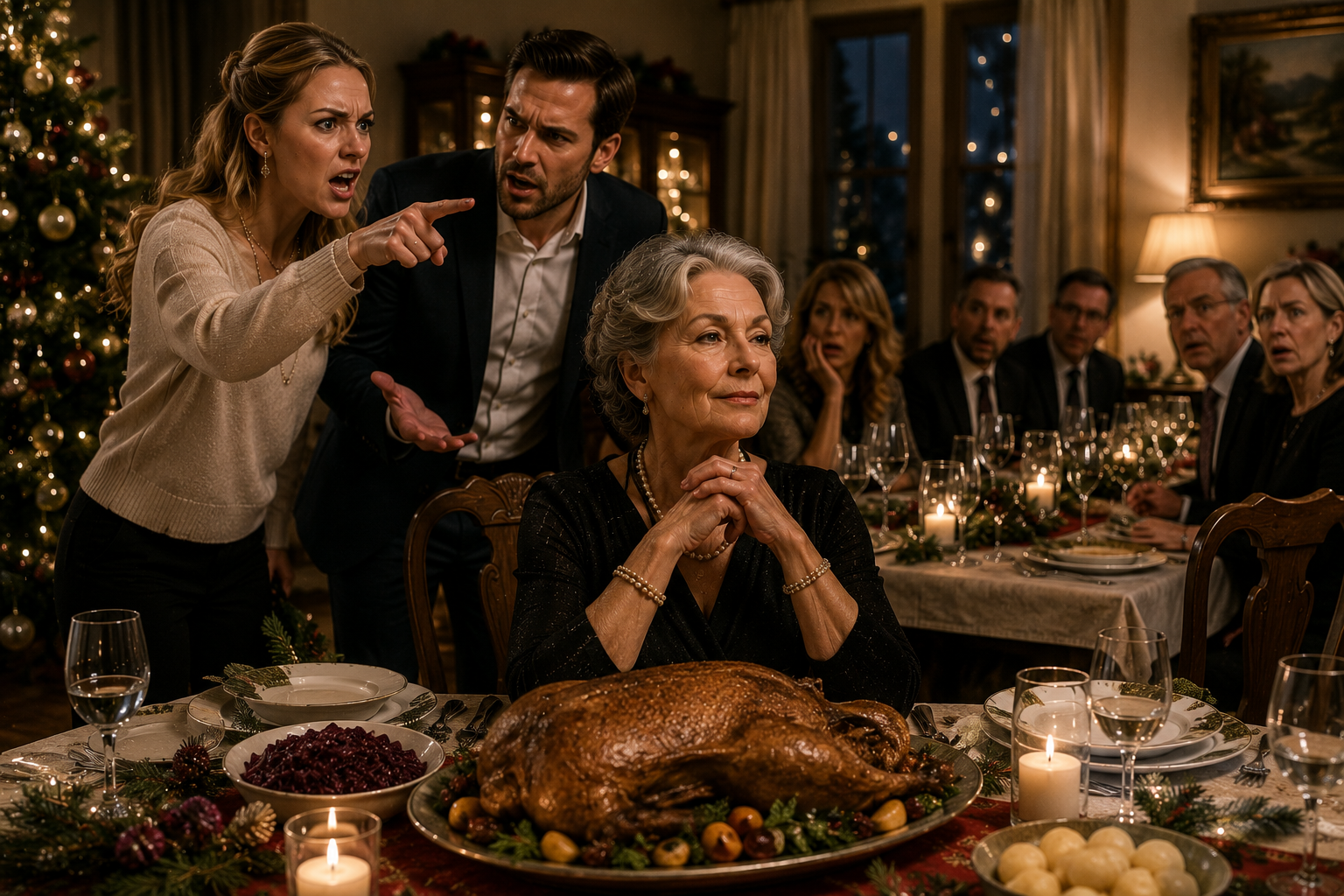
On Saturday evening, the Whitmore Ballroom looked like a spread from Architectural Digest. White orchids lined every table, a string quartet played Vivaldi in the corner, champagne towers caught the light from three crystal chandeliers, and a 6-foot banner across the entrance read, “An evening of elegance hosted by Victoria Caldwell.
” Victoria stood at the door in a silver floor-length gown, greeting guests like the building belonged to her. 200 guests filled the ballroom by 7:30. Not one of them had been on Opal’s original list. At 7:45, Opal arrived.
She had spent the afternoon getting ready. She pressed her lavender dress, the one she had bought 3 weeks ago for the occasion, the nicest thing in her closet. She pinned her mother’s pearl brooch to the collar and curled her silver hair with the same iron she had used since 1986. She looked at herself in the hallway mirror and, for the first time in years, felt beautiful.
She slipped the cream envelope into her purse—the one containing the trust deed for Hayes Holdings Corporation. She had carried it for 3 days, not because she planned to use it, but because something deep and quiet inside her said she might need to. Dorothy Wells drove her to the Whitmore. They pulled up to the front entrance at 7:47.
Through the tall arched windows, Opal could see the golden light and the moving silhouettes of guests. “Sounds like a real party in there,” Dorothy said. “That’s because it is,” Opal said. She squeezed Dorothy’s hand and stepped out of the car.
—
The front doors were closed. A security guard stood on each side, broad-shouldered, earpieces in, arms crossed. Outside contractors—Victoria had insisted, because the building’s regular staff would have recognized the woman who signed their paychecks. Opal walked up the four marble steps.
The first guard held up his palm. “Name, please. ” “Opal Hayes. ” He scanned the clipboard, flipped a page, flipped another, ran his finger down the last column.
“I’m sorry, ma’am. You’re not on the list. ” “That can’t be right. This is my event.
I booked this room myself. ” The guard looked at his partner, who shrugged. “Ma’am, the organizer provided the list. Your name isn’t here.
I can’t let you through. ” “The event organizer? Who told you—“
The front doors swung open. Victoria stepped out, champagne flute in hand, silver gown catching the porch light like a blade.
She looked at Opal from the top step and let out a long theatrical sigh. “Oh, you actually came. ” “Victoria. Why isn’t my name on the guest list?
” Victoria tilted her head, speaking loud enough for the cluster of guests forming behind her in the doorway. “Because this isn’t your party anymore, Opal. I booked this venue. I paid for everything.
” “You paid? With what? Your social security check? ” She turned to the crowd.
“This woman, my mother-in-law, she has these episodes. Gets confused. Thinks things belong to her that don’t. It’s heartbreaking, really.
”
Opal stood very still. “Victoria, let me into my party, please. ” “Your party? Honey, look around.
Does any of this look like something you could put together? The orchids alone cost more than your entire house. The champagne is older than your wardrobe. ” Laughter rippled through the doorway.
Someone clapped once, a single mocking clap. “You know what your problem is, Opal? You don’t know your place. You never have.
You show up places you don’t belong, wearing clothes from a decade ago, smelling like you just walked out of a church basement kitchen, and you expect people to what? Bow? ” She stepped down one stair, her voice dropping to a hiss. “I have spent 11 years cleaning up after you.
11 years explaining to my friends why my mother-in-law looks like the help. 11 years of your cheap shoes on my hardwood floors. Your greasy food stinking up my kitchen. Your sad little Bible verses on my refrigerator.
You are an embarrassment to this family. You have always been an embarrassment. ” She leaned in close. Opal could smell the champagne on her breath.
“And tonight—tonight is mine, not yours. You don’t get to shuffle in here and pretend you matter, because you don’t, Opal. You never did. ”
Victoria straightened and snapped her fingers at the guards.
“Get her off the property now. And lock the front doors behind her. If she comes back, call the police. ” The first guard reached for Opal’s arm.
She pulled back. “Don’t touch me. ” “Ma’am, you need to leave the premises. ” “This is my—“ The second guard grabbed her other arm.
They walked Opal down the four marble steps. Her left heel caught the edge of the last step; she stumbled forward, her knee hitting the pavement. The cream envelope tumbled from her open purse and skidded across the concrete. No one moved to help her.
Victoria watched from the top of the stairs, champagne still in hand. She didn’t flinch. She smiled a thin, satisfied smile. “Someone pick that envelope up before it blows into the garden.
It’s cluttering my entrance. ” No one picked it up. The front door closed behind Victoria. The lock clicked.
—
Inside, 200 guests returned to their champagne, and the string quartet resumed. Outside, Opal knelt on the sidewalk in her lavender dress. The pearl brooch had come loose when she fell, lying on the concrete beside her. She picked it up first, then the envelope, brushing the dust off both with slow, deliberate hands.
Dorothy Wells was still parked at the curb, hands shaking on the steering wheel. She opened the car door and started to get out. Opal raised one hand without turning around. “Stay there, Dorothy.
” “Opal, honey, let me—“ “Stay. ” Opal stood up. Her knee throbbed. Her hands were steady.
She pulled her phone from her purse and dialed a number she had memorized 40 years ago but never once used for herself. It rang twice. “Gregory,” she said, her voice even and calm. “It’s Opal.
I need you at the Whitmore estate. Bring the file. All of it. ” She hung up, looked at the locked doors, looked at the envelope in her hands, looked at the banner above the entrance.
Something behind her eyes shifted. Then she sat down on the bottom marble step, crossed her ankles, and waited. —
Gregory Bennett arrived in 14 minutes. He drove a black Lincoln Town Car older than most of Victoria’s guests, stepping out with a leather briefcase in one hand and a manila folder in the other.
He was 71 years old, 6 foot 3, and moved with the deliberate slowness of 46 years spent making people wait for his next sentence in courtrooms across the Eastern Seaboard. He had been Opal’s attorney since 1984, had drafted the original charter for Hayes Holdings, and had structured the shell companies and trusts that kept Opal’s name out of every headline and public record. He looked at Opal sitting on the marble step, then at the locked doors, then at the banner. “An evening of elegance,” he read aloud.
“Hosted by Victoria Caldwell. ” “That’s what it says,” Opal said. Gregory set the briefcase down on the step beside her. “How do you want to do this?
” “The right way. ” “The right way takes longer. ” “Gregory, I’ve been sitting on this step for 20 minutes. I’ve got time.
” He almost smiled. “I’ll need to make two calls first. One to Judge Whitfield’s clerk for an emergency asset freeze order, the other to Detective Solace at the Financial Crimes Unit. I’ve had the embezzlement file ready for 6 weeks.
I was waiting for your word. ” Opal looked at him. “You have my word. ”
—
Gregory stepped away toward his car, phone already at his ear.
Dorothy got out of the car and walked over, sitting down on the cold step beside Opal, draping her wool shawl across both their shoulders. “You don’t have to sit out here like this,” Dorothy said. “I know. ” “You could just tell them who you are, walk in there, and—“ “And what?
” “Make a scene? ” Dorothy looked at her. “Baby, they already made the scene. Victoria made it the second she put that banner up.
” Opal didn’t answer. She stared at the locked doors and thought about the first time Victoria had called her an embarrassment. Thanksgiving 2016: Victoria rearranged the seating so Opal was at the end of the table, closest to the kitchen, furthest from the grandchildren, and when Opal brought out the sweet potato pie she had baked from scratch, Victoria scraped it into the trash and replaced it with a store-bought tart. “We’re not doing that this year,” she said.
Opal drove home that night with the empty pie dish on the passenger seat and didn’t cry until she pulled into the driveway. Christmas 2019: the mop, the bucket, the bleach wrapped in silver paper with a bow. Easter 2021: Victoria told the twins that Grandma Opal couldn’t come to the egg hunt because she was having “one of her episodes. ” Opal was not having an episode.
She was planting tomatoes in her garden, waiting for an invitation that never came. Every holiday, every birthday, every family photo taken without her. Victoria had built a wall between Opal and her own bloodline, brick by brick, and tonight she had made that wall literal: a locked door, two armed guards, a guest list with every name except the one that mattered. “She’s been stealing from me, Dorothy,” Opal said quietly.
Dorothy turned. “What? ” “Victoria. From the family accounts.
Gregory’s people found it 6 weeks ago. 23 wire transfers over 4 years. $2. 3 million.
” Dorothy’s hand went to her mouth. “I didn’t want to believe it. I kept hoping Gregory was wrong. But the records are clear.
Lord have mercy. ” “I wasn’t going to do anything tonight. I was going to let the lawyers handle it quietly. But then she locked me out of my own birthday party and called me trash in front of 200 people.
” Opal’s voice was steady, but her jaw tightened. “So now we do it the other way. ”
—
Inside the ballroom, Victoria was having the night of her life. She stood at the center of a half circle of women—her book club, her Pilates friends, the councilwoman she had been courting for months—and spoke with the confidence of someone who had never been questioned in a room she controlled.
“I planned every detail myself,” Victoria said. “The orchids are from Ecuador. The quartet is from the conservatory. I even designed the table settings.
Hand-caligraphed place cards. ” “Stunning, Victoria,” said the councilwoman. “You have a real gift. ” “Well, when you care about quality, it shows.
” None of them asked about the woman who had been dragged down the steps. None of them asked whose birthday it was supposed to be. At the far end of the ballroom, Elliot Caldwell stood near the bar with a glass of whiskey he hadn’t touched. His phone sat face down on the counter.
He had received a text from his mother 18 minutes ago. Four words: “They locked me out. ” He had read it twice, started typing a reply three times, deleted it each time. Elliot knew the truth.
He had always known. He knew his mother owned the building they were standing in. He knew she owned the company that paid his salary—a vice president title at a real estate firm that was, through three layers of holding companies, a subsidiary of Hayes Holdings. He knew his wife had stolen his mother’s party.
He knew his wife had been stealing his mother’s money, and he had done nothing. Not because he was afraid of Victoria, though he was, but because doing something meant admitting he had allowed all of it. Every exclusion. Every insult.
Every Christmas Opal spent alone. His silence had made him complicit, and his complicity had become its own kind of prison. His phone buzzed. Gregory Bennett.
“Elliot, your mother has made her decision. I’m outside the Whitmore. I need you to understand what’s about to happen. ” “Greg, can we just—“ “No, we can’t just.
Listen carefully. I have filed a forensic audit report with the DA’s office documenting 23 unauthorized transfers from the Hayes family trust into accounts controlled by Victoria. $2. 3 million over 4 years.
Wire records, bank statements, a signed affidavit from your mother’s accountant. ” Elliot closed his eyes. “I also have Victoria’s signature on six documents she had no legal authority to sign—including tonight’s event contract, which she executed using a fraudulent claim of power of attorney. That alone is a felony.
” “She told them she had power of attorney? ” “She did. She doesn’t. ” Elliot set his whiskey down.
His hand was shaking. “Your mother isn’t doing this to hurt you, Elliot, but she’s done protecting you from the consequences of your own silence. I suggest you decide which side of that door you want to be on when it opens. ” The call ended.
Elliot stood at the bar for a long moment. Around him, the party continued: a woman laughed at something Victoria said, a waiter passed with crème brûlée on a silver tray, the quartet shifted into Debussy. He put his phone in his pocket, drank the whiskey in one swallow, and walked toward the front entrance. —
Outside, the night had turned cooler.
A second car pulled into the Whitmore lot: an unmarked sedan, Detective Solace stepping out with a uniformed officer. A third car followed—a silver Audi belonging to Howard Tillman, Opal’s accountant, who had driven 40 minutes with a box of financial records in his trunk. They gathered in the parking lot: Gregory, the detective, the accountant, the officer—all of them standing in front of a building Opal owned, preparing to walk through doors that had been locked against her. Opal stood up from the step.
Dorothy stood with her. Opal brushed the dust from her lavender dress and straightened her pearl brooch, her fingers finding the clasp by memory in the dim light. Gregory approached her. “We’re ready.
Solace has the arrest warrant. Tillman has the records. I have the trust deed and the ownership certificates. ” Opal looked at the locked doors.
She could hear Victoria’s laughter leaking through—that high, brittle sound she had endured for 11 years. “It’s my building,” Opal said. “It’s my party. And those are my doors.
” She walked up the four marble steps. This time no guard stopped her. They had seen the detective’s badge. They stepped aside without a word.
Opal placed her hand on the brass door handle. The metal was cold. She could feel the vibration of the music through it: the bass notes of the cello, the hum of 200 conversations, the clink of champagne glasses raised to toast a woman who had built nothing and stolen everything. She pushed the door open.
—
The door swung open, and the music stopped. Not because anyone told the quartet to stop—the cellist saw Opal first, then the violinist, then the viola player lowered her bow, and the sound simply died, one instrument at a time, like candles going out in a draft. 200 heads turned toward the entrance. Opal stood in the doorway.
Behind her: Gregory Bennett with a leather briefcase, Detective Solace with a badge clipped to his belt, a uniformed officer, and Howard Tillman holding a banker’s box against his chest. Dorothy Wells stood at the rear, arms crossed, chin high. Victoria was mid-sentence when she saw them. Her champagne glass stopped halfway to her lips.
“What—what is this? ” She set the glass down on the nearest table; it wobbled but didn’t fall. “I told security to keep her out. Who let her in?
” No one answered. Victoria marched toward the entrance, heels striking the marble floor like punctuation marks. She stopped 6 feet from Opal and pointed a finger at the officer. “Officer, this woman is trespassing.
I am the host of this event. I want her removed immediately. ” Detective Solace stepped forward. He didn’t raise his voice.
He didn’t need to. “Ma’am, are you Victoria Caldwell? ” “Yes. And I demand—“ “Mrs.
Caldwell, I’m Detective Solace, Financial Crimes Division. I’m not here to remove anyone. I’m here on official business. ”
The room went quiet.
Not party quiet. Funeral quiet—the kind of silence where you can hear someone swallow three tables away. Gregory Bennett stepped past Opal and placed his briefcase on the nearest table. He opened it with two precise clicks, removed a single document—heavy bond paper, embossed seal, notarized signatures along the bottom—and held it where the light from the chandelier caught the ink.
“Ladies and gentlemen,” Gregory said, his voice carrying without effort. 46 years in courtrooms had trained it. “My name is Gregory Bennett. I am the chief legal counsel for Hayes Holdings Corporation.
I am here tonight on behalf of the sole owner and founder of that corporation. ” He turned to Opal. “Mrs. Opal Hayes.
”
Victoria laughed. It came out wrong—too sharp, too fast, like a reflex she couldn’t control. “That’s absurd. She’s a—she doesn’t own anything.
She lives in a shack on Birch Lane. ” Gregory continued as if she hadn’t spoken. “Hayes Holdings Corporation is the registered owner of this building, the Whitmore Estate. It is also the owner of 14 additional commercial properties across three states, including the Caldwell residence at 412 Briarwood Drive, and the parent company of Elliot Caldwell’s employer, Ridgepoint Capital.
” He held the trust deed higher. “This document, the original trust deed filed in 1984, establishes Mrs. Opal Hayes as the sole proprietor, sole beneficiary, and sole decision-maker of Hayes Holdings and all subsidiary entities. Every asset, every property, every account.
”
The room didn’t breathe. Victoria’s face went white—not pale, white. The color drained from her cheeks like water from a cracked glass. Her lips moved, but nothing came out.
“That’s—that’s not possible,” she finally whispered. “You’re just a—” Opal stepped forward, one step. She didn’t raise her voice. She didn’t need to.
“Just a what, Victoria? ” Victoria’s mouth opened and closed. The word she wanted to say—the word she had said a hundred times in private, in whispers to friends, in jokes she thought were clever—sat on her tongue like a stone she suddenly couldn’t swallow. “Say it,” Opal said.
“You’ve said it before, in my son’s kitchen, at your dinner table, to your book club on the phone when you thought I couldn’t hear. Say it now, Victoria, in front of everyone, in front of the cameras. ” She gestured toward the guests with phones still raised, red dots blinking, every lens pointed at Victoria. Victoria said nothing.
Elliot stepped out from the edge of the crowd. His face was drawn. His hands were in his pockets. He walked to his mother’s side and stood there—not in front of her, not behind her, but beside her.
“Everything she said is true,” Elliot said. His voice cracked on the last word. “Mom built all of this. Every building, every company, everything we have.
It all started with her. ”
The councilwoman at Victoria’s table set down her champagne. The woman in the beaded necklace covered her mouth with her hand. The man in the slim-cut suit who had been recording since the confrontation on the steps lowered his phone and stared.
Gregory placed the trust deed on the table face up and stepped back. The embossed seal of Hayes Holdings caught the chandelier light one more time: a small golden circle stamped 40 years ago by a 31-year-old widow with $400 and a used calculator. Opal looked at Victoria. She didn’t gloat.
She didn’t smile. She simply looked at her the way you look at a door you’ve finally decided to walk through. “This is my building,” Opal said. “This is my party.
And you are no longer welcome in it. ”
—
The room erupted. Not in anger—in applause. The applause hadn’t finished when Victoria started bargaining.
“Wait. Wait. Wait. Wait.
” She held up both hands, fingers trembling. The silver gown that had made her look like a queen 10 minutes ago now hung on her like tin foil. “This is a misunderstanding. Elliot, tell them.
Tell them this is a mistake. ” Elliot didn’t look at her. He stood beside his mother, hands in his pockets, eyes on the floor. “Elliot, look at me.
” “I’ve been saying nothing for 11 years,” he said quietly. “I’m done. ”
Victoria searched the crowd for an ally: the councilwoman, the book club president, the Pilates friend. Every one of them looked away.
The councilwoman was already walking toward the exit, phone pressed to her ear, erasing herself from the evening. Gregory Bennett removed a second folder from his briefcase—thicker, held with a black binder clip. “Mrs. Caldwell, over the past 4 years you authorized 23 wire transfers from the Hayes family trust into personal accounts held solely in your name.
Total: $2,300,000. ” He laid three pages on the table. “Wire records, bank statements from your offshore account in the Caymans, and a signed affidavit from Mrs. Hayes’s accountant confirming none of these transfers were authorized.
” Howard Tillman set the banker’s box on the table, black marker on the side: “Caldwell, unauthorized transfers, complete file. ”
Victoria stared at the box. A sound came out of her—not a word, but a small wet sound, like air escaping from something sealed too long. “That—that money?
I had access. Elliot gave me—” “Access is not authorization,” Gregory said. “And the power of attorney you claimed tonight is fraudulent. You never held power of attorney over Opal Hayes.
Filing a false claim is a class D felony, up to 7 years. ” Detective Solace stepped forward. He had been watching from the door the entire time. Now he moved with unhurried precision.
“Victoria Caldwell, you are under arrest for embezzlement, fraud, and forgery. You have the right to remain silent. ”
The uniformed officer moved behind her. The click of the handcuffs was small, barely audible over the whispers spreading through the room like brushfire.
But Opal heard it clearly. It sounded like a lock turning—the same metallic click she had heard from the other side of that door 40 minutes ago. Victoria’s wrists were pulled behind her back. The silver gown bunched at her shoulders.
A strand of hair fell across her face; she couldn’t brush it away. “Opal. Please. I didn’t mean—” Opal looked at the woman who had thrown her pie in the trash, who had given her a mop for Christmas, who had told her grandchildren that grandma was sick, who had locked her out of her own birthday and called her trash on steps she owned.
“You meant every word, Victoria. Every single one. ”
The officer led Victoria through the ballroom. 200 guests parted like water.
No one spoke. The heels that had struck the marble with such authority now dragged, scuffing the floor with each reluctant step. The front doors opened one last time. Victoria was walked down the four marble steps and into the back of the unmarked sedan.
The door closed. The tail lights disappeared down Whitmore Drive. —
Inside, the security guard who had grabbed Opal’s arm walked up to her. He removed his earpiece and looked at the floor.
“Ma’am, I’m sorry. I didn’t know. ” Opal nodded once. “Now you do.
” Then, from somewhere near the back, someone began to clap. Then another. Then the entire ballroom thundered with it—not polite applause, not cocktail party appreciation, but the raw, full-throated sound of 200 people who had just watched something they would never forget. —
The video hit the internet before Victoria’s sedan reached the county jail.
The man in the slim-cut suit, the one who had been recording since the confrontation on the steps, uploaded the full clip to social media at 11:14 that night. 7 minutes and 42 seconds. No edits, no filters. Just a 75-year-old black woman being dragged out of her own birthday party by security, followed by the moment she walked back in and proved she owned everything in the room.
By midnight, the video had 400,000 views. By sunrise, it had crossed 6 million. By Monday morning, it was on every major news network in the country. The headline wrote itself: “Rich wife locks black mom out of her own party, doesn’t know she owns the building.
” A hashtag formed overnight: #justiceforopal. By Tuesday, it was trending in all 50 states. News vans lined Birch Lane by Wednesday morning. Opal didn’t give a single interview.
Dorothy Wells answered the door each time with the same sentence: “Mrs. Hayes is having her coffee. She’ll speak when she’s ready. ” Then she closed the door and went back inside to sit with her friend at the kitchen table, where a plate of toast and a jar of peach preserves sat between them like they did every morning.
—
Victoria’s arraignment took place on Thursday at the county courthouse. She arrived in an orange jumpsuit, wrists cuffed in front, hair unwashed. The silver gown was gone. The chignon was gone.
The confidence that had filled the Whitmore Ballroom like expensive perfume was gone. Her attorney, a criminal defense lawyer named Philip Archer, entered a plea of not guilty and requested bail. The judge, a 63-year-old woman named Judge Carolyn Reed, reviewed the charges: three counts of embezzlement, one count of fraud, one count of forgery, and one count of identity misrepresentation for the false power of attorney claim. She set bail at $500,000.
Victoria couldn’t pay it. The accounts were frozen. The assets were frozen. The house on Briarwood Drive—Opal’s house, technically, always had been—was no longer available as collateral.
Victoria sat in the county jail for 9 days before her parents wired the bail from Connecticut. Old money. Except it wasn’t old money anymore. It was the last of the money.
The family account that had been running on fumes for two generations finally emptied itself to keep their daughter out of a cell. —
The trial began 6 weeks later. It lasted 4 days. The prosecution presented the wire records: 23 transfers, 4 years, $2.
3 million moved from the Hayes family trust into three separate accounts—a personal checking account, a brokerage account, and the offshore account in the Caymans. Howard Tillman took the stand. He walked the jury through each transfer with the calm, methodical precision of a man who had spent 30 years reading spreadsheets. He showed the timestamps.
He showed the routing numbers. He showed the forged authorization signatures. Victoria had used a digital copy of Opal’s signature lifted from a birthday card Opal had mailed to the twins 3 years earlier. A birthday card.
She had stolen her mother-in-law’s signature from a birthday card to her own grandchildren. The jury foreman later told reporters: “That was the moment the verdict became inevitable. ”
Victoria’s defense tried three strategies. The first: Elliot had given her implied permission.
Elliot testified that he had not. The second: Opal’s advanced age made her an unreliable witness. Gregory submitted Opal’s medical records: perfect cognitive health confirmed by two independent physicians. The third: the money was used for family expenses.
The prosecution showed receipts: a $40,000 handbag, a leased Porsche Cayenne, a two-week vacation in Turks and Caicos, a $12,000 facial rejuvenation package. None of it was family. The jury deliberated for 3 hours and 20 minutes. Guilty on all counts.
Judge Reed delivered the sentence 2 weeks later: 8 years in federal prison. Full restitution of $2. 3 million. A permanent restraining order barring Victoria from contacting Opal Hayes, Elliot Caldwell, or their children.
Victoria stood when the sentence was read. She didn’t cry. She didn’t speak. She stared straight ahead at the wood-paneled wall behind the judge’s bench, and for the first time in 11 years, her face held no expression at all.
No contempt. No superiority. No performance. Just the blank, hollow look of someone who had finally run out of rooms to control.
—
Elliot filed for divorce the following Monday. The papers were simple. He asked for shared custody of the twins. He asked for nothing else.
Outside the courthouse, #justiceforopal was still trending. People had made t-shirts. A muralist in Atlanta painted Opal’s face on the side of a community center: lavender dress, pearl brooch, cream envelope in hand. A retired teacher in Ohio started a GoFundMe to send flowers to Birch Lane.
Opal asked her to redirect the donations to the local women’s shelter instead. The story had become bigger than one party. Bigger than one locked door. It had become a mirror, and millions of people saw their own mothers, their own grandmothers, their own families reflected in it.
The comment sections filled with stories: women who had been dismissed by their own children, elders who had been pushed aside by spouses who married into their families and rewrote the guest list, black mothers who had built everything and been credited with nothing. One comment, liked 400,000 times, read: “She didn’t need revenge. She just needed one document and the truth. ”
Gregory Bennett saw the comment on his phone and forwarded it to Opal.
She read it at the kitchen table with Dorothy beside her. She set the phone down and picked up her coffee. “That’s about right,” she said. —
Six months later, Opal Hayes turned 76.
She threw another party. Same venue—the Whitmore Estate. Same ballroom. Same chandelier, light falling through the same tall windows.
But this time, every detail was hers. The guest list had 112 names. Dorothy Wells was at the top. Pastor Green was second.
The women from the quilting circle filled an entire table near the front. The soul food caterer from Magnolia Avenue—the one Victoria had canceled—prepared the menu: roast chicken, collard greens, cornbread, peach cobbler from Opal’s mother’s recipe, the one handwritten on an index card in 1958. No orchids from Ecuador. No string quartet.
No champagne towers. Sunflowers. A gospel choir from Opal’s church. Sweet tea and mason jars.
The banner above the entrance read: “Happy birthday, Opal. ” Nothing else. No last name. No title.
No corporation. Just Opal. Elliot came with the twins. It was the first family event he had attended without checking Victoria’s schedule first.
The girls—Harper and Nora, 10 years old now—ran to their grandmother before he could park the car. Opal knelt on the grass outside the Whitmore entrance. Her knees still ached. They always would.
And she held both of them against her chest. She smelled their shampoo. She felt their heartbeats against her collarbone. She didn’t let go for a long time.
“Grandma, we missed you,” Harper said. “I missed you more,” Opal said. “I missed you every single day. ”
Elliot stood a few feet away.
He watched his mother hold his daughters on the same steps where she had been dragged down 6 months earlier. His eyes were red. He didn’t wipe them. “Mom.
” “Come here, baby. ” He did. And for the first time in 11 years, the four of them stood together without anyone telling them they shouldn’t. —
Inside, the party was everything the first one was supposed to be.
Loud. Warm. Full of people who had known Opal for decades—who had eaten her sweet potato pie at funerals, drunk her lemonade at baby showers, borrowed her garden tools and returned them with thank-you notes tucked inside the handles. Dorothy gave a toast.
She stood at the head table with a glass of sweet tea and spoke without notes. “I’ve lived next door to this woman for 19 years,” Dorothy said. “I’ve seen her carry groceries for strangers. I’ve seen her pay rent for families she barely knew.
I’ve seen her sit on her porch at 5:00 in the morning reading The Wall Street Journal, and I never once asked why. ” The room laughed. “But I’ll tell you what I do know. Opal Hayes is the strongest person I have ever met.
Not because of what she owns—because of what she survived and still chose to be kind. ”
Opal wiped her eyes with a napkin. She mouthed, “Thank you,” across the table. Dorothy mouthed back, “You owe me pie.
”
—
After the party, Opal announced the creation of the Hayes Foundation: a nonprofit funded by Hayes Holdings, dedicated to supporting elderly black women facing financial abuse, family estrangement, and housing instability. The foundation’s first office opened on Magnolia Avenue, three doors down from the soul food restaurant. Gregory Bennett served as board counsel. Howard Tillman managed the books.
Dorothy Wells appointed herself chief of staff without asking anyone’s permission. Within its first year, the Hayes Foundation assisted over 300 families. It funded legal aid for grandmothers denied access to their grandchildren. It provided emergency housing for elderly women displaced by family members who had drained their accounts.
It ran financial literacy workshops in churches, community centers, and senior living facilities across four states. Opal didn’t put her name on the building. Dorothy did it anyway. On the foundation’s opening day, a reporter finally got through to Opal.
One question, one answer. “Mrs. Hayes, what do you want people to take away from your story? ” Opal stood on the sidewalk outside the new office.
She wore her lavender dress. The pearl brooch was pinned to the collar—the same one that had fallen on the concrete outside Whitmore 6 months ago. “Age doesn’t weaken you,” she said. “It sharpens you.
And if someone locks you out of a room you built, don’t break the door down. Just bring the deed. ”
—
Eight years. That’s what Victoria got.
And Opal sat through her 76th birthday—same ballroom, same beauty—except this time: sunflowers, gospel choir, sweet tea and mason jars, and her granddaughters running into her arms on those same marble steps. But here’s what really stays with me. Opal didn’t walk back into her life. She walked back in because for 11 years she had let someone convince her family she didn’t belong at her own table.
A mop for Christmas. Her pie scraped into the trash. Her grandkids told grandma was “not well. ” And she took it.
Not because she was weak, but because she kept hoping love would fix it. But it didn’t. Sometimes the people who should love you just won’t. And waiting for them to change isn’t patience.
It’s punishment. I know some of you have an Opal in your life—a mama, a grandma, an auntie who did everything, got credited with nothing. So be honest with me: when’s the last time you sat down, looked her in the eye, and said, “Thank you for what you carried so I didn’t have to? ” Opal had children.
Who do you have? Drop it below if this story reminded you of someone. Send it to them right now. And remember: if someone locks you out of the room you built, don’t break the door down.
Just bring the deed.