Grant Prescott opened his mother’s bedroom door and stopped dead. A black maid was kneeling by the bedside, pressing a pad against Eleanor’s forearm. A dark bruise spread from her wrist toward her elbow. “What have you done to my mother?
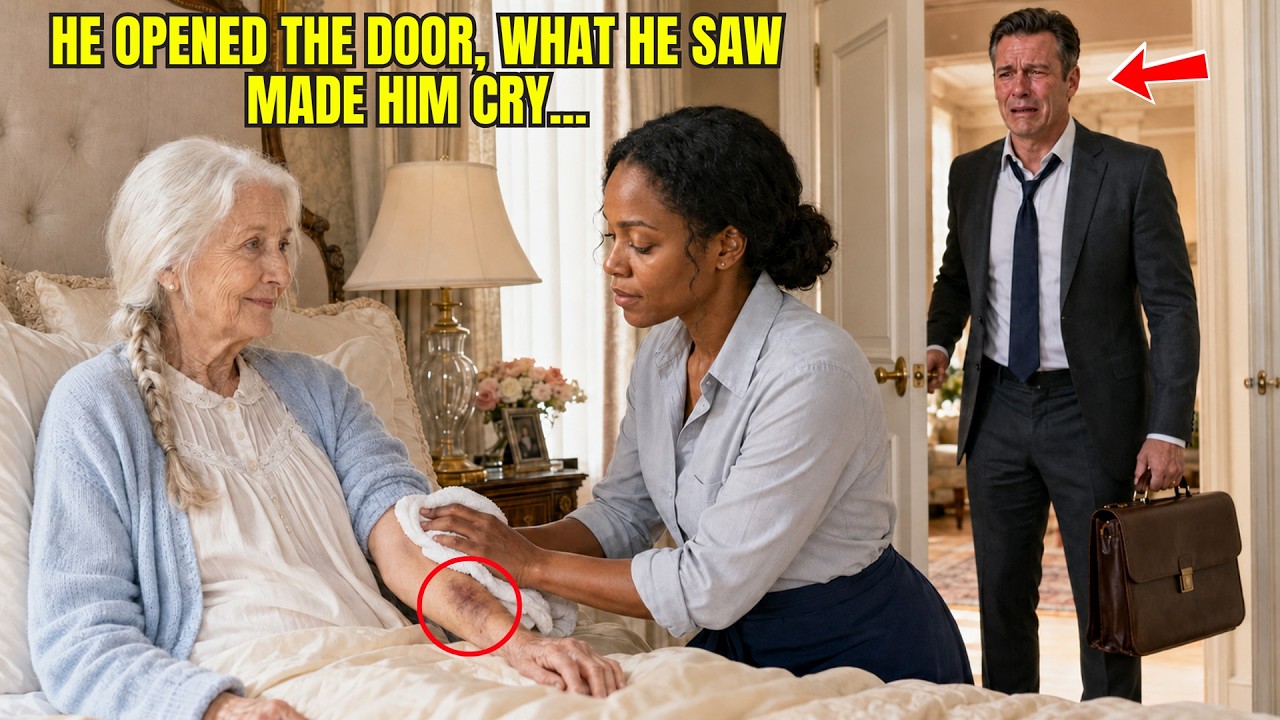
”
“Sir, please. I was only trying to help. ”
“I warned you. ”
Clarissa stepped from behind him, eyes glistening with calculated tears.
“That maid is suspicious. She’s the one who did this. ”
Eleanor stared at her son, vacant, hollow. She couldn’t even remember his name.
“Get out of my sight. You’re fired. ”
“Don’t go, my girl. Please don’t go.
”
Evelyn stepped into the cold night with nothing. Her stomach was empty. Not a single penny to her name. A black maid accused of harming an elderly white woman never gets a second chance.
Grant thought the matter was settled. But he had no idea who the real monster in that house was. Have you ever trusted the wrong person so deeply that the one who truly loved you paid the price? Six months earlier, Grant Prescott sat across from Dr.
Holloway in a sterile office that smelled of antiseptic and old coffee. The doctor’s words landed like stones. “Your mother’s condition is progressing, Grant. She needs consistent full-time care.
Someone patient. Someone present. ”
Grant pressed his thumb into his temple. He was the CEO of Prescott Capital, a commercial real estate firm he’d built from a single office lease into a portfolio worth over two hundred million.
He could solve most problems with a phone call. But this—watching his mother forget how to button her own coat, forget the name of the street she’d lived on for forty years, forget him—was the one thing money couldn’t fix. Eleanor Prescott had been a music teacher for three decades. She taught piano to hundreds of students, hummed Chopin while she cooked dinner, and sang her son to sleep every night with a lullaby she’d written herself the day he was born.
Now at seventy-eight, the music was fading. Some mornings she recognized Grant. Some mornings she called him “the nice man who visits. ” The diagnosis was early-stage Alzheimer’s, but the word *early* felt like a lie.
Grant’s wife, Clarissa, had a different perspective. “She needs professionals, Grant. A facility. Sunrise Gardens has a lovely memory wing.
Marble floors, a garden, the whole thing. ”
“She’s not going to a facility. ”
“She wanders at night. She left the stove on twice last week.
”
“I said no. ”
Clarissa was thirty-eight, blonde, immaculate. She’d married Grant at twenty-nine and stepped into wealth the way people step into a warm bath—slowly, then completely. She loved the house, the name, the social calendar.
What she didn’t love was the old woman upstairs who called her a stranger and once asked her politely to leave. Eleanor was inconvenient. Eleanor was embarrassing. At a charity dinner two months ago, Eleanor had wandered into the ballroom in her nightgown asking for her late husband.
Clarissa hadn’t spoken to Grant for three days. So when Grant told her he was hiring a live-in caregiver instead, Clarissa forced a smile and said nothing. She could wait. Then Evelyn Harper arrived.
Dr. Holloway had recommended her personally. “She doesn’t have a nursing degree, but she spent four years caring for her grandmother who had dementia. She knows this disease from the inside.
And she’s got the kind of patience you can’t teach. ”
Evelyn carried a single duffel bag. She’d been living in a studio apartment across town, working double shifts at a nursing home that had cut her hours three months ago. Her parents died in a car accident when she was nine, and her grandmother raised her.
That woman spent her final seven years lost in dementia, and Evelyn cared for her alone, without insurance, without help. When her grandmother died, Evelyn had nothing left but the experience of loving someone who was disappearing. When Grant introduced her to Eleanor, Evelyn knelt down to meet the old woman’s eyes and said, “It’s so nice to meet you, Mrs. Prescott.
I hear you used to teach piano. I always wished I could play. ”
Eleanor looked at her for a long moment. Then she smiled, a real smile, the kind Grant hadn’t seen in weeks.
“I could teach you, dear. ”
Grant hired Evelyn on the spot. Clarissa came down when Evelyn moved in, took one look, and her expression hardened into something Grant chose not to notice. From that first week, the hierarchy was clear.
Clarissa called Evelyn “the help,” never her name. She assigned her a small plate and a separate seat in the kitchen, away from the dining room. She told her the guest bathroom was off-limits and that there was a utility sink in the laundry room she could use instead. Evelyn said, “Yes, ma’am.
” Every time. She didn’t argue. She didn’t complain. She ate her meals alone in the kitchen, washed up in the laundry sink, and went upstairs to sit with Eleanor.
Because Evelyn understood something Clarissa never would. This job wasn’t about the house or the paycheck or the Prescott name. It was about the woman in that bedroom who couldn’t remember her own son’s face but lit up every time Evelyn walked through the door. Within weeks, the change in Eleanor was visible.
She ate more. She wandered less. She started humming again—fragments of old melodies Evelyn would pick up and hum along with. On good days she sat in the garden and named every flower.
On bad days, Evelyn held her hand and said, “I’m right here, mama. I’m not going anywhere. ” She called her *mama*, not Mrs. Prescott.
And Eleanor responded. One Sunday morning, Grant walked past the kitchen and found Evelyn teaching Eleanor to knead bread dough, their hands covered in flour, Eleanor laughing at the mess she was making. It was the first time Grant had heard his mother laugh in over a year. He stood in the hallway for a full minute, afraid that if he moved, the sound would stop.
Clarissa noticed. And Clarissa couldn’t stand it. She couldn’t fire Evelyn—Grant had made that decision. So she chose a different weapon.
Words. “I saw her going through mother’s jewelry box yesterday. I’m not saying she stole anything. I’m just saying she was in there.
”
“She closes the door when she’s with your mother. Doesn’t that seem odd to you? ”
“Mother seems weaker since she arrived. Have you noticed?
”
Each sentence was a drop of poison. Not enough to kill trust in one dose, but steady, consistent, patient. Grant dismissed it at first. Then he began to notice things—or thought he did.
Why did Evelyn close the bedroom door? Why did Eleanor sometimes have small marks on her arms? Was that a scratch? Had she fallen?
Evelyn always had an explanation. “She bumped the bed frame. ” “She scratched herself in her sleep. ” The explanations were reasonable.
But Clarissa’s whispers had done their work. A seed of doubt had taken root in Grant’s mind, and it was growing. It happened on a Tuesday in October. Grant was supposed to be in Chicago for three days, but the seller pulled out at the last minute, and by four in the afternoon he was on a flight home.
He didn’t call ahead. He just wanted to see his mother. The house was quiet when he walked in. Then he heard it—a soft, low, melodic voice coming from upstairs.
Grant climbed the stairs slowly. His mother’s bedroom door was open just a crack. He pressed his back against the hallway wall and looked through. Evelyn was sitting on the edge of the bed.
Eleanor was propped up against two pillows, her white hair freshly combed and braided—something Grant hadn’t seen in months. Evelyn had a warm cloth in one hand, gently wiping Eleanor’s face, her neck, her hands. And she was singing. The melody stopped Grant cold.
It was his mother’s lullaby. The one she’d written the day he was born. The one she used to sing every night, standing in the doorway of his childhood bedroom. He hadn’t heard it in over twenty years.
He thought it was gone, lost inside the fog that had swallowed his mother’s mind. He’d searched for it once—gone through old tapes, old notebooks, even asked his mother’s former students. No one remembered it. But Evelyn was singing it note for note.
She must have heard Eleanor humming it on one of her better days, caught the fragments, pieced them together, and learned it by heart. She had rescued a piece of his mother he thought was gone forever. Eleanor’s eyes were open, clear, present. She reached out and took Evelyn’s hand, her fingers curling around it like a child holding onto safety.
“My girl,” Eleanor whispered. “You always come back. ”
Evelyn smiled and squeezed her hand. “Always, mama.
”
Grant stood in the hallway, tears running down his face. This woman his wife called “the help” was giving his mother something he hadn’t been able to give her in years. Presence. Warmth.
A reason to come back. He left before Evelyn saw him. That night, when Clarissa started her usual commentary, Grant said very quietly, “Leave it alone, Clarissa. ”
Something shifted.
Clarissa felt it. She saw the way Grant started thanking Evelyn at dinner. The way he said her name instead of “the caregiver. ” Her foothold in the house was slipping, and she knew who was pulling it out from under her.
Three weeks later, Grant left for a five-day trip to Houston. And Clarissa made her move. On the second night, while Evelyn was downstairs preparing Eleanor’s evening meal, Clarissa went into the old woman’s bedroom. She closed the door.
When she came out twelve minutes later, Eleanor’s forearm had a bruise the size of a fist—deep purple, spreading. Clarissa picked up her phone and called Grant. “Grant, I need you to come home. Something happened to your mother.
” A pause. A manufactured sob. “I think it’s Evelyn. ”
Grant’s stomach dropped.
All the doubts Clarissa had planted—the closed doors, the marks, the whispers—flooded back. The beautiful scene he’d witnessed three weeks ago suddenly seemed naive. Had he been fooled? He caught the next flight home.
What he walked into was exactly what Clarissa had staged. Evelyn kneeling by the bed, bandaging Eleanor’s arm. The bruise dark and ugly. Clarissa standing behind him, eyes glistening with calculated tears.
“I warned you. That maid is suspicious. She’s the one who did this. ”
Grant looked at the bruise.
He looked at Evelyn’s hands, still holding the gauze. He looked at his mother, who stared back with vacant, hollow eyes. She couldn’t tell him what happened. “Sir, please,” Evelyn said.
“I did not do this. ”
“Get out of my sight. You’re fired. ”
Evelyn stood slowly.
She looked at Eleanor one last time. The old woman’s hand reached out, trembling, grasping at the air where Evelyn’s fingers had been. “Don’t go, my girl,” Eleanor whispered. “Please don’t go.
”
But Grant had already turned his back. Evelyn walked through the front door with nothing. No severance. No reference letter.
No explanation anyone would believe. She had four hundred dollars in savings, was two months behind on rent, and had a reputation Clarissa was already destroying. Within a week, Clarissa had called every family in their social circle. The story was always the same.
“We had to let our caregiver go. It involved my mother-in-law. Physical harm. We’re considering pressing charges.
” In a town where wealthy families hired help through recommendation, Evelyn’s name became a warning. She applied to thirty-two positions in three weeks. Not one call back. The rent came due, then due again.
Her landlord left a notice on her door, red paper, black letters. She packed what she could carry into her fifteen-year-old sedan with the cracked windshield. She slept in that car for eleven nights, parked behind a laundromat on the edge of town. She showered at the YMCA.
She ate once a day—whatever she could afford, usually bread and peanut butter. On the twelfth night, the car was repossessed. Evelyn walked into the Greenfield Community Shelter carrying a plastic bag with two changes of clothes and a photograph of her grandmother. They gave her a cot in a shared room and a night shift at the laundromat next door, folding other people’s clothes for minimum wage.
Every night before she fell asleep on that thin cot, she thought the same thing: *Is she okay? Is anyone singing to her? Is anyone holding her hand? *
The door had closed behind Evelyn Harper.
And for the first time in eight months, Eleanor Prescott was completely alone with the person she feared most. Clarissa didn’t waste a single hour. The morning after Evelyn left, she was already at the breakfast table with a brochure—glossy, trifold, pictures of smiling elderly people surrounded by gardens and sunlight. “Sunrise Gardens Memory Care.
They have an opening next week. Private suite, twenty-four-hour nursing staff. It’s the best in the state. ”
Grant didn’t look at it.
He was staring at the chair where Evelyn used to sit, the small one in the corner of the kitchen, separated from the dining table. “No. ”
“Grant, be reasonable. You just fired the caregiver.
Who’s going to look after her? ”
“I said no. I’ll find someone new. ”
Clarissa pressed her lips together and folded the brochure back into her purse.
She could wait. She’d waited this long. Grant posted the job listing that afternoon. Fourteen applications in the first week.
He interviewed six candidates. None were right. One smelled like cigarettes. One kept checking her phone.
One referred to Eleanor as “the patient” four times in ten minutes. Grant sent them all away. Two weeks passed. Then three.
No hires. Which meant Clarissa had to do it. The first morning, she brought Eleanor a bowl of oatmeal. She set it on the nightstand without a word and turned to leave.
Behind her, she heard a small, strangled whimper—like an animal caught in a trap. Eleanor was pressed against the headboard, both hands clutching the blanket to her chest. Her eyes were wide. Her lips were trembling.
She was staring at Clarissa the way a person stares at something that has hurt them before and will hurt them again. “Stop it,” Clarissa said. “I’m bringing you breakfast. Eat.
”
Eleanor shook her head. A single tear rolled down her cheek. She pulled the blanket over her face and curled into a ball. Clarissa left the oatmeal and walked out.
It happened again at lunch, again at dinner. Every time Clarissa entered the room, Eleanor’s entire body reacted—shoulders rising, hands flying up to shield her face, breath coming in short, rapid bursts. She wouldn’t eat. She wouldn’t drink.
She wouldn’t let Clarissa touch her. Clarissa tried to force it once, gripped Eleanor’s wrist to guide the spoon toward her mouth. Eleanor screamed. Not a scream of confusion or dementia.
A scream of terror—raw, guttural, primal, the kind that comes from a place deeper than memory. Clarissa dropped the spoon and stepped back. “Fine. Starve.
”
Grant heard the scream from his study. He found Eleanor trembling in bed, oatmeal splattered across the blanket. “She won’t eat,” Clarissa said flatly. “She’s getting worse.
This is exactly why she needs a facility. ”
Grant knelt beside his mother’s bed. She flinched, but when she saw it was him, her fingers slowly uncurled and wrapped around his. “Mom, it’s me.
What happened? ”
Eleanor looked at him with cloudy eyes. For a moment, he thought she might say something. But the fog rolled in, and she turned her face to the wall.
That night, Grant couldn’t sleep. He kept hearing that scream. Not a scream of confusion—a scream of fear. His mother was afraid of something in this house.
Or someone. At two in the morning, Grant walked past Eleanor’s room. The door was open a crack. He heard her talking in her sleep—fragments of words, half-formed sentences.
Then, very clearly: “Please, not again. ”
Grant stopped. His hand gripped the doorframe. The next morning, he told Clarissa he had a conference call.
Instead, he stood in the hallway outside Eleanor’s room, out of sight, and waited. At 9:15, Clarissa walked in carrying a tray. Toast, juice, pills. She set it down hard enough that the juice sloshed over the rim.
“Sit up,” she said. Eleanor didn’t move. “I said sit up. ”
Still nothing.
Clarissa reached down and pulled Eleanor’s shoulder, turning her over. The old woman’s reaction was immediate. Both hands flew up to cover her face. Her knees drew toward her chest, and a low, keening wail escaped her throat.
It was the sound of a person who had learned through repetition that the presence of this woman meant pain. “Stop being dramatic, mother. ”
Grant stood in the hallway, his jaw clenched so tight his teeth ached. His mother—the woman who had taught hundreds of students to find beauty in music, who had raised him alone after his father died, who had hummed Chopin while she made Sunday dinner—was cowering in her own bed, protecting her face from his wife.
Something broke inside him. Not anger. Not yet. The slow, sickening realization that he had been looking at the wrong person all along.
That night, after Clarissa fell asleep, Grant went to his study. He logged into the home security system. He’d installed cameras two years ago in the hallways, kitchen, living room, foyer—standard security. He’d never once reviewed the footage.
He started from six months ago, the day Evelyn arrived. The first few weeks were uneventful. Then he saw it. A Tuesday afternoon, three months in.
Clarissa walking into Eleanor’s room, grabbing the old woman’s arm, squeezing, twisting. Eleanor crying out. Clarissa leaning close and whispering something. The audio was too faint to catch, but the body language was unmistakable.
Grant’s hand covered his mouth. He kept watching. Wednesday, Thursday, the following week—a pattern emerged. Clear, consistent, devastating.
Every time Grant was away, every time Evelyn was downstairs, Clarissa went into that room. She pinched. She grabbed. She shoved Eleanor back into the chair, onto the bed, against the wall.
She left her without water for hours. She took away half-eaten food. Once Eleanor fell trying to reach the bathroom and lay on the floor calling out. Clarissa walked past the open door, looked in, and kept walking.
And every single time—every bruise, every fall, every cry that went unanswered—the same person appeared. Evelyn running up the stairs, kneeling beside Eleanor, lifting her gently, whispering, “I’m here, mama. I’m not going anywhere. ” Cleaning the marks, applying ointment, bringing fresh water, warm food, a blanket.
Sitting beside the bed, humming that lullaby until Eleanor’s trembling stopped and her breathing slowed and she finally fell asleep. Grant watched six months of footage in four hours. He saw Evelyn rearrange the pillows so Eleanor wouldn’t roll off the bed. He saw her cut food into tiny pieces so Eleanor wouldn’t choke.
He saw her sit on the cold bathroom floor at three a. m. holding Eleanor’s hand through a panic episode, whispering, “You’re safe, mama. I’m right here.
Nobody’s going to hurt you. ”
By the end, his face was wet and his hands were shaking. Evelyn had never hurt his mother. Not once.
Not ever. Evelyn had been the only thing standing between Eleanor and the woman who was supposed to love her. And she had done it silently, without complaint, without credit, because she understood that if she spoke up, she’d be fired. And if she was fired, no one would be there the next time Eleanor fell.
She was right. Because Grant had fired her anyway. And now no one was there. Grant didn’t sleep that night.
He sat in his study until the sky turned gray, saving files, taking notes. When the first light came through the window, he washed his face, put on a clean shirt, and walked downstairs. Clarissa was in the kitchen making coffee. She was humming, as if nothing in the world was wrong.
She looked up and smiled. “Morning. Want some? ”
Grant sat down at the table.
He placed his laptop in front of him, screen facing Clarissa. He pressed play. The footage showed Clarissa grabbing Eleanor’s forearm, the old woman crying out. Clarissa leaning close, whispering, then walking away—leaving Eleanor slumped in the chair, holding her arm.
Clarissa’s smile disappeared. The color drained from her face in stages. First the cheeks, then the lips, then the skin around her eyes. “Those cameras—the angle.
It’s misleading. I was trying to help her sit up. She’s difficult, Grant. You don’t know what it’s like.
”
“Don’t. ” Grant’s voice was quiet, controlled. The kind of quiet that frightens people more than shouting. “I’ve watched every recording.
Every day for six months. I’ve seen what you did to her. I’ve seen what you did to Evelyn. And I’ve seen what Evelyn did for my mother while you were hurting her.
”
Clarissa’s strategy shifted in real time. The denial evaporated. In its place came tears—sudden, theatrical, accompanied by a hand pressed to her chest. “I was overwhelmed, Grant.
You were never here. I was alone with her, and she doesn’t even know who I am. Sometimes I just lost control. I’m so sorry.
I’m so, so sorry. It won’t happen again. I swear on my life. ”
She reached for his hand.
Grant pulled it away. “I’m calling Philip Archer this morning. And then I’m calling the police. ”
The tears stopped.
Clarissa stared at him with an expression he’d never seen before. Not fear. Not anger. The cold, calculating blankness of a person who had run out of strategies and was realizing for the first time that the game was over.
Philip Archer arrived by ten a. m. He was sixty-one, silver-haired, and had spent thirty years specializing in elder protection law. Grant handed him a flash drive containing every relevant clip.
Philip watched twelve minutes of footage, removed his glasses, and said, “This is criminal. Clear, documented, repeated elder abuse. We file today. ”
By noon, Grant had signed a police report.
By three p. m. , a detective from the county elder abuse unit confirmed that formal charges would be filed against Clarissa Prescott. By five p.
m. , Grant was in his car driving across town. Dr. Holloway had made some calls.
It took two days to trace Evelyn’s path—her apartment, evicted; her car, repossessed; the Greenfield Community Shelter on the east side of town. The doctor called Grant with the address and said simply, “Go. ”
The shelter was a converted warehouse—cinder block walls, fluorescent lights, the smell of industrial cleaner and boiled vegetables. Grant had driven past this part of town a thousand times on the highway.
He’d never stopped. He’d never had a reason to. A woman at the front desk said Evelyn was working the night shift at the laundromat next door. Grant walked through a narrow alley.
The laundromat was small, harshly lit, empty except for one person. Evelyn Harper stood behind a folding table, smoothing a crease out of a stranger’s shirt. She was thinner than he remembered. Her eyes had a hollow quality.
Not broken. Worn. She looked up when the door chimed. When she saw Grant, her body went rigid.
She took a step back. “I told you,” she said, her voice flat, practiced. “I didn’t do it. ”
“I know.
”
“Then why are you here? ”
Grant took a breath. He had rehearsed this in the car, at every red light. But standing in front of her, every prepared word dissolved.
“I saw the cameras, Evelyn. All of them. Every day. I saw what Clarissa did.
And I saw what you did. ”
Evelyn didn’t move. “I saw you pick her up when she fell. I saw you clean the marks on her arms.
I saw you feed her when no one else would. I saw you hold her hand every single night and sing her to sleep. ” His voice cracked. “And I saw myself throw you out of my house for it.
”
Grant lowered himself to one knee on the dirty laundromat floor, his slacks pressed into the damp tile. “I’m sorry. I’m sorry I believed her. I’m sorry I didn’t protect you.
And I’m sorry I didn’t protect my own mother. ”
Evelyn stood perfectly still for a long time. The washing machines hummed in the background. Then, very quietly, she asked the only question that mattered to her.
“How is she? ”
Grant told her. The screams. The cowering.
The flinching. The hands flying up to cover her face. The oatmeal on the blanket. The whimpers in the night.
That was when Evelyn cried. Not for herself. Not for the lost apartment, the repossessed car, the weeks in the shelter. She cried for Eleanor.
For every day she wasn’t there to pick her up, to hold her hand, to hum the lullaby that kept the old woman tethered to a world she was slowly forgetting. “Every night in this shelter,” Evelyn whispered, “I close my eyes and I hear her calling for me. ” She looked up, her eyes wet. “Take me back.
Please take me back to her. ”
The next evening, Evelyn walked through the front door of the Prescott mansion for the second time. The house was quiet. Clarissa’s things were gone.
Grant had asked her to leave that morning; a restraining order ensured she wouldn’t return. Evelyn climbed the stairs. She pushed open the door to Eleanor’s room. The old woman was lying on her side, facing the wall.
The curtains were drawn. The room smelled stale—no one had opened a window in weeks. A tray of untouched food sat on the nightstand. Eleanor’s hair was tangled.
Her shoulders looked smaller. Evelyn sat down on the edge of the bed. She didn’t speak. She just began to hum.
The melody drifted through the room like something remembered from a long time ago. Eleanor’s breathing changed—slower, deeper. Then her body uncurled. She turned slowly, like a flower turning toward light.
Her eyes found Evelyn’s face. For three seconds, nothing happened. Then Eleanor’s hand reached out. Her thin, trembling fingers found Evelyn’s wrist, then her palm, then laced through her fingers and held on.
“My girl,” Eleanor whispered, her eyes clear and present. “You came back. ”
“I came back, mama. ”
Grant stood in the doorway, one hand over his mouth, and watched the woman he’d fired hold his mother’s hand in the fading light.
He cried without making a sound. Clarissa Prescott had spent three years building the perfect image among the elite. The trial ahead would destroy all of it in thirty minutes. The courtroom was cold—not the temperature, the atmosphere.
Polished wood, fluorescent lights, the low murmur of people who had come to watch something they would talk about for years. Clarissa sat at the defense table in a navy dress and pearl earrings, her face arranged into an expression of wounded dignity. Her lawyer had advised her to look sympathetic but not broken. She had practiced this face in the mirror.
Across the aisle, the prosecution’s table was simple: a laptop, a stack of folders, and a flash drive containing six months of footage Clarissa had never known existed. Grant sat in the front row. His testimony wasn’t required—the footage spoke for itself. But Grant came anyway.
He owed it to his mother. He owed it to Evelyn. And he owed it to himself to face the full weight of what his silence had allowed. The charges were read: two counts of elder abuse, one count of neglect, one count of filing a false report against a domestic employee.
Clarissa pleaded not guilty to all charges. Her voice was steady. She even managed to look offended. The prosecution opened with the footage.
The courtroom watched in silence as Clarissa entered Eleanor’s bedroom on a Wednesday afternoon, grabbed the old woman’s wrist, twisted, leaned close to whisper something, and walked away, leaving Eleanor clutching her arm and weeping. Thursday: Clarissa pushing Eleanor back onto the bed when she tried to stand. Then the next clip. And the next.
Six months compressed into twenty minutes that no amount of legal strategy could explain away. A woman in the gallery pressed her hand to her mouth. A man in the third row shook his head. The judge watched without expression, but her pen had stopped moving.
Then Evelyn Harper was called to the stand. She walked to the front in clothes that were clean but worn. No jewelry. No makeup.
The prosecutor’s questions were simple: How long did you work for the Prescott family? What were your duties? Describe your relationship with Eleanor Prescott. Evelyn answered carefully.
Her voice was low and steady, but her hands, folded in her lap, were trembling. “Can you explain to the court why you never reported what you saw? ”
Evelyn was quiet for a moment. Then she looked at her own hands.
“Because if I said anything, Mrs. Prescott would have had me fired. And I knew that if I left…” Her throat tightened. “If I left, who would be there the next time Eleanor fell?
Who would pick her up? Who would sit with her at night when she was scared? ”
“So you chose to stay, knowing you were at risk. ”
“I chose to stay because leaving her alone was worse than anything they could do to me.
”
The courtroom was silent. Clarissa’s lawyer stood for cross-examination. “Miss Harper, you’ve testified that you witnessed the defendant’s behavior toward Eleanor. Yet you said nothing for six months.
There was no call to the police. No informing Mr. Prescott. No contact with adult protective services.
Doesn’t that silence make you complicit in the very abuse you claim to have witnessed? ”
Evelyn looked at him. She didn’t blink. “I stayed because the moment I spoke up, I would have been thrown out.
And the moment I was thrown out, there would have been no one between Eleanor and the person hurting her. I wasn’t complicit. I was the only thing standing in the way. ”
The lawyer had no follow-up.
The final witness was not on anyone’s list. Dr. Holloway had arranged for Eleanor to be present, accompanied by a court-appointed medical advocate. The judge had approved her appearance with the understanding that she would not be questioned.
She was there only for the court to observe. Eleanor was wheeled in by a nurse. She sat small and still in her chair, white hair combed neatly, her eyes drifting across the room without settling on anything. She looked like a woman who had wandered into someone else’s story.
For several minutes, she said nothing. Then Clarissa’s lawyer began his closing remarks—something about context, about the pressures of caregiving, about how the footage lacked audio and could be misinterpreted. Clarissa dabbed her eyes with a tissue and let out a carefully timed sob. Eleanor’s head turned.
She looked at Clarissa, and something changed. Her body went rigid. Her thin hands gripped the armrests of the wheelchair so hard her knuckles turned white. Her breathing became shallow and fast.
A small sound escaped her lips—not a word, not a cry, but the involuntary whimper of a body remembering what the mind could not. Then she raised one trembling hand. Her index finger extended toward Clarissa. And in a voice that was thin and shaking but unmistakably clear, Eleanor Prescott said:
“She hurt me.
Every time the door closed. ”
The courtroom didn’t gasp. It didn’t murmur. It went completely, absolutely silent.
The kind of silence that presses against your ears and makes you aware of your own heartbeat. The verdict came within the hour. Guilty on all counts. Clarissa Prescott was sentenced to eighteen months in a state correctional facility, with a permanent restraining order prohibiting her from contacting Eleanor for the remainder of Eleanor’s life.
In the concurrent divorce proceedings, the prenuptial agreement and the criminal conviction stripped Clarissa of all claims to the Prescott estate. She left the courtroom the same way she had entered the Prescott family. With nothing. Six months after the trial, the Prescott mansion looked the same from the outside—stone facade, manicured lawn, iron gate.
But inside, everything had changed. The dining room table, which Clarissa had reserved for two, now had three place settings. The small plate in the kitchen corner was gone. The utility sink had been replaced with a proper vanity, though Evelyn never used it.
She used the guest bathroom upstairs now—the one with the window that overlooked the garden. The one Clarissa had told her she wasn’t allowed to touch. Evelyn was no longer the maid. Grant had offered her a formal position: Director of Care for Eleanor Prescott.
Full salary, health insurance, a private room on the second floor three doors down from Eleanor’s. When Grant handed her the employment letter, Evelyn read it twice, set it on the table, and said, “I don’t need a title, Mr. Prescott. I just need to be with her.
”
“You’ll have both. ”
The change in Eleanor was the kind doctors struggle to explain. Alzheimer’s doesn’t reverse. The fog doesn’t lift permanently.
But within weeks, Eleanor’s good days began to outnumber the bad ones. She ate full meals. She hummed in the garden. She let Evelyn braid her hair every morning, a ritual Eleanor’s body remembered even when her mind forgot.
On her best days, Eleanor narrated memories from forty years ago with startling clarity—the names of piano students, the lilies her late husband brought every Friday, the exact shade of blue of Grant’s nursery. Evelyn would listen and smile and say nothing, because she understood these memories were fragile things, and the quieter the room, the longer they stayed. On her worst days, Eleanor sat by the window staring at the garden, her mind somewhere no one could reach. Evelyn sat beside her in silence, holding her hand, waiting for the woman she loved to come back.
She always came back. Maybe not the same day. Maybe not the next. But she always came back.
Grant had become a different man. He cut his travel schedule in half. He came home for dinner every night. He sat with his mother on the porch in the evenings—sometimes talking, sometimes just sitting.
He was learning, slowly and awkwardly, how to be present for the person who had always been present for him. One evening, three months after the trial, Grant called Evelyn into his study. On his desk was a stack of legal documents, a nonprofit charter, and a name written in Grant’s handwriting: *Eleanor’s Hands Foundation*. “I want to build something,” he said.
“A foundation that supports caregivers—people like you, people who don’t have degrees but have experience, people who do this work because it matters. Training programs. Scholarships. Emergency housing for caregivers who lose their jobs.
I want it to be real. ” He paused. “And I want you to run it with me. ”
Evelyn looked at the paper.
She touched the name with her fingertip. “She’d like that,” she said softly. “She always talked about hands. She said a good piano teacher doesn’t teach the keys.
She teaches the hands to remember. ”
The foundation launched four months later. Its first project was a twenty-four-hour hotline for caregivers in crisis—people fired without cause, accused without evidence, left without resources. Within six weeks, the hotline had received over three hundred calls.
At the press conference, Evelyn stood behind a podium for the first time in her life. She wore a blue dress Grant’s assistant had helped her pick out. Her hands were steady. Her voice was clear.
“I didn’t stay because I’m brave. I stayed because she needed someone. And sometimes being someone is the most important job in the world. There are thousands of people like me—people who cook and clean and hold hands and sing songs and never get thanked.
This foundation is for them, because they deserve to be seen. ”
The speech was carried by three local news stations. It was shared over two hundred thousand times online. Within a month, Eleanor’s Hands had raised enough to fund its first year of operations.
But none of that was the moment Grant would remember most. It was a Tuesday afternoon in spring. The garden behind the mansion was in full bloom—roses, hydrangeas, the jasmine Eleanor had planted thirty years ago still climbing the stone wall by the gate. Evelyn walked with Eleanor along the gravel path, their arms linked, moving slowly.
Eleanor stopped beside a cluster of white roses and leaned in to smell them. “Evelyn,” she said. “Yes, mama. ”
Eleanor turned to her.
Her eyes were clear, focused, present—one of those rare, luminous moments when the fog pulled back and the woman she used to be stood fully in the light. “Thank you,” Eleanor said, “for not leaving me. ”
Evelyn’s throat tightened. She squeezed Eleanor’s hand and smiled through the tears that were already falling.
“I never will, mama. I never will. ”
Grant watched from the second-floor balcony. He leaned against the railing, coffee growing cold in his hand, looking down at the two women in the garden—his mother, and the woman who had saved her.
He thought about the months of blindness, the months of listening to the wrong voice, the months his mother had spent afraid in her own home while the person who loved her most was folding strangers’ laundry in a shelter across town. He thought about what family means. Not the name. Not the ring.
Not the legal document. Family is the person who stays when it costs them everything. Family is the woman who picks you up off the floor at two in the morning and sings you back to sleep. Family is the one who never leaves.
Clarissa had shared his bed, his name, his fortune. Evelyn had shared nothing but her time, her patience, and her heart. And yet it was Evelyn who had loved his mother more than anyone else in the world. Below, Evelyn pointed at something in the garden—a butterfly, maybe.
Eleanor clapped her hands like a child discovering something wonderful. The sound drifted up through the warm afternoon air, fragile and perfect. Grant closed his eyes and let it stay.