The alarm went off at 5:45. Andre Crawford’s hand found the phone before the second ring. He lay still for three seconds, staring at the ceiling of his two-bedroom apartment in Decatur, Georgia. Then he swung his legs off the bed and walked barefoot to the kitchen.
Coffee first. Always coffee first. The machine was old, a drip maker with a broken handle he’d fixed with duct tape two years ago. It still worked.
That was enough. Andre stood at the counter sipping from a chipped mug, looking out at the parking lot below. His Honda Civic sat in its usual spot. Faded blue paint, a dent in the rear bumper from a shopping cart three winters ago.
He could have replaced it hundreds of times. He never did. By 6:30 he was dressed. A white button-down, slightly wrinkled at the sleeves.
Gray slacks from the clearance rack. Brown shoes, polished but cracked at the soles. He picked up his briefcase, its leather corners worn, its brass latches dull from years of use, and closed the door behind him. The drive to his office took 11 minutes.
Crawford Legal Consulting occupied a single suite on the second floor of a strip mall between a nail salonand a tax preparer’s office. One desk. One filing cabinet. One assistant named Ruth who had been with him from the startand never asked why a man of his intelligence ran an office this small.
Because Ruth didn’t know what no one else knew. At 8:15, Andre’s personal phone vibrated. Not the office line. The other one.
The one he kept in the inner pocket of his briefcase, the phone with no name on the account. “Good morning, sir. Prescott account balance is currently 400 million, including principal and accrued interest. Awaiting your instructions.
” Andre leaned back in his chair. “Not yet. ” “Understood, sir. We stand ready.
” The line went dead. He returned the phone to his briefcase, opened his laptop,and began reviewing a bankruptcy file for a small restaurant chain in Marietta. Just another ordinary Tuesday. Forty-three miles north, in a penthouse suite of a glass tower overlooking Buckhead, Harold Prescott’s day was anything but ordinary.
He sat in the office of Nathan Greer, a private oncologist who charged 400 dollars an hourand had never once delivered good news to Harold. The scans were up on the light box. The shadows hadn’t shrunk. They had spread.
Dr. Greer said, “Six months. Maybe eight with aggressive treatment. But I want to be honest with you, Harold.
The trajectory isn’t good. ” Harold stared atthe scans. He didn’t blink. He didn’t speak.
He picked up his coat, walked out of the office,and called his driver from the elevator. In the backseat of a black Bentley, Harold Prescott made a list in his mind. Not a list of things he wanted to do before he died, nor people he wanted to see, but a list of problems. At the top of that list, written in invisible ink only he could see, was a number.
400 million dollars. Three years ago, Prescott Realty had been bleeding money. Bad deals in South Florida. A failed resort project in Carolina.
A commercial portfolio that collapsed when three anchor tenants pulled out the same quarter. Harold had needed quick capital, total secrecy, no questions asked. He found it through a private investment vehicle called Pinnacle Capital. No public filings.
No press releases. Just a wire transferand a repayment schedule Harold had fully intended to honor. He never did. Now the debt sat on the books of Prescott like a tumor, hidden from the board, the auditors, and everyone save Harold and his personal attorney.
If that debt ever came to light, the company would be insolvent within 30 days. His legacy, 40 years of deals, the buildings with his name etched on their facades, his reputation carved into the skyline of Atlanta—all of it would collapse overnight. And Lauren, his 28-year-old daughter, beautiful, pampered,and utterly unprepared for any of it, spent her days at spa appointmentsand charity galasand her nights at rooftop bars with people whose family names opened doors. She’d never reada balance sheet.
She didn’t know the difference between revenue and profit. And she certainly didn’t know that every dollar she spent came from a house of cards her father had built on borrowed money. Harold needed a plan. And he needed it before time ran out.
The call came on a Thursday afternoon. Ruth handed Andre the message slip without comment. Prescott Realty board meeting, Monday 9:00 a. m.
, 40th floor. No agenda. No explanation. No topic stated.
Just an order disguised as an invitation. Andre had done contract work for Prescott Realty for three years. Small things. Lease reviews.
Liability clauses. Due diligence on modest acquisitions—the kind of work a company like Prescott outsourced to firms it didn’t consider important enough to handle in-house. He’d never once been invited to a board meeting. He’d never even been offered a seat.
The first time he visited the Prescott offices, Harold’s executive assistant made him wait in the lobby for 45 minutes. When he finally came up, Harold was on the phone. He didn’t look up. He gestured to a chair—the small one, no armrests, pushed against the wall like it was reserved for deliverymen—and kept talking.
When the call ended, Harold said,“You’re the outside man. ” Andre said,“Yes. ” Harold tossed a stack of files across the desk. “Finish these by Friday.
And next time, use the service elevator. ” That was the relationship. Three years of service elevators, waiting rooms, files tossed across desks. Three years of Harold mangling his last name—sometimes Crawford, sometimes Carlton, once just “you.
” Three years of invoices paid 30 days late every time, as if the lateness itself was the message:“You are not a priority. You are barely a person. ” Andre never complained. He did his work.
He cashed the checks. And he watched. On Monday morning, Andre drove his Honda Civic intothe underground parking garage of the Prescott Tower. The attendant looked at the car, then at Andre, then back ata car.
““Sir, this parking is reserved for executivesand board members of Prescott Realty. ”” Andre said,“I’m expected upstairs. ” The attendant hesitated. I’ll need to call up to confirm.
Andre waited. The call was made. The barrier rose. He parked between a black Mercedesand a white Porsche Cayenne, took his briefcase,and rode the elevator to the 40th floor.
The boardroom was enormous. Floor-to-ceiling windows on three sides overlooked the Atlanta skyline. A long mahogany table, polished like a mirror, ringed by144 leather chairs—12 for the board, one at the head for Harold, and one at the far end. That far chair had no nameplate.
Andre sat there. Board members filed in over the next ten minutes. Twelve men and women in tailored suits, carrying monogrammed briefcasesand coffee from the executive lounge. A few glanced atthe stranger.
Most didn’t. Gregory Palmer, a silver-haired man in his mid-fifties who served as vice chairman, nodded politely but said nothing. A younger board member two seats over leaned toward his neighbor. Whispered something.
Both looked atthe Andre’s shoes. Neither tried to hide it. No one introduced themselves. No one shook his hand.
No one asked his name. At 9:15, Harold Prescott entered the room. He was thinner than the last time Andre had seen him. His suit hung loose atthe shoulders.
The collar gaped atthe neck, as if sewn for a larger man. His skin had a grayish cast under the fluorescent lights. When he gripped the back of his chair, his knuckles stood out like piano keys. But his voice—his voice was exactly the same.
Harold buttoned his jacket and stood atthe head of the table. “Thank you all for coming on short notice. I’ll get straight to the point. ” He paused, scanned the room.
All eyes were on him. “I’ve been diagnosed with pancreatic cancer. Stage four. The doctors give me six months, maybe less.
” The room went silent. A few board members exchanged glances. Gregory Palmer set down his pen. Lauren Prescott, seated to her father’s right in a cream suit with gold buttons, stared straight ahead.
Her expression didn’t change. She already knew. Harold continued, his voice steady. “This company is my life’s work.
I built it from a two-room office downtown into the largest private real estate firm east of the Mississippi. I will not—I refuse to—let it collapse just because I won’t be here to hold it together. ” He turned to Lauren. “My daughter will assume the role of chairman,the effective upon my death.
” Murmurs around the table. Gregory Palmer leaned forward. “Harold, with all due respect, Lauren has no operational experience. She hasn’t been involved in day-to-day operations, I—”“I’m not finished.
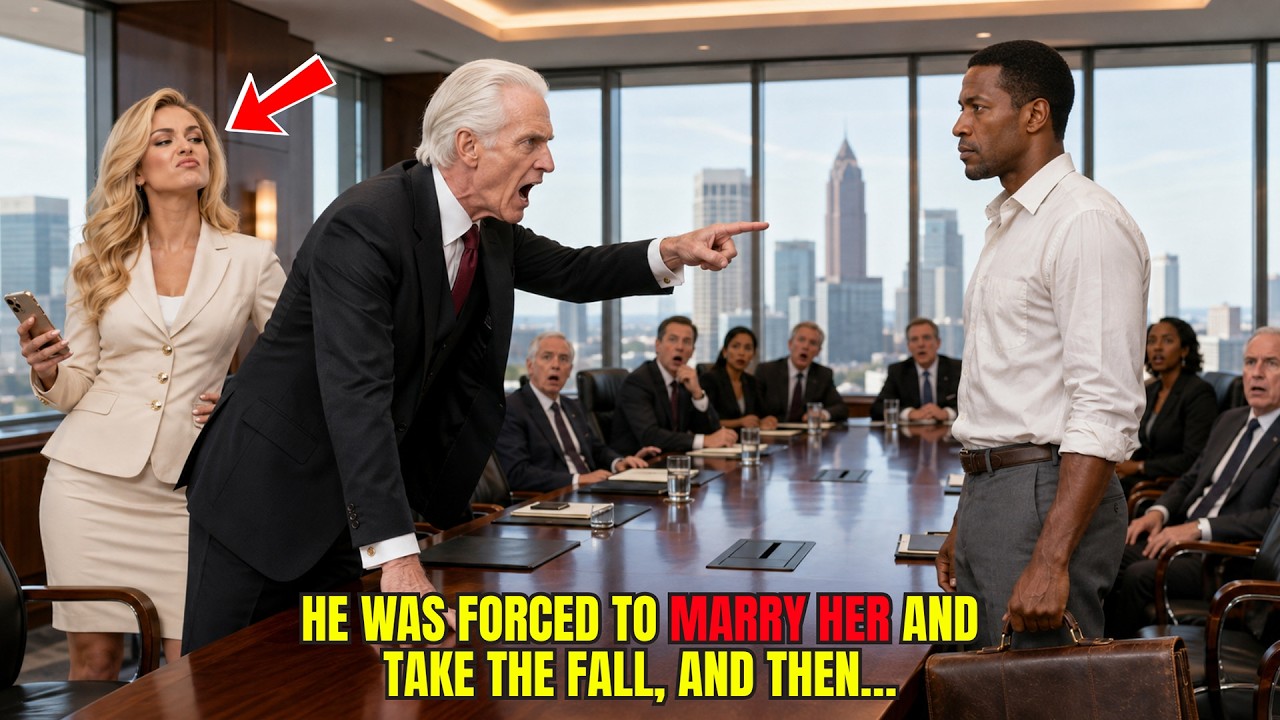
” Harold raised his hand. The murmurs stopped. “Lauren will need a partner. Someone with legal expertise who can manage the compliance side, handle regulatory matters,and serve as co-signatory on all major transactions.
” He turned to the far end of the table, toward Andre. “That person is you. ” Andre looked up from his notepad. “Excuse me?
” “You’re going to marry my daughter, Crawford. ” The words landed like bombs on the mahogany. Twelve board members turned to stare atthe Andre. Two pushed their chairs back, as if the phrase itself had a blast radius.
Lauren’s eyes narrowed. She uncrossed her legs, leaned back,and let out a short, sharp laugh. “Him? ” She looked at her father.
“You can’t be serious, Dad. Look at him. ” Harold didn’t blink. “This isn’t about romance, Lauren.
This is about structure. Legal structure. When Crawford marries you, he becomes family. And as family, he assumes fiduciary responsibility for the company’s obligations.
In return, he gets a 5% equity stakeand a board seat. ” 5%? Andre did the math instantly. 5% of a company sitting on400 million in hidden debt.
Not an opportunity. A trap. 5% of a debt bomb with a six-month fuse. “Mr.
Prescott,” Andre said carefully,“I appreciate—”“This is not an offer. ” Harold’s voice hardened. “It’s a directive. You’ve been handling our contracts for three years.
You know this company, and frankly, Crawford, you need us more than we need you. ” He walked slowly, deliberately, around the table. Each footstep echoed on the hardwood. “Let me be clear.
” He stopped three feet from Andre’s chair. “If you refuse, every contract you currently hold with Prescott Realty is terminated immediately. I will personally call every managing partnerand every general counsel in this city. Every firm that has ever considered hiring you will hear from me.
Andre Crawford is untrustworthy, unreliable,and unfit for legal practice. ” He leaned down. Close. Close enough that Andre could smell the mouthwash masking something medical beneath it.
Something bitter. Something chemical. Something that reminded Andre of hospital corridors. “You’re a single Black father running a one-man office out of a strip mall.
You have no savings. No connections. No options. This is your chance—your only chance—to enter a world you could never have reached on your own.
” He straightened, adjusted his cuffs,and delivered his final line the way a judge hands down a sentence. “Marry my daughter, or lose everything. ” Silence filled the boardroom. Not polite silence born of agreement, but suffocating silence of people who knew they were witnessing a wrongand chose not to stop it.
Gregory Palmer stared at his hands. Helen Cross, the board treasurer, pressed her lips together. She’d built her career from nothing. She knew exactly what was happening.
She looked out the window. She said nothing. No one spoke. No one objected.
No one said,“Harold, this isn’t right. ” Because in Harold Prescott’s boardroom, the only opinion that mattered was Harold Prescott’s. Andre sat completely still. His briefcase rested against his chair leg.
His hands lay flat on the table. His face showed nothing—no anger, no fear, no surprise. Only a stillness, an unreadable calm that made Harold’s jaw tighten. Because this wasn’t the face of a man who’d just been cornered.
It was the face of a man who had been waiting for this moment for a very long time. Andre said,“I need 48 hours to think. ” Harold stared at him, searching for something, then nodded once. “48 hours.
Not a minute more. ” Andre picked up his briefcase, nodded to the room,and walked out. His footsteps were measured. His pace even.
He didn’t look back. Behind him, 12 board members sat insilence. Lauren Prescott filed her nails. Harold Prescott, the man who controlled everything, stood alone at the head of the table.
A room full of people surrounded him. None of them were brave enough to tell him he’djust made the biggest mistake of his life. Andre didn’t go home. He drove his Honda Civic to a parking garage six blocks from his office, rode to the top floor, empty as usual,and killed the engine.
He sat inthe silence for a full minute. Then he took out his second phone. “It’s me. ” He said.
“Activate the Prescott file. I want every document ready by tomorrow evening. The original loan agreement. The chain of title for the fund structure.
The board disclosures—or rather, the lack of them. Everything. ” The voice on the other end belonged to Sandra Kane, the administrative director of the legal division at Pinnacle Capital—one of only four people on earth who knew Andre Crawford’s true financial identity. She paused for exactly one second.
“We’ve been waiting for this call for 18 months, sir. ” “I know. Get it done. ” He hung upand sat inthe car another five minutes, watching the Atlanta skyline through the concrete pillars of the garage.
The city looked the same as always. Tall buildings. Slow traffic. People living their lives with no idea what was about to change.
Then he drove to his officeand spent the rest of the afternoon reviewing a bankruptcy file for a dry-cleaning chain in Marietta, as if nothing had happened, because nothing had—yet. The next morning, Harold’s personal attorney arrived at Andre’s office. His name was Clifford Haynes, mid-sixties, wearing a tailored suitand cufflinks that probably cost more than Andre’s monthly rent—the kind of lawyer who charges900 dollars an hourand expects everyone in the room to know it. He walked into Andre’s modest strip-mall office, looked around at the used furnitureand the water stain on the ceiling tile, and exhaled through his nose.
He didn’t bother hiding his expression. He didn’t think he needed to. “Mr. Crawford.
” He placed a leather folder on Andre’s desk. “Inside you’ll find a prenuptial agreementand corporate merger documents. 62 pages. Mr.
Prescott expects your signature on all flagged pages by end of business tomorrow. ” Andre opened the folder. He didn’t read fast. He read the way a surgeon reads an X-ray—systematically, methodically, with the kind of focus most people reserve for things they fear.
But Andre wasn’t afraid. He was cataloguing. Page14. Andre would relinquish all claims to personal assets acquired before marriage.
Every cent he’d earned—or more precisely, every cent the world didn’t know he’d earned—would be legally out of reach of the Prescott family. That part was standard. That part didn’t matter. Page29.
Upon Harold’s death, the surviving spouse of Lauren Prescott—i. e. , Andre—assumes primary fiduciary responsibility for all outstanding corporate obligations. Not joint.
Primary. Sole. Andre read the sentence again. Then a third time.
The drafting was precise, elegantly cruel. If Andre signed this document, he wouldn’t be marrying Lauren Prescott. He’d be marrying a 400 million dollar debt. Every dollar Harold had borrowed from Pinnacle Capital—Andre’s own money—would become Andre’s legal obligation to repay himself through a corporate structure so convoluted that a team of forensic accountants would need six months to unravel it.
Harold wasn’t looking for a son-in-law. He was looking for a scapegoat. Page41. A non-disclosure clause prohibiting Andre from discussing the company’s financial position with any third party, including regulators, for 10 years.
A gag order signed under the guise of a marriage contract. Page55. A clause granting Lauren Prescott unilateral authority to terminate the marriage. She could end it for any reason.
And “reason” was defined so broadly that it included any conduct inconsistent with the Prescott family valuesand reputation. In other words, Lauren could divorce him at any time, for any reason, keep everything,and leave Andre holding the debt. Andre closed the folder. He set it on his desk.
He looked at Clifford Haynes. “Tell Mr. Prescott I’ll have my answer tomorrow morning. ” Haynes frowned.
“Mr. Prescott was very clear. He expects a signed agreement, not more delays. ” “Then Mr.
Prescott will have to wait one more night. ” Andre stood and opened the door. “Thank you for coming, Mr. Haynes.
” Haynes left without shaking his hand. His polished shoes clicked down the concrete stairwell,and Andre watched his Audi pull out of the mall parking lot. Then he closed the door, locked it,and drew the blinds. He spent the next three hours on the phone with Sandra Kane.
Every document was reviewed. Every chain of title verified. Every legal exposure identified, measured,and stress-tested against three scenarios: voluntary disclosure, compelled disclosure, and hostile confrontation. Sandra, who’d spent 20 years at Goldman Sachs before Andre hired her to build Pinnacle’s legal infrastructure, ran every scenario with the precision of a bomb disposal expert.
She said,“The loan agreement is bulletproof. Harold signed in his personal capacity. The board was never informed. That alone is a material breach of his fiduciary duty to the shareholders and creditors of Prescott Realty.
If we file a formal demand for repayment, the company has 30 days to comply. If they default—and they will, because they don’t have the liquidity—we can begin seizing assets under the terms ofthe security agreement. ” Andre asked,“What about the SEC angle? ” “Harold concealed a 400 million dollar liability from his board for three years.
He filed annual reports that omitted that debt entirely. That’s not negligence. That’s fraud. Securities fraud, to be precise.
If we file with the SEC in tandem with the repayment demand, Harold won’t just lose the company. He’ll face federal charges. ” Andre was silent for a long moment. Outside, the parking lot was nearly empty.
The streetlight hummed through the blinds, casting thin lines across the floor. He said finally,“I don’t want to destroy him. ” He paused. “I want him to understand.
” Understand what? That the man who’d contempted him every day—the man who made him wait in lobbies, use service elevators, sit in chairs without nameplates—was the only reason his company still existed. Sandra was silent too. Then she said,“The documents will be ready by 6 a.
m. I’ll send them by courier to your apartment. ” “No. Put them in my briefcase.
” “The old one? The battered leather one? ” “That one. ” He hung up.
He sat alone inthe office as the sun went down. The mall parking lot emptied. The nail salon next door turned off its neon sign. The tax preparer closed upand drove off in his ten-year-old Camry.
The lot lights flicked on, casting orange pools on the asphalt. And Andre Crawford, the man who could have bought the entire strip malland every strip mall around it, sat on a used chair in a rented office inthe quiet dark, preparing for tomorrow. He didn’t sleep much that night. Not because he was nervous.
Because he was remembering. Ten years ago, his father, James Crawford, a retired teacher who’d saved every spare dollar for 30 years, had invested his entire retirement nest egg in a real estate development deal. The developer was white, influential,and persuasive. The deal was designed to fail.
Promised18% returns. The paperwork was glossy. The handshake firm. The money evaporated within nine months.
James lost everything. His savings. His house. His dignity.
He spent the last two years of his life in a one-room apartment above a laundromat, too ashamed to tell his neighbors what had happened. He stopped going to church. He stopped answering the phone. He died on a Tuesday morning in April, alone, with11 dollars in his checking accountand a stack of legal notices he never opened.
Andre found those notices when he cleaned out the apartment. He read them all. He understood them all. And he made a promise—not to God, not to the universe, not to anyone listening, but to himself.
To build something so strong that no one could ever do to him what they had done to his father. And that when the time came, he wouldn’t use that strength for revenge. He would use it for the truth. Tomorrow was going to be very clear.
At 5:45 the next morning, Andre’s alarm went off. He showered, shaved,and put on his best suit. It wasn’t a luxury brand, not custom-tailored, just a dark navy suit, sharp and fitting, that he’d bought from Nordstrom three years agoand worn exactly twice. He tied his tie atthe mirror—a double Windsor knot, the way his father had taught him.
He adjusted it until it was perfect, then adjusted it again. He picked up his briefcase—the old one, the battered leather with dull brass latchesand worn corners—and drove to the Prescott Tower. The boardroom was full when Andre arrived. Same chairs.
Same table. Same windows framing the same skyline. But the atmosphere was different. Harold sat at the head of the table, arms crossed.
Lauren sat beside him, scrolling through her phone without looking up. Clifford Haynes stood by the wall holdinga pen, with a stack of signature pages arranged on a side table. The twelve board members were in their usual seats, their usual silence, their usual solemnity. Everyone was expecting Andre Crawford to say“yes.
” He walked in at exactly nine o’clock, with the same wrinkled shirt, the same worn briefcase,and the same unhurried steps. He sat at the far end of the table, on the chair without the nameplate,and placed the briefcase flat on the wooden surface in front of him. Harold didn’t waste time. “Well, what’s your answer, Crawford?
” Andre looked at him. Then at Lauren, who still hadn’t lifted her eyes from her phone. Then at the twelve board members, none of whom had spoken a single word to him in three years of working together. “I’m not going to marry your daughter, Mr.
Prescott. ” Harold’s jaw tightened. Lauren finally looked up. “Excuse me?
” Harold’s voice was low, controlled, but sharp. “I don’t think you realize what you’re saying. ” “I realize it perfectly. I’m not doing it.
” Harold stood. His chair scraped the hardwood. “Then you’re finished. Everything I told you on Monday—every contract, every client, every door in this city—gone.
You’ve thrown away everything because you’re too proud to accept the opportunity of a lifetime. ” Lauren laughed—a short, sharp sound like breaking glass. “I told you, Dad. He’s too stupid to know what’s good for him.
” Andre didn’t respond. He opened the latches on his briefcase. The dull brass clinked—a quiet sound that echoed through the entire room. He reached inand pulled out a file, thick and heavy, secured with a black clip.
“Mr. Prescott,” Andre said,“before you make any more threats, I think there’s something you should see. ” He pushed the file across the table. It traveled the full length of the mahogany and stopped directly in front of Harold.
Harold looked down at it, then back up at Andre. “What is this? ” “Open it. ” Harold opened the file.
The first page was a loan agreement, dated three years ago, bearing Harold’s signature, for 400 million dollars, from Pinnacle Capital. The second page was Pinnacle Capital’s fund registration, filed with the SEC. The third page was a chain of title—a cascading diagram of shell companies, holding entities,and trust structures, each leading to the next,and all converging on a single point. Andre Crawford.
Sole beneficial owner. Harold’s hands stopped moving. His eyes froze on the name at the bottom of the page. His mouth opened, but no sound came out.
“I’m your lender, Mr. Prescott. ” The silence that followed was unlike any silence this boardroom had ever known. Not the polite pause between agenda items.
Not the tense quiet of negotiation. This was the silence of a world turning upside down. The silence of 12 people suddenly realizing that the man they’d ignored for three years was the most powerful person in the room. Gregory Palmer moved first.
He leaned forward, pulled the file toward him,and read the chain of title. Then he leaned back, took off his glasses,and exhaled—the way a man does when he realizes the building he’s standing in has no foundation. “My God. ” He said it quietly.
Lauren stood. Her phone clattered onto the table. “This isn’t—This can’t be right, Dad. Tell me this isn’t real.
” Harold didn’t answer her. He was still staring at the document. His hands had begun to tremble. Not dramatically.
Not visibly to anyone more than a few feet away. But enough. Enough to make the pages rustle under his fingertips like dry leaves. “This is impossible.
” Harold’s voice was hoarse. “You’re nothing. You drive a Honda. You work out of a strip mall.
” Andre folded his hands on the table. “I drive a Honda because I choose to, Mr. Prescott. Not because I have to.
” “This is fraud. This is some kind of setup. ” “It’s not fraud. Every document in that file has been verified by independent counsel.
The loan agreement bears your signature. The terms are clear. And as of this morning, I am formally exercising my right under Section4. 2 of that agreement to demand full repayment within30 days.
” The room erupted. Not into screams—board members don’t scream—but into motion. Chairs scraped back. Phones appeared.
Gregory Palmer began writing on his notepad with the speed of a man drafting a contingency plan. Helen Cross put her hand to her foreheadand closed her eyes. Harold stood frozen at the head of the table, the file still open in front of him, his legacy unraveling page by page. “400 million dollars, Mr.
Prescott. ” Andre said. “30 days. I suggest you call your accountant.
” Andre stood. He closed his briefcase with the same unhurried calm he’d entered with. Buttoned his jacket. Adjusted his tie—the double Windsor knot his father had taught him.
“One more thing. ” He said from the door. Every head turned. “I never wanted your daughter, Mr.
Prescott. And I never wanted your company. I only wanted you to know exactly who it is you’re threatening. ” He walked out.
His footsteps echoed down the marble hallway—steady, measured,and unhurried. Behind him, the boardroom door clicked shut. And inside that room, Harold Prescott sank into his chair, staring atthe signature on the loan agreement—his own signature—and experienced, for the first time in63 years, the feeling of helplessness. The first call came before Andre reached the parking garage.
Gregory Palmer’s voice was measured but tense—the voice of a man trying to sound calm while standing in a burning building. “Mr. Crawford, this is Greg Palmer, vice chairman. I think we need to talk.
” “I agree,” Andre said,“but not today. ” “Mr. Crawford—Andre—the board had no knowledge of this loan. None of us were informed.
You have to understand—” “I do understand, Mr. Palmer. That’s exactly the problem. ” He ended the call.
By the time he pulled his Honda Civic out of the garage, his second phone was already buzzing. Sandra Kane. “It’s done. ” She said.
“The formal demand letter was delivered to the registered agent for Prescott Properties at 9:32 this morning. Simultaneously, a summary notice was sent to the personal attorney of every board member. They all know now. And the SEC filing was submitted electronically at 9:35.
The complaint details Harold’s failure to disclose a 400 million dollar financial obligation over a36-month period. Wire fraud. Securities fraud. Breach of fiduciary duty.
Enforcement will assign an investigator within72 hours. ” Andre merged ontothe highway. Atlanta traffic was thick, as always. He settled inthe middle laneand drove exactly the speed limit.
“Thank you, Sandra. ””Andre,” she hesitated. “You know what happens next. Once the SEC opens a formal investigation, there’s no turning back.
Harold’s assets will be frozen. Lauren’s accounts, everything tied to the Prescott trust—it’ll all be frozen. It’s almost certain the company will default on the loan within the30-day window, triggering the security clause. You’ll effectively take control of the majority of Prescott Realty’s real estate portfolio.
” “I know. ” “Are you ready for that? ” “I’ve been ready for three years. ” Inside the Prescott Tower, the boardroom had become a war room.
Harold sat at the head of the table, but the authority had drained from his chair like heat from a cooling engine. Clifford Haynes was on the phone with the firm’s outside litigation counsel. Gregory Palmer had called an emergency session. Helen Cross was reviewing the company’s liquid assets on her laptop, her face growing paler with every spreadsheet she opened.
She said,“We have31 million in available reserves, against a 400 million claim. We can’t cover it. Not even close. ” Harold said,“Sell assets.
” His voice was flat. “The South Florida portfolio. The Carolina project. The downtown land.
” “Harold. ” Gregory Palmer took off his glasses. “Those assets are already encumbered. We can’t sell what’s already been pledged as collateral.
And even if we could, the market won’t move that fast. We have a30-day window. You can’t liquidate370 million in real estate in30 days. ” “Then negotiate.
Call Crawford. Offer him whatever he wants. ” “He doesn’t want money, Harold. He has money.
He has all the money. He’s had it the whole time. ” Lauren Prescott sat inthe corner of the room, her cream suit unbuttoned, her phone face-down on the table. She hadn’t spoken since Andre left.
When Gregory Palmer said Andre’s name, she lifted her head. She said,“He sat in this room for three years. ” Her voice was faint, stripped of its usual sharpness. “He sat right there, in that chair, without a nameplate—and he owned us the whole time.
” No one answered her, because the answer was yes,and saying it aloud would make it worse. Harold turned to Haynes. “Can we challenge the loan agreement? Claim duressor fraud on his part?
” Haynes shook his head slowly. “I’ve reviewed the documents, Harold. They’re watertight. You signed voluntarily.
The terms were standard. There’s no fraud on his part. On the contrary—” He stopped. “On the contrary what?
” Haynes chose his words carefully. “On the contrary, the fraud is on our side. You concealed this loan from the board for three years. You filed financial statements that omitted it entirely.
Andre Crawford hasn’t broken any law. You have. ” Harold gripped the arm of his chair. His knuckles went white—the same white they’d been when he slammed the table two days ago.
But the gesture no longer carried power. It was just a dying man clinging to a chair he no longer controlled. “Get out,” Harold said quietly. “All of you.
Get out. ” The board members filed out insilence. Lauren was the last to leave. She paused atthe door, turned,and looked at her father.
Really looked at him, perhaps for the first time in years. “Did you know? ” She asked. “Did you know he was the one?
” Harold stared atthe empty chair atthe end of the table. The chair without the nameplate. “No,” he said. “I didn’t know anything.
” The story broke within72 hours. Not via press conference or official statement, but via a leak. A single document—a summary of the SEC complaint—posted to a financial news blog by someone with access to the file. Within six hours, every major outlet inthe Southeast was covering it.
By the next morning, it was national news. CEO of Prescott Realty concealed 400 million in debt from board for three years. That was the headline in the Atlanta Journal-Constitution. The Wall Street Journal ran a longer piece: “The Collapse of a Real Estate Empire: How a Secret Loan to One Man Brought Down a40-Year Legacy.
” Cable news ran it on loop with aerial footage of the Prescott Towerand archival photos of Harold shaking hands with senatorsand cutting ribbons at building openings. The SEC assigned two investigators within the72-hour window Sandra had predicted. They arrived at Prescott’s offices on Wednesday morning with a federal subpoena for all financial records going back five years. The company’s CFO, a man named Terrence Howle, who had personally signed off on the falsified financial statements, resigned that same afternoon.
His resignation letter was three sentences longand contained the phrase“on the advice of counsel. ” Gregory Palmer was named interim CEO by unanimous board vote. His first official act was to issue a public statement acknowledging the debtand pledging full cooperation with the SEC investigation. His second act was to call Andre Crawford.
Palmer said,“We need to negotiate. The company can’t survive a full liquidation. 1,500 employees will lose their jobs. Dozens of ongoing construction projects will stop.
Not to mention the immediate impact on the commercial real estate market in Atlantaalone. ” Andre said,“I’m aware of the consequences, Mr. Palmer. That’s why I’m willing to negotiate.
” The negotiations took11 days. Andre’s legal team, led by Sandra Kaneand four corporate attorneys from Pinnacle Capital, sat across from Palmer, Helen Cross,and Prescott’s outside counsel in a neutral conference room in downtown Atlanta. The terms were complex, but the principle was simple. Andre would restructure the loan into a5-year repayment plan with reduced interest, in exchange for three conditions.
First: Harold Prescott would resign from all positions at Prescott Properties, effective immediately and permanently. No advisory role. No honorary title. No board seat.
His name would remain on the building only because removing it would cost more than keeping it. Second: Lauren Prescott would be removed from the boardand stripped of her trust fund allowances until the restructured debt was repaid in full. She would retain her equity stake—Andre wasn’t interested in taking what wasn’t his—but she would have no operational authorityand no access to company funds beyond a modest living stipend. Third—and this was the condition Andre cared about most—Prescott Properties would establish a 10 million dollar scholarship fund for underrepresented students pursuing careers in lawand finance.
The fund would bear the name James Crawford. Andre’s father. Palmer agreed to all three conditions within24 hours. The board ratified the agreement the next day.
Harold, who had been absent from all sessions, was informed of the terms by Clifford Haynes in the living room of his Buckhead penthouse. According to Haynes, Harold read the document, set it down on the table,and did not speak for a very long time. The federal case moved quickly. Harold was charged with three counts of securities fraud, two counts of wire fraud,and one count of making false statements to regulators.
His attorneys negotiated a plea agreement that took his medical condition into account. The judge, Patricia Coleman, known for being fair but unsympathetic, accepted the plea but made her position clear during sentencing. She said,“Mr. Prescott, you spent40 years building a reputation asa pillar of this city’s business community.
You sat on charitable boards. You gave commencement speeches. You shook hands with governors. And all the while—all through the last three years of that legacy—you were lying.
Not to your competitors. Not to your enemies. To your own people. To the board members who trusted you.
To the employees who depended on you. And to a man—a man you treated with contempt every single day—who was, in fact, the only reason your company still exists. ” She paused. The courtroom was packed.
Local press filled the gallery. Andre sat inthe back row, in the same navy suit, with the same briefcase on the floor beside his chair. She continued:“This court sentences you to five years of probation, with home confinement for the duration. A fine of25 million dollars.
And a lifetime ban from serving as an officer or director of any public or private company. ” Harold, now in a wheelchair, his health having deteriorated rapidly in the weeks since the boardroom confrontation, nodded once. His lawyer whispered something to him. Harold shook his head.
As the courtroom emptied, Harold’s wheelchair was pushed downthe center aisle. Andre was already standing, briefcase in hand, near the back door. For a moment, their eyes met. Harold’s lips moved.
The word was barely audible above the shuffle of feetand the murmur of reporters. “I should have seen it. ” Andre held his gaze for exactly three seconds. Then he turned, pushed the courtroom door open,and walked intothe hallway without looking back.
Outside the courthouse, the midday sun was bright and warm. A reporter from Channel5 approached, microphone in hand. “Mr. Crawford, do you have any comment on the verdict?
” Andre kept walking. “No comment. ” “Is it true you’re the sole owner of Pinnacle Capital? That you personally funded the400 million?
” “No comment. ” He reached his Honda Civic, parked at a meter on the side street. Same faded blue paint. Same cracked windshield wiper he kept meaning to replace.
He got in, started the engine. Turned on the radio—a jazz station, mid-song. He turned it down,but didn’t turn it off. And he drove away from the courthouse the same way he’d come—quietly, steadily, exactly the speed limit.
In the weeks that followed, the fallout spread like cracks in dry concrete. Prescott Realty’s shares collapsed in private equity partnerships. Three major tenants in the company’s commercial portfolio invoked exit clauses citing adverse material change. Two banks that had extended credit lines demanded immediate repayment.
The company’s workforce shrank from1,500 to900 employees within a month as cost-cutting measures took effect. Lauren Prescott’s world shrank just as fast. Her credit cards were frozen. Her apartment—a two-bedroom unit in a luxury residential tower owned by her father’s company—was reclassified as a company assetand placed inthe restructuring plan.
She moved out on a Thursday afternoon, carrying two suitcasesand wearing sunglasses indoors. The tabloids ran photos. She made no statement. Within six weeks, Lauren had taken a job as a sales associate at a furniture showroom in midtown.
No fancy title. No corner office. No assistant to fetch her coffee. The owner, a woman named Carol Bennett, told a reporter Lauren had applied like everyone else.
Interviewed like everyone else. Started at the same hourly wage as everyone else. Carol said,“She shows up on time. That’s all I ask.
” Six months later, Andre Crawford still lived in the same two-bedroom apartment in Decatur, Georgia. Same cracked coffee maker. Same chipped mug. Same Honda Civic inthe parking lot below.
Though he’d finally fixed the dent inthe rear bumper. Not because it bothered him, but because he’d had a free Saturdayand a tube of auto-body filler. Pinnacle Capital had completed the restructuring of Prescott Properties. The company survived—leaner, smaller,but functional.
Andre didn’t keep the name“Prescott. ” He renamed it“Crawford Development Group. ” Not as a prize. Not as a statement.
Just because it was his now. And he believed a company should carry the name of someone willing to bear its responsibility. The James Crawford Scholarship Fund awarded its first50 scholarships on a clear October morning. The ceremony was held inthe community college auditorium in South Atlanta.
Not a hotel ballroom. Not a country club. Nowhere that required valet parking. Andre stood atthe podium in his navy suit—the same suit he’d worn inthe courtroom—and spoke for four minutes.
He didn’t talk about Harold. He didn’t talk about Prescott Properties. He didn’t talk about the400 million dollars. He talked about his father.
Andre said,“James Crawford was a schoolteacher for31 years. He taught eighth-grade history. He made42,000 dollars a year at the peak of his career. He saved every dollar he could, and he believed—truly believed—that if he worked hardand played by the rules, the system would work for him the way it worked for everyone.
” He paused. The hall was silent. “It didn’t. The system took everything from him.
Not because he made bad choices, but because someone with more power decided his trust was an opportunity to be exploited. His faith was a vulnerability. His kindness was a weakness. ” He looked out atthe50 scholarship recipients—young men and women, most of them Black, most of them from neighborhoods where“real estate developer” was a phrase that meant someone about to raise your rent.
“This fund exists because my father’s name deserves to be attached to something that gives. Not something that takes. And it exists because I want every single one of you to know something no one ever told me when I was sitting where you’re sitting now. ” He leaned intothe microphone.
“Power doesn’t announce itself. It doesn’t drive a Bentley. It doesn’t wear a five-thousand-dollar suit. Sometimes power looks like a man in a wrinkled shirt, driving an old car, working out of a modest strip-mall office.
And the people who underestimate that—they always learn the truth too late. ” The hall applauded. Andre stepped down from the podium, shook the college president’s hand,and walked toward the parking lot. Four months after the sentencing, Harold Prescott died at home in Buckhead.
His obituary inthe Atlanta Journal-Constitution was twelve lines long. It mentioned his forty-year career. It mentioned his fraud conviction. It did not mention Andre Crawford.
But two days before he died, Harold had written a letter. It arrived at Andre’s strip-mall office in a plain white envelope, addressed in shaky handwriting. Ruth placed it on his desk without comment. Andre opened it that evening, alone, after the office was closedand the parking lot was empty.
The letter was one paragraph. Crawford, I spent my entire life believing that power meant making everyone else smaller than me. I made you smaller at every opportunity. I made you wait.
I made you use the service elevator. I made you sit in a chair without a name. And all the while, you were the biggest man inthe room. I was wrong about you.
I was wrong about everything. I don’t expect forgiveness. I only wanted you to know that I see the truth now. Andre read the letter twice.
Then he folded it, placed it inthe top drawer of his desk,and closed the drawer. He didn’t cry. He didn’t smile. He sat quietly for a long moment, listening to the hum of the parking lot lights outside.
Then he stood, turned off the office light, closed the door,and drove home. The sun was setting over Decatur. The Honda Civic merged intothe highway—just another car inthe evening traffic. No one looked at him.
And that was exactly what Andre Crawford wanted.


