The gas station sat quiet at three in the morning, just a lonely island of light on the Nebraska highway. Charles Starkweather had come back for the stuffed dog he couldn’t afford, and now he stood in the cold air with a shotgun in his hands, forcing the manager, Robert Calvert, to open the safe. Robert did what he was told, hands trembling, eyes fixed on the barrel. Charles took the cash, then marched the man into his own car and drove him out to a remote stretch of road.
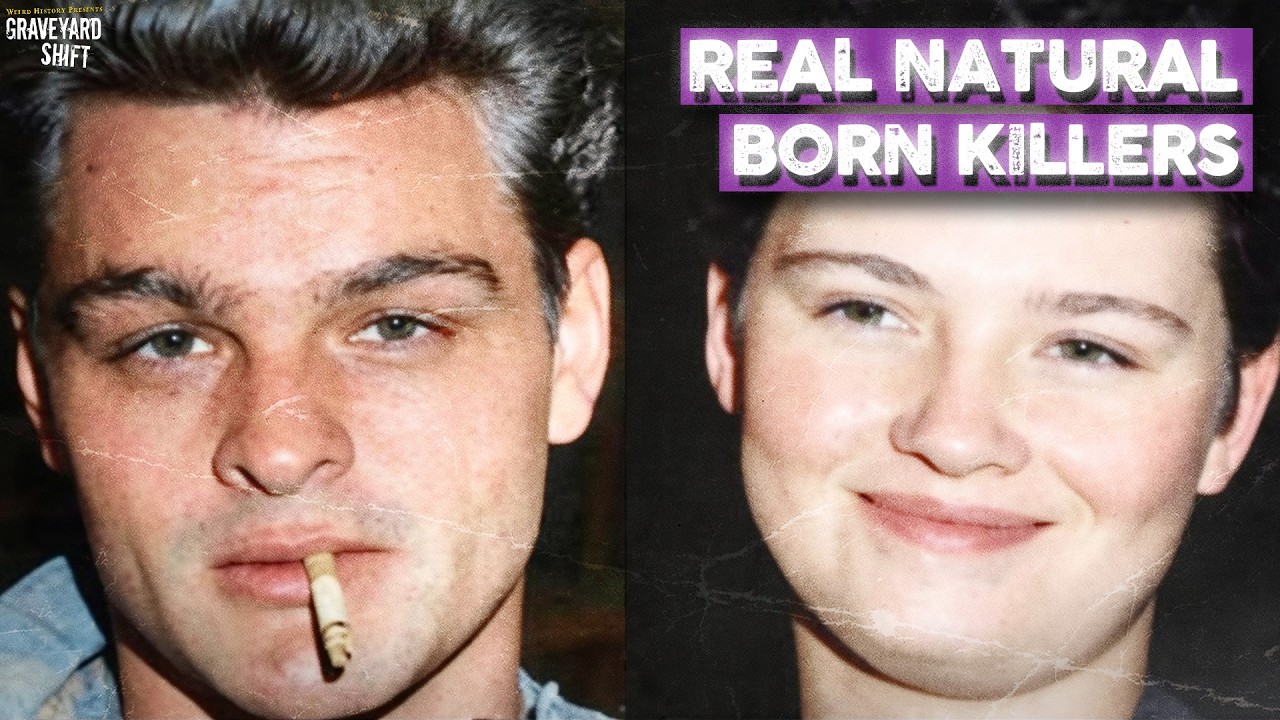
When the car stopped, Charles raised the gun and shot Robert Calvert dead. A life ended because of a stuffed toy, a few dollars, and a nineteen-year-old’s wounded pride. Six days after his nineteenth birthday, Charles had crossed into something dark, and he liked the feeling. He went home and told his girlfriend, thirteen-year-old Caril Ann Fugate, about the robbery.
She didn’t flinch. She loved it. She loved him. He was older, reckless, and he made her feel grown-up in a way nothing else in her life ever had.
He dressed like James Dean, smokes, sunglasses, sneers, and she thought he was the most exciting man she had ever met. She’d been just a kid, and he treated her like she mattered. He taught her how to drive, even though he wrecked his father’s car doing it. Her parents didn’t approve, but she didn’t care.
She was his, and he was hers, and that was enough. A few months later, on January 21st, 1958, Charles showed up at the Fugate home carrying a rifle and a box of ammunition. He had lost his job and gotten evicted from his apartment, and something had shifted inside him, a hunger that didn’t care about consequences
What happened inside that house has never been fully untangled. Caril Ann’s mother, Velda, and her stepfather, Marion Bartlett, were shot dead.
Her two-year-old half-sister, Betty Jean, was strangled and stabbed. The bodies were hidden in a shack on the property. And Caril Ann and Charles stayed in the house, living among the dead, for six days
When neighbors came by, Charles and Caril Ann leaned out the windows and called out that the whole family was sick with the flu. Stay away.
Keep out. No one came too close. The grandmother finally got suspicious enough to call police. By the time anyone forced their way in, the couple was already gone, stepping just ahead of the law
Caril Ann always claimed she had no idea her family was dead.
Charles told her they were being held hostage, she said, and that they would be safe as long as she did exactly what he said. She said she believed him. She never asked where they were being kept. She never asked why she couldn’t see them.
She never asked how he was feeding them. For six days, she lived in that house, ate the food, slept in her bed, and never once tried to run for help. When police arrived, she left with her boyfriend without looking back
After leaving Lincoln, they drove to Bennet, Nebraska, to the farm of August Meyer, a seventy-one-year-old family friend. Charles shot him in the head, then beat his dog to death with the rifle butt.
Just like that. No reason. No hesitation. Then they fled, the car getting stuck in mud near the farm.
Two teenagers, Robert Jensen and Carol King, stopped to help. It was a kindness they would never survive
Charles pulled a gun on them and forced them to drive to an abandoned storm cellar in the middle of nowhere. He marched Robert Jensen into the cellar and killed him. Then he turned on Carol King.
He wanted her. He tried to force himself on her, but he couldn’t perform. And in that moment of frustration, that small crack of humiliation, he raised his gun and shot her dead too
At trial, Charles swore Caril Ann was the one who pulled the trigger on Carol King. Caril Ann swore she stayed in the car, too scared to move, even as a girl her own age was murdered just feet away.
The truth vanished between their two stories, buried under years of lies, exactly like the bodies hidden in that shack
By January twenty-ninth, just eight days after the first killing, it all collapsed. They had been switching cars, stealing rides, moving through the dark. Charles tried to break into another car, and someone called the cops. When they arrived, Caril Ann ran toward them, screaming that Charles was crazy, that he had just killed a man, that he was going to kill her too.
Charles jumped back into his own car and tore off down the highway. High-speed chase. Roadblock. Gunfire.
And then it was over. Charles surrendered. It was done
Eleven people were dead. A toddler.
Two dogs. Teenagers. A gas station manager. An old man.
A mother and stepfather. And two young people who just wanted to help a stranger on the side of the road
Charles Starkweather was sentenced to death. He was executed in the electric chair just five months before his twenty-first birthday. He was the last person executed in Nebraska until 1994
Caril Ann Fugate spent nearly eighteen years in prison.
She maintained her innocence, claimed she was a hostage, claimed she was too young and too scared to understand what was happening. But her guilt has never been settled. People still argue about it today. Some say she was a terrified child caught in the orbit of a monster.
Others say she was a willing partner, a jealous girlfriend who hated anyone who caught her man’s eye. The truth died with Charles in the electric chair
Years later, filmmaker Oliver Stone and writer Quentin Tarantino took this story and turned it into the movie Natural Born Killers. But they changed something important. They gave Mickey and Mallory abusive parents.
They gave them a reason. They gave them a tragic backstory so audiences could understand how two people could become murderers without remorse
But Charles Starkweather wasn’t abused. He had friends. He had teachers who liked him.
He was known as a kind kid who would do anything for someone he cared about. His childhood wasn’t full of horrors beyond the ordinary. He just killed people. And Caril Ann Fugate wasn’t fleeing abuse either.
She was running toward something, maturity, excitement, a boy who made her feel like an adult
They were the real thing. Natural born killers, with no backstory to explain them away. No trauma to point at. No villain to blame but themselves
In the movie, the couple becomes infamous, the media turning them into folk heroes while they slaughter their way across the Southwest.
The cameras love them. The reporter, Wayne Gale, laps them up, makes them famous, makes them legends. But in real life, Charles and Caril Ann didn’t seek fame. They hid from it.
They killed in the shadows, hoping to get away with it, hoping to keep moving, hoping to stay invisible
And yet the media found them anyway. Charles Starkweather and Caril Ann Fugate became the face of random violence, inspiring movies, songs, and more books than anyone can count. Stephen King kept a scrapbook about Charles when he was a child, and he always said the fear that man put in him was what made him a horror writer. And the movie inspired by their story has been accused of inspiring its own copycat killers, including the Heath High School shooting and the Columbine massacre
So what do you make of it?
Are some people born with something missing inside them? Something that no loving home or kind teacher or ordinary childhood can fix? Or are they made, shaped by pain and neglect and cruelty, till one day the rage just snaps? And if they can walk around in broad daylight, laughing, buying gas, dating your neighbor, killing without purpose or remorse, here is the question that stays with you:
Would you even recognize one if you ran into him at the grocery store?
Or would you just smile, say hello, and walk away, never knowing what he was capable of? Charles Starkweather was nineteen when he started. Nineteen. A kid.
A boyfriend. A killer. And he walked among us like anyone else, right up until the moment he didn’t