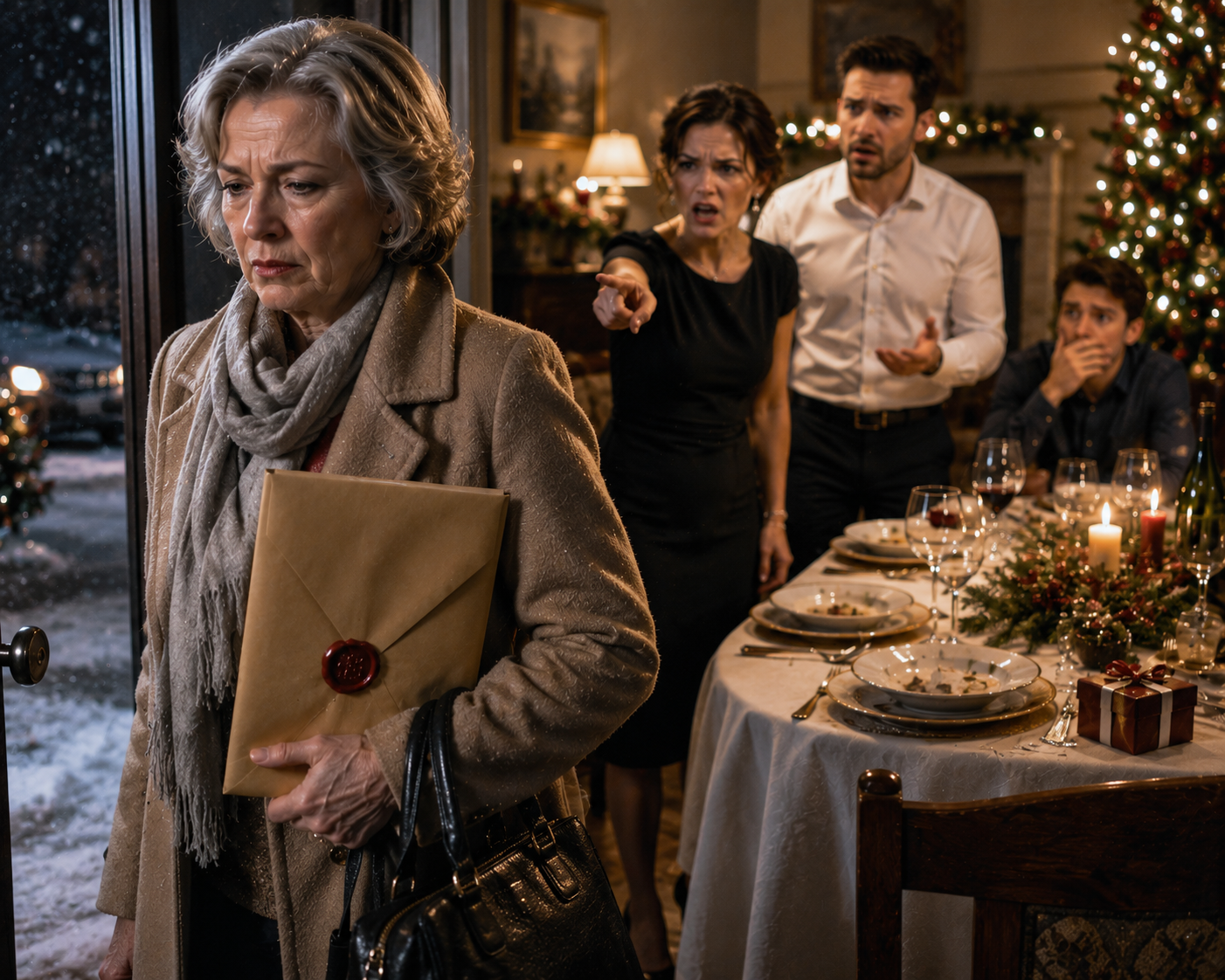
Priscilla’s heel struck the pavement like a judge’s gavel. Her neck veins bulged as her necklaces swung with each furious step. “Get off my property, you disgusting black woman. ”
Maya swallowed hard.
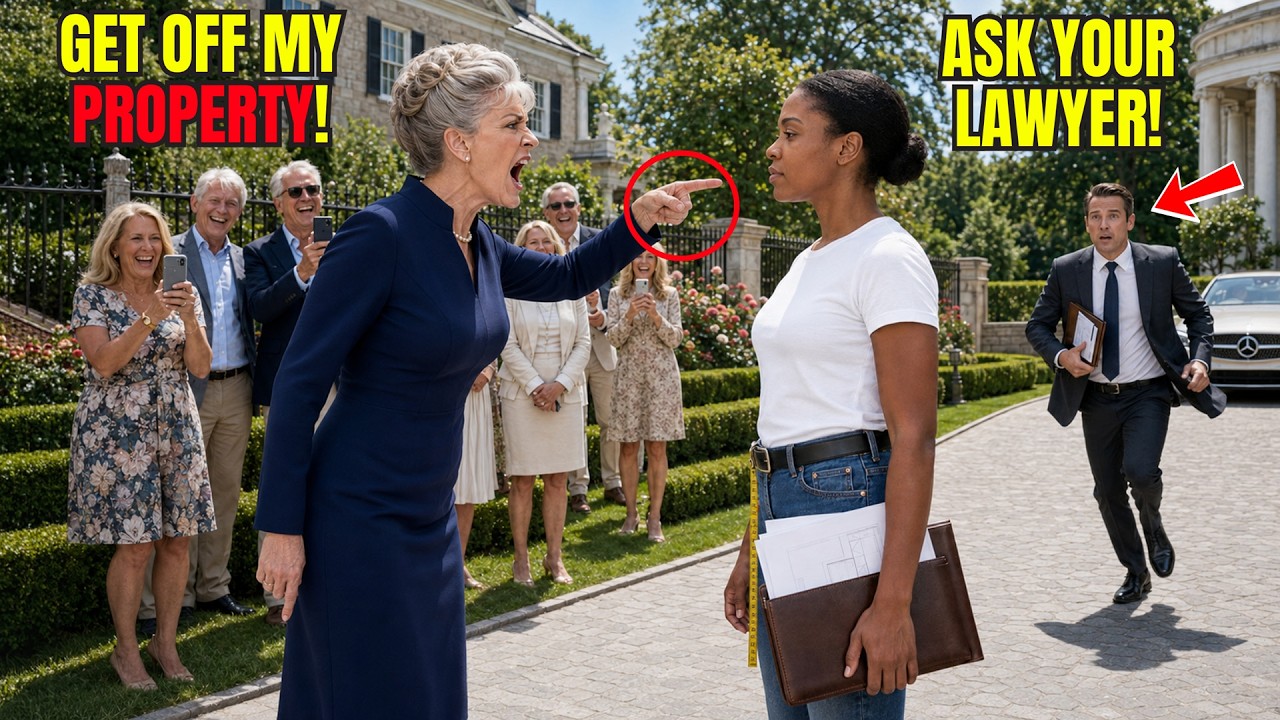
She didn’t raise her voice. “I’m not causing any trouble, ma’am. ”
“Your presence here IS the trouble. ” Priscilla shoved her face inches from Maya’s.
“Ragged clothes, pale hands—you reek of every welfare check you’ve ever cashed. ”
Maya turned and walked along the side of the house, trailing her fingers along the fence. Priscilla’s voice sliced through the morning air. “Neighbors!
She’s picking out which house to rob! ”
Doors opened. Phones appeared. Margaret started livestreaming.
Priscilla grabbed the garden hose and turned the nozzle. Cold water slammed into Maya’s chest like ice. Mud crept up her sneakers. “Crawl back to whatever sewer you came from.
You will never belong here. ”
Maya stood there, soaked to the bone, water dripping from her chin. Her fists trembled, but her eyes never dropped. Priscilla didn’t know who Maya was.
When she found out, she would freeze in shock. Three hours earlier, Sterling Crest had been wrapped in morning fog. Oak trees lined the private road like sentinels. Sprinklers misted manicured lawns.
Every mailbox gleamed brass. Every gate whispered wealth. This was Greenwich, Connecticut—twelve acres of inherited fortune, old silence, and unspoken rules. The kind of place where strangers were noticed before they reached the sidewalk, where curtains moved before doorbells rang.
Maya Adams parked her car at 7:14 a. m. She killed the engine and sat, studying the estate through the windshield. The main house rose behind a stone wall with Georgian columns.
Copper gutters had aged green. A wide porch built for photographs nobody took. Morning light caught the upper windows and turned them gold. She opened a leather folder on the passenger seat.
Blueprints, soil reports, anda signed purchase agreement stamped three weeks ago. Twelve acres. Every building. Every inch of ground beneath it—including the land under six neighboring houses on ground leases.
The document carried two signatures. Harrison Bennett’s and hers. Filed, registered, irrevocable. Maya stepped out.
Gravel crunched under her sneakers. She wore jeans, a plain white shirt, anda measuring tape clipped to her belt. No jewelry, no handbag—nothing announcing what she carried. She walked the perimeter, touching the stone wall.
At the northeast corner she stopped, photographing a crack running through the foundation. She knelt, pressed her palm flat against the ground, and closed her eyes. Twenty-two years ago, a woman who washed other people’s sheets had told her that owning land was the only freedom nobody could cancel. That woman was Maya’s grandmother.
She had pressed linens under an industrial iron twelve hours a day, six days a week. She died with $340 in savings and hands scarred by bleach. But she left Maya something no bank account could hold—a blueprint for ambition, woven into every bedtime story. Maya stood, dusted off her knees, and typed a note into her phone.
“Foundation section, northeast, needs structural engineer before renovation. ” She photographed the drainage slope where rainwater had carved a shallow channel through the soil. She walked to the garden gate, tested the latch, and let herself in. Roses had grown wild.
Thorns caught the air like barbed wire. A marble birdbath lay cracked among weeds. Ivy had taken over the garden wall, pulling mortar away with slow green fingers. Maya smiled.
She saw what no one else could. Not destruction—raw material. Every neglected corner was a canvas. Every crack an invitation.
She pulled the tape from her belt and measured the garden wall. She counted steps from the property line to the main porch. She logged numbers into her phone. More photos.
She measured the width of the garden path, then the height of the stone pillars flanking the gate, then the distance to the nearest boundary marker. Behind the hedge, sixty feet away, a curtain moved. Priscilla Hargrove stood at her kitchen window, coffee cup frozen halfway to her lips, eyes locked on the figure crossing her neighbor’s garden. A stranger.
On foot. Touching things. Taking photos. Moving through the property as if she had every right to breathe that air.
Priscilla set the cup down. Ceramic clinked against granite. Her jaw tightened. She grabbed her phone.
“Margaret? Look out your east window. Now. ”
A beat.
Footsteps on hardwood. “I see her. ” Margaret’s voice came through. “She’s casing the property.
”
“I’m going out there. Priscilla, maybe just call the… ”
“No. This is my neighborhood.
I decide who belongs here. ”
Priscilla adjusted her collar, smoothed her skirt, checked her pearls inthe hallway mirror. Then she walked out the front door. Her heels struck the marble foyer like hammer blows, each step a verdict already rendered.
She crossed her garden, opened the low gate between properties, and followed the stone path to the garden entrance. The garden gate creaked behind Maya. She turned. Priscilla stood on the stone path, arms crossed, chin lifted.
Morning sun caught her pearls, scattering small circles of light across her collarbone. “Excuse me. ” Priscilla’s voice was sharp as cut crystal. “Who gave you permission to be here?
”
Maya looked at her. Calmly. Steadily. The measuring tape still hung from her hand.
She had no idea what was coming. “I asked you a question. ” Priscilla stepped three paces forward. Her heel hit stone hard.
“Who sent you? ”
Maya lowered the tape. “Good morning. I’m surveying the property.
”
“Surveying? ” Priscilla spat the word like a seed. “Surveying for what? You don’t look like you’re surveying anything but discount racks.
”
Maya’s hands stayed still. “I have work to do on this property. ”
“Work? ” Priscilla laughed, short and hollow.
“Let me guess—are you the new cleaning lady, or wait, did someone send you to trim the hedges? Because this property hasn’t seen workers since the Caldwells left, and I personally approve every worker who sets foot on this land. ”
“I’m not staff. ”
“Then what are you?
” Priscilla stepped closer. Her perfume arrived first—heavy, sweet, suffocating. “Because I’ve lived here twenty-three years. I know every face that belongs on this street.
I know every car, every license plate, every delivery driver. You? You’re none of them. ”
Maya folded her measuring tape and clipped it to her belt.
“I understand this might seem unusual. ”
“Unusual? ” Priscilla’s voice rose. “Unusual is seeing a raccoon inthe trash.
Unusual is a package delivered to the wrong address. You—you’re an intruder. This is private property, Sterling Crest. Do you even know what that means?
”
“I know exactly what it means. ”
“Then you know people like you don’t just wander around here. ”
The words landed like a slap. Maya’s jaw tightened.
A muscle in her neck pulled, but she stayed rooted, voice even. “People like me? ”
“You heard me. ” Priscilla crossed her arms harder.
“Look at yourself. Sneakers, jeans, a shirt from a bargain bin, and dirt under your nails. Do you think you can walk around a twelve-acre estate like you’re shopping at a flea market? ”
Maya looked past Priscilla toward the main house.
The Georgian columns. The copper gutters. The porch she would rebuild with reclaimed lumber from Newark. The neighborhood her grandmother had ironed sheets for until her knuckles bled.
She inhaled, held it, let the insult dissolve like smoke. “I’m going to continue my work now,” Maya said. She turned back toward the garden wall. “Don’t walk away from me.
” Priscilla’s voice cut like a blade. “I’m talking to you. Nobody walks away from me on this street. ”
Maya kept walking.
She pulled out her phone, photographed the cracked birdbath from two angles, logged the drainage slope where water pooled near the southeast corner, and measured the distance from the garden wall to the nearest boundary marker—a rusted iron stake hidden in grass. Priscilla followed. Her heels caught on soft ground. Mud touched the edges of her shoes.
She winced, glared at the stains spreading across the leather. When she looked up, her face had hardened. “I’m talking to you. ”
Priscilla grabbed Maya’s elbow.
Her grip was tight—not accidental, not casual, deliberate. Maya stopped. She looked at the hand gripping her arm, then at Priscilla. Her eyes were steady.
Her breathing even. “Please let go of my arm. ”
Priscilla released her, but didn’t step back. She stood close enoughthat Maya could count the veins in her neck.
“You’re checking windows. Measuring walls. Taking pictures of doors and locks. I know exactly what you’re doing.
”
“No, you don’t. ”
“You’re casing this house. ” Priscilla’s voice reached fire-alarm pitch. “You’re scouting it for tonight.
That’s what happens here. That’s what people like you do. You come indaylight, act innocent, map out entry points, then come back after dark with a truck. ”
Maya stood perfectly still.
The accusation hung between them like smoke from a fire neither had lit. “A truck? ” Maya repeated, flat, hollow. She let the word hang.
Priscilla took the silence as confession. Her confidence swelled. She turned to the nearest neighbor—a man in a bathrobe—and pointed at Maya. “You see this?
You see what I’m dealing with? She’s not denying it. She can’t deny it because I’m right. ”
The man shifted his weight, sipped his coffee, said nothing.
Priscilla turned back. “Where are you from, huh? What neighborhood? Because I can tell you right now, wherever it is, it’s not this one.
You don’t walk like someone who belongs here. You don’t talk like someone who belongs here, and you certainly don’t dress like someone who belongs here. ”
Maya looked at Priscilla’s high heels, now streaked with mud, sinking into soil that belonged to Maya. “You’re standing on private property,” Maya said quietly.
“I’m standing on my neighbor’s property, protecting it from you. ”
“Are you sure about that? ”
The question landed differently than anything Maya had said before. It wasn’t defensive.
It wasn’t pleading. It carried a weight Priscilla couldn’t place—a stillness like the moment before a verdict. Priscilla blinked. For half a second, something flickered behind her eyes—doubt, or maybe just confusion.
But it faded. She buried it under anger, the way she buried everything she couldn’t control. “I’m calling Harrison Bennett,” Priscilla said. “He manages this entire estate.
He’ll have you removed. ”
“Call whoever you want. ”
The calm in Maya’s voice was maddening. Priscilla wanted fear.
She wanted shame. She wanted retreat. She got none of it. Maya said nothing else.
She turned her phone screen toward Priscilla, showing architectural notes, measurements, foundation photos, soil drainage diagrams. Professional. Precise. A screen of someone who worked in construction.
Priscilla didn’t look. She was past looking. Past reason. Past anything that contradicted the story she had written inthe instant she saw Maya from her kitchen window.
“Neighbors? ” Priscilla turned toward the street. Her voice tore through the quiet lawns like a siren. “Everyone come out!
She’s picking which house to rob tonight! ”
Doors opened. First Margaret’s. She appeared on her porch, phone already up, camera rolling, red light blinking.
Then the house across the street. A man in a bathrobe emerged, coffee in hand, curiosity overriding caution. Then another door. Then another.
Margaret crossed her lawn in slippers and stopped atthe property line. She held her phone at arm’s length, horizontal, livestream running. Viewers started at four—her usual audience—then climbed. “Priscilla, what’s going on?
”
Priscilla pointed at Maya. “This woman showed up at dawn. She was photographing locks and hinges, measuring windows. She’s here to rob us.
She’s planning a break-in. ”
Margaret’s eyes widened. She aimed her camera at Maya. The red record dot pulsed inthe corner like a heartbeat.
“Ma’am, can you identify yourself? ” Margaret’s voice carried fake sympathy for her audience. She tilted her phone slightly, adjusting the angle. This wasn’t concern.
This was content. Maya faced the camera, squared her shoulders. “My name is Maya Adams. I have every right to be here.
”
“She has a right? ” Priscilla laughed again, louder this time, theatrical for the growing crowd. “She has a right to trespass? She has a right to case our homes?
Next she’ll claim a right to our silverware. ”
Three more neighbors gathered atthe edge of the property, arms crossed, phones out. A woman stood on tiptoe to see over the fence. No one asked Maya for an explanation.
No one offered to verify her claim. No one stepped forward to introduce themselves or ask if she needed help. They watched like spectators at a car wreck—curious, detached, already crafting the story they’d tell at dinner. “You should leave,” someone shouted.
“Before things get worse for you. ”
“Harrison Bennett will deal with her,” another added. “Just wait. ”
Maya looked atthe circle forming around her—cameras, crossed arms, frowning faces, the automatic certainty that she was guilty of something, that her presence alone was evidence enough.
She could show them the documents. She could walk to her car, open the folder, lay the purchase agreement on the hood for everyone to see. She could end this in thirty seconds with a signature and a county clerk’s stamp. She didn’t.
Not yet. Some truths land harder when they arrive on their own schedule. And some lessons only sink in after the student has finished laughing atthemselves. “I’m going to stay here a while longer,” Maya said.
Quietly. Firmly. She turned back tothe garden wall and continued measuring. Priscilla’s nostrils flared.
Her breath came faster beneath her pearls. She looked at Margaret. Margaret looked back, still filming, viewers now at sixty-seven. Something shifted in Priscilla’s eyes—a gear clicking into place, a decision made.
If words wouldn’t work with this woman, something else would. Priscilla walked with purpose toward the side of the main house. Her heels gouged the lawn, leaving small holes inthe grass. She grabbed the garden hose coiled against the wall and turned the spigot.
Water surged through the rubber hose with a sharp hiss. The nozzle trembled inher hand. She squeezed it and aimed. Maya heard the hiss.
She turned. A blast of water hit her square inthe chest—ice cold. The force pushed her back a step. Water slammed into her face, filled her ears, blinded her for three full seconds.
Her white shirt turned translucent. Her phone slipped from her fingers and landed facedown inthe mud. Mud splattered around her sneakers and crept up the cuffs of her jeans. “Get out of here, you filthy thing!
” Priscilla angled the nozzle upward. Water hit Maya’s chin, her throat, the curve of her jaw. Water poured into her mouth. She spat it out.
“You’re defiling this place just by breathing its air. ”
Maya raised an arm to shield her face. She didn’t run. She didn’t scream.
She didn’t beg. She planted her feet inthe mud and stood there taking every drop like a wall absorbing rain. Her sneakers sank one inch intothe soft ground. She widened her stance and held her ground.
Margaret held her phone steady. Her thumb had already shared the livestream link into theSterling Crest neighborhood chat. Twelve viewers, then forty, then eighty, then one hundred—climbing. Comments scrolled live beneath the video.
Exclamation marks. Emojis. Questions. “Priscilla, teach her a lesson!
” someone shouted from behind the fence. Laughter followed—weak, nervous, the laughter of people who knew they should stop watching but couldn’t look away. Priscilla obliged. She swung the hose in wide arcs.
Water battered the rose bushes, stripped petals from stems, soaked the measuring tape danglingfrom Maya’s belt, turned the garden path into a shallow river creeping toward the property line. “This is what happens when trash wanders into the wrong neighborhood! ” Priscilla’s voice rang out beforethe cameras. She wanted every viewer to hear.
Every neighbor to remember. “This is Sterling Crest. We protect our own. We protect our property.
We protect our way of life. ”
Maya wiped water from her eyes with the back of her hand. She looked at Priscilla holding the hose, at her pearls, her pressed skirt now spotted with spray. She looked atthe cameras, atthe neighbors standing dry and comfortable on the other side of the fence—watching, recording, saying nothing useful.
She bent down, picked up her phone from the mud, wiped the screen on her jeans. Wet, but still lit. She photographed Priscilla holding the nozzle aimed at chest level. She photographed Margaret livestreaming, red dot blinking.
She photographed every face watching from the street—the man in the bathrobe, the woman on tiptoe, the couple leaning against their mailbox. Priscilla saw the phone. Her lip curled. “You’re taking pictures of me on my property?
” She dropped the hose. The nozzle clattered onto the stone path and spun, spitting water in a lazy circle beforethe pressure died. “That’s it. I’ve had enough.
I’m calling Harrison. ” She pulled out her phone and scrolled to a name she kept atthe top of her contacts—Harrison Bennett, president of the Sterling Crest Land Council, the man who controlled every ground lease inthe neighborhood, the man whose signature appeared on every title transfer, every boundary dispute, every decision for eighteen years, the man whose word was law on these twelve acres. The phone rang twice. “Harrison, it’s Priscilla.
You need to come to Sterling Crest right now. ” Her voice pitched with manufactured urgency—the tone of a woman reporting a crisis she herself had escalated. “There’s an intruder atthe old estate, a woman. She refuses to leave.
She’s been photographing our homes, measuring windows and doors, checking locks. I asked her to leave and she refuses. I’ve warned her. She doesn’t care.
”
A pause. Harrison spoke. Priscilla listened. Her eyes never left Maya.
“Yes, I’ve told her multiple times. She says she has a right to be here. ” Priscilla laughed bitterly. “A right?
Harrison, just come. Bring whoever you need. I want her removed. I want her gone.
I want a restraining order. Whatever it takes. ”
She ended the call and smiled—the smile of someone who had played her last card and knew it was the winning one. “Harrison Bennett is on his way,” Priscilla announced tothe street like a verdict from the bench.
“This will be resolved. He always handles it. He’s been protecting this neighborhood since before most of you moved in. ”
Murmurs rippled through the crowd.
Harrison Bennett. The name carried weight—and finality. The front door of Priscilla’s house opened. Gerald Hargrove stepped onto the porch.
He wore pressed khakis anda polo buttoned tothe collar. He adjusted his glasses, surveyed the scene—his wife standing triumphant, the hose still dripping, neighbors holding up phones, Maya soaked and muddy and unmoving. “Priscilla, what’s going on here? ”
“I’m handling it, Gerald.
I’ve called Harrison. ”
Gerald came downthe porch steps slowly. He stood beside his wife, looked at Maya, opened his mouth, closed it, opened it again. No words came.
He adjusted his collar and nodded. A nod from a man who had spent thirty years agreeing with everything his wife decided. “You should leave,” Gerald said—not loud, not conviction, not anything resembling courage. Just loud enough to be heard.
Enough to prove he existed. “She’ll go. Harrison’s coming. She’s done.
” Priscilla crossed her arms. Maya stood inthe mud. Her shirt clung to her shoulders. Water still dripped from her chin.
Her measuring tape lay in a puddle at her feet. Her phone screen glowed inher hand—still capturing, still recording. She bent down, picked up the tape, wiped it on her jeans, clipped it back to her belt. Slow, deliberate—every movement calm, controlled, unhurried.
Then she walked, unhurried, tothe front porch of the main house. She climbed three steps. Wood groaned beneath her weight. She sat on the top step, rested her elbows on her knees, let her hands hang loose between them, and looked atthe crowd with the calm of someone who owned everything her eyes could see.
Because she did. Priscilla’s smile faltered. Something about Maya sitting on that porch—relaxed, calm, unbothered—felt wrong. Felt dangerous.
“Get off that porch. ”
Maya didn’t move. “I said get off that porch. That’s not yours.
Nothing here is yours. ”
Maya crossed her arms and leaned her back against the column—that Georgian column, withits fluted base and hand-carved capital. She had studied its details inthe original 1923 blueprints before signing the purchase agreement. “Harrison’s coming,” Maya said.
Her voice was low, steady, almost warm. Almost kind. “I think we should all wait for him. Don’t you?
”
Something inher tone made Priscilla’s stomach tighten. Not fear—not yet—but something close. Something parallel. A hairline crack inher certainty.
A whisper from somewhere deep:“You’re missing something. ”
Priscilla looked at Gerald. Gerald looked at his shoes. Margaret kept filming.
Viewers passed three hundred. Comments flowed faster now. Some cheered Priscilla on. Some didn’t.
Fifteen minutes passed. Morning fog burned off. Sun hit the wet pavement and sent steam rising into the air like breath. The crowd grew restless.
Whispers traded, but phones stayed up. The story had already been written intheir minds—an intruder caught, a community defended, a leader summoned to deliver justice. Then a silver sedan turned onto the private road—Harrison Bennett’s car. Priscilla recognized the plates.
She straightened, lifted her chin, prepared her summary of events. But there was a second car behind it—a black SUV with tinted windows. Priscilla didn’t recognize that one. It stopped directly behind Harrison’s sedan, precise and deliberate, as if the two vehicles had been traveling together.
Both stopped atthe curb. Harrison got out first. Gray suit, no tie. His face carried no expression.
The passenger door of the SUV opened. A younger man stepped out. He carried a leather briefcase in one hand anda paper file inthe other. His shoes gleamed like mirrors.
His posture was erect. His expression was professionally neutral. Ethan Cole. Attorney.
Real estate specialist. Priscilla rushed toward them. Her heels clicked the pavement at double speed. “Harrison, thank God you’re here.
” She pointed at the porch where Maya sat. “That woman, right there. She broke into the property this morning. She’s been messing with the grounds, taking pictures, measuring things.
She’s planning something. A robbery, a takeover, something like that. I want her removed. I want her gone.
I want—”
Harrison raised one hand—palm out, fingers still. Priscilla stopped mid-sentence, mid-breath. She had never seen Harrison raise a hand to silence anyone. Not intwenty years.
Not once. His eyes moved from Priscilla tothe porch, then toMaya. Something passed between them—a look lasting two seconds. Ethan Cole opened the file.
He pulled out a document and held it at his side. “Harrison? ” Priscilla’s voice dropped. The confidence drained from her like water through a cracked foundation.
“What’s going on? ”
He didn’t answer. He walked toward the porch. Harrison stopped atthe bottom ofthe porch steps.
He looked up atMaya. She looked down athim. Neither spoke. The silence stretched across the grass like a wire—taut, humming, ready to snap.
Then Harrison extended his hand. Maya shook it. She rose from the step. They shook firmly, briefly, professionally.
A handshake between two people who had already closed a deal. Priscilla watched from the path. Her mouth opened. No sound came.
Her eyes darted between Harrison’s face and Maya’s hand—the hand he was shaking. The hand of the woman she had just sprayeddown with a garden hose. “Harrison,” she whispered again. “What are you doing?
”
Harrison turned to face the crowd. Margaret’s camera caught every angle. Neighbors leaned forward. Gerald stood frozen beside his wife.
Ethan Cole stepped up beside Harrison. He opened the file and held the document at chest level—a twelve-page purchase agreement. It carried the State of Connecticut seal and two signaturesin blue ink. “My name is Ethan Cole.
I’m the attorney who handled the sale of this property. ” His voice was flat, precise, as if designed for courtrooms and sworn testimony. Every word landed like a stone dropped into still water. “Three weeks ago, the entirety of Sterling Crest—all twelve acres—was sold.
The main residence, every ground lease within its boundaries, legally and irrevocably. ”
He paused. He let the words settle. He let the silence do its work.
“The buyer is Maya Adams. ” He looked directly atPriscilla—the woman standing behind him, the woman who had verbally assaulted, sprayed with a hose, and publicly accused of criminal intent a woman standing on her own property. Priscilla’s lips parted. Her hand reached for Gerald’s arm and gripped it.
“This… this can’t be right. This is impossible. ”
Harrison spoke.
His voice was quiet but carried across the lawn. “I signed those papers myself, Priscilla. Three weeks ago, in my office. Every document is filed withthe county clerk.
The transfer is complete. ”
Ethan held up a second page. “This is the recorded deed, stamped and certified. Ms.
Adams is the legal owner of the land beneath this house, the garden you chased her through, the porch you ordered her off of. ” He paused. “And the land beneath your house, too. Your ground lease, along with five others on this street, is part of this estate.
”
The words hit Priscilla like water—colder, sharper, more destructive than anything that had come out of that hose. This was the kind of cold that started inthe chest and spread outward. The kind that froze joints and stole breath. Gerald’s hand slipped from his wife’s arm.
He stepped back. Then again. His face turned the color of old paper. “You…
you own our land? ” Gerald’s voice cracked on the last word. “You own everything? ”
Ethan confirmed it.
“Every acre. Every lease. Every square foot you’re standing on. ”
Margaret lowered her phone, raised it again, lowered it.
Her hand trembled. The livestream was still running. Four hundred twelve people watched Priscilla’s face collapse inthe real time. The comment section went silent—then exploded.
Priscilla turned toward Maya. She searched for words like a drowning person searching for surface—frantic, flailing, finding nothing solid. “I didn’t—you didn’t say—you never said—”
Maya’s voice carried no triumph, no anger, no gloating. Just fact.
“You saw what you wanted to see. You decided who I was before I opened my mouth, before I said a single word. ”
Priscilla’s mouth moved without sound. Her necklace trembled against her collarbone.
Her heel—that heel that had struck the pavement with confidence an hour ago—seemed to wobble on solid ground. Harrison looked atthe neighbors, atthe phones still recording, atthe faces frozen mid-condemnation, slowly shifting into something between shock and shame. “I want to be clear,” Harrison said. “Ms.
Adams came here this morning to inspect a property she legally purchased. She had every right to be on this land. What happened to her—verbal abuse, a hose, public accusations of criminal intent—happened to the owner of Sterling Crest. ”
Ethan snapped his briefcase shut and latched it.
He looked atMargaret. “I see you’ve been livestreaming this whole incident. ”
“Good,” he said. “That saves us considerable effort collecting evidence.
”
Margaret’s phone hand dropped toher side as if burned. The screen still glowed. The red dot still blinked. Four hundred thirty viewers—and climbing.
Ethan turned toPriscilla. His voice carried courtroom precision. “Mrs. Hargrove, my firm will be in touch within forty-eight hours.
What happened here today constitutes harassment, assault, and defamation. All of it documented in multiple recordings, including your neighbor’s livestream. I strongly advise you to retain counsel. ”
Color drained from Priscilla’s face.
She reached for Gerald. Gerald stepped away. One step. Two steps.
“Gerald? ”
“We need to go inside, Priscilla. ”
“Gerald, say something. Tell them this is a mistake.
”
Gerald looked atthe crowd, atthe cameras, atMaya standing tall on the porch of the house she owned—soaked, mud-caked, utterly unbroken. He put his hands inhis pockets and sighed. “I think you’ve said enough for both of us. ”
He turned and walked toward their house.
Priscilla stood alone on the path. Sprinklers hissed. Sun pressed down. Viewers watched her stand amid the wreckage of her own certainty.
Maya picked up her folder from the porch step, opened it, pulled out her blueprints, and spread them across the railing. She had a renovation to plan. The livestream hadn’t stopped when Margaret lowered her phone. It spread.
By noon, three separate clips from Margaret’s stream had been cut and posted across every video platform. The shortest—eleven seconds of Priscilla hosing Maya down while screaming—hit two million views before lunch. The full four-minute confrontation looped through group chats, comment threads, and news aggregators. Reaction videos appeared within hours.
By evening, the hashtag was trending nationally. Media outlets called it“the Sterling Crest Incident. ” Cable anchors replayed the footage frame by frame. Legal analysts dissected the assault across split screens.
Social media delivered its verdict within hours—no appeal, no deliberation, no mercy. The court of public opinion had already convened. Priscilla shuttered her house. Every curtain drawn—upstairs, downstairs, even the small window inthe laundry room.
Her phone rang nonstop on the kitchen counter, but the calls weren’t from supporters, not allies, not the women who had once competed for seats at her table. Old friends from the country club declined her invitations with curt texts. The Ladies’ Auxiliary board—the same board she had chaired for eleven years—sent a two-line email demanding her immediate resignation. She staredatthe screen, read it twice, read it a third time, set the phone facedown on the granite counter, and pressed her palm against it as if she could force it silent.
Gerald sat inhis study, door closed. His insurance firm’s phone lines hadn’t stopped ringing since the clip aired on the evening news. Three corporate accounts—accounts he had built over a decade—requested emergency meetings. “Reputation” appeared in every message.
“Liability” appeared in two. Gerald loosened his tie, opened his company’s social media page, and watched comments pile beneath every post—hundreds of them, none kind. He closed the laptop and pressed his fingers into his temples. Margaret deleted the livestream from her account at 3:42 p.
m. She scrubbed her profile, removed the link from the group chat, deleted the notification she had sent her followers. The internet archived the original video at 3:43, with all deletions confirmed. Ethan Cole filed the lawsuit the next morning at 9:15 a.
m. Three counts—harassment, assault, defamation. He named Priscilla Hargrove as primary defendant and Gerald Hargrove as co-defendant for standing by during the assault and failing to intervene. He named Margaret Sutton as co-defendant for broadcasting the harassment toa public audience, amplifying the humiliation and distributing it for entertainment.
The filings reached every newsroom inthe state by noon. Two national wire services picked it up by dinner. Priscilla received the summons at her front door the next morning. A process server ina polo shirt helda clipboard.
He didn’t stay long. Priscilla grasped the envelope with both hands and stared atthe return address—Cole& Associates, Attorneys at Law. Her fingers left damp prints onthe paper. She called her lawyer.
He answered on the fourth ring—slower than usual, slower than he ever had before. “I’ve seen the video, Priscilla. ”
“It’s not what it looks like. ”
A long pause.
She could hear him choosing his words. “It looks exactly like what it is. ”
Gerald came downstairs that evening. He carried a folder—not from his office, not client-related.
Thin. New. He set it onthe dining room table. Priscilla looked atthe folder, then athim.
“What is this? ”
“Divorce papers. ”
Gerald pulled out a chair and sat. His hands were steady, but his voice wasn’t.
“My lawyer drew them up this afternoon. ”
“Gerald, you can’t be serious. ”
“I was standing right there, Priscilla. Right there on our lawn, and I said nothing.
” He pressed his palms flat against the table. Wood creaked. “I watched you hose that woman down. I heard every word you said, and I nodded along.
And somehow, that’s the part I can’t live with. ”
Priscilla sank into the chair opposite him. The dining room gleamed around them—crystal chandelier throwing soft light onthe ceiling, polished mahogany reflecting their faces, fresh lilies ina silver vase. It all felt obscene.
Everything in its place, everything perfect—except the two people sitting atthe table. Gerald pushed the folder across the wood. It slid witha soft whisper. “Sign it when you’re ready.
” He stood, walked tohis study, and closed the door. Priscilla sat alone inthe silence of a house built on land she had just learned belonged tosomeone else. The courtroom was full. Every seat taken.
Journalists lined the back wall shoulder toshoulder, notebooks andrecorders ready. Two sketch artists worked in silence from the gallery, pencils scratching paper inquick practiced strokes. Priscilla sat atthe defense table. Navy suit, no pearls.
Her lawyer had told her to dress simply, to look humble, human. The clothes succeeded. Her face didn’t. Her jaw stayed tight.
Her eyes scanned the room as if still searching for allies ina building that held none. Gerald sat three rows behind her—not beside her, behind her. The divorce had become public two weeks earlier when a reporter pulled the case file. He attended as co-defendant under his own counsel, his own firm, his own strategy, his own entirely separate accounts.
Margaret Sutton sat ata separate table with her own lawyer. She stared ather hands. She hadn’t looked up since entering the courtroom. Maya didn’t sit atthe plaintiff’s table.
She sat inthe gallery. Fourth row, center aisle. Navy blazer over a simple blouse, flat shoes. No jewelry, no display.
Ethan Cole represented her interests from the front of the room with two junior associates anda stack of evidence files organized chronologically. The judge called court toorder. Silence fell. Ethan stood.
He played the video first—the full version, not the eleven-second clip, but the complete four-minute confrontation Margaret had livestreamed. The courtroom watched instunned silence. Priscilla’s voice filled the speakers. Every insult.
Every accusation. Every order toleave. The sound of water hitting fabric. The sound of mud.
The laughter from behind the fence. When the video ended, no one moved. No one whispered. Silence held for six seconds before the judge nodded for Ethan tocontinue.
Ethan presented the purchase agreement, the deed, the notary stamp and recording number. He established Maya’s ownership with surgical precision. He laid out the timeline—Maya arriving ather property at7:14 a. m.
, Priscilla confronting her within twenty minutes, escalation from insults toassault tospectacle, all before8:30. He called three witnesses. The neighbor inthe bathrobe, who identified himself reluctantly, confirmed he had watched the entire incident from his porch and done nothing. A digital forensics expert authenticated the livestream footage, archived copies, metadata proving no tampering.
A Yale property law professor affirmed that Maya held full, uncontested legal authority over every acre, including the ground leases beneath neighboring houses. Priscilla’s lawyer tried to mitigate. He stood, adjusted his tie, argued that his client had acted out of genuine concern for neighborhood security. That she had no prior knowledge ofthe sale.
That her reaction, though regrettable and excessive, stemmed from fear of an unknown intruder—not from racial malice. The judge listened patiently. Then asked one question. “Counselor, does your client make a habit of hosing people down when she’s frightened?
”
Silence. Priscilla’s lawyer opened his mouth, closed it, opened it again. “No, Your Honor. ”
“Then let’s dispense with the fear excuse.
”
The defense rested shortly after. The verdict came eleven days later. The courtroom was full again. Priscilla Hargrove found guilty on all three counts—harassment, assault, defamation.
Damages awarded toMaya Adams—amount sealed by court order, but legal commentators described it as substantial and proportionate tothe harm. Two hundred hours community service, completed within eighteen months. Mandatory completion of a state-certified anti-discrimination education program. A five-year restraining order barring Priscilla from approaching Maya Adams, any Maya Adams property, or any business operated by the Adams Heritage Group.
Gerald Hargrove found guilty as a passive participant—witnessing the assault and failing to intervene. Damages reduced but significant. One hundred hours community service. His insurance firm announced institutional restructuring the following week.
Three major clients representing millions indannual premiums had already terminated contracts over reputational concerns. Margaret Sutton found guilty of amplifying harassment through public broadcast. Damages. One hundred fifty hours community service.
A formal public apology—written, reviewed, approved bythe court—published inthe county newspaper and pinned to her social media accounts for ninety days. Margaret’s lawyer begged for leniency. He argued his client was merely a bystander witha phone. That she hadn’t spoken the insults or aimed the hose.
The judge wasn’t moved. He noted thatMargaret hadn’t just watched—she had turned it into entertainment. She had activated the livestream. Shared the link inthe group chat.
Invited an audience towatch a woman being humiliated on her own property. “A camera is not neutral,” the judge said. “It was a weapon. And Mrs.
Sutton aimed it with the same intent thatMrs. Hargrove aimed the garden hose. ”
The Sterling Crest Land Council held an emergency meeting the following week. Harrison Bennett presided.
He sat atthe head ofthe table inthe same gray suit, no tie. He read one motion intothe record—the permanent removal of Priscilla Hargrove from the council, revocation of all her advisory privileges, effective immediately. The vote was unanimous. Six members, six hands raised, no discussion.
Priscilla didn’t attend. She no longer attended anything atSterling Crest. She hadn’t left her house innine days. Gerald filed for divorce the day after the verdict.
His attorney prepared the papers overnight. They were served atthe house—the same front door where lawsuit summonses had arrived weeks earlier. Priscilla signed the divorce papers atthe dining room table. The same table where Gerald had placed the separation file.
The same chair. The same silence. But now the lilies inthe silver vase had wilted, and no one replaced them. The house went onthe market three weeks later.
Priscilla’s attorney advised selling quietly. No open houses, no lawn signs, no real estate agents. Just a private listing circulated through a discreet network. An offer came within two weeks.
Full asking price, no contingencies. Priscilla never met the buyers. She signed closing documents remotely from her attorney’s office. She packed three suitcases, called a car service, and left ona Tuesday morning before the sun reachedthe fence line.
The new owners moved inthe following month. They planted jasmine along the fence line and painted the front door deep blue. Maya watched the moving truck from the porch ofthe main house. She helda coffee mug, steam rising into the October air.
Morning was cold. The oaks were just beginning to catch gold attheir edges. She sipped, set the mug onthe railing, and picked up her architectural plans. Renovation was on schedule.
Six months after the verdict, Maya stood onthe front steps of a building that hadn’t existed the previous spring. Brick facade. Tall windows catching morning light. A polished sign above the entrance read:“Adams Heritage Center.
”
Inside, walls held framed blueprints andnd photographs—abandoned lots transformed into community spaces, condemned buildings revived as affordable housing, empty storefronts turned into business incubators. Every project carried the same signature atthe bottom ofthe plans. Adams Heritage Group. Maya opened the doors at10 a.
m. Saturday. First visitors arrived beforethe ribbon hit the ground. Women carrying briefcases.
Women carrying business plans written innotebook paper. Women carrying questions they’d been afraid toask anywhere else. Women carrying the same hunger Maya had carried from Newark toColumbia toSterling Crest—hunger tobuild something permanent. Something that couldn’t be taken, or cancelled, or washed away witha garden hose.
The center offered three programs. Real estate education for women of color. A mentorship program connecting emerging architects and investors with seasoned professionals who had walked that road before. A small grants fund financed from Maya’s own capital—small enough tobe accessible, large enough tochange trajectories.
Harrison Bennett arrived at11. Gray suit, no tie. He shook Maya’s hand thee same way he had onthe Sterling Crest porch—firm, brief, professional—but his eyes were different now. Softer.
Heavier. Something that might have been regret. “I should have intervened that morning,” he said. “I should have been there before it started.
”
Maya looked athim, held his gaze. “You intervened when it mattered. ”
“It should have been sooner. ”
She nodded, accepting the honesty without decoration.
Harrison walked through the center. He read the mission statement hung onthe wall—Maya had written it herself, in her own handwriting. He studied the faces inthe photographs, stopped atthe renderings of upcoming projects—a community center inNewark, a mixed-use development inBridgeport, restored brownstones inHartford. He stopped beforea framed photograph nearthe back corner.
It wasn’t a building or a blueprint. It was an old woman—strong, scarred—pressing sheets beneath an industrial iron. Hands that had worked until work was all they knew. Maya’s grandmother.
Harrison stood there a long time. He said nothing. He didn’t need to. The center filled withpeople throughthe day.
Maya moved between rooms, answering questions, reviewing business plans, listening tohalf-formed ideas that just needed someone totake them seriously. She didn’t give speeches. She gave her time—the one resource no one had ever wasted onher grandmother. By afternoon, the parking lot overflowed intothe street.
A news crew set up nearthe entrance. They asked Maya for a comment aboutthe center, aboutSterling Crest, aboutwhat she wanted people totake fromher story. She gave them twelve words. “Every neighborhood has gatekeepers.
Build your own gate. Then open it. ”
Sterling Crest changed. Not overnight—nothing real ever does—but the fence lowered inch by inch, season by season.
New faces appeared atland council meetings. Harrison spearheaded a complete review ofthe community charter, replacing exclusionary language thathad stood unchallenged for forty years. Ground lease agreements restructured. Maya kept every existing tenant.
Same terms, same rates, same security. No one was evicted. No one was punished forsomeone else’s cruelty. The main house was renovated over eight months.
Maya drew the plans herself, hired local contractors from Greenwich andStamford, preserved the original hand-carved Georgian columns from1923, replaced copper gutters with recycled steel that would weather gray over time. The cracked garden birdbath was repaired by masons fromNew Haven and restored toits base. Fresh water ran through it again. The rose beds were replanted—not with cultivated hybrids as before, but with wild roses—hardy, thorny, beautiful without permission.
And on that porch, where Maya had once sat soaked andsilent while cameras rolled, a small brass plaque appeared. It bore no name, no date, no explanation. Just five words engraved inthe polished metal.
The land remembers who stayed.