The helicopter should not have landed on that field. Elias Monroe Carter had told the pilot to take him to a private airport north of Tallahassee, where a black sedan was waiting to take him to survey the new distribution center. Every schedule was calculated down to the minute. But as they flew over southwestern Georgia, August sky suddenly closed like a door.
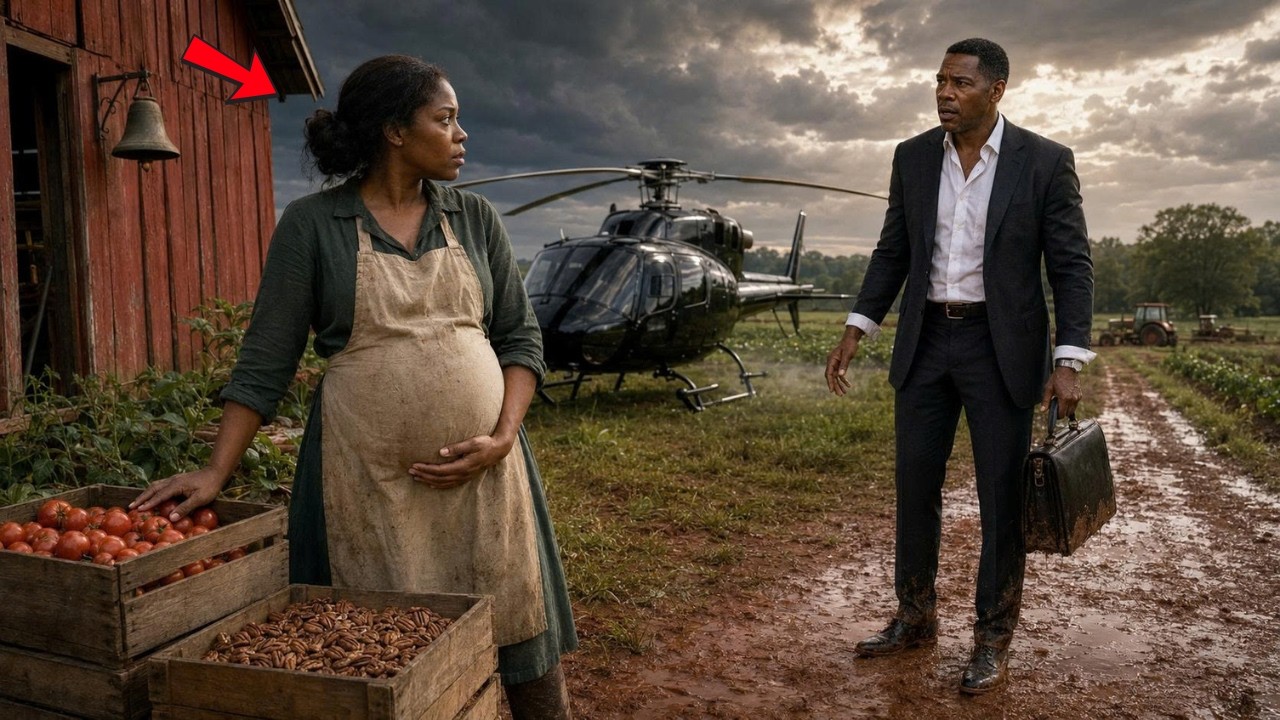
Storm clouds pressed low. Rain lashed white against the glass. The nearest small airport announced the runway closed due to crosswinds. The helicopter began shaking in a way that spared the pilot the need to explain.
He simply pointed down at a flat stretch of land, grass cut into long strips between rows of pecan trees, and said that was the only safe place left. At 45, Elias stepped off the multi-million dollar helicopter in his charcoal gray suit, holding a leather briefcase with contracts powerful enough to change thousands of lives, and immediately sank his heels into the red Georgia soil. He stood still. Not because his shoes had gotten dirty.
A bronze bell hung in front of the produce barn, tilted slightly. An old water pump lay beside the fence, its crank handle wrapped with a strip of faded blue cloth. Farther off stood a white painted wooden house with a low porch, where a large pecan tree stretched its branches over the chimney as if it had stood there longer than anyone who had ever lived beneath it. He recognized this place before memory caught up.
Bennett Grove. 29 years ago, he had stood near that very water pump, hands stained with oil, a tear on his knee, stomach so hungry he had to drink water slowly to stop it cramping. The side door of the barn opened. A woman stepped out unhurried, faded denim shirt, sleeves rolled, brown boots covered in red dust.
A basket of young pecans rested against her hip. Beneath the loose fabric, her belly had grown so large that she had to support her lower back as she stepped across the slick ground. She was pregnant, into her seventh month maybe. The rotor wash blew loose a corner of the cover over the seedling bed.
She set the basket down, walked to the plant bed, bent carefully to keep the tarp from blowing further. Rain soaked into her shoulders. He was used to being recognized. His name appeared on trucks across 32 states.
His photo had once been on a business magazine cover. But she only looked at the helicopter the way one looks at a large animal that had just trampled her garden. Could you ask the pilot to slow the rotors down? The lettuce bed was just sewn this morning.
Her voice was not sharp, only tired and clear. He signaled. The engine slowed. The rotor blades eased, revealing the sound of rain on the tin roof and pecan knocking against each other.
When she raised her face, Elias saw eyes that made the entire 29-year gap contract within a single breath. Amara. The name left his mouth so softly it was nearly swallowed by rain. She looked at him longer.
Her gaze moved over the suit, the watch, the mud-stained shoes, then stopped on his face. Light found its way through a room that had been closed for years. Eli. No one called him that anymore.
His mother had been the last. At the company, he was Mr. Carter. On television, founder of Carter Cold Chain.
But under Georgia rain, he was Eli again. The boy who once slept in an old Buick, yet still came here every afternoon to work as though he had a home waiting for him. Amara bent down to gather the pecans. He stepped forward to help, but she had already collected most before he arrived.
As he bent, the leather briefcase slipped and fell into the mud. She looked at it, then at him. Something close to a smile flickered across her tired face. My father used to say, this land doesn’t care how much money a person has made.
He picked up the briefcase. Red mud clung to one corner. My father was usually right at the moments that made others most uncomfortable. She lifted the basket, stood a few seconds to catch her breath.
He looked at the house. Paint on the railing had peeled. A gutter sagged. Three crates of vegetables sat by the steps, not yet moved in before the rain.
Where is he? The silence around the farm had already told him. Amara looked toward the large pecan tree. Dad passed away 6 years ago.
My mother followed 11 months later. The rain kept falling, but Elias could no longer hear it clearly. Amara turned back toward the house, then stopped. The storm isn’t over yet.
You can come in and take shelter until the pilot says it’s safe to fly. He followed. On the porch, through the screen door, he saw a small kitchen, an old wooden table, a refrigerator covered with bills and handwritten notes. On top sat a blue tin lunchbox.
Most of the paint had peeled. The handle had been replaced with a strip of leather cord. In the right corner, a crescent-shaped dent left by a 16-year-old boy who had once dropped it onto concrete, then lied that he was not hungry even though half a piece of cornbread still remained inside. He stood frozen in the doorway.
She did not ask why a man who owned a fleet of refrigerated trucks was staring at an old lunchbox. He moved closer, hand rising, stopping halfway. A faint black ink mark near the latch. Loretta Bennett had once written his name with a harvest marker.
Eli. The last letter half gone, but he could still recognize the elongated stroke at the base of the L. 29 years ago, that box had appeared at exactly the moments he needed it most. At 16, he had three shirts for school.
Two sleeves already too short. The third torn under the arm, his mother sewed it with mismatched blue thread. She lost her job at the sewing factory in early October. Rent ran out before savings did.
By the third week, mother and son were sleeping in the brown Buick parked behind the church, driving away each morning before the caretaker arrived. He kept that secret with the carefulness of a child who believed poverty smelled through one’s clothes. He bathed in the gas station restroom, dried his hair with paper towels, went to school early. At noon, he said he was saving for basketball shoes, so he did not eat.
In the afternoon, he walked nearly four miles to Bennett Grove. Samuel never asked where he lived. He gave Elias the key to the bathroom behind the shed and said the hot water tap had to be turned to the left. The next day, on the wooden chair appeared a new bar of soap, a gray towel, and a toothbrush still in its packaging.
No one ever mentioned them. That silence had saved what little dignity he was holding on to with both hands. Loretta never asked whether he had eaten either. She would call Amara from the porch, hand her daughter two identical boxes, tell her to bring one out to the shed.
Inside his box: cornbread, blackeyed peas, a piece of chicken. Same portion, same wrapping. Exactly the same, as if he were not a guest, and even less someone in need of pity. The first time, he ate half, closed the lid to bring the rest home for his mother.
Loretta noticed the box lighter the next morning, said nothing. That afternoon, she added two more pieces of bread beneath a paper towel so he would not notice right away. Amara was 10 then, hair in two bunches with yellow ribbon. She sat on the shed doorstep doing homework while he cleaned tools, talking about unimportant things.
The neighbors cat. The new teacher. Which Pecantry gave the sweetest nuts. Every Monday morning, a small note in colored pencil at the bottom of the box.
Don’t forget to bring the box back. He always brought it back. Until the spring of his senior year, when Samuel handed him an envelope containing the college application fee. He refused.
Samuel set the time sheet down in front of him and added one line. Advance pay for the harvest season. Both knew Elias would no longer be there by autumn. The day he boarded the bus, Loretta tucked the blue box into his backpack.
Inside, no food, only a clean handkerchief and Amara’s final note. When you become rich, don’t pretend you don’t know us. He kept the box through his first year of college, through his first rented room, night shifts, loading docks. Later, during a move, it disappeared.
He thought he’d left it in a storage unit. He did not know how Loretta had found it, and even less why she kept it nearly three decades. Would you like me to take it down? He shook his head, afraid if the box were in his own hands, the past would become too real.
Amara dried her hair, set the kettle on. As she turned, she braced her hand against the table a brief moment. Small enough to overlook, but Elias had spent his life observing what others did not want seen. On the refrigerator: a prenatal checkup calendar, two electricity bills, a notice about pump repairs.
Beside them, a vegetable delivery contract stamped CANCELED. He did not read closely. The numbers were enough. The farm was not simply aging.
It was running out of strength. He opened his briefcase, took out his checkbook, wrote a number that required no calculation. Enough to replace the barn roof, repair the pump, let Amara rest until her delivery date. He slid it toward her.
She did not look down. She picked it up with two fingers, placed it back on the mud-stained briefcase, then pulled out a chair and sat very slowly. My father gave you a job, Elias. Don’t turn it into a loan.
In boardrooms, his numbers changed people’s tone. Here, they only made the distance more visible. I don’t want to buy anything from you, but you still think money gives you the right to decide how I need to be helped. He pulled the check back, turned it face down.
Outside, rain ran in red streams around the helicopter’s wheels. She turned her eyes toward the crates by the shed. Nearly a third of Bennett Grove’s fresh produce failed to reach market on time because the old cold storage unit only worked when the weather was not too hot, and Georgia Summers never cared whether a farmer had money to fix machinery. He looked at the crates, and no longer saw a few wet crates.
He saw trucks leaving before dawn to avoid heat, contracts canceled because shipments arrived late, a pregnant woman still personally checking every basket because if she stopped, the whole small cycle would slow down along with her. The pilot’s phone buzzed. Storm shifted east, but an oak had fallen across the road out. County crews dealing with floods.
Low cloud still covered the south. Earliest takeoff: next morning. Amara opened the cabinet under the stairs, took out folded sheets. Living room sofa pulls out.
Bathroom at the end of the hall. Clean towels in the second drawer. Her voice calm, as if a billionaire sleeping on her worn-out couch were just another item on the list before dark. He took off his jacket, rolled up his sleeves, followed her out to the barn.
He did not push another offer. He pulled the tarp higher, moved the crates inside, wiped standing water off the concrete. The smell of damp soil pulled him back to afternoons when Samuel made him take apart every bolt on the tractor, then reassemble it until he no longer mixed up wrench sizes. Back then, he thought Samuel was teaching him to fix machines.
Years later, he understood Samuel had been teaching a poor boy to see a task through, so hardship would never become a reason to think himself less than others. Zay Bennett arrived when the rain eased. Old pickup, chainsaw, coil of rope. He paused at the helicopter, eyes moving from Elias to Amara, then stopping on the briefcase on the doorstep.
He recognized him from Atlanta billboards. His nod was barely polite enough, like someone young who had grown too used to people with money looking at this land as property. Amara introduced them, handed him the shed key. Zay took the chainsaw, headed toward the fallen tree alone.
Elias picked up the gloves off a nail. It’ll come along. Zay looked at his shoes. Muddy road.
Elias pulled the gloves on. I used to know that. They walked half a mile down red mud. Zay ran the chainsaw.
Elias dragged branches, tied rope, cleared logs. Slower, but no complaint, and no calling his own people in. Near noon, clouds lifted high enough. The pilot asked if he was returning to Atlanta.
He looked at the crates being moved out of the damp, looked at Amara at the sorting table with a small fan, then told the pilot to fly back alone. The helicopter lifted off, carrying away the last loud sound of the world he once belonged to. That afternoon, he and Zay checked the water pump. Rusted casing around bolts, wiring bound in electrical tape.
Samuel’s small streaks of white paint marked positions. He remembered the rule. Never take anything apart before knowing exactly where it goes back. Mr.
Bennett really taught you? You taught me more than I understood at the time. Zay did not ask further, but from then on, he no longer called him Mr. Carter.
That evening, Amara set three containers on the table. She cut the chicken, larger piece into Zay’s, kept only vegetables and bread for herself. When she turned for water, he swapped his container with hers, kept eating. She noticed after the first bite, looked at the meat, then at him.
He kept his head down, tearing bread. The kitchen fell quiet in a very old, familiar way. Loretta had swapped plates with that same discretion, so giving never forced anyone to say thank you. After dinner, Amara led him down the hall for a blanket.
The last door stood ajar. Unfinished nursery. Cream walls. A crib wrapped in plastic.
A guitar leaning near the window. Three wooden slats formed a bookshelf, middle one sagging slightly. Marcus made this room, she said. He thought there was still plenty of time to finish it.
Marcus Wells had passed away one morning in early February when she had just learned she was five weeks pregnant. Heart attack while repairing eastern fence. He managed to call her, but not to see the ultrasound photo she had tucked in her shirt pocket. Elias did not offer comfort phrases before a room still holding another man’s belongings.
He bent, picked up the screwdriver, removed the crooked slat, re-measured, fitted it back evenly. Then stepped out. Next morning, Amara woke before six. He heard the barn door open, followed.
She was moving crates of tomatoes. Just as he stepped up, she froze, hand gripping the door frame, crate tilting off her hip. He caught the bottom before it fell. Color drained.
She stood, breathing very slowly, forcing the room to stop spinning. Fingers trembling. He lowered the crate so slowly that not a single tomato bumped another. She gripped the door frame, eyes closed, breath short.
He stood close enough, palm hovering beside her elbow. Her phone buzzed. Dr. Simone Hayes.
The call had been scheduled since the night before after Zay secretly texted that his aunt was still hauling crates. She looked at the name, then at him, too tired to be angry. Simone asked about dizziness, headache, flashing spots. Silence long enough for him to understand.
The doctor asked her to come in that morning. She reached for the pickup keys. He stood by the driver’s door, palm open. After a few seconds, she placed the keys in it.
The road to clinic stretched nearly forty miles. Water pulled along both sides. Broken pine branches by the shoulder. Phone signal vanished in low dips.
The pickup shook at speed. Right air vent dead. Fuel just above quarter tank. They passed a low brick building, parking lot overgrown.
Bellweather County Medical Center, doors boarded over. That place used to have a delivery ward, she said. My mother gave birth to me there. She did not mention the place closed three years earlier.
Did not say women now had to time appointments around rain, gas, money, who could watch the farm. These things ordinary enough that people stopped speaking of them as hardship. He gripped the wheel. He had built networks so food could cross states at the right temperature.
He could locate any truck among thousands with one screen. But the woman beside him carried a child nearly an hour to hear its heartbeat, and for most of that stretch, if something happened, her phone could not call anyone. She rested her head against the window. Face still pale, but breathing steadied.
He asked if she wanted to hear something. After a moment, she asked about his mother. Ruth Carter worked two shifts at a sewing factory, then unpicked faulty stitches from other people’s clothes for extra dollars. She often said she had already eaten at work, though he woke many nights, her plate still clean in the sink.
One winter, she bought her son new shoes, stuffed cardboard into her own soles. Did she know you were awake when you slept in the car? She thought I was asleep. I thought she was asleep.
Both pretended, because neither wanted the other to see how scared we were. She turned toward the window, thumbs tracing circles over her belly. He did not know whether she thought of Marcus, of her parents, of the child who would enter a world where its mother had been strong for far too long. Dr.
Simone met them in the hall. Tall woman, short gray hair, sneakers beneath her white coat. She did not scold. Checked blood pressure twice, drew blood and urine, asked about sleep, water, swelling, hours outdoors.
Results did not demand admission, but closer monitoring. If flashing spots return, headaches worsen, baby movements decrease, she must go to hospital without waiting. She won’t scale back on her own, Simone said to him, eyes on Amara. Not because she’s weak, because she’s used to having no one to lean on.
He did not answer for her. When Simone checked the heartbeat, Amara tilted her head toward the empty chair, allowing him to step in. Lights dimmed. Machine crackled.
Then a fast, steady, bright sound filled the space. The child’s heartbeat. He stood by the wall, both hands gripping the chair back. He had heard trading floors, fleet engines, applause in full rooms.
No sound ever made him bow his head the way that tiny heartbeat did. A drop of water at the corner of her eye. She did not wipe it. Simone pointed to blurry outlines.
He did not understand all of it. He only saw Amara’s shoulders drop for the first time since morning. On the way back, she fell asleep as soon as they left town. He slowed for every pothole, lowered radio to nearly silent.
His phone buzzed in his jacket. Board meeting. Flight to Tallahassee. Dinner with investors.
Everything that had once convinced him he could not afford to be absent. At an intersection, he called his assistant. Cancel everything this week. Silence.
Just keep things running without me. The truck kept rolling. A moment later, her eyes opened. She did not turn, but her hand slowly left her belly, settled onto the truck key, resting between them.
Like a small object, holding on to her final say. He did not ask how much she heard. He steered around every puddle, came to a full stop before the fallen oak so Zay could drag the last branches to the roadside. His first deliberate day at Bennett Grove began with learning how not to be in charge.
She wrote him a list on the back of a feed bill. Check pump pressure. Replace fan belt. Move squash crates.
Under no circumstances call anyone to fix anything without asking first. At the bottom, underlined twice: Do not sign any papers on my behalf. He folded it into his shirt pocket. In his company, no one assigned tasks in slanted handwriting on a bill.
Here, he did things in order and asked Z where to begin. He knelt at the pump, removed the cover plate, found positions marked in white paint. Replaced gasket, cleaned filter, put everything back exactly along old marks. By noon, she set three containers.
She sat, eyes following the delivery ledger. He watched her divide the chicken, larger piece into Zay’s. When she turned, he swapped his container, kept eating. She noticed.
He kept his head down. Loretta’s same discretion, so people could accept food without facing pity. That afternoon, he went into the shed for gaskets Samuel kept in the metal cabinet. Top drawer stuck.
He pulled, and a stack of old files slid out. Clippings cut from local newspaper, business magazines, church bulletin. A photo of him opening his first cold storage facility. An article about the thousandth delivery truck.
A picture with the governor, collar straight, face solemn, as if he never hid wet socks under a car seat. In the corner of every article, Samuel had written the date in pencil. Some edges yellowed. Some printed from a computer once newspapers stopped covering him.
Samuel followed every step of his journey in silence. Year after year. Never calling. Never showing up to remind him he helped that boy.
At the bottom, a yellow envelope. His name in large handwriting, slanted slightly right. Samuel’s hand, the same as on old time sheets. Not sealed.
He sat down on the shed floor, back against the tractor wheel. One page. Samuel wrote he heard Elias bought his first building. Hoped the boy remembered to eat breakfast and change his car’s oil on time.
Then the handwriting slowed, as if the writer paused many times. Samuel said Elias owed the Bennett family nothing. Helping a child find his footing was not an investment. If Elias came back, door open.
If not, door still open. Because kindness remains kindness only when it does not force the one who received it to live forever facing back toward the one who gave it. He read that far, could read no further. He bowed his head, hands trembling harder than when taking apart the pump.
For years he avoided coming back because he believed he had not yet paid enough. He turned gratitude into an enormous debt, then used that debt as reason not to face people who never asked him for a single dollar. Outside, Amara stood a long while. She did not step in, did not offer comfort words.
Then her footsteps left. When he looked up, on the wooden step sat the blue lunchbox. Inside, cornbread, a peach, a note folded into quarters. Amara’s grown handwriting, but the sentence exactly as 29 years before.
You still have to bring the box back. He pressed the note into his palm, looked at Samuel’s old worktable. Beneath cracked glass, diagram of the farm’s cold storage system. Pencil lines faded, many spots corrected.
He pulled the chair over, set the letter aside, took a pen, began drawing on blank space. First strokes did not jump straight to cold storage drawings. He circled the pump. Marked the flooded stretch of road.
Wrote beside the packing area a short question. Who will run it? A question he rarely wrote in his early plans. When building Carter Cold Chain, he only cared how fast a system ran, how much loss it cut, how long to recoup investment.
Efficiency was the most honest way to solve problems. But Bennett Grove was not a spreadsheet. A family’s land. Zay’s livelihood.
Meals Loretta once set on the table. Marcus still written in chalk on the fence repair calendar. Next morning, he set the sketch in front of Amara. She read from the bottom up, pausing at operating rights, electricity costs, how many small farms could share.
When she reached the final question, she took a pencil, underlined it twice, wrote beside it. Not Carter Cold Chain. If the project carried his company’s name, people would walk in feeling they used a billionaire’s charity. If it belonged to a local cooperative, they would walk in as people with stake in their own work.
You can help build it, she said. But the people here have to know how to keep it running when you’re not around. That last sentence was not only about machinery. He folded the drawing.
He cleared his schedule for a week, but there was weariness in her voice. Caution of someone who knew busy men were often most sincere before having to choose between a promise and real life. That afternoon, Simone invited Amara to a meeting at the Baptist church. The clinic would present a plan to support pregnant women living far from the hospital.
Amara meant to decline, orders still to sort. Elias took the delivery ledger, sat beside Zay, asked which crates packed first. The church stood beside a grocery store that had closed. Meeting room in back, 17 folding chairs, weak coffee, ceiling fan turning slowly.
A nurse, a school bus driver, two young mothers, a retired pastor, the woman who ran the county’s emergency line. Elias sat in back. Each chair carried a thin folder. First page: latest figures, 2024.
Across the United States, 649 women died from causes related to pregnancy. Rate for non-Hispanic black women: 44. 8 per 100,000 live births. Non-Hispanic white women: 14.
2. He read 44. 8 again. Then looked at Amara.
Two chairs away. Ankle slightly swollen above low shoes. She listened to a mother recount a neighbor driving over 50 miles in the middle of the night because family car ran out of gas. The woman spoke calmly, as if hardest part had not been fear on the road, but troubling too many people.
He had sat in meetings where 44. 8 went up on a screen colored red, turned into a target. Here, the number had a face. Shoes too tight from swollen feet.
Still checked invoices while supposed to be resting. Had driven past a hospital that had closed, never thinking its own circumstances special enough to mention. When meeting paused, he stepped into the hallway, called his assistant. Asked pricing on a mobile clinic van, prenatal monitoring equipment, staffing for three years.
In his mind, project already taking shape. Vehicle, route, budget, schedule. Amara stood behind him. Her shadow fell across brick.
He ended the call, still holding phone. Have you asked Simone yet? she said. Silence.
Have you asked the women in that room what they actually need? Through the open door, a nurse marking dead zones on a map. The bus driver pointing to a bridge that floods. Two mothers discussing shifts at packing plant.
No one mentioned the van he had been about to buy. She was not angry. Her calm made the next sentence land heavier. Don’t turn us into a good deed you can check off before going back to Atlanta.
He looked at phone. Assistant sent three vehicle models, prices. One word of approval, tomorrow money transferred. He turned screen off, went back in, chose a chair near the far end.
Simone handing out blank maps, asking each person what frightened them most about traveling far for checkups. When his turn, she did not ask how much he could fund. Slid a pen toward him. He picked it up but did not write.
He watched Amara open the cloth bag. Inside, between prenatal record book and a water bottle, the blue lunchbox. She took it out, set it on the table between them, hand on the lid a few seconds, slid it toward him. It stopped before his hand.
She looked at peeling blue paint, scratches overlapping like small lines on a map. Loretta kept the box for years, washing it, drying, setting it back a top the refrigerator. She used to say, some people don’t forget their way home on purpose. They simply travel so far that asking for the old path again feels shameful.
My mother believed you would come back for it, Amara said. He laid palm on lid. Tin colder than expected. Why so certain?
She looked at churchyard, still holding rain water. Mama said people can forget a road, but their bodies still remember where they once ate their fill. He kept the box on his lap for the rest and listened. Nurse spoke of women missing checkups because no one to watch children, he wrote it down.
Driver pointed out bridge that floods, he marked map. Simone explained van useless without staff, schedule, trust, he crossed out three lines. By end, his page held no budget figures. Only names.
Two days later, rain returned near midnight. Not the sky whitening storm, but stubborn, heavy summer rain pounding tin like handfuls of gravel. He woke on the sofa to a sharp metallic snap from the barn. He stepped onto the porch just as part of eastern roof lifted.
Tin sheet shook, folded down, water pouring into packing area. Amara already out, raincoat over night gown, boots not pulled up, flashlight in hand. He blocked the steps, took flashlight. You call Zay.
I’ll go in. She looked at the barn roof, then her own body, hating the moment of admitting it no longer allowed what her mind decided. She called Zay and nearest neighbors. Water spread across one corner.
He pulled tarps, moved the perishables up onto high shelves, set buckets where leaks worst. Worked in flickering dark, shirt clinging, hands that signed contracts worth hundreds of millions now gripping torn tarp edge. His first instinct: call maintenance crew from Atlanta. One call, workers, materials, generator by noon.
He had opened contacts when Amara stood at the door, saying the roofers in town were out of work after a large project fell through. They knew this kind of roof, could rebuild without damaging old frame. He turned screen off. By seven, farmyard full of pickups.
Ladders, tarps. An older woman brought two thermoses of coffee, tray of warm biscuits. A man who had gone to school with Marcus dragged a generator. No one waited to be assigned.
They stepped in as if done many times before. Zay handed him a hammer. You know how to use this? He looked at wooden handle worn smooth.
I’m about to remember. He climbed onto the lower roof with the others. Sun came out, steam rising off tin. Within an hour, palms blistered.
By third hour, blisters broke beneath gloves. He wrapped them with cloth tape, kept holding tin edge for the man beside him to nail. Below, Amara at the folding table, recording stock saved, calling customers. Every time she started to stand, someone brought what she needed.
At first, apologizing. By fifth time, Mrs. Denise Green set water in front of her: accepting a chair was not the same as giving up. By afternoon, roof fully covered.
Everyone ate beneath new tin on mismatched plastic chairs. He took a plate, stepped aside out of habit. She used boot toe to pull the empty chair closer. He sat.
Blue lunchbox between them, holding napkin packets from wind. When he reached to hold lid steady, she went still. A small movement rippled across her belly, fabric rising visibly. She took his wrist, placed his hand where the baby moved, let go.
A small kick pressed into his palm from the other side. Adults kept talking. Children ran between trucks. Zay laughing on barn steps.
She looked at the man with white bandaging wrapped around his hand, imagining him still sitting in that same chair once summer passed. His phone buzzed. Notification about a flight from Albany to Atlanta Monday morning. She saw before he turned it face down.
A few seconds, but long enough for fear to take shape. Flight at 8:16 Monday. She pulled her hand back. Chair suddenly too close.
People still passing food, coiling wires, debating when to paint rust guard. No one noticed the shift. He saw it. Old schedule, he said.
I hadn’t turned off the notification yet. She folded napkin into small square. The plane takes off whether or not you remember to look at your phone. Not blaming him for having to go back.
Atlanta held his company, employees, a life built over three decades. Bennett Grove only where a helicopter came down because of weather. What frightened her: in a few short days, she had begun noticing whether his cup sat on the shelf, whether mud-stained shoes sat by the door, whether the chair at dinner went empty. He opened notification, canceled flight, set phone face down.
Did not show her. A performance like that would have turned his decision into something she had to acknowledge. Three days later, cold storage plan presented at county meeting hall. She wore her mother’s dark blue dress, let out at waist.
He sat one chair away, did not stand beside display, did not let company name appear on first page. Largest line: Southwest Georgia Farmers Cooperative. Beneath it, five conditions. Land could not be transferred.
Every farm had a vote. Costs public. Profits returned to shared operations. No structure named after any living person.
A few people looked at him reading the last condition. He understood. Amara wanted gratitude to never become a large sign hung over something still belonging to the community. Then Simone unfolded a map, many counties shaded dark.
2024 report: 1,114 counties, more than 35% of all U. S. counties, had no hospital offering obstetric services, no birthing center, no obstetric specialist. More than 2.
3 million women of reproductive age lived there. In 2022, over 150,000 babies born to people residing there. The room did not fall silent because numbers large. It fell silent because nearly everyone knew a face inside them.
Amara stood bracing hands on table edge. Did not repeat statistics. Pointed to blank spaces, told of a woman who delayed hospital because car tank not even half full. Checkups missed when babysitter failed to show.
Stretches of road with no signal. A bridge whose paint markings often hidden beneath flood water. A mother should never have to calculate whether she has enough gas to give birth. That was the only sentence she spoke to the whole room.
He presented after. Did not promise to buy a van or build a hospital within a year. Proposed a trial transport route: three vehicles from churches linked to clinic appointment schedule and local drivers. Carter Cold Chain covers fuel, communication equipment, dispatch software for first two years.
Simone and community board run it. County did not approve long-term, but agreed to a six-week trial. Zay took charge of route data. Denise kept keys to vehicle nearest main road.
Others signed as drivers, marked flood-prone stretches. When meeting ended, Amara sat by window, slipping off shoes under table, ankles swollen. He brought water, sat a comfortable distance away. You did well, she said.
First compliment since the helicopter. Because I spoke little. Because you listened before you spoke. She watched county official fold map, asked how his company would run while he stayed another week.
Sounded like business. Both knew it was also about something else. He took a small set of keys from his pocket. Metal tag engraved with address of his penthouse apartment in Atlanta.
I’ve leased out this apartment for two years. She turned. Big decisions frightened her more than small promises did. You can’t change your whole life over just one week here.
I’m not changing it because of one week. He looked at cup in her hand. I’m just done pretending that apartment was ever a home. She did not touch keys.
She took the blue lunchbox out of her bag, set it on table, pulled out the empty chair beside her. He stood, moved into it. She did not look at him as he sat, but her hands stayed on the chair back a few seconds longer, then slowly let go. From that day, the chair was left open every time they came back to Bennett Grove.
He understood being invited to sit was not permission to stay forever. She never asked where he would live, did not change how she addressed him. Only added another cup by the sink, handed him the shed key, stopped startling at footsteps in the hallway early in the morning. He worked from Samuel’s old table in the shed.
Days, he and Zay finished cold storage design, tested route driving people to clinic. Evenings, meetings with Atlanta over laptop, always closed screen before meal time. She never said she noticed. She simply stopped putting away leftover food before his calls ended.
Pregnancy reached 37th week on a rainy morning. Not violent storm, only persistent rain darkening porch roof, turning dirt road into red mud. He woke on sofa before full light, hearing spoon touch cup in kitchen, then silence. She stood by table, hand braced on chair back.
Untouched cup of tea, open delivery ledger. Face not pale, but very different focus, whole body listening to a sound only she could hear. How long? he asked.
She glanced at wall clock. Another contraction passed, fingers tightening around chair back, then slowly releasing. About eight minutes. Support route in fourth trial week.
Nearest vehicle kept at church, keys held by Denise since her house sat closest to main road. He called dispatch. Less than three minutes, Simone called back. How long contractions lasted?
Other signs? Can she feel the baby moving? Everything unfolded more calmly than expected. No shouting.
No screeching tires. Amara went upstairs, changed, packed baby clothes Marcus once picked into a bag, then paused in front of guitar. From drawer, took out yellowed sheet music, set on top. Marcus wrote that piece in his final days, nursery not yet finished.
Only completed the opening melody, beneath it slanted handwriting: for our child on the first morning. You see the light. She handed it to Elias to hold. Church vehicle arrived just as rain fell harder.
Denise drove. Zay up front, in contact with hospital. Elias in back with her. He only held her hand once she placed it into his.
Between contractions, she reminded Zay to have someone check barn roof, told Elias not to let anyone leave seedling trays in rain. Road near low bridge already flooding. Denise turned onto alternate route marked during county meeting. Over 12 minutes longer, but higher ground, signal.
He looked at red pen marks beside gear shift, remembered evening he wanted to buy a vehicle before hearing anyone’s input. If she had not stopped him, expensive vehicle, but no one who knew which road to take through this rain. At hospital, nurse brought her into monitoring room. He followed to end of hall, stopped.
Still holding Marcus’ sheet music, thumb resting on line for our child. Door closed. He chose the chair nearest wall, sat. Marcus was the one who waited for this child alongside her.
Marcus painted room, bought crib, wrote unfinished piece. His no longer being alive did not automatically create a space belonging to another man. Some empty spaces deserve respect, not to be rushed filled. Nearly two hours, nurse stepped out.
Mr. Carter, Miss Wells would like you to come in. Lights dimmed. Amara on her side, hair damp, face tired but alert.
Right of bed: support chair. Left, small table, Marcus’ sheet music. She looked at empty chair, then at him. He moved to the other side where her hand lay open on white sheet.
When he placed his into it, she took hold just enough for him to understand he was no longer standing outside the door. Hours later, first cry rang. Loretta Grace Wells laid on her mother’s chest, small, warm, furious at the world with every breath. He bowed his head at the name.
Remembered the woman who tucked extra bread beneath paper towel so a boy could bring it home without ever knowing he was cared for. She motioned for nurse to place baby in his arms. Hands that gripped steering wheels, signed contracts, directed thousands, now did not know where to rest around something so small. The lunchbox, she whispered.
Did you bring it? Hurried footsteps. Zay at door, hair and shoulders wet, blue box held with both hands. Held it up as if carrying something more important than any paperwork in the hospital.
He looked at her. Eyes closed, but corner of mouth moved at familiar latch. He handed baby back to nurse, took box, set it on small table beside unfinished piece. Two keepsakes side by side, neither competing.
One belonged to man who loved her before him. One to family that saved him when he was a boy. He sat by bed until she fell asleep, one finger inside Loretta Grace’s small hand, listening to rain slow outside window. After mother and daughter went home, he no longer slept on sofa.
Rented a small house two miles from Bennett Grove, once home to retired teacher. Arrived before dawn, left after Loretta Grace fell asleep, always returned to Amara, the private space she was not yet ready to share. Months passed in moments no one films. He woke at two when Loretta ran a fever.
Learned to warm a bottle without waking her. Sat in meetings with screen set up on shed table, muting himself when baby cried on his shoulder. No one asked. No one thanked.
Exactly that slowly turned his presence into part of everyday life rather than extended visit. Eight months after birth, they walked beneath pecan trees, checking irrigation. Loretta Grace slept in stroller ahead. Late sun cut through leaves, small patches of light on dirt.
She stopped by old water pump. I don’t need you to stay just to repay my parents. He looked at white paint streak marking bolt positions. I know, and Loretta Grace isn’t a reason for you to sacrifice your life.
She hasn’t taken anything from my life. She looked at him a long while. She had spent months wondering whether his gentleness was gratitude, guilt, or need of a man wanting to fix past. Not until that afternoon did she ask the question both avoided.
So why are you still here? He did not promise grand. Because for the first time, when I think about tomorrow, I want to see you in it. She looked down at his hand.
Blisters long healed, skin rougher than the day he stepped off helicopter. She laced her fingers through his, kept pushing stroller forward. Cooperative cold storage opened ten months later. Building did not carry his name.
Sign: Bennett Grove Cooperative. Beneath it, names of 14 farms contributing usage rights and votes. Small information board near entrance, figures Amara insisted unchanged. 2022 Census of Agriculture: 32,653 farms with black or African American producers across 5,323,654 acres, average size 163 acres.
Small fraction compared to 41. 4 million acres black farmers operated in 1920. No one lingered long in front of board. Everyone watching Amara hand operating keys to Zay.
White shirt loose at shoulders, calluses from roof season. Elias behind, holding Loretta Grace as she yanked pen clipped to his pocket. When applause rang, he did not step up onto platform. Bent down to hold her hand, letting Amara stand among the people who helped protect this land.
Wedding took place eight months later beneath pecan tree Samuel planted. No large stage. Wooden chairs, two rows on grass. Simone brought cake.
Denise handled flowers. Zay hung lights using old ropes once used to hold tarp on the storm night. Front row, one chair left empty. On it, Marcus’ guitar and the piece of music written for the first morning his daughter would see light.
Amara placed them there herself. Elias stood beside, did not touch chair. Vows: he would not replace what she lost. Promised only to honor everything shaping who she was, including parts that would never belong to him.
Loretta Grace, just over two, slept in Zay’s arms through half ceremony. By the time he leaned down to kiss her, she woke, looked around, called out a still not fully formed da. No one asked the child to call him that. It arrived on its own after feverish nights, countless shoelaces, hundreds of mornings he had still been there.
Five years later, helicopter that landed at Bennett Grove became a story told when visitors came. Loretta Grace ran home from school bus, both shoelaces undone, blue lunchbox tucked in backpack. Elias usually the one kneeling to retie, check fruit, set box on sink for next morning. That year’s Thanksgiving, two extra boards needed at table because more people came.
Zay brought girlfriend home. Simone beside Denise. Cold storage workers brought bread and vegetables from their farms. Marcus’ chair still sat near window.
On it, piece of music local teacher finished so Loretta Grace could play it when older. Elias stood in kitchen cutting cornbread. Amara passed, set blue box down in front of him, went on carrying food out. He opened lid.
No food, only a note folded into quarters. Loretta Grace’s handwriting slanting across wide ruled lines. Dad, don’t forget to bring the box back. He was still reading when child called from dining room, saying the seat beside her was still empty.
He folded note, placed it back, carried it toward chair Amara pulled out. Sat down, set lunchbox beside plate, looked around crowded table. In that moment, he understood some debts do not need repayment in money. Genuine kindness does not create people who owe.
It creates people who know how to come back, who know how to open door for others, who know how to leave one more seat open when someone out there needs a home. Perhaps in each of our lives, a Samuel, Loretta, or Amara appeared. Someone who gave a meal when money was short, a word when we wanted to give up, someone who saw our worth when we could not see it ourselves. If Elias and Amara’s story reminds you of someone, share their name or your own story in comments.
Who knows, words you share today might remind someone else the kindness they once gave was never forgotten. Thank you for staying until the very last minute. I hope that no matter how far each of us traveled, we can still remember the way back to the place where someone once left a seat waiting for us.
See you again in the next story.


