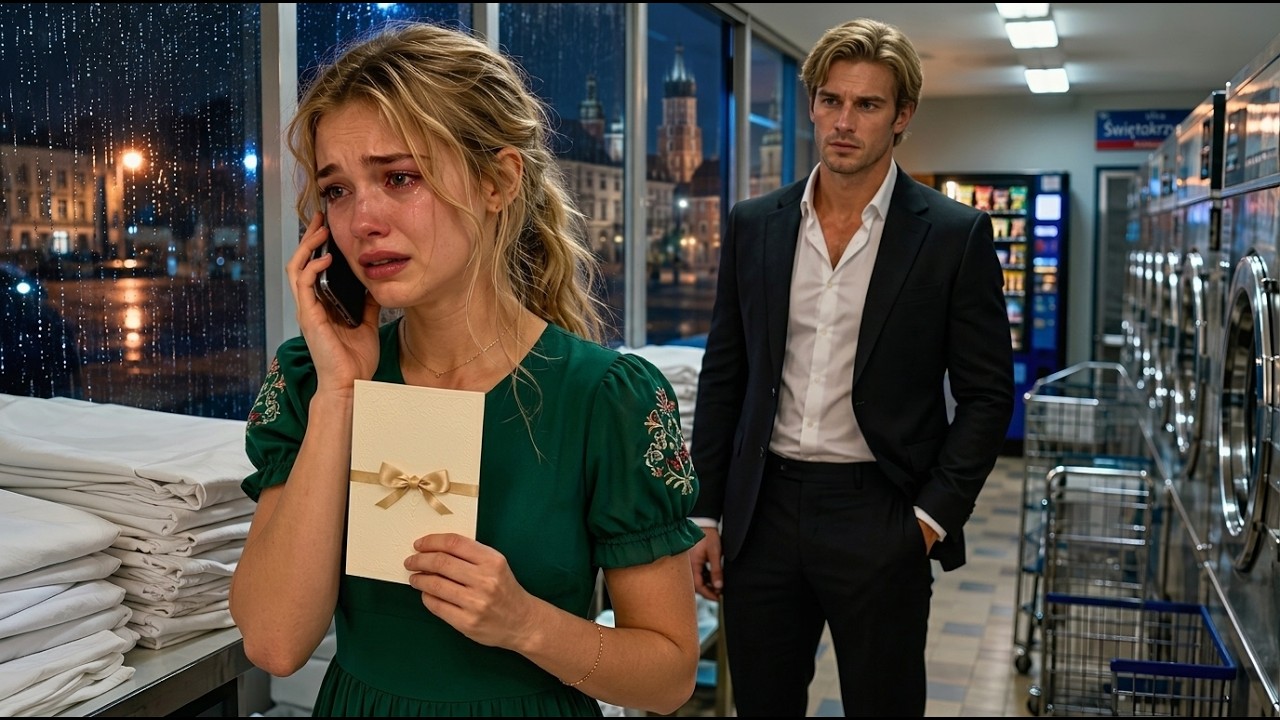
I stood outside the door to penthouse 34A at the Ritz Residences in White Plains on Christmas Eve, and for the first time in my life, I felt unwelcome in a home I was paying for. I could hear the jazz music inside, the kind people play when they want guests to believe the host has taste. I touched the small stuffed bear in my coat pocket for Liam, my three-year-old grandson, and rang the bell. Thomas opened the door.

My son, thirty-two years old, looked like a man bracing for impact. He hugged me quick and firm, the kind that communicates both affection and anxiety at the same time. “You made it. ”
“It’s Christmas Eve, Thomas.
Of course I made it. ”
The apartment opened up before me. Floor-to-ceiling windows, a dining table set for fourteen, candles everywhere. Catering staff moved between rooms like a choreographed performance.
I recognized the logo on their uniforms. A French catering company out of Manhattan, eight hundred dollars a head minimum. I had received the LLC invoice for this month’s rent three days ago—twenty-two thousand dollars. Westchester Property Holdings LLC, the company I had quietly built over thirty years, the one that held title to this apartment, the one Thomas believed was some faceless corporate landlord.
A small hand grabbed my fingers. Liam stood at my knee, dark-haired, round-cheeked, wearing a tiny sweater vest that probably cost more than my first car. I crouched down and handed him the bear. “Merry Christmas, buddy.
”
He grabbed it with both hands, pressed it against his chest, and made a sound of pure satisfaction. My throat tightened in a way I hadn’t expected. Isabella appeared from the direction of the kitchen, moving the way she always moved, like someone who had rehearsed the entrance. She kissed the air somewhere near my cheek.
“So glad you could come. ”
“Wouldn’t miss it. ”
“Let me introduce you to some people. ” She touched my elbow lightly, steering me toward a cluster of guests near the windows.
“This is Preston and Camille Hartwell. Preston is in private equity. And this is Dr. Serena Voss.
She just opened a practice in Greenwich. ” She paused, turning to her friends with a smile that didn’t quite reach her eyes. “And this is Allan, Thomas’s father. He’s retired.
”
She said it the way people say a word they find mildly embarrassing. Preston Hartwell extended his hand. “What field were you in, Allan? ”
“Real estate,” I said.
“Oh, residential, commercial? ”
“Mostly commercial, some residential. ”
“Interesting. ” He said it the way people say interesting when they mean small-scale.
I didn’t correct him. I excused myself and moved toward the far end of the room where Dorothy Callahan was sitting alone with a glass of sparkling water, watching the party with the calm expression of a woman who had seen too much to be impressed by any of it. “Alan. ” She patted the seat beside her warmly.
“You look like a man who needs five minutes of honest conversation. ”
I sat down and felt my shoulders drop for the first time since I’d walked in. From across the room, Liam toddled toward the couch, still clutching his bear. Isabella intercepted him, crouching down to his level, pressing a kiss to his forehead.
For just a moment, watching her hold my grandson, something ached in my chest. I reached into my jacket and touched the folded envelope I had been carrying for three years. The DNA report. The one I had never shown anyone.
Not yet. Dinner began the way Isabella liked everything to begin—on her terms. She had placed herself at the head of the table, which was technically Thomas’s seat. I sat near the middle between Dorothy and Preston, who was already on his second glass and talking about his ski house in Telluride.
Liam had been whisked off to his room by a babysitter. Whatever was coming, at least the boy wouldn’t see it. Isabella steered the conversation with precision and very little warmth. A gallery opening in Chelsea.
A renovation she was planning for the second bathroom. A trip to Tuscany she and Thomas were considering for the spring. Thomas nodded at appropriate intervals, refilling his wine glass more than he should have. At one point Isabella gestured toward me with her fork.
“Allan, do you travel much? ”
“Not lately. ”
“You should. Europe especially.
There’s so much you’d appreciate—the architecture, the culture. ” She smiled at Camille Hartwell across the table. “Thomas gets his love of beautiful things from his father, I think, though Alan tends to express it more quietly. ”
Camille laughed softly.
Thomas stared at his plate. The catering staff began clearing the main course plates just after eight. Isabella stood up. She reached for her glass, and the table noise softened the way it always does when someone is about to make a toast.
“I want to say something,” Isabella began, her voice warm and practiced. “Christmas is about family and about coming together. And tonight I am so grateful for every single person at this table. This dinner, the wine, everything tonight, it’s on me.
My treat. Every single one of you. ”
Several guests smiled, raised their glasses. Preston said, “Here, here.
”
Isabella’s smile widened. She let the silence stretch one second too long. Then she raised her voice. “Every single one of you.
” Her arm came up, index finger extended, aimed directly across the table at my chest. “Except him. ”
It wasn’t a toast anymore. It was a declaration, loud enough that the couple at the next table turned to look.
“Allan has more money than he knows what to do with,” her voice had climbed now, bright and sharp. “But in four years—four years—I have never once seen this man reach into his pocket for anything. So tonight, Allan, you are on your own. ”
Three seconds of absolute stillness.
Then someone laughed a short, uncomfortable sound that died immediately. Camille Hartwell looked down at her dessert fork. Dorothy’s jaw tightened so hard I could see the muscle move in her cheek. Thomas pushed back his chair so fast it scraped against the hardwood floor.
“Bella. That’s enough. You need to stop. ”
“Thomas, sit down,” Isabella said pleasantly.
“I’m just being honest. ”
“You’re being cruel,” Thomas said, and his voice broke on the last word in a way that seemed to surprise even him. I set my napkin on the table. I opened my wallet.
I counted out two hundred and twenty dollars in cash, enough to cover my plate, the tip, and a little extra for the young woman watching Liam, and I placed it beside my wine glass. Then I stood. “Dorothy. ” I touched the back of her chair.
“Thank you for the company this evening. ”
“Allan,” she said softly. “You don’t have to. ”
“I know.
Good night. ”
I walked to the hallway and took my coat off the rack. Thomas appeared at my elbow, his face flushed, his eyes red at the corners. “Dad, please stay.
I’ll fix this. I swear I’ll fix this. ”
I put my hand on his shoulder. “You don’t need to fix anything, son.
I already have. ”
He stared at me. “What does that mean? ”
I squeezed his shoulder once, then let go.
The elevator doors closed behind me at 9:41 p. m. I rode down thirty-four floors in silence, reached into my jacket, and dialed. “Ethan.
It’s time. All of it. Tonight. ”
On the other end of the line, Ethan Cross, my attorney of twenty-two years, exhaled once, then understood.
“I’ll start drafting in the morning. ”
The lobby doors opened and the cold December air hit my face like a clean slate. The morning after Christmas, Isabella woke up before Thomas. That was unusual.
She opened her banking app first the way she did every morning, the same way other people check the weather. The account balance stopped her cold. The fifteen thousand dollars that appeared in Thomas’s account on the last Friday of every month like clockwork for four years was not there. “Thomas, wake up.
The deposit didn’t come through. ”
A pause. The pillow didn’t move. “I know.
”
Isabella felt something cold settle in her stomach. “What do you mean you know? ”
Thomas sat up slowly. He didn’t look at her.
He sat on the edge of the bed with his elbows on his knees, staring at the floor like a man preparing to confess something he had been rehearsing for a long time. “The bonus was never real. It was never from the firm. ”
“Then where did it come from?
”
“My father. He transfers fifteen thousand dollars every month into my account through one of his LLCs. Has been doing it since we got married. I told you it was a performance bonus because I was ashamed, Bella.
Because I knew if you found out we were living on his money, you’d look at me the way you looked at him last night. ”
Isabella reached for her phone and opened her shopping app. She tapped checkout on a handbag she had been watching for three weeks. Payment declined.
She tried the black card, the one she used for everything, the one that had never once been declined in four years of marriage. Payment declined. “Thomas, what is wrong with the card? ”
“He guaranteed the credit line.
When he pulled the guarantee, the account flagged for default within forty-eight hours. The card is frozen. ”
“He can do that? ”
“It was always his card, Bella.
He had the right to withdraw the guarantee at any time. It’s in the cardholder agreement. ”
“What else? ” Her voice was shaking now, but not with grief.
With fury. “What else is his? ”
“The apartment. ”
He crossed the room and handed her a piece of paper he had pulled from the nightstand drawer.
A copy of the lease agreement for penthouse 34A. The name at the top of the landlord section read Westchester Property Holdings LLC. “I looked it up last night,” Thomas said. “After Dad left.
Westchester Property Holdings. It’s one of his companies. It’s always been one of his companies. ” His voice dropped to barely above a whisper.
“We’ve never owned this apartment, Bella. We never owned any of it. ”
Isabella pressed both palms flat against the cold glass of the window. Four years of dinner parties and Instagram posts and carefully curated moments in this apartment.
This view, this life, and none of it had ever been hers. The intercom buzzed. The building manager’s voice came through professionally neutral. “Mr.
Sterling, there’s a letter here from Westchester Property Holdings LLC. Shall I send it up? ”
The envelope arrived two minutes later. Thomas opened it.
He read it once, then read it again as though the second reading might change the words. *Notice to pay or quit. Under New York State Law, Westchester Property Holdings, LLC, hereby notifies the occupants of unit 34A to either remit outstanding market rate rent of $20,000 per month within 14 days or vacate the premises. *
Thomas set the letter on the kitchen counter.
His hands were shaking so badly the paper rattled against the marble. Isabella stared at the letter. Then she picked up her phone and dialed a number she had saved three years ago and never used. It rang twice.
“Mark Vance,” said the voice on the other end. Smooth, ready, as though he had been expecting her call for a very long time. Two weeks after Christmas, I asked Ethan to make one more call—to a licensed vehicle recovery company out of Yonkers. The Range Rover Isabella had been photographing for her social media accounts for three years, parked in just the right light with just the right caption, was registered under Sterling Property Holdings, LLC.
The lease had expired on December 15th, one week before Christmas. I had simply chosen not to renew it. I found out what happened next from Thomas, who heard it from a neighbor walking her dog on Maple Avenue. Isabella had been driving to a lunch appointment, moving through traffic with the particular confidence of someone who has never had to think about where her next payment is coming from.
She was on the phone. She was always on the phone. A white flatbed truck pulled smoothly into the lane ahead of her and stopped. A man in a gray vest climbed out.
“Ms. Sterling. This vehicle is registered to Sterling Property Holdings LLC. The lease agreement expired December 15th.
I have authorization to take possession of the vehicle. I’m going to need you to step out, please. ”
She argued for four minutes. She demanded to call her attorney.
She said there had been a mistake. The recovery agent waited, because waiting was part of the job. When the White Plains police cruiser arrived, which the recovery agent had pre-arranged, Isabella finally opened the door. She stepped out onto Maple Avenue in her Loro Piana coat and her Bottega Veneta boots while the flatbed’s hydraulic ramp lowered itself behind her with a mechanical groan that sounded, I was told, extremely final.
Thomas picked her up twenty minutes later in his own car, a four-year-old Volvo he had bought himself, paid for with money he had actually earned. She did not speak during the drive home. That evening she sat across from him at the kitchen table and said with the cold clarity of someone who had made a decision and was done reconsidering it, “I want a divorce, Thomas. I want it filed before the end of the month.
”
Thomas told me he felt something release in his chest when she said it. Not relief exactly, more like the particular exhaustion that comes when a thing you have been dreading finally arrives and turns out to be survivable. “Is it because of my father? Or because the money’s gone?
”
She looked at him for a long moment. Then she picked up her phone and walked into the bedroom and closed the door. What Thomas didn’t know, what I didn’t learn until later, was what happened inside that bedroom. Isabella dialed Mark Vance, and this time the conversation lasted forty-seven minutes.
I know the duration because of Gary Russo, a former NYPD detective Ethan had retained three months before Christmas, when I first began to suspect that Mark Vance was more than just a name Isabella mentioned too carefully. Mark Vance. I had known about Mark Vance for eight months. I knew what he was to Isabella.
I knew what he was to Liam. I knew exactly what kind of man answered a desperate woman’s phone call at eleven at night and talked for forty-seven minutes. The question was never whether he would betray her. The question was simply when.
I poured two fingers of bourbon I didn’t particularly want and dialed Ethan. “Start building the file on Vance. Everything. I want it complete before this goes anywhere near a courtroom.
”
There is a particular kind of knowledge that doesn’t get easier with time. I had been carrying the envelope for three years, two months, and eleven days. I knew the number precisely because I had counted it once in a weak moment, sitting in this same armchair on a night very much like this. The envelope lived in the floor safe behind the bookcase, between Margaret’s original will and the deed to the property in Vermont.
I already knew what it said. The result was absolute. Thomas was not Liam’s father. Not even close.
The memory of the night I’d first read those words came back the way it always did—not gradually, but all at once. November 2020. Liam had been born four days earlier. I’d gone to the hospital to see him, stood at the nursery window the way new grandfathers do, and felt something I couldn’t name.
He was beautiful, dark-haired, entirely healthy. Thomas had been standing beside me with tears running openly down his face, his hand pressed flat against the glass, and I had thought, “My son is happy. Whatever else is wrong in that marriage, in this moment, my son is happy. ”
But the feeling I couldn’t name didn’t go away.
Two weeks later, I contacted a private laboratory in Connecticut. I collected the samples carefully—a strand of hair from Liam’s car seat, a toothbrush of Thomas’s from the guest bathroom. The results came back on a Thursday. I read them in my car in the parking garage of my office building and sat there for two hours without moving.
When I finally drove home, I went straight to the safe and put the envelope inside. Then I sat down at the kitchen table, the same table where Margaret and I had eaten breakfast every morning for thirty-one years, and I talked to her photograph for a long time. She didn’t answer, of course. But I knew what she would have said.
She would have said, “Be careful. ” She would have said, “Thomas loves that baby. ” She would have said, “Don’t blow up your son’s life over something he didn’t choose and can’t change. ”
So I waited.
The doorbell rang at nine one night in January. I opened it to find Thomas on the porch, his coat unzipped despite the cold, his eyes carrying the particular devastation of a man who had not slept in several days. We sat at the kitchen table. Thomas wrapped both hands around his mug and stared into it as though it might offer him something the rest of the world hadn’t.
“She’s going through with it. The divorce. Mark Vance filed the paperwork last week. ” He looked up, his eyes red and swollen.
“Dad, I need to know something, and I need you to tell me the truth. Even if it’s bad. Did you always know there was something wrong? Not just with the marriage.
With Liam. ”
I set down my coffee cup. I stood up. I crossed to the bookcase, moved the third volume of a set of encyclopedias Margaret had refused to throw away, and opened the safe.
I took out the envelope and carried it back to the table and set it in front of my son. Thomas opened it. He unfolded the single sheet inside. He read it.
The sound he made was not a sob exactly. It was something that came from deeper than that, a low, broken noise that seemed to compress three years of love and confusion and willful blindness into a single moment of absolute clarity. “I still love him, Dad. ” The words came out muffled, fractured.
“He’s still my son. I don’t care what that paper says. He is still my son. ”
My throat tightened so sharply I had to look away.
“I know. That’s exactly why I never told you. ”
“What do I do? ”
“You file a motion with the court.
You request an official paternity test through the family court. That makes the result legally binding and fully admissible. It protects you. It protects Liam.
” I reached across the table and put my hand over his. “And then you let me handle the rest. ”
Mark Vance withdrew from the divorce case on January 28th. He filed a motion citing conflict of interest—the precise legal term for what happens when an attorney’s personal relationship with a client compromises his ability to represent her objectively.
Isabella was furious, then frightened, then furious again. By the first week of February, she had retained a new divorce attorney, a competent woman named Sandra Okafor, who had no idea what she was walking into. But Mark Vance didn’t disappear. He simply changed roles.
Without the professional constraints of attorney-client representation, he became something more useful to Isabella and considerably more dangerous to himself: an unofficial strategist, meeting her in coffee shops and parking garages, taking calls after midnight, helping her build a case that had nothing to do with the divorce proceedings and everything to do with what she still believed was hidden money. I knew about every meeting. Gary Russo was very good at his job. The idea, as best as Ethan and I could reconstruct it afterward, came from Isabella herself.
In the second week of February, she found something on Thomas’s laptop. Or rather, she found something I had made sure she would find. Three months earlier, I had asked Ethan to draft a memorandum, deliberately vague, professionally formatted, referencing a 2019 commercial real estate transaction in which Sterling Property Holdings had acquired a warehouse property in the Bronx under circumstances that, read without context, could suggest a regulatory irregularity. It wasn’t true.
The transaction had been completely clean, documented to the last comma. But the memo on its own read like a thread worth pulling. I had put it in a folder on the shared drive Thomas used for household documents. Isabella found it on a Tuesday.
By Thursday, she and Mark had drafted a letter. Ethan received it by email on February 15th. It was two paragraphs. The language was careful.
It referenced the 2019 transaction in general terms and suggested that if Alan Sterling wished to avoid the document becoming a matter of public record during the divorce proceedings, certain adjustments to the asset division might be mutually beneficial. I read it twice. Then I looked at Ethan. “They sent this from Mark’s personal email account.
”
“Not through any legal channel. Personal account, personal device, according to Gary’s records. ” He paused. “That’s wire fraud, Alan.
The moment that email crossed state lines—and it did, our server is in New Jersey—it became a federal matter. ”
“How long before you can have this to the FBI? ”
“I can have it on an agent’s desk by end of day. ”
A second email arrived four days later.
This one was less careful. The word *mutually beneficial* had been replaced by a figure: $500,000, transferred to an account Mark specified, in exchange for the document being permanently destroyed and both parties withdrawing entirely from any further claims against Sterling Property Holdings. Ethan forwarded it to FBI Special Agent Diana Rivera at the New York field office within the hour. I thought about Isabella reading that memo on Thomas’s laptop, the little surge of triumph she must have felt, the certainty that she had finally found the thing that would undo me.
I thought about how long I’d been waiting for her to find it. Mark Vance arrived at 4:15 p. m. on a Thursday, fourteen minutes late.
I noticed because punctuality is a form of honesty. Fourteen minutes late meant he had sat in his car at the end of the driveway, working up his nerve. I opened the door before he could ring the bell. He was taller than I expected, well-dressed in the way of men who spend money on appearance as a professional strategy.
He looked at me—a sixty-five-year-old man in a cardigan and reading glasses—and I watched the calculation happen behind his eyes. He was deciding in real time how much to be afraid of me. “Mr. Sterling,” he said, extending his hand.
“Thank you for agreeing to meet. ”
“Come in. I made tea. ”
I showed him into the study.
He sat in the chair across from my desk, the chair where Thomas had sat three weeks earlier. Thomas had come in grief. Mark Vance came in strategy. I opened the folder on my desk and turned it to face him without theatrics.
Three documents side by side. The first was the DNA report, laboratory letterhead, dated November 2020. The result was unambiguous. Thomas Sterling was not the biological father of Liam Sterling.
The second was a contact sheet—photographs taken by Gary Russo over the past eight months. Mark and Isabella at a restaurant in Tribeca. Mark and Isabella at a parking structure in White Plains. A half dozen more after that, all timestamped, all taken from public spaces by a licensed investigator in full compliance with New York surveillance law.
The third was a transcript of a phone call, legally obtained through proper channels, in which two people discussed in careful but unmistakable terms a plan to position Isabella within a wealthy family through marriage. Mark looked at the three documents for a long moment. The color left his face in stages, like a tide going out. “What do you want?
”
“The truth. At the divorce hearing. Full cooperation with the court—your relationship with Isabella, Liam’s paternity, the original plan, all of it on the record. And in exchange, I don’t pursue civil damages against you personally.
I have grounds for a civil suit that would consume the next four years of your professional life. I’m offering you the opportunity to avoid that. ”
Mark’s eyes narrowed. “I was told you were offering a million dollars.
”
“Then you were told incorrectly. There is no money, Mark. There never was. What I’m offering you is your freedom and your law license.
When this is over, you walk away intact. You can rebuild. ”
Mark Vance stared at the documents on my desk. I watched his face cycle through the calculations, the risk assessment, the cold arithmetic of a man who had built his entire life knowing when to fold.
“I want it in writing,” he said. “The civil immunity. Signed by your attorney before I say a word in any courtroom. ”
“Ethan will have the agreement to you by Monday morning.
”
Mark stood. He was almost at the door when he stopped. “The kid. Liam.
Is Thomas going to—will he? ”
“Thomas loves that boy. He’s not going anywhere. ”
Mark nodded once and walked out.
That night, my phone buzzed with a text from Thomas. *Dad. Isabella just threatened to take Liam out of state before the hearing. What do I do?
*
I closed my eyes for exactly three seconds, then I typed back: *Nothing. I’ll call Ethan. She won’t get far. *
The Westchester County Supreme Court on a Monday morning in early March smells like floor wax and old ambition.
Ethan had filed the emergency motion to restrict travel two weeks earlier, the morning after Thomas’s text message. A family court judge had granted it within six hours. Under New York domestic relations law, when one parent in an active custody dispute demonstrates credible intent to remove a child from the state, the court can issue an immediate travel restriction order. Isabella’s passport had been flagged.
Liam’s had been flagged. Isabella walked into the courtroom at 9:03 a. m. with Sandra Okafor beside her.
She found Thomas first, then Ethan, then me sitting in the second row in the same gray suit I had worn to Margaret’s funeral twelve years ago. She looked at me for exactly two seconds. Then she looked away. Dorothy Callahan sat beside me, her back very straight.
“I’ve been waiting to say my piece since Christmas Eve,” she told me in the hallway. “I don’t need a car service for that. ”
The proceedings began. Ethan presented the court-ordered DNA results—the test Thomas had voluntarily requested through the family court in January, conducted by an accredited laboratory, fully admissible under New York evidentiary standards.
Sandra Okafor objected on procedural grounds. Judge Morrison, a woman in her early sixties with the expression of someone who had heard every possible argument and found most of them wanting, overruled her in eleven words. Then the clerk called Mark Vance. Isabella’s head turned so fast I heard her neck crack from two rows back.
She stared at him as he walked to the witness stand, and the expression on her face was the specific nauseating shock of someone who has just understood that the ground they were standing on was never solid. Mark Vance did not look at her once during his testimony. Yes, he had maintained a personal relationship with Isabella Sterling prior to and during her marriage. Yes, he was the biological father of Liam Sterling, as confirmed by the DNA evidence already submitted to the court.
Yes, there had been a prior understanding between himself and Isabella regarding the purpose of the marriage. Sandra Okafor objected four times. Judge Morrison sustained none of them. When Dorothy Callahan took the stand twenty minutes later, she straightened her jacket and recounted the events of the Christmas Eve dinner with the precise, unhurried clarity of a woman who had been rehearsing the moment in her head for three months.
“She stood up,” Dorothy said, “pointed directly at Alan Sterling across the table, and stated—and I am quoting her exactly—‘Everyone except him. ’”
Dorothy paused, then she laughed. She didn’t need to say more. The room had heard it.
Ethan submitted the extortion emails as his final exhibit. Both messages timestamped, routed through Mark Vance’s personal account, transmitted across state lines to a server in New Jersey. Wire fraud in the precise technical sense defined by 18 USC Section 1343. Judge Morrison read the divorce decree from the bench without pausing.
Marriage dissolved. No spousal support. No claim against Sterling family assets on grounds of fraudulent inducement of marriage. Primary custody of Liam Sterling awarded to Thomas Sterling as established legal father under the presumption of paternity doctrine, with the best interests of the child as the court’s governing standard.
The gavel came down once, clean and final. In the hallway outside the courtroom, Thomas found me by the water fountain. He didn’t say anything. He just put both arms around me the way he hadn’t since he was six years old, and I held my son in a courthouse hallway in White Plains, New York, and felt something in my chest that had been clenched for three years finally let go.
Behind us, near the main doors, I heard a woman’s voice say, “Ms. Sterling, Special Agent Rivera, FBI. I need you to come with me, please. You have the right to remain silent.
”
Now September in Bedford Hills arrives without drama. No announcement, just the oak tree in the backyard shifting from green to the particular gold that Margaret used to call honest color. She said summer hides everything. Fall shows you what’s actually there.
Isabella signed her plea agreement on May 9th. Four years in federal prison. Two counts of wire fraud under 18 USC Section 1343. One count of extortion under 18 USC Section 875.
Her attorney had spent three weeks telling her the evidence was insurmountable—timestamped emails, FBI documentation, the sworn testimony of her former co-conspirator. She argued until the day before the deadline, then she signed. Mark Vance surrendered his New York law license on June 3rd and left the city without a forwarding address. I did not look for one.
Family court finalized Thomas’s sole custody of Liam on June 17th. The judge’s written decision was four pages long and used the phrase *stability and continuity* seven times. Thomas Sterling was Liam’s father in every sense the law recognized, and in every sense that mattered. Dorothy Callahan called me that evening.
She cried for about forty-five seconds, then collected herself completely and said, “Allan, I want you to know Margaret would have stood up and clapped. ”
I told her Margaret would have done it louder than anyone. I drove to Tarrytown on a Saturday afternoon in late September, carrying sandwiches from the deli on Route 9 that had operated continuously since 1987. Thomas had moved into a two-bedroom apartment there in April.
No doorman, no catering service. He had painted Liam’s bedroom walls himself, unevenly, with roller marks near the ceiling he kept promising to fix. He was the happiest I had seen him since he was young enough not to know better. Liam heard my car.
By the time I climbed the stairs, he was already standing in the doorway in his socks, arms raised, the bear tucked under one elbow. “Grandpa,” he said, the way three-year-olds say things they are entirely certain of. I picked him up. He grabbed my neck with both hands and pressed his face against my jaw, and I stood there holding thirty-four pounds of absolute certainty and felt something settle in my chest that had not been settled in a very long time.
Thomas appeared behind him smelling like attempted chili. “Sixty percent chance it’s edible,” he said. “I’ve eaten worse odds,” I told him. After Liam went down for his nap, Thomas and I sat at his kitchen table.
Four mismatched chairs. Secondhand coffee maker. Hudson Valley going gold and amber outside the window. Thomas wrapped both hands around his mug the way he used to wrap both hands around his hot chocolate when he was eight years old and had something serious to say.
“Dad. When did you actually start—not Christmas? ”
“Before Christmas. ” I looked at my coffee for a moment.
“The night Liam was born. I sat in the hospital parking garage and read the DNA report for two hours, and I thought, I can walk back in there right now and blow everything apart. Or I can wait and do it in a way that actually protects you instead of just satisfying me. ”
Thomas stared at me.
“Three years. You carried that for three years and never said a word. ”
“I waited until she gave me something clean. Something that happened in front of witnesses, something I didn’t need to manufacture or explain.
” I set the cup down. “She gave it to me at Christmas dinner. ”
Thomas pressed the back of his hand against his mouth for a moment, collecting himself. “Why didn’t you just tell me, Dad?
Why did you let me stay in it that long? ”
“Because you needed to find your own way out. If I had handed it to you, you would have let me carry it. And carrying it for you wouldn’t have made you stronger.
It would have just made me tired. ”
He laughed at that, a short, real sound that surprised him. Then his face went soft again. “Thank you.
For doing it right. ”
Ethan called at four. The Margaret Sterling Scholarship Fund, designated for architecture students at Fordham University, funded through the Charitable Trust, had received its first ten applications. Fully endowed, running in perpetuity.
Thomas was watching me when I hung up. “Mom,” he said, not a question. “She would have done it faster,” I said. “And she would have named it something better.
”
He smiled, the real kind, all the way to the corners. “She really would have. ”
Liam woke at 4:45 and climbed directly into my lap without asking, which was correct behavior. I put my arm around him.
Outside, the oak tree held its gold against the September sky. Old and patient, the way things get when they have survived enough. I had protected what I came to protect.
That was enough.