When the Union cannons finally opened up on the Confederate charge, the men of Pickett’s division were already in the open, crossing nearly a mile of farmland toward Cemetery Ridge. They had been told the Union guns were silent because their ammunition was spent. They were wrong. The volley tore through their lines, and the soldiers who made it to the wall were beaten back with rifle butts, fists, and stones.
By the end of that third day, the Confederates who had marched into Pennsylvania with such confidence were retreating south, leaving nearly 28,000 of their own behind. It was a victory for the Union, but it did not feel like one. In the North, the celebrations that followed the Battle of Gettysburg lasted only as long as it took people to realize the war was not over. Two years had passed since the first shots were fired, and Robert E.
Lee, the Confederate commander who had seemed unstoppable, was already planning his next move. The trouble began months before the first shot at Gettysburg was fired. In early 1863, Lee had won a stunning victory at Chancellorsville against a larger Union force. Emboldened, he decided to invade the North for a second time, hoping to force the Union into a peace agreement.
But the Union had plans of its own. When word reached Lee that Federal forces had crossed the Potomac River into Maryland, he moved quickly, positioning his troops near Cashtown, just eight miles from the small town of Gettysburg, Pennsylvania. On the Union side, the Army of the Potomac was in turmoil. Its commander, Major General Joseph Hooker, rarely saw eye to eye with his superiors, and President Abraham Lincoln was looking for any excuse to replace him.
When Hooker unexpectedly resigned, Lincoln accepted without hesitation and promoted George Meade, a man the army barely knew, to take command. When the two armies finally collided near Gettysburg on July 1st, neither side expected the fight to become the bloodiest battle in American history. The Confederates, confident after their earlier successes, believed they were facing little more than local militia. They spotted Union cavalry to the south but dismissed them as no real threat.
The Union, however, had a good idea of what the Confederates intended. Major General John Buford positioned his men along three ridges west of town, where he was certain the enemy would come. The battle opened when Union Lieutenant Marcellus Jones fired the first shot that morning. The Confederates tried to gain an advantage by pushing through the nearby Herbst Woods, but they were met by the Iron Brigade under Brigadier General Solomon Meredith, who drove them back and captured several hundred men.
It was a bright start for the Union, but it did not last. Brigadier General J. Johnston Pettigrew brought his North Carolina Brigade straight into the woods and forced the Iron Brigade out of their position. Elsewhere, the Union was losing ground.
Two Confederate divisions overwhelmed the Federal corps stationed north and northwest of town. Outmaneuvered and outmatched, the Union forces made a difficult decision. Most of them retreated to Cemetery Hill, just south of Gettysburg, hoping the higher ground would give them an advantage. From a distance, Robert E.
Lee watched the Union take up position on the hill. He worried that they would only grow stronger, but he chose to trust his subordinate, General Richard Ewell, who decided not to attack. Historians would later call that decision a critical mistake. Throughout the next day, both armies reinforced their lines.
Lee planned a two-sided attack on the Union flanks, ordering Lieutenant General James Longstreet to strike the Union’s left and General Ewell to march on Cemetery Hill once the fighting began. Everything was going according to plan until Longstreet found an unexpected obstacle. Major General Daniel Sickles had abandoned his assigned position in favor of a better one, and his Third Corps was now isolated and face to face with the Confederates, with no support. When Meade realized Sickles was missing from a scheduled meeting, he rode out to find him.
He told Sickles that retreating would endanger the rest of the army. So Sickles stayed and fought, taking such a terrible leg wound from a cannonball that his leg was later amputated. Elsewhere on the field, the Union was barely holding its own. Confederate General Richard Anderson’s division made it all the way to Cemetery Ridge, only to be pushed back by a nearly suicidal bayonet charge from the Union Second Corps.
One of the most desperate fights took place at Little Round Top, a rocky hill that was critical to the Union position. Colonel Strong Vincent watched wave after wave of Confederate soldiers climb toward his defenses. No matter how many came, he refused to let the line break. Eventually, the Confederates were forced to fall back.
General Ewell, who had been ordered to attack the Union’s right flank, interpreted his orders differently than the other Confederate leaders. Instead of charging directly, he launched a massive cannonade, but the cannons were too far away and the bombardment largely failed. He had also been tasked with attacking Culp’s Hill, but so many Union soldiers had been pulled away to face Longstreet that only a single brigade remained to defend it. Brigadier General George Greene was prepared to hold the hill to the last man, but he was saved by reinforcements from the First and Eleventh Corps.
On the morning of July 3rd, Lee was preparing to launch another attack when Union artillery opened fire on the remaining Confederates at Culp’s Hill. The Union drove them off, and Lee grew furious. That afternoon, he responded with what was likely the largest artillery bombardment of the war. Nearly two hundred Confederate guns fired on the Union lines, followed by another eighty cannons.
The barrage lasted about two hours, and Lee believed he had done enough damage. He ordered Major General George Pickett to lead the final charge against the Union position at Cemetery Ridge, hoping to end the battle then and there. The Confederates had not noticed that the Union had not fired back once during the entire bombardment. Lee assumed their guns were useless.
He was wrong. It was a calculated silence. As soon as Pickett’s men came within range, the Union cannons let loose, sweeping through the Confederate lines. Some men made it far enough to fight hand to hand, and the combat devolved into brutality, rifles, bayonets, fists, and rocks.
By the end of the third day, Meade’s cavalry had positioned themselves behind the Confederate lines. The Confederates knew they had lost. Lee realized there was no point in pushing further and ordered his army to retreat back to Virginia. Meade allowed most of them to leave without pursuit, a decision that would be criticized for years, though Union forces did catch up to the Confederates at Monterey Pass and captured nearly fifteen hundred men.
The cost was staggering. The Union lost just over twenty-three thousand soldiers. The Confederates lost around twenty-eight thousand. In total, nearly fifty thousand men were killed, wounded, or missing, making Gettysburg the bloodiest battle in American history.
It also holds the record for the most generals killed in a single battle. For a brief moment, celebrations erupted across the Union states. But as people realized the war would continue, praise for Meade gave way to frustration and scrutiny. He had turned back the invasion, but he had not ended the war.
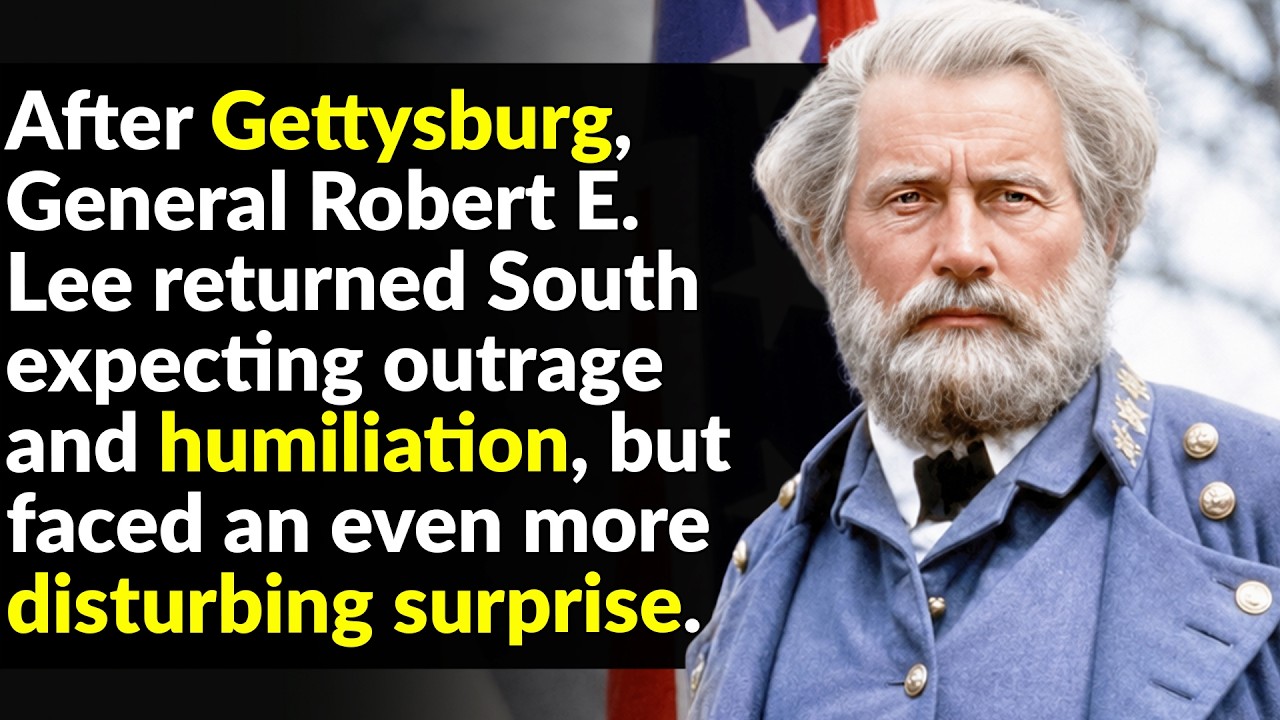
Robert E. Lee returned to the South expecting outrage and embarrassment. Instead, most of the South believed he had done his job, treating the defeat as a temporary setback on the road to a larger victory. However, some in the press relentlessly condemned his leadership.
The criticism wore him down until he believed he was no longer fit to serve. He formally offered his resignation to Confederate President Jefferson Davis, but Davis rejected it. Lee’s reputation before Gettysburg had been nearly legendary. He had won so many battles against impossible odds that both sides wondered if he could ever be beaten.
But his victories came at a terrible cost. He spent his men like currency. Meade, promoted just days before the battle, had no such reputation to lean on. He proved himself through his actions, showing tact, nerve, and an understanding of how to get the best out of his officers.
Historians have since noted that while Meade knew how to manage an army, Lee did not. Although the war continued for another two grueling years, and Lee remained a constant danger to the North, he never again tried to invade the North the way he had at Gettysburg. Months after the battle, the evidence of the bloodshed was still clearly visible on the fields around the town. To honor the fallen, the U.
S. government dedicated a national cemetery there on November 19, 1863. President Lincoln attended and delivered a short address, only a few minutes long. That speech, the Gettysburg Address, would go on to become one of the most iconic moments in American history.
The stories and memories of those three days have never faded. The National Park Service still maintains the battlefield and cemetery as places of deep historical significance. But the true significance of Gettysburg went beyond the staggering loss of life. The battle finally shifted the tide in the Union’s favor, and it is widely believed to have been the turning point that allowed the North to defeat the Confederacy once and for all.
It was a victory bought with almost fifty thousand lives, and the country never forgot it.


