The man in the corner was an easy mark. That was what Vince Calloway saw when he walked into Buck’s Beer Garden that Tuesday afternoon with his crew at his heels. An old man with a limp, sitting alone under the vine-covered trellis, nursing a pint. Free entertainment.
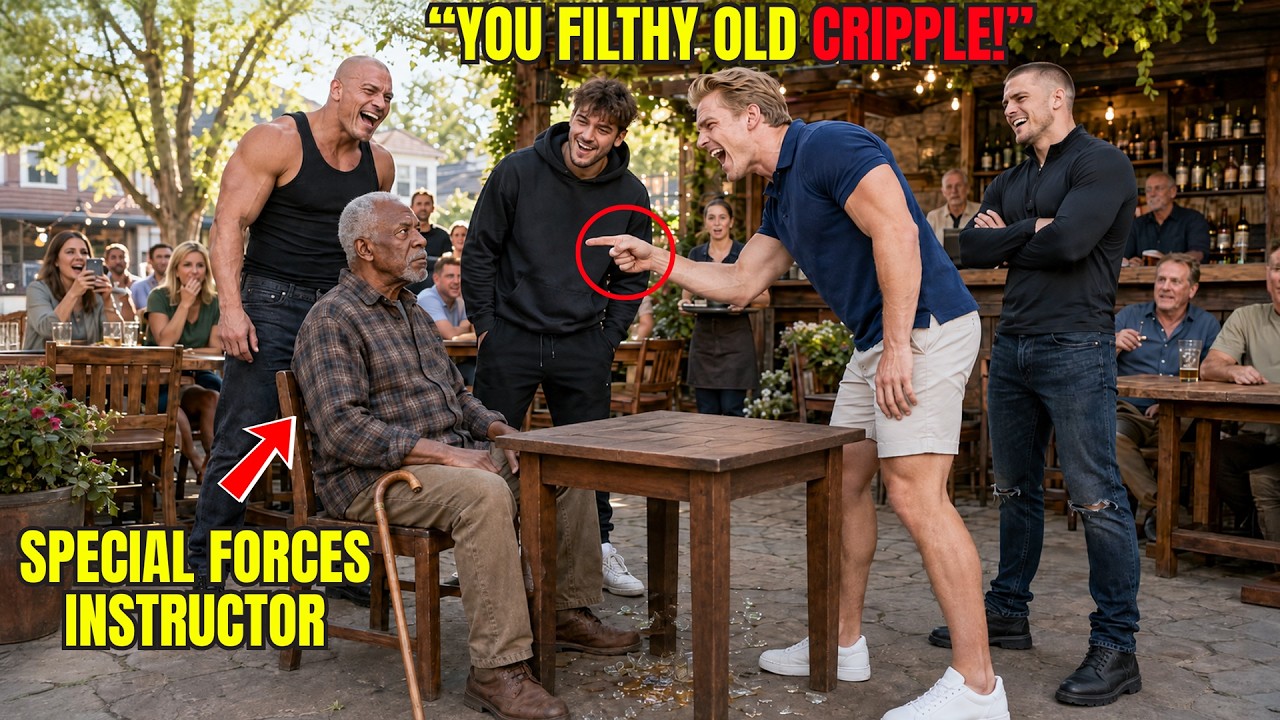
Vince slapped his own thigh and laughed. “Look at me,” he said, loud enough for the whole garden to hear. He grabbed the old man’s glass off the table and let it slip onto the cracked tiles. “You’re a disgusting piece of work.
Your stinking foot has filled the whole place with your smell. ”
He grabbed the old man’s cane, snapped it over his knee. “Can’t even stand without this, you useless old man. ”
Kyle Bruer held his phone up to the old man’s face.
Live stream rolling. “Hey folks, should we make this cripple dance? ”
Vince grabbed him by the throat and pushed him down hard. “Crawl to the door, cripple.
Entertain us. You look pathetic. ”
Miles Thornton pressed his palms flat against the cold floor. He stayed still.
*Don’t shake. *
“Open your mouth for the camera. ”
Not a single soul in that garden stepped forward. They didn’t know who they were dealing with.
By the time they found out, it was far too late. Greystone, Georgia. Population 4,000. A town where everyone knew your name, your business, and what you had for breakfast.
The main street ran straight through the middle. A barbershop, a hardware store, a church whose bell still rang on Sunday. And right on the square, beneath a row of old oaks, sat a beer garden. Wooden tables, hanging string lights, a trellis heavy with vines that made the whole place feel like somebody’s backyard.
That was where Miles Thornton could be found every afternoon. Same table, same corner, under the thickest part of the trellis. He sat with his back to the wooden fence, a cold pint in front of him, watching the square. People walked dogs.
Couples pushed strollers. Teenagers weaved through the crowd on skateboards. Miles watched it all with the patience of a man who had learned, long ago, that stillness was its own kind of strength. He was 67.
Silver hair cropped short, almost military. Thin, but he stood straight—a posture born of decades of discipline, not pride. His face was weathered, deep lines around his eyes. His hands were rough, working hands.
Hands that had built things, shaped things, broken things. He walked with a limp. Left leg. A piece of shrapnel was still lodged in his thigh, a souvenir from his last deployment—the one they never talked about.
He used a cane. Simple wood, unpolished, no rubber grip. Just a stick that got the job done. No one in Greystone knew what Miles Thornton used to be.
To them, he was just the quiet old man who came every afternoon, ordered one beer, tipped well, and never caused any trouble. Buck Whitfield, who everyone called Buck, had owned the beer garden for 22 years. He liked Miles. Liked him because Miles never complained, never raised his voice, never stayed past sunset.
Buck never knew about the 30 years before that. Never knew about the medals. Never knew that the man sitting under his trellis had trained three generations of Special Forces operators in hand-to-hand combat. Miles liked it that way.
Elli Dawson worked the afternoon shift. 22 years old, brown skin, bright eyes, always moving. She was a college student working extra hours between classes. She liked Miles because he asked about her exam results, remembered her test dates, and once left a $50 tip on a $9 bill with a napkin note that read: *For textbooks.
* She called him Mr. T. He called her Sweetheart. In that town, it was the closest thing to family either of them had.
Then there was Vince Calloway. 28, white, loud. The kind of voice that filled a room and dared anyone to interrupt. His father was Howard Calloway, town councilman, golf buddy of the police chief, and the name on half the commercial leases on Main Street.
Vince grew up knowing one thing: the Calloways didn’t answer to anyone. He wore that knowledge like armor. Every day, Vince and his crew would pick a new bar, a new restaurant, a new patio, and make it theirs. Not with money.
With fear. They took the best table, ordered without paying, harassed the waitstaff. If anyone objected, Vince leaned in and said the only six words that mattered in Greystone: “You know who my father is. ”
Nobody ever answered.
Ray Dutton was 25, white, thick-necked, built like a man who lifted weights but never figured out why. He was Vince’s enforcer. The one who stood when Vince sat. The one who cracked his knuckles when the conversation stalled.
Kyle Brewer was 24, Black, wiry, always had his phone in his hand. He was the crew’s promoter. Filmed everything, posted everything, turned every humiliation into content. For Kyle, other people’s pain was engagement.
Likes. Shares. Comments. The three of them moved through Greystone like a slow-moving storm.
Everyone saw them coming. No one got in their way. And on that bright Tuesday afternoon, that storm rolled into Buck’s Beer Garden and found a one-legged old man sitting alone under the vine-covered trellis, drinking a beer he’d paid for. Vince smiled.
Free entertainment. They walked in like they owned the place, because they believed they did. Vince in front, Ray to the right, Kyle pulling out his phone before he even sat down. A fourth one, Trent Hale, 26, broad-shouldered, a head taller than the rest, brought up the rear.
They took the middle table without asking, shoved two chairs aside, and sat down like the garden had been waiting for them. From behind the counter, Buck saw them. His stomach twisted. He’d heard about the Calloway crew.
Every bar owner in three counties had. Vince swept his eyes across the patio. A few families at the far end. A couple sharing a pitcher near the vines.
And in the corner, a silver-haired old man, cane leaning against his chair, sitting alone. Vince elbowed Ray. “You see that? ”
Ray looked and grinned.
“Hey, old man! ” Vince didn’t bother standing. He just raised his voice loud enough for the whole garden to hear. “That’s a nice cane.
Did you bring it for decoration, or do you actually need it? ”
Miles glanced up once, blinked, and went back to his beer. That was the wrong answer. Vince stood, walked over, grabbed a chair from the next table, and sat down across from Miles without asking.
Close enough to smell his cologne and his sense of entitlement. “I asked you a question. ”
“I heard you,” Miles said. “I just didn’t think it deserved an answer.
”
Ray stepped in from behind Miles, lifted the pint glass out of his hand, drained it in three gulps, and set the empty glass back on the table. “Get yourself another one, gramps,” Ray said, wiping his mouth with the back of his hand. “If you can walk that far. ”
Kyle’s phone was already recording, the red dot blinking.
Miles looked at the empty glass. Looked at Ray. Then slowly, carefully, he pushed himself up from the table, steadied himself on his cane, and limped toward the counter. Every step was unsteady.
Every step was on display. First Trent laughed, then Kyle, then two strangers at a nearby table who should have known better. Elli met him at the bar. Her eyes were wet.
“Mr. T, are you okay? ”
Miles smiled. Small, tired, but sincere.
“I’m fine, sweetheart. Just a man. ”
Behind him, Vince sprawled into Miles’s chair, put his boots up on Miles’s table, and announced to his crew: “We’re coming back tomorrow. That old cripple is our new favorite show.
”
They came back on Wednesday. Same time, same crew, same table. Like clockwork. Miles was already there, under the trellis.
Same seat, same beer. He heard them before he saw them. Vince’s voice cut through the garden like a siren nobody wanted to answer. “There he is!
” Vince spread his arms wide. “Our guy. The cripple. Missed you, old man.
”
Miles didn’t look up. Vince sat down across from him, closer this time, their knees almost touching under the table. Ray stood behind Miles, not sitting, arms crossed, blocking the path to the counter. “So here’s what’s going to happen today,” Vince said.
He picked up Miles’s glass and slowly poured the beer out onto the table. The brown liquid spilled over the edge, dripping onto Miles’s pants, pooling around his shoes. “You’re going to sit here, take what we give you, and smile while you do it. ”
Miles watched the beer drip onto the table.
“You hearing me? ”
“I hear you. ”
“Good. ” Vince snapped his fingers at Ray.
“Show him. ”
Ray scooped a handful from a basket of nachos at the next table—a family’s untouched order—and crumbled them over Miles’s head. Chips and cheese dusted his silver hair, slid down his shoulders, scattered onto the table. The family stared, then looked away.
Kyle held up his phone. Live. Viewers climbed. 40.
80. 150. Comments rolled in. Laughing emojis.
Fire emojis. One wrote, “Make him dance, hahaha. ”
Miles slowly, carefully brushed the food off his shoulders. He didn’t stand.
He didn’t move. He didn’t raise his voice. Around the garden, people watched from behind their drinks. A man in a polo shirt whispered to his wife.
She shook her head. “Don’t get involved. ”
A couple at a far table packed up before finishing their meal and left. Buck stood behind the counter, jaw tight, phone in hand, thumb hovering over emergency dial.
He knew it wouldn’t matter. The police chief golfed with Howard Calloway every Sunday. The last time someone filed a complaint against Vince, the complaint disappeared. The officer who took it got transferred to traffic duty in the next county.
Greystone had learned. That night, Vince called his father. Howard picked up on the second ring. “How’s my boy?
”
“Good, Dad. Real good. You wouldn’t believe this town. ” Vince was grinning, feet up on his apartment’s coffee table.
“Nobody said a word. Not one. I could burn down the whole square and they’d just watch. ”
Howard laughed, low and satisfied.
“That’s how it works, son. Power isn’t what you do. It’s what they don’t do. Keep it that way.
”
Vince hung up, pulled up Kyle’s live stream replay, watched the old man sit still while nachos rained down on his head. He saved the clip. Favorited it. Watched it twice more before bed.
*Old men know better than to touch the Calloways. *
Thursday was worse. The garden was packed—busier than usual. Word had spread, not as outrage, but as entertainment.
Some came to see if the rumors were true. Some came because Kyle’s live stream had 800 followers now, and they wanted to be in the frame. Vince arrived at 4:15. Miles was already there.
The crew surrounded his table like a stage. “Alright, cripple. Stand up. ”
Miles looked at him.
“I said stand up. ” Vince kicked the leg of his chair. “Today you walk for us. Back and forth.
Show everyone that funny little limp of yours. Come on, entertain us. ”
Miles set his beer down, gripped the edge of the table, pushed himself up. His left leg buckled slightly.
He caught himself on his cane. Then he walked. Three steps forward, a turn, three steps back. His limp was deliberate, each step heavy on the uneven stones.
Vince clapped, slow and sarcastic. “There it is. See that? That’s comedy.
”
Ray pulled out his phone and played a circus tune at full volume. The tinny melody bounced off the wooden fence, mixing with the laughter of people who should have been ashamed. Kyle zoomed in on Miles’s face. Still.
Unreadable. The comment section exploded. Then Elli came out with a tray of drinks. She was heading to a table in the back when Ray stepped into her path.
“Where are you going, sweetheart? ” Ray reached out and grabbed her wrist. Not hard, but enough. “Stay here.
Watch the show. ”
Elli pulled her hand back. “Let go of me. ”
Ray held on.
He pulled her closer, leaned in, said something too low for the mic to catch. But it caught on Elli’s face. Half a second, her annoyance turned to fear. The tray tilted.
A glass slid off and shattered on the stone. Miles saw it. For the first time in three days, his jaw tightened. His left hand clenched, then opened.
His fingers spread slowly, deliberately, like a man counting down from five. He didn’t move. Not yet. But something changed behind his eyes.
Something cold. Something trained. A stillness that wasn’t calm—it was calculation. Ray released Elli.
She backed away quickly, clutching the tray to her chest, eyes wide. Miles sat down, picked up his beer, and took a sip. That night, Buck called the police. The dispatcher took the report.
Said someone would look into it. No one did. Later, alone in his house, Miles opened the drawer of his nightstand. Inside, on top of a folded American flag, was a photograph.
The corners were worn, faded with age. It showed a younger Miles, straighter, stronger, no limp, standing at the center of a squad. Twelve men in tactical gear flanked him. Every face turned toward him.
Every expression the same. Respect so deep it didn’t need words. Below the photograph, someone had written in black ink: *To Sergeant Major Thornton, who taught us how to survive. *
Miles held the photograph for a long time.
Then he set it upright on the nightstand. *Not yet,* he whispered. He turned off the light. Friday, 6 AM.
Miles stood in his backyard in gym shorts and a faded Army t-shirt. The sun was barely up. Dew clung to the grass. The neighborhood was still asleep.
He started with his left leg. Slow, controlled stretches, deliberate rotations. The shrapnel in his thigh would never let him run again. He’d accepted that years ago.
But the muscles around it still remembered. They remembered how to pivot, how to plant, how to draw power from the ground and channel it through the hips into a strike that could put down a 200-pound man before his brain caught up. He ran through the old forms. CQC sequences.
No flourish, no speed, just perfect execution. Elbow to wrist lock. Wrist lock to takedown. Takedown to pin.
Each movement deliberate, each transition precise. His body creaked. But his hands were perfect. At 8 AM, Elli knocked on his door.
She was pale. Her voice was tight. “They said they’re coming back today, Mr. T.
Vince told Buck it’s going to be a grand finale. Those were his words. ”
Miles poured her a glass of water. “You working today?
”
“Yes. ”
“Then I’ll be there. Just like every day. ”
Elli hesitated.
“Mr. T, maybe you shouldn’t go. ”
“I’ll be there. ”
After she left, Miles stood alone in the backyard.
He looked down at his left leg, pressed his palm against the old wound. *Twelve seconds. That’s all it will take. *
Friday afternoon, 4 PM.
The beer garden was full. Every table occupied. People who never came on Fridays were there. Buck noticed.
Elli noticed. Even the couple from the flower shop next door pulled out two chairs and sat on the edge of the patio, pretending to sip lemonade. Word had spread. Not through news.
Not through whispers. Not through Kyle’s live stream. Through that silent, shameful gravity that pulls crowds toward other people’s pain. They came to watch.
Miles arrived at 3:45. He sat in his usual spot. Under the trellis. Back to the fence.
One pint of beer. He didn’t look around. Didn’t acknowledge the crowd. He sat the way he always sat.
Straight. Hands flat on the table. But today, something was different. His cane wasn’t leaning against the chair.
It was leaning against the fence behind him. Out of reach. Deliberate. At 4:12, a black SUV pulled up to the curb.
Doors opened. Vince. Ray. Kyle.
Trent. Vince walked in first. He paused at the entrance, took in the crowd, smiled. An audience.
He liked that. “Showtime,” he said, loud enough for everyone on the patio to hear. They advanced in a line toward Miles’s table. Four men, none older than 30, all of them bigger than the man they surrounded.
Kyle’s phone was already live. Viewers ticked past 300 before Vince even opened his mouth. Vince dragged a chair over and sat down backwards, facing Miles, arms folded across the backrest. “Last day, old man?
The grand finale. You know what that means? ”
Miles looked at him. Said nothing.
“It means you’re going to kneel right here, in front of everyone, and say, ‘I am nothing. ’ Loud enough for the cameras. ”
“I’d rather finish my beer. ”
Vince leaned forward.
“I wasn’t asking. ”
Ray moved behind Miles. Trent took the left. Kyle circled to the right with his phone.
A box. A cage. A sloppy, unorganized formation built on arrogance, not training. Miles took it all in without turning his head.
“Kneel,” Vince said again. Miles took a slow breath, then spoke calmly. “Son, I gave you three days. I haven’t had this much patience with anyone in 30 years.
”
The garden went silent. Even the string lights seemed to stop swaying. Vince’s face darkened. He shot to his feet, shoving his chair back and knocking it over.
“Get him. ”
Trent reached for Miles’s collar, grabbed a fistful of flannel, and yanked him up off the chair. At that exact moment, Ray snatched the cane off the fence behind him and hurled it across the patio. It skidded under a table ten feet away.
And then Kyle saw Elli. She was rushing toward the table with a tray in her hands, shouting, “Stop! Leave him alone! ”
Kyle stepped into her path, grabbed a fistful of her hair, twisted, and shoved her into a table.
Glasses shattered. Elli slammed into the table’s edge, cried out, and hit the floor. Everyone in the garden gasped. Everyone held their breath.
Miles watched Elli fall. Something inside him unlocked. Not anger. Not adrenaline.
Something older. Deeper. A switch that had been installed 30 years ago, in a training facility with no name on any map. It ran on muscle memory.
Time and injury had dulled it, but never erased it. *Twelve seconds. *
Miles’s right hand came up and caught Trent’s wrist—the one still gripping his collar. He didn’t pull.
He rotated. A perfect wrist lock. Trent’s grip broke instantly. His knees buckled, and he dropped to the ground, clutching his wrist, gasping—not from pain, but from the shock of a joint bending a direction it was never meant to go.
Three seconds. Ray charged from behind, fast and sloppy. Miles didn’t turn. He shifted his weight to his right leg, dropped his left shoulder, and drove his elbow back into Ray’s ribs.
Ray’s own momentum did the rest. He folded, staggered, and Miles swept his front leg in a clean arc. Ray hit the patio stones flat on his back. The air left his lungs with a sharp grunt.
Six seconds. Kyle dropped his phone and lunged. Miles caught his extended arm, twisted it down, and applied pressure to the nerve cluster at the base of his shoulder. Kyle’s legs went numb.
He crumpled onto a chair in a contorted position he couldn’t see and couldn’t understand. Nine seconds. Finally, Vince. He threw a wild right hook—the kind that works in bar fights against people who don’t know better.
Miles stepped inside the arc, caught the punch mid-flight, twisted Vince’s arm behind his back, and drove his face down onto the wooden table. Twelve seconds. Four men down. No one standing.
The old man hadn’t thrown a single punch. No broken bones. No cuts. Just controlled, perfect, minimal, final.
The garden was silent. Miles held Vince pinned to the table for a long moment. Then he leaned in, and said, quietly but clearly—loud enough for every phone still recording to pick up: “I train the people who protect this country. You can’t even protect your own ego.
”
He let go. Vince didn’t move. His face stayed pressed to the wood. His hands were shaking.
Miles straightened up, walked over to where Elli was still on the ground, reached down, and gently lifted her to her feet. “You okay, sweetheart? ”
Elli’s lips were trembling. She nodded.
The garden was silent for three full seconds. Then someone at the back table started clapping. Slow. Deliberate.
Then another. Then the couple from the flower shop. Then the man in the polo shirt who had looked away two days ago. The sound didn’t become a cheer or a celebration.
It became something heavier. Something that sounded like guilt being released. Buck came out from behind the counter and stood next to Miles. He didn’t say anything.
Just set a fresh pint of beer on the table. Miles sat down, picked it up, and took a sip. His left leg throbbed. The shrapnel burned.
But his hands—his hands were steady. Buck’s security camera caught everything. Every angle. Every second.
But the video that went viral wasn’t Buck’s footage. It was a bystander’s clip. 30 seconds. No context.
No beginning. Just the takedown. An old man dismantling four young men with terrifying precision. No sound.
No setup. No explanation. The caption read: *Crazy old man attacks group of young men at beer garden. *
By midnight, it had 4 million views.
By morning, Vince Calloway called his father. “Dad, I want you to destroy him. ”
Howard Calloway moved fast. By Saturday morning, before Miles finished his coffee, the wheels were in motion.
Howard didn’t need to threaten anyone. He just made phone calls. A friendly chat with the police chief. A text to the District Attorney’s office.
A quiet lunch with the editor of the Greystone Gazette. By Saturday afternoon, two officers showed up at Miles’s door. “Mr. Thornton, you need to come with us.
There’s been a complaint. ”
Miles didn’t argue. He put on his jacket, took his cane, and rode in the back of a patrol car to the Greystone Police Department. He sat in a gray room for two hours, answered every question, told the truth from start to finish.
The officers nodded, wrote it all down, and then charged him with aggravated assault. By Sunday, the Greystone Gazette ran a front-page story. The headline read: *Retired Veteran Violently Attacks Four Young Men at Local Beer Garden. * The article was 400 words.
It mentioned Miles’s military background twice—both times as a warning. *A man trained in lethal combat techniques, capable of extreme violence. * It didn’t mention the beer poured on his head. It didn’t mention the nachos.
It didn’t mention Elli. The bystander video had gone everywhere. 20 million views across three platforms. No context.
No beginning. Just the attack. Brutal. Effective.
Terrifying. And beneath it, the comment sections had already delivered their verdicts. *That old man is a psycho. *
*Four guys and he went after all of them.
*
*Lock him up before he kills someone. *
Vince gave an interview to a regional TV channel. He sat in a borrowed, unused wheelchair just off-camera. His right arm was in a sling.
His voice cracked on cue. “We were just having a drink, just sitting there, and he just came at us out of nowhere. I thought he was going to kill me. ” His eyes were wet.
Wet out of habit. “I still have nightmares. ”
Ray posted photos on social media. Arm in a cast.
Neck brace. Caption: “This man is dangerous. He needs to be locked up. ” The cast was clean.
No hospital band. No discharge papers. The online tide turned fast. The people who had cheered the 12-second justice on Friday were now sharing a very different story.
The hashtags changed. #limpinglegend became #limpingsycho. The comment sections filled with armchair experts analyzing the takedown frame by frame. *Excessive force.
* *He could have walked away. * *A classic case of PTSD-driven violence. *
Miles saw none of it. He didn’t have a smartphone.
Didn’t use social media. Had no computer. He sat in his house with the curtains drawn, drinking coffee from a chipped mug, feeling the silence grow heavier by the hour. On Monday, the consequence arrived in person.
The grocery store on Main Street refused to serve him. The clerk, who had known him for three years, wouldn’t even look at him. “I’m sorry, Mr. Thornton.
I really can’t. ”
His neighbor moved his car to the far end of the driveway, as far from Miles’s house as possible. Elli called him. Her voice was shaking.
“If I testify, the university has threatened to revoke my scholarship. They said it would damage the university’s reputation. ”
“Then don’t testify,” Miles said. “Protect yourself.
”
“But it’s not right. You were protecting me. ”
“I know. But this town hasn’t had justice in a long time.
”
On Tuesday, Buck’s Beer Garden received a surprise health inspection. Three violations. All fabricated. Immediate closure order pending review.
Howard Calloway’s name wasn’t on the paperwork. It didn’t need to be. Everyone knew. Miles sat alone in his kitchen.
The walls seemed to close in. Not from fear. He’d been trained to handle fear. This was worse.
The slow, crushing weight of injustice. Not done through fists, but through phone calls, headlines, and quiet arrangements made over lunch. Then, on Wednesday evening, a car pulled into his driveway. A gray sedan, dusty from a long drive.
The engine ticked in the heat. A man got out. Age 45. White.
Slim build. Clean-shaven. He wore a dark suit that didn’t match the dusty road. One hand held a leather briefcase, the other a folder.
Miles recognized his walk immediately. Straight spine. Level shoulders. Chin up.
Military. The man knocked on the door. Miles opened it and looked at him, saying nothing. The man stared back.
His jaw was tight. His eyes were wet—not from practice, but genuinely wet. “Sergeant Major Thornton? ”
A pause.
“Private Cole. Class of ’04. ”
Miles blinked. Slowly.
“I was 19 when you trained me at Bragg,” the man said. “You taught me how to clear a room. How to disarm a man twice my size. How to survive when everyone said I was a dead man walking.
” He set the briefcase on the porch railing. “My name is Nathan Cole. I’m a lawyer now. I drove six hours to get here because I saw a 30-second video that had everything important cut out of it.
”
He opened the folder. Inside were printed screenshots of Kyle’s entire live stream. The parts that led up to the takedown. The parts the bystander’s clip had erased.
“They think this town is theirs,” Nathan said. “They think the story is what they say it is. But I have the real footage. I have medical records that don’t match those photos.
And I have 20 years of gratitude that says you don’t fight this alone. ”
Miles looked at the folder. Looked at Nathan. Then he stepped aside and opened the door wider.
“The coffee’s still hot. ”
Nathan sat at the kitchen table. The same table where Miles had eaten breakfast alone every morning. The one with the folded American flag on it.
Next to the photo of 12 men in tactical gear. Nathan saw the photo. Paused. Walked over to it.
His finger stopped on the second man from the left—young, scared, barely old enough to vote. “That’s me,” he said quietly. “I was 19 in that photo. ”
Miles poured two cups of coffee and set one in front of Nathan.
Then he sat down across from him. “Tell me everything,” Nathan said. “From day one. ”
Miles told him.
Tuesday through Friday. Beer poured on the table. Nachos on his head. Circus music.
The cane broken in half. Elli’s wrist. Elli’s hair. The 12 seconds.
Then the silence. The charges. The headlines. The grocery store.
The scholarship threat. The inspection. Nathan listened without interrupting. When Miles finished, he opened his briefcase and pulled out a legal pad.
“Here’s what we’re going to do. ” He clicked a pen. “First: Buck’s security cameras. Full footage, unedited.
I need to get it preserved and notarized before Howard Calloway finds a way to make it disappear. Buck will cooperate. ”
“Fine. ”
“Second: I’m going to subpoena medical records for all four of them.
Real hospital records, not Instagram photos. If those injuries are staged—and based on what you’re telling me, they are—that’s fraud. It changes everything. ”
Miles nodded.
“Third: Your service record. 30 years. Four commendations. CQC instructor certification.
I want you to authorize a partial release. Enough to show the court exactly who you are and what you were trained to do. Which is neutralizing threats with minimal force. The entire purpose of CQC is control, not harm.
The fact that four men walked away with nothing but bruised egos is the strongest evidence we have. If you wanted to hurt them, Sergeant Major, you would have. ”
Miles sat silent for a long time. He looked at the photo on the shelf.
“Okay,” he said. “Do what you need to do. ”
Nathan stood and offered his hand. Miles took it.
Firm. Steady. The same grip that had pulled Nathan out of a failed rappel exercise 20 years ago. “One more thing,” Nathan said at the door.
“Elli Dawson. They’re threatening to revoke her scholarship. ”
“Yes. ”
“I’ll handle that too.
No one punishes a witness for telling the truth. Not on my watch. ”
He paused at his car door. “Sergeant Major, when I was 19, you told me something I never forgot.
You said, ‘The strongest man in the room is the one who waits the longest before he moves. ’ I thought about that every day of my career. ” He smiled. “You waited four days.
That must be a record. ”
Miles watched the gray sedan pull out of the driveway. Dust rose behind the tires and hung in the evening light. For the first time in five days, Miles Thornton felt something he hadn’t expected.
Hope. The courtroom was packed. Every seat filled. Only standing room along the back wall.
Local reporters crowded the left side. Two regional news crews set up cameras near the exits. The people of Greystone—those who had watched, those who had looked away, those who had laughed—sat in rows behind a wooden rail, waiting for a decision they already knew but hadn’t had the courage to say. Miles sat at the defense table.
Navy blazer, white shirt, no tie. His cane leaned against the edge of the table. Beside him sat Nathan Cole, calm, composed, a legal pad in front of him filled with notes he probably wouldn’t need. Across the aisle, Vince Calloway sat with his attorney—62-year-old Gerald Preston, one of the most expensive lawyers in Atlanta.
Howard Calloway had spared no expense. Preston wore a charcoal suit worth more than most people’s rent. His opening statement was smooth, polished, devastating. “Ladies and gentlemen, what we have before us is a trained killer.
A man whose government spent three decades teaching him how to destroy people with his bare hands. And on one Friday afternoon, at a peaceful beer garden, he applied that training to four unarmed young men who were simply enjoying a drink. ”
Preston paused. The word *killer* hung in the air.
“This is not self-defense. This is violence. Planned, rehearsed, military-grade violence. ”
A murmur rippled through the gallery.
Miles didn’t move. Nathan didn’t blink. When Nathan stood, he buttoned his jacket and walked into the center of the courtroom. No notes.
No dramatic gestures. Just a steady voice. “My client is 67 years old. He walks with a cane.
He has a piece of shrapnel in his left thigh that will never come out. Every afternoon, he sits in a beer garden and drinks one glass of beer. That’s his life. This is the trained killer you just heard about.
”
Nathan turned to face the gallery. “What happened at that beer garden didn’t start on Friday. It started on Tuesday. And we’re going to show you all of it.
”
He gestured to the screen. “Play the footage. ”
Buck’s security camera footage. The complete recording.
Unedited. Time-stamped. Filling the courtroom monitors. The crucial portion of the 42-minute tape, condensed for the court.
Tuesday. Vince’s crew arrives. The first insult. Ray drinking Miles’s beer.
Miles limping alone to the bar. Elli’s wet eyes. Wednesday. Nachos.
Beer poured on the table. Miles brushing food off his shoulders while the whole garden watches in silence. Thursday. Miles being forced to walk back and forth.
Circus music from Ray’s phone. Kyle’s camera zooming in on the old man’s face. Then Ray grabbing Elli’s wrist. The fear in her eyes.
The glass slipping from her tray and shattering. Each clip landed like a weight on the prosecution’s table. Preston shifted in his seat. Vince stared straight ahead.
Then Nathan played Friday’s footage. The full version. From the beginning. Vince telling Miles to kneel.
The cane being hurled across the patio. Trent grabbing Miles’s collar. And then Kyle grabbing Elli. Twisting her hair.
Shoving her into a table. The sound of glass breaking. Elli hitting the floor. And only then—after Elli hit the floor—did Miles move.
Twelve seconds. The same twelve seconds the world had already seen 20 million times. But now with context. With cause.
With three days of humiliation stacked behind them like evidence. The courtroom was completely silent. Nathan let the silence hang. Then he spoke.
“Now let’s talk about the injuries. ”
He brought out the medical records. Subpoenaed. Hospital-verified.
“Vince Calloway. Diagnosis: mild wrist sprain. No fracture, no dislocation. Treatment: ice and over-the-counter painkillers.
Released the same day. ”
He clicked to the next slide. A side-by-side comparison. Vince’s Instagram post—arm in sling, face contorted in pain—next to the hospital X-ray showing nothing.
“Ray Dutton. Diagnosis: minor lower back strain. No structural damage. Released within two hours.
” Another comparison. Ray’s social media post—neck brace, arm cast—next to a medical report that mentioned none of it. “The injuries were staged. The photos were props.
The story was fabricated. ”
Preston objected. The judge overruled. Nathan moved to the final piece.
“Your Honor, I’d like to enter a partial release of Miles Thornton’s military service record as evidence. ”
The document appeared on the screen. Redacted in places, but clear enough. 30 years of active service.
Four commendations for valor. Senior Instructor, Close Quarters Combat Program, Fort Bragg. Responsible for training over 300 Special Forces operators over three decades. Specialty: neutralization with minimal force.
Techniques designed to incapacitate a threat without permanent injury. Nathan faced the jury. “If Sergeant Major Thornton wanted to hurt those men, this courtroom would be looking at hospital beds, not Instagram posts. He didn’t throw a single punch.
He didn’t kick anyone. He applied joint control, pressure points, and leverage. The exact techniques designed to stop a threat and walk away unharmed. This wasn’t an assault.
It was 30 years of discipline doing exactly what it was trained to do. ”
Then Nathan called his witnesses. Elli Dawson took the stand. She wore a plain blue dress.
Her voice was steady, but her hands gripped the rail. She told them everything. The three days of humiliation. The nachos.
The cane. Ray’s hand on her wrist. Kyle’s fist in her hair. The table’s edge hitting her ribs.
And then Miles standing up—not in anger, but in resolve. “He didn’t lose control,” Elli said. “He was the only one in that garden who had any control at all. ”
Nathan called three more witnesses.
Bar and restaurant owners from neighboring towns. Each told the same story. Vince’s crew had come through their establishments. Intimidation.
Property damage. Threats. No police response. Every time, Howard Calloway’s shadow hanging over the process.
The pattern was undeniable. The judge ordered a broad inquiry into Howard Calloway’s conduct as a public official. A shift ran through the gallery. Howard, seated in the third row, pulled out his phone and called his lawyer.
He didn’t look at his son. Vince turned to look at his father. Howard didn’t turn back. Preston asked for a recess.
The judge denied it. At 4:17 PM, the verdict came in. Not guilty. All charges dismissed.
The courtroom broke. Not into cheers, but into something more complicated. Relief. Shame.
The slow, painful realization that justice had almost been buried under phone calls, Instagram posts, and a 30-second video that told the completely wrong story. Miles stood. Nathan put a hand on his shoulder. Elli was crying in the front row.
Miles looked at the gallery. At the people of Greystone who had seen everything and done nothing. He didn’t smile. Didn’t wave.
He just nodded once. Slowly. The way a man nods when he’s been through the worst and knows there’s nothing left to do but move forward. His eyes were red.
Just slightly. The first crack in four days of perfect stillness. He picked up his cane and walked out of the courtroom. The verdict changed everything.
But not all at once. Two weeks later, Vince Calloway’s sentencing hearing was held. Assault. Harassment.
Filing false police reports. Conspiracy to fabricate evidence. 18 months in prison without bail pending appeal. The judge called his actions “a campaign of calculated cruelty shielded by privilege and silence.
” Vince stood in the courtroom in an orange jumpsuit. No wheelchair. No sling. No friendly news cameras.
Just handcuffs and a door that closed behind him. Ray Dutton received 12 months probation and 200 hours of community service. Kyle Brewer got the same, plus a court order to delete all harassment-related content. His live stream account, with its 12,000 followers, was terminated within 48 hours.
Trent Hale pled no contest. Six months probation. He was the only one who sent an apology letter. Short.
But sincere. Miles read it once, folded it, and put it in the drawer next to the photograph. Howard Calloway’s fall was slower, but devastating. The investigation revealed over a decade of suppressed complaints, weaponized inspections, and intimidated business owners.
The police chief, Howard’s golf buddy, was suspended pending review. Howard resigned from the town council on a Tuesday morning via written statement, citing “personal reasons” that fooled no one. Three other council members called for a full audit of his office. The Greystone Gazette, the paper that had branded Miles a violent threat on its front page, printed a retraction on page six.
It was the smallest possible gesture of courage. The paper doing, belatedly, the hardest thing it had done in 20 years. Then the real footage went viral. With Miles’s permission, Nathan Cole’s firm uploaded the full 42-minute, time-stamped, unedited security camera footage from Buck’s.
It spread faster than the edited clip. Within a week, it had 60 million views across all platforms. The difference was staggering. The people who had shared the edited clip and called Miles a psychopath went silent.
Some deleted their posts. Some publicly apologized. Most just moved on, never saying anything. But the video did something else.
Something Miles hadn’t expected. Messages started arriving. First as emails forwarded through Nathan’s office. Then as letters stuffed into a P.
O. box at the Greystone post office, which Buck opened without asking. Hundreds. Then thousands.
Former soldiers who had served under Miles at Bragg, scattered across the country now—officers, sergeants, contractors, retired operators. Each one with a message. A story. Each one remembered the man who taught them how to survive.
A retired colonel from Virginia recorded a video from his living room. “Sergeant Major Thornton trained me in 1998. I was 22 and thought I was invincible. He taught me that real strength isn’t about what you can do.
It’s about what you choose not to do. That man saved more lives through restraint than most soldiers save through force. ”
The video got 8 million views. The hashtag changed.
#limpingsycho disappeared. #limpinglegend returned. But this time it meant something different. Not a meme.
Not a joke. A tribute. Two weeks after the trial, Miles walked back into Buck’s Beer Garden. The afternoon sun fell through the vines exactly as it always had.
The string lights swayed in the same breeze. The old oaks cast the same shadows on the edge of the square. Nothing had changed. Everything had changed.
Buck was behind the counter. He froze when he saw Miles come through the gate. Then he took a pint glass from the shelf, filled it without being asked, and walked it to the corner table. “This one’s on me,” Buck said.
“Today. Tomorrow. As long as you want it. ”
Elli was waiting.
At first she said nothing. She just walked up to Miles and hugged him. Held on for a long time. When she let go, her eyes were wet.
“Thank you, Mr. T. For standing up when no one else would. ”
Miles put a hand on her shoulder.
“You stood up too, sweetheart. In that courtroom. That took more courage than anything I did. ”
The garden was quiet.
A few regulars at the far tables raised their glasses. No applause this time. No spectacle. Just acknowledgment.
The kind that comes after shame, after silence, after knowing what the cost of looking away really is. Miles sat down, took a sip, and looked out at the square. The same table. The same corner.
The same man. But the town was different now. Six months later, Miles Thornton was still in Greystone. Still in the same small house at the end of the dirt road.
Still walked with a limp. Still carried a cane—a new one, hand-carved from oak, made by a former soldier in Alabama who had sent it without a return address. Just a note taped to the handle: *For the Sergeant Major. Semper Fi.
*
But his afternoons looked different now. Three days a week—Tuesday, Thursday, Saturday—Miles walked to the old community hall behind the church on Pine Street. The building had been unused for years. Peeling paint.
Warped floors. A basketball hoop with no net hanging above the door. Nathan Cole had rented it. For a dollar a month from the church board.
Miles had turned it into something no one expected. A self-defense class. Free. Open to everyone.
It started with 11 people. Mostly older women from the neighborhood. The kind who had been told their whole lives that they were too small, too old, too soft to protect themselves. Miles told them differently.
“You don’t need to be strong,” he said on the first day, standing in front of a room full of strangers who looked at him like he was made of something they weren’t. “You need to be precise. Strength fades. Precision doesn’t.
The technique I’m going to teach you was designed for people who are smaller, outnumbered, and underestimated. Sound familiar? ”
A few of them laughed. Some nodded.
In the back row, a 71-year-old woman who stood under five feet raised her hand. “When do we start? ”
By the third month, the class had 90 students. By the sixth month, over 200—from all over Georgia.
Young women. Retired soldiers. College kids. Store clerks.
Nurses. Teachers. People who had been mistreated. Grabbed.
People who had watched someone else get hurt and done nothing, and hated themselves for it ever since. Miles taught them the same thing he’d taught soldiers for 30 years. The best fight is the one you walk away from. But if you can’t walk away, know how to end it in 12 seconds.
Nathan Cole kept his promise too. He didn’t go back to his firm in Atlanta. He opened a small law practice in Greystone. Mostly pro bono.
Tenants fighting illegal evictions. Small business owners resisting corrupt inspections. Witnesses being pressured to stay silent. The kinds of cases that never make headlines, but matter more than the ones that do.
The next spring, Elli Dawson graduated at the top of her class. Her thesis was titled “Social Self-Defense and the Failure of Institutional Protection. ” A 42-page paper. Research.
Case studies. Personal testimony. She dedicated it to Miles Thornton. The dedication read: *For Mr.
T. Who stood up when the whole world sat down. *
Buck’s Beer Garden became a landmark of sorts. Tourists drove through Greystone just to sit at the corner table under the vines.
Buck put up a small brass plaque. Nothing flashy. Just a few words etched into the metal, screwed to the edge of the table. *Reserved for the Sergeant Major.
*
Miles told Buck to take it down. Buck refused. On a warm October evening, Miles sat in his usual spot. The sun was setting over the square.
The string lights came on. The oaks turned gold. His left leg ached the way it always did when the temperature dropped. The cane—the new one, the oak one—leaned against his chair.
On the table next to his beer sat a stack of letters. Mostly handwritten. From students. From former soldiers.
From strangers in towns he’d never visited—people who had seen a 12-second video, then the full footage, and then sat quietly with the difference between the two. Miles picked up his beer. Took a slow sip. Set it down.
He looked out at the square. People walking dogs. Couples pushing strollers. A group of teenagers weaving through the crowd on skateboards.
The same scene he’d watched every afternoon for years. Same table. Same corner. Same beer.
But the man sitting there was no longer invisible.