The little girl opened the front door. She was six years old, with dark curly hair and two uneven ponytails she had tied herself that morning because she was practicing. She looked up at the man on the porch with the total trust of a child who hasn’t yet learned to fear strangers. He had been standing there for almost a minute before he rang the bell.
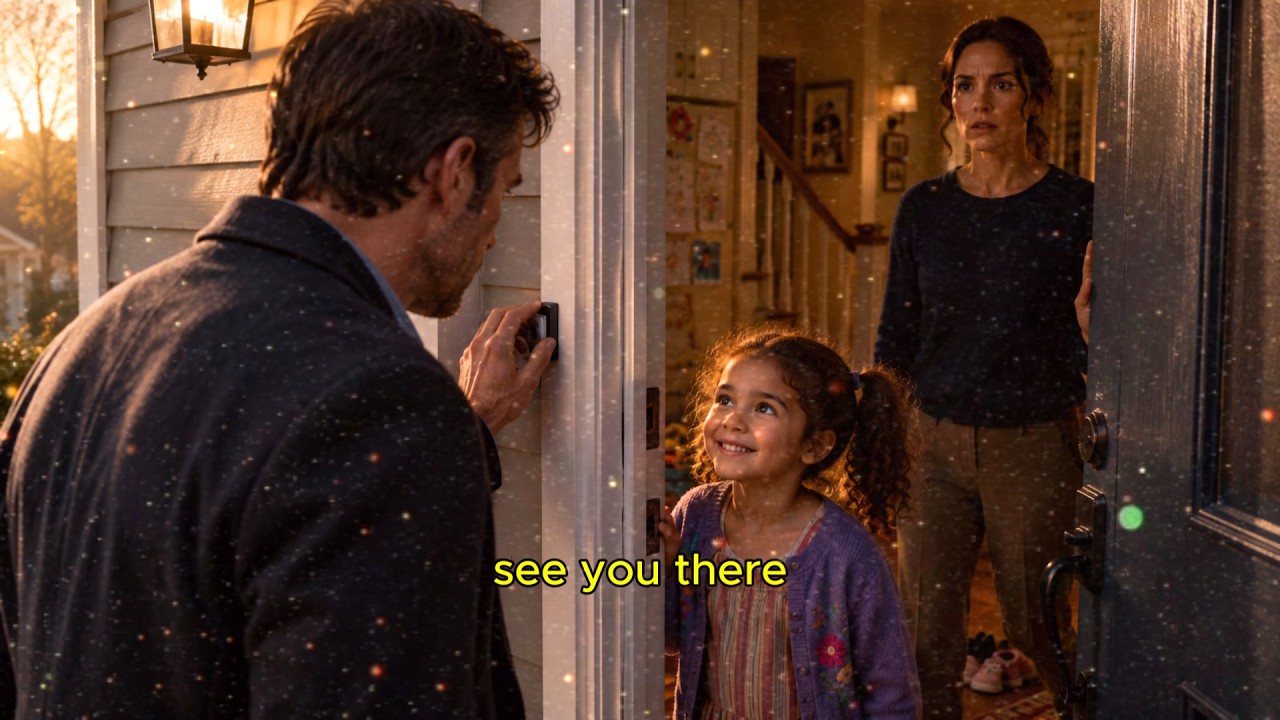
“Is your mother home? ” he asked. She smiled. “Mom!
”
Footsteps in the hallway. Then silence. Sarah Callahan appeared and looked at the man on her porch, and the floor seemed to shift beneath her feet. Six years.
He looked older—not worse, just older, as if the years had taken something. They had. Neither of them spoke. Then he said, quietly, “I need your help.
”
Sarah looked at him. She looked at her daughter. She looked back at him. This was the man who handed her divorce papers when she was eight months pregnant.
Who told her he never wanted the child. Who changed his phone number and disappeared for six years. She took a breath. “You have five minutes.
”
What happened in those five minutes would change everything. But to understand why, you need to understand what happened before. All of it. Sarah was thirty-four.
She had taken her name back after the divorce—one of her first small acts of reclaiming herself. She had met Daniel Mercer at a graduate school event she almost skipped, because she was exhausted from her shift at the pediatric hospital where she was doing her practicum for her social work degree. She went anyway. He was across the room, watching her before she noticed him.
When she looked over, he was already looking. She liked him immediately. She loved him gradually, the way real love grows—through someone choosing you again and again, through the quiet intimacy of being known. They married when she was twenty-seven.
She worked two jobs during the first year while his business consultancy found its footing, never complaining because she believed in what they were building. On a Saturday afternoon in March, she was painting a shelf in the baby’s room when she heard his key in the door. She looked up. She felt, before she understood why, that something in the air had changed.
She was right. Daniel Mercer was thirty-five when the marriage ended—and for years before that, he had been becoming someone worse than who he started out as. He was charming and intelligent, the kind of man who had always been told he was exceptional. When his consultancy lost two major clients in one quarter, when the debt piled up, when their apartment felt less like a choice and more like a cage, he didn’t examine the choices that had led him there.
He looked for something to blame. He found it in the pregnancy. That was how he came to think of it. Everything changed when she got pregnant.
Before the announcement, the problems were manageable. After—they became permanent. A closing of options he hadn’t yet exercised. He said that out loud once.
“Everything changed when you got pregnant. ”
Sarah looked at him and asked what he meant. He said he was just tired. He wasn’t just tired.
He was afraid, and he confused his fear with her fault, and let that confusion harden into conviction. He came home on a Wednesday evening in November. Sarah heard the door and called out. He didn’t answer.
She came to the living room and found him standing there with his jacket still on, unmoving, the stillness of someone who had rehearsed something. He reached into his jacket and placed an envelope on the coffee table. “What is this? ” she asked.
“I can’t do this anymore,” he said. She was eight months pregnant. “I need you to go. ”
“I’m eight months pregnant.
”
“I never wanted this child. ”
The words arrived flat and cold. Sarah went to the bedroom. She packed a suitcase—not everything, just the immediate things.
She came back out. He was still standing where she had left him. She picked up the divorce papers from the coffee table and opened the front door. It was raining.
She hadn’t thought about that. She stood on the landing outside their apartment, eight months pregnant, suitcase beside her, divorce papers in hand, in the rain. She would not go back inside. She made herself think about the next thing, because the next thing was all she could afford to think about.
The woman on the second floor was named Miriam. Seventy-three years old, twenty-eight years in the building. She had heard the conversation. She was standing at her door when Sarah came down the stairs.
She looked at the suitcase, at the rain on Sarah’s coat, at the divorce papers, at the eight-months-pregnant reality of the situation. She opened her door wider. “Come in. ”
Sarah said she didn’t want to.
“Come in,” Miriam said. Sarah came in. Miriam made tea. She didn’t ask questions right away.
She put a blanket on the sofa and sat across from Sarah and waited. Sarah talked. When she finished, Miriam refilled her cup. “You’ll stay here,” Miriam said.
“The spare room—good bed, morning light. You’ll stay until you figure out the next thing. ”
Sarah stayed. Six years later, she would still be close to the woman who took her in when she had nowhere to go.
Weeks before Lily was born, Sarah found an apartment of her own and a plan. And long before that, in April, when Lily was four months old, a letter came. Daniel’s handwriting on the envelope. Sarah looked at it for a long time.
Then she put it in the kitchen drawer, under the takeout menus and old receipts. She did not open it. She would not open it for six years. Here is what Daniel did after he threw out his eight-months-pregnant wife in the rain.
He went to a woman named Claire. He had been seeing her for four months—she had been his client, then his affair, then his reason for everything. He moved into her apartment within a week. He filed an aggressive counter-response to the divorce, strategically designed to minimize what he owed Sarah by characterizing her contribution to their life together as minimal.
He stopped paying the joint credit card in month two. He changed his phone number in month three, forcing Sarah’s calls to go to a recording and her attorney’s calls to go through to his attorney—structuring things so that any contact about child support would be delayed through layers of legal cost that cost him money and cost her more time. He did not go to the hospital when Lily was born. He could have known.
He chose not to know. He had a daughter, and he chose not to know her name. He sent a letter in April and never followed up. He married Claire the following January, fourteen months after throwing Sarah out into the rain.
Every one of these was a choice. Lily arrived on a Tuesday in December, during a snowstorm. Miriam drove because Sarah had no one else. Seven pounds, four ounces, entirely healthy.
She looked at the world with the focused attention of someone who had important assessments to make. The first year was the hardest. Daniel had structured the initial divorce response to delay the child support determination for eight months, while Sarah had a newborn and no income. When the determination came through, it was less than it should have been.
Sarah worked, slept in two-hour intervals, and did the math every morning on the back of an envelope. By year two, the math was less terrible. By year three, she had a senior role at the health center. By year four, she was coaching Lily’s soccer team because no other parent volunteered—and she discovered she was good at it.
By year six, she had a small house she rented from a landlord she liked, a garden in the backyard, a daughter who was curious and determined, with two uneven ponytails she tied herself because she was practicing. She built a life. Not the life she imagined at twenty-four, but a different one—piece by piece, with what she had available. The letter stayed in the drawer.
She hadn’t forgotten it. She had decided she didn’t need it yet. Daniel hadn’t meant for any of it to happen the way it happened. That is true.
It does not excuse any of it. The marriage to Claire lasted three years. It ended because Claire encountered the same person Sarah had encountered: the man Daniel became when circumstances required more than he could give. Claire filed the papers herself, on a Tuesday.
The consultancy collapsed eight months after that. Not from bad luck—from three consecutive bad decisions. His parents died two years apart. He was present at the funerals, absent from the grief.
His friendships thinned, gradually, the way they thin when a person becomes progressively more difficult to be around. He began seeing a therapist named Dr. Porter two years after his divorce from Claire, because his doctor told him to. The work was the hardest thing Daniel had done since the suitcase in the rain.
In the second year, Dr. Porter asked him to describe the moment he was most ashamed of. Daniel described a November evening. He described putting a suitcase outside a door.
He described the rain. He described the look on Sarah’s face. He couldn’t finish. “She didn’t argue,” he said finally.
“She knew I meant it. She didn’t try to change my mind. She just went. ”
Dr.
Porter waited. “She was better than me,” Daniel said. “Already, she knew how to choose correctly even when it cost her everything. ”
He spent the next two years deciding what to do with that understanding.
Then he drove to an address he’d found through the child support filings—the address where his payments had been directed—and sat in his car for forty minutes. Then he rang the bell. Sarah gave him five minutes. She didn’t invite him inside.
They stood on the porch. “What do you need? ” she asked. He looked at the front door Lily had closed behind her.
“Is she—? ”
“Four minutes fifty seconds,” Sarah said. He looked at her. “I’ve been writing letters to Lily for six years.
I never sent them. I have forty-three of them. ”
Sarah looked at him. “I don’t want to show up and disrupt her life,” he said.
“I don’t want to be something that happens to her without warning. I thought maybe you could decide—read them or don’t, keep them for when she’s older, throw them away. Whatever you decide. ”
He reached into his jacket and held out a thick envelope.
Sarah didn’t take it. “That’s the help you need? ”
“Yes. ”
“You want me to manage the consequences of what you did.
”
“I want you to have the choice. Which I should have given you six years ago. ”
Sarah looked at the envelope. Then she looked at him.
“You also sent me a letter six years ago. ”
Something moved across his face. “I know,” he said. “I never opened it.
”
He was very still. “Come inside,” she said. “I’m going to open it now. ”
They sat at the kitchen table.
Sarah went to the drawer and found the letter under six years of being the thing she didn’t need to address yet. She placed it on the table. “Before I open this,” she said, “I want you to tell me what’s in it. ”
Daniel looked at the letter.
Then at Sarah. “It’s not good,” he said. “I know. I assumed that from the timing.
” She held his gaze. “Tell me. ”
He told her. The words he had written six years earlier, the specific cruelty of a man defending himself against his own conscience by attacking the person his conscience was accusing him of wronging.
He had written that he hoped she would never find him, that he wanted nothing to do with the child, that he had moved on and intended to stay moved on. When he finished, the kitchen was very quiet. “You knew all of that was in there,” Sarah said, “and you came here anyway. ”
“Yes.
”
“Why? ”
“Because the person who wrote that letter is who I was. I needed you to know that who I am now is different. And the only way to show you that was to be here when you read it.
”
Sarah picked up the envelope. She looked at it, then at Daniel. Then she carried it to the kitchen counter, turned on the gas burner, and held the letter to the flame. She held it over the sink while it burned, dropping the last piece when it reached her fingers, then ran the water over the ashes.
She turned around. “I’m not doing that for you. I’m doing it because Lily doesn’t need those words to exist in the world. ”
Daniel was staring at the sink.
“I know. ”
“The man who wrote that letter does not get to meet my daughter,” Sarah said. “That man had his chance, and he used it to change his phone number. ” She held his gaze.
“So I’m going to ask you one question, and the answer determines everything that happens next. ”
“All right. ”
“Not why you left. I know why you left.
Not whether you’re sorry. I can see that you are. ” She paused. “I want to know what you’re going to do when it’s hard.
When Lily is angry at you—and she will be, eventually, because she will understand what happened and she will have feelings about it. When she asks you why, when it’s inconvenient, when you have something else you want to do. What are you going to do? ”
Daniel was quiet for a moment.
“I’m going to be there. Not because I deserve to be—because she deserves to have me be. ”
“That’s the right answer. Now I need to see if it’s also true.
”
She walked to the living room doorway. “Lily, can you come in here? ”
Lily came in with a snack in her hand and looked at Daniel with the same assessing expression she gave everything. Then she took two steps forward, reached up, and touched his hand.
“It’s okay,” she said. “Mom cries sometimes, too. ”
Daniel pressed his lips together and nodded. “My name is Lily,” she said.
“I know. It’s a good name. ”
“I know. I picked it.
Well, Mom picked it, but I told her I liked it. ”
He smiled—the first time Sarah had seen him smile in her house. “Can you read? ” Lily asked, holding up a picture book about a mouse building something and encountering obstacles.
“Yes,” he said. “Good. ” She sat on the couch and patted the cushion. “Sit here.
”
He sat. He read every word, including the part about the rope. Three weeks later, Daniel was tested. He was supposed to pick Lily up from school on a Thursday because Sarah had a client session that couldn’t be moved.
He had written it in his calendar. He confirmed it the night before. Thursday morning, he got a call from a potential client—the first significant business opportunity in eight months. The meeting was at three.
School ended at three-fifteen. He couldn’t do both. He called Sarah. She answered on the second ring.
“I have a conflict Thursday. The school pickup. ”
There was a pause. “A conflict,” she said.
“A potential client. First real meeting in months. ”
“Lily has been telling everyone at school that her dad is picking her up on Thursday. She told me four times this week.
”
He was quiet. “I’ll move the meeting,” he said. Another pause. “Are you sure?
”
“Yes. ”
He moved the meeting. He was at the school at three-fifteen. Lily came out, saw him, and her face did the thing faces do when something expected arrives and is still better than expected.
“You came,” she said. “I said I would. ”
She didn’t say anything else about it. She didn’t need to.
Sarah read the forty-three letters over three evenings, after Lily was asleep, sitting at the kitchen table. They weren’t apologies, exactly. They were records. He had written about what he imagined Lily was doing at each age, what she might look like, what kind of person she might be growing into.
He got some things right and some things wrong. The ones he got wrong were the ones that cost Sarah the most to read—because they showed clearly what he had missed. The letter about first steps, dated the month Lily turned one, read: “I imagine you figured out walking the way you figure everything out—by deciding it was happening and making it happen. I imagine you weren’t afraid of falling.
I imagine you were annoyed it was taking so long. ”
He was exactly right. Sarah folded that letter and held it for a while. She was not forgiving him for leaving.
That wasn’t the accounting she was conducting. She was deciding what Lily deserved. Lily deserved the letters—not now, but someday, when she was old enough to understand what they were and what they weren’t. Sarah put the letters in a box, labeled it, and put it on the shelf in the closet.
Then she called Daniel. “I read them,” she said. “All right,” he said. “I’m keeping them, for when she’s old enough to decide whether she wants them.
”
He was quiet. “Thank you. ”
“I’m not doing it for you. ”
“I know.
”
“I’m doing it because she deserves to have all of her story. Including the parts that are painful. Including the parts where you wrote to her for six years and didn’t send it. She’ll decide what to do with that when she’s old enough to decide.
”
Daniel said nothing for a moment. “That’s more than I deserve. ”
“Yes,” she said. “It is.
”
In the spring, Lily was cast in her school’s production of a simplified Wizard of Oz. She was a munchkin, which she described as small but important, with surprising stage time. She told Sarah she wanted Daniel to come. Sarah thought about it for three days.
Then she called him. “Lily wants you at her school play. Friday evening, six-thirty. ”
A pause.
“I’ll be there. ”
He was there at six-fifteen. He sat two seats from Sarah, with Miriam between them—Miriam had arranged the seating herself without explanation, which was characteristic. Lily came on in the second scene and found them immediately.
She gave a wave that was technically against the stage directions. Daniel waved back. Afterward, in the lobby, Lily found them, and Daniel crouched to her level. “You were magnificent,” he said.
“I know,” Lily said. “But the rope scene was important. I had a speech. ”
“I know.
I watched every word of the rope scene. ”
Lily considered this. “Good,” she said. Then she took Sarah’s hand and Daniel’s hand simultaneously—one in each—and began walking toward the exit.
She didn’t notice this required them both to move together. She was six. She just went where she was going. Daniel looked at Sarah over Lily’s head.
Sarah looked back. Later, after Lily had been taken for ice cream, Daniel stayed behind. “I used to think the hardest day of my life was throwing you out,” he said. “It wasn’t.
The hardest day was watching a six-year-old girl wave at me from a stage like I was a guest. ”
Sarah held his gaze. “You were a guest. You’re still a guest.
That changes when she decides it changes. ”
“I know. ”
“She didn’t know you long enough to hate you. That could have gone either way.
It went the way it went because she’s who she is. ” She paused. “Who she is came from six years of me and Miriam and her teachers and everyone who showed up for her when she needed it. You don’t get credit for who she is.
”
“I know. ”
“But you do get to be part of who she becomes—if you keep showing up. ”
He nodded. “I’m going to keep showing up.
”
“Then that’s what we’ll see,” she said. In the months that followed, Daniel did what he said he would do. He was there when he said he’d be there. He moved two more meetings.
He made it to nine of eleven soccer games, told Sarah in advance about the two he missed, and never missed two in a row. He paid the back support—all of it—with a letter from his attorney confirming the calculation within thirty days of the conversation on the front porch. He met Miriam properly at Sunday dinner. She watched him across the table for most of the meal.
At the end, she said, “You missed a great deal. ”
“I know. ”
“She raised that child alone. ”
“I know.
”
“Make sure she knows you know that. Not once—consistently. ”
“Yes. ”
Miriam looked at him a moment longer, then asked Lily if she wanted more cake.
The conversation moved on. Lily began calling him Daniel in October. She began calling him Dad experimentally the following spring. Not consistently—occasionally, the way children try on language for things they’re not yet sure they own.
He didn’t encourage it. He didn’t discourage it. He showed up. That was the work.
Not grand gestures—the Thursday pickup, the moved meeting, the rope scene, showing up when it would have been easier not to. The hardest consequence was not the money. It wasn’t the failed marriage or the collapsed business or the years of loneliness. The hardest consequence was specific and quiet and permanent.
His daughter learned to walk without him. She said her first word without him. She had a fever at eighteen months and reached for a hand in the dark, and the hand that reached back was not his. He read about it in forty-three letters he never sent.
He imagined her first steps and got it exactly right—and wasn’t there to see it. That is not recoverable. It simply is. What is also true is this: on a Friday evening in spring, a six-year-old girl walked out of a school auditorium, took her mother’s hand and her father’s hand simultaneously, and walked toward the exit without asking whether either of them deserved to be held.
She simply went where she was going. And where she was going required both of them to move together. The question is not whether Daniel deserved it. The question is whether he will keep showing up for it.
That question doesn’t have an answer yet. That question has a Thursday pickup, a moved meeting, a rope scene, and the next time and the time after that. He threw her out in the rain at eight months pregnant. He changed his phone number.
He married someone else. He wrote forty-three letters he never sent. And then he rang a bell, and a little girl opened the door and smiled and asked him to read the part about the rope. In forty-three letters he never sent, he got one thing exactly right about his daughter.
He said she wouldn’t be afraid of falling. She isn’t. The question is whether he is.