The small Russian Orthodox chapel in the quiet town of Tegernsee, Bavaria, held no imperial splendor on the morning of October 8, 1905. There were no rows of glittering courtiers, no representatives of the great houses of Europe, and no blessing from the Tsar who ruled the groom’s homeland.
What transpired within those borrowed walls was a quiet act of defiance, a private rebellion against the accumulated weight of two empires, an act of personal conviction that would reverberate through the highest echelons of European royalty for decades. A 28-year-old woman, a granddaughter of Queen Victoria, stood in a ceremony that the reigning powers, both sacred and secular, had expressly forbidden. She was about to marry her first cousin, and she was doing it anyway.
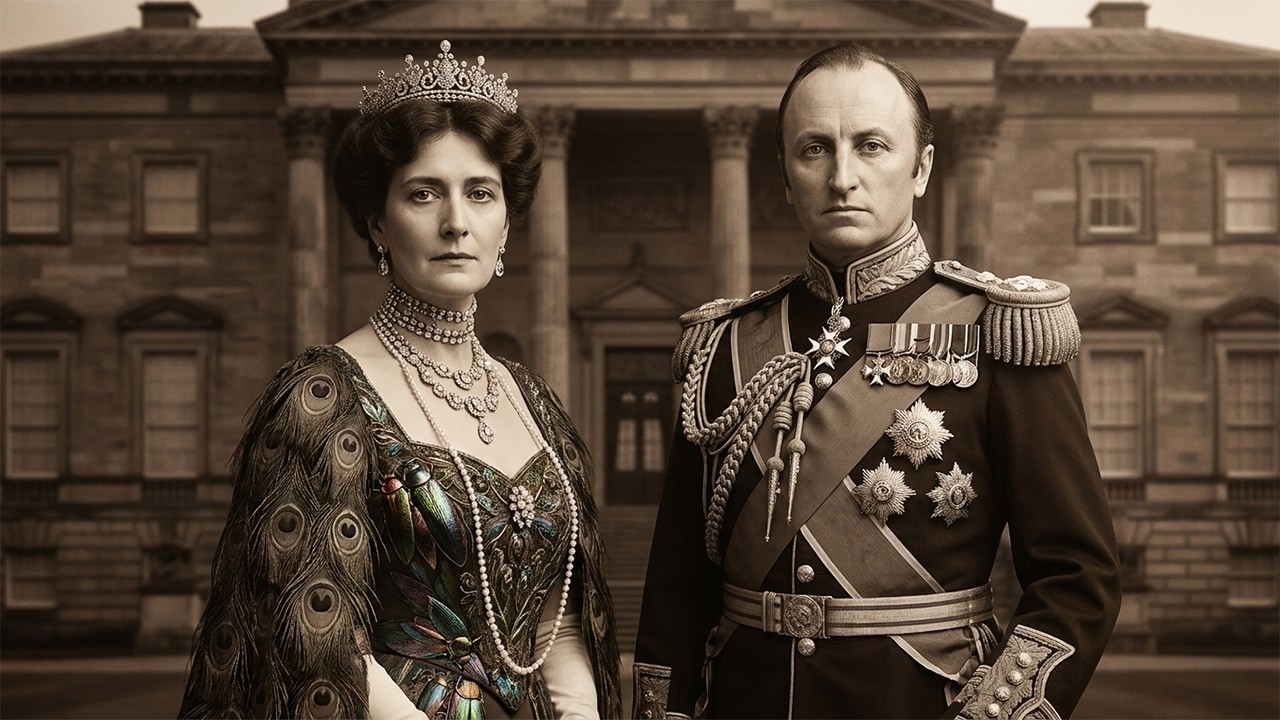 The bride was Victoria Melita of Saxe-Coburg and Gotha, a woman of formidable spirit. The groom was Grand Duke Kirill Vladimirovich, a prince of the Russian Empire. Their union was not just a scandal; it was an open challenge to the prevailing order.
It was a declaration that, for one moment at least, personal choice trumped the iron will of dynastic rule. The Tsar of Russia, Nicholas II, had made his position absolutely clear: this marriage was unacceptable. His veto was firm, based on both the strict rules of the Orthodox Church, which considered cousin marriages an affront to canon law, and the personal humiliation of the bride’s earlier, scandalous divorce.
As the ceremony concluded in that borrowed chapel, the couple knew their lives were about to change irrevocably. Within weeks, the full force of the Tsar’s wrath descended. Kirill was stripped of his imperial titles, his income of 100,000 rubles a year, his place in the imperial navy, and his decorations.
He was ordered to leave Russia immediately. They were to be the exiles, the pariahs of the Romanov house, and the story of their life together began with a total, shocking exclusion. Victoria, who had been raised in the gilded cage of palaces, who was the granddaughter of the most powerful monarch on Earth, was now a woman without a country, married to a man without a future.
Her life before this moment had been a procession of other people’s decisions. She was born in 1876 in the sun-drenched island of Malta, where her father, Prince Alfred, the second son of Queen Victoria, was stationed as a naval officer. Her middle name, Melita, was a tribute to that accidental birthplace.
Her mother, Grand Duchess Maria Alexandrovna, was the only surviving child of Tsar Alexander II of Russia, a woman who had grown up amidst the exquisite gold and malachite of the Winter Palace and never adapted to the comparably modest, chilled atmosphere of the English court.
The marriage of her parents, described as an alliance stitched together from mutual suspicion, created a woman caught between two worlds her entire life. They called her Ducky, a nickname she would carry with her forever. On paper, she was Princess Victoria of Edinburgh to the British, and Grand Duchess Victoria Fyodorovna to the Russians, but at the core, she was Ducky.
But behind that familiar nickname was a fierce and independent spirit. She was a complicated child, tall, dark-haired, and serious, a stark contrast to her blonde, more effortlessly charming older sister, also named Marie. She played the piano with real skill, painted with passion, and rode with an ease that unnerved the more conservative men around her.
Her life was mapped out by her formidable grandmother when she was just 14. During a trip to Russia, she met her first cousin, Kirill Vladimirovich, who was exactly one month younger than her. A tall, dashing officer with an easy, direct manner, he was instantly different from the rigid sons of Europe.
The pair, poles apart in temperament, fell in love with a complete, unembarrassed seriousness that only teenagers can manage. But the path was blocked from the start. The Russian Orthodox Church outright forbade marriages between first cousins.
And her own mother, having found her time in the Russian court more of a trial than a triumph, held fast to her refusal. Queen Victoria, aware that the situation was untenable, assured another path forward.
The Queen noticed the easy rapport between Ducky and another of her grandchildren Ernst Ludwig, the Prince of Hesse. The match seemed perfect to her: same taste for art, a shared love of music and theater, even the same birthday. In 1994, at the age of 17, Ducky was dutifully married to Ernie in a grand ceremony in Coburg.
For years, she did her duty. The marriage produced a child, a daughter named Elizabeth. For a time, she played the part of the contented Grand Duchess.
 But beneath the surface, the marriage was a quiet catastrophe. The two cousins, despite their shared interests, were fundamentally mismatched. He was sullen, moody, and withdrawn, and she was strong-willed and direct.
Theirs became a silent, shared misery.
The final break, when it came, was decisive. In 1901, Ducky did the unthinkable for a woman of her royal blood. She filed for divorce.
She left her husband and once again defied the conventions of the age, turning her life into a scandal that echoed from London to St. Petersburg. The divorce was granted, and then, two years later, tragedy struck with devastating finality.
Her young daughter, the one uncomplicated love of her life, died of typhoid at the age of eight. Ducky, who had already lost the life that had been made for her, was now left with a massive, silent, devastating void.
It was into this barren landscape that Kirill returned. Their love affair, of necessity, had been private for years, but now the obstacles were gone. Or so they had hoped.
The church still refused. The Tsar was adamant. Tsar Nicholas II had no intention of allowing a senior member of the Romanov family to marry a divorced woman, not even for royal blood.
He was resolute. His uncle, King Edward VII, tried to intervene on their behalf personally, and even that failed. So they chose exile.
They chose the backwater chapel. The marriage was a tiny lie to the Tsar, but a truth to themselves. The reaction was brutal and swift: titles stripped, income revoked, commands revoked, and a hard banishment from Russia.
For a time, the pair settled in Paris. For a Royal who had grown up in the glittering gold of palaces, the reality of exile came as a shock. They lived in a modest rented house with a smaller staff, learning the very human arithmetic of a budget.
These years, though, were among the most contented of Ducky’s adult life. Away from the suffocating court, she had the freedom of her own life. She bore two daughters, Maria and Kira, in the rented rooms.
And she wore, almost without thinking, the small ring of Russian gold her mother had given her. It was her own small compass needle, a tiny point of connection to the identity that no Tsar could revoke.
 Ironically, their salvation came from the implosion of the very institution that had exiled them. By 1909, the Russian court began to relent. The couple was allowed to visit, and by 1910 they had moved back, with Nicholas formally recognizing Victoria as Grand Duchess Victoria Fyodorovna.
The exile was over, and Ducky converted to the Orthodox faith after the marriage no longer was in doubt, an important, self-serving decision.
But the Russia she returned to was a storm gathering on the horizon. The throne that had once banished her was now shaking beneath the strain of revolution and war. The time had come for the First World War, and Kirill resumed his military career.
Ducky threw herself into the war effort, organizing infirmaries and caring for the wounded. All the while, the dynasty that had forced her into obscurity was one emperor who possessed nothing more than a bitter old enmity, which was crumbling.
The events of February 1917 presented Kirill with one of the most controversial decisions of his life, the seed of which would be debated for decades. As the imperial government crumbled, he chose a side that would define his legacy. He marched his naval guard to the Tauride Palace and pledged his allegiance to the new provisional government.
The absolute price, by all accounts, was to love his men and protect his family. But for loyalists, it was an unforgivable act of betrayal. The monarchy as an institution was dead, and the danger to any Romanov was escalating with every passing week.
Ducky, pregnant again, followed Kirill to Finland, where their son, a son, was born in August 1917—a child born into a family with a crown but, for the first time in a generation, no throne.
The years that followed in Finland were a desperate, real struggle for survival. News from their former attendance trickled in, culminating in the horror of the murder of the Tsar and his family at Yekaterinburg. The Romanov dynasty, which had until recently been the height of their pride, was now eradicated.
Ducky, who had fought her entire adult life to live within those walls and be accepted by its denizens, watched it disappear in the space of a few short years.
—
They moved to onto France, finally settling in Paris. In the late 1920s, Kirill made the declaration that would define the rest of their lives. He proclaimed himself Head of the Imperial House of Russia and in 1926 declared himself Tsar in Exile.
There was no actual throne to sit on, but the small, disputed title of Sovereign meant more to them than the reality of their situation was ever able to. Ducky, who had spent her life being told she could not be a Grand Duchess, supported his claim with a diplomatic, determined loyalty, and she kept the household as a court.
 For the remainder of her life, his title offered her a way to hold onto a shred of dignity and identity that had survived two marriages in exile. She stayed by his side, but even that connection through the years was also strained, however. As the reality of their world shrank to a few loyalists, and dispersions of their own dreams, Kirill’s own fidelity wavered.
The marriage which she had fought so hard for, which had cost her everything, began to weather its own quieter, sutler betrayals.
In February 1936, she suffered a devastating stroke. As she lay dying, she was surrounded by her children and her beloved sister, Marie, who had remained the one constant in her life. At the bedside of a Stretton, she demanded no comfort from her husband that Anna, toward whom she had a very remarkable sense of bitterness for his infidelities.
On the 2nd of March, 1936, at the town of Amorbach in Bavaria, at age 59, Victoria Melita died.
She was buried in Coburg, but it was nearly six decades before she was brought to her final, far more fitting resting place. In 1995, after the collapse of the Soviet Union, her remains, the last vestiges of her mother’s home, were moved to the Grand Ducal Mausoleum in St. Petersburg, where she was upright, next to the Imperial family that had exiled her for the crime of loving her.
She was once again a Grand Duchess of Russia. The title she had now paid for with her entire life.
Her story is not the story of a simple triumph of love over adversity. It’s a story of the costs of love. It’s the story of a woman who was willing to accept the fact that the most powerful people in the world would see her as a failure, even as a traitor, but that her own judgment of her own life was the price she was willing to be the sole and decisive authority over.
She had chosen to leave the marriage that was chosen for her and chose the love that was forbidden with both. She was exiled for that choice, and she was alone. But the ring of Russian gold, the ring she wore so carefully for her entire life without seeing the world through given, was belonged to no one but her.
It was a tiny, heavy reminder that in a world that existed entirely to control her, her heart was the one territory that no one, no emperor, no Grand Duke, no politician, could ever annex.
The annals of the royal were never the terrain of the great courts and, in truth, the dynasty’s descendants still fight over who is the rightful heir to a vacated throne. But Ducky’s legacy does not lie in who inherits the Romanov name. Her legacy lies in the portrait of a woman who understood, perhaps more clearly than any of her generation, that even in the midst of continents, empires, a woman’s own life was the one and only territory on which she had the absolute right to decide who she was going to love.
She paid an infinite price, but to the last, she would not have traded it for the security of a million, a life she did not want.


