Victor Harrington’s finger shot toward Solomon like a weapon. “I can fix the engine,” Solomon said quietly. Victor laughed. “Fix it?
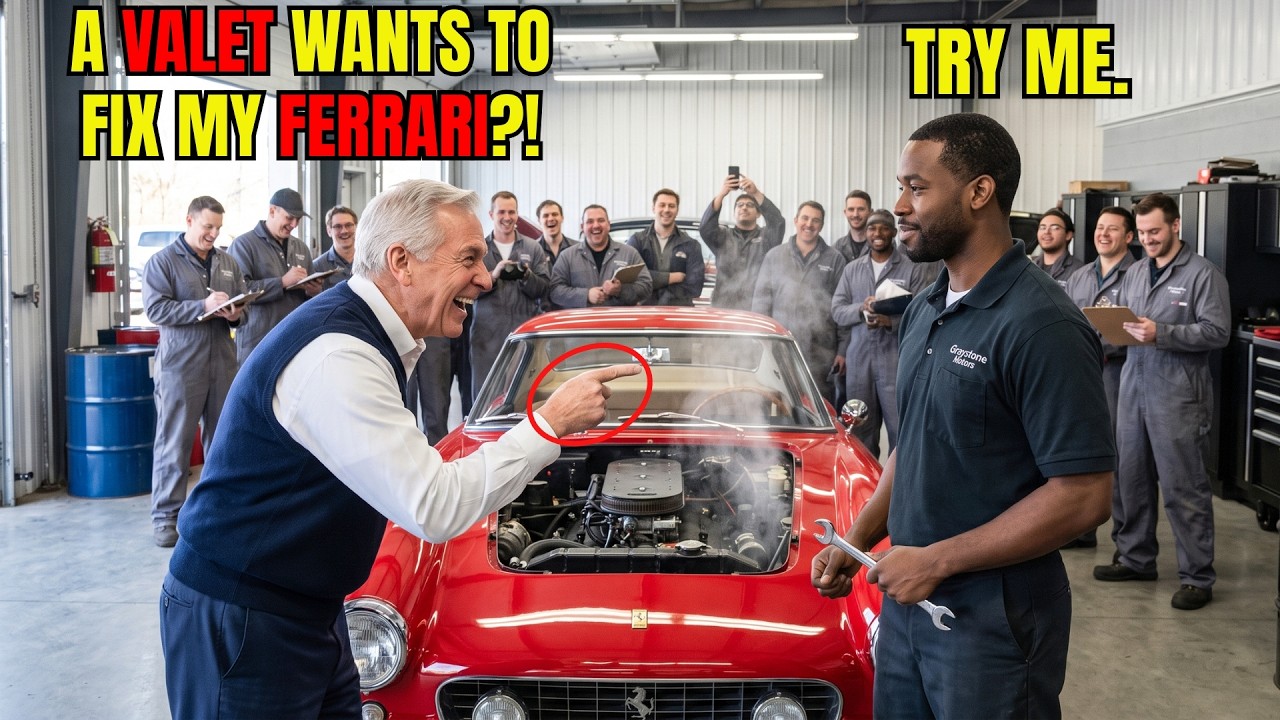
You can’t even fix your own life. Look at you. Broke, dirty, pathetic. ”
Solomon didn’t move.
“Just give me 15 minutes. ”
Victor stepped closer, grabbing Solomon’s collar. “I’ve got a hundred engineers here. Real engineers.
And you, a parking boy who can barely read. You think you belong in this room? ”
Solomon looked down at the hand on his collar, then back up, calm, still. “I can fix it,” he said a third time.
Nobody knew that in 15 minutes, Victor Harrington would be the one who couldn’t speak. —
Solomon Owens had never been the kind of man who asked for much—a steady paycheck, a roof over his daughter’s head, enough leftover for Lily’s school shoes every September. That was the whole list. He worked as a parking valet at Greystone Motors, the most exclusive car restoration facility in Detroit.
Every morning at 6:00, he walked through the side entrance. Every evening at 10:00, he walked back out. In between, he parked cars for people who earned more in a lunch meeting than he made in a year. He never complained.
He never spoke unless spoken to. He kept his head down, did his job, and went home to Lily. Lily was six. She had her mother’s eyes and her father’s stubbornness.
She drew engines with crayons on the back of grocery receipts and taped them to the kitchen wall like they were masterpieces. To Solomon, they were. Her mother left when Lily was two—no note, no phone call, just an empty closet and a crib that still smelled like her perfume. He didn’t talk about it.
He just picked up extra shifts: three jobs, five hours of sleep a day. But here’s the thing about Solomon nobody at Greystone knew, and nobody ever bothered to ask: he could fix anything with an engine. He’d learned from someone whose name the car industry had never written down, but whose hands could heal machines the way doctors heal people—
—
Three weeks before Solomon spoke up in that bay, Preston Whitfield III arrived at Greystone with one request: a 1961 Ferrari 250 GT SWB, cherry red, engine dead for fourteen years. It belonged to Preston’s father, who loved that car more than anything.
When he died, he left Preston a single instruction: bring her back to life. Preston hired Greystone’s best team first—they failed in a week. Then German engineers, Italian restoration experts, a Japanese team that rebuilt museum engines—all of them shook their heads. So Preston put out an open call: a hundred of the best mechanical engineers in the country, all expenses paid.
Just fix the car. The lead engineer was Victor Harrington, who ran the operation like a military campaign: ten teams, ten stations, diagnostic equipment worth more than most houses. Every wire, every sensor, every valve mapped and retested. But the Ferrari wouldn’t start—day three, day five, day eight.
Victor started screaming at his team, blaming the parts, blaming the facility, blaming everything except himself. He was looking in the wrong place: every engineer in that bay was focused on electronics and computer diagnostics—modern solutions for a machine built before any of them were born. Not one of them thought to listen. Solomon noticed on day one.
Walking past the bay after parking a Bentley, he heard Victor’s team crank the ignition. The engine turned over, almost caught, then died—but in that half second, Solomon heard something: a click, faint, almost invisible beneath the grinding of the starter motor. He stopped walking. He knew right then, exactly what was wrong.
But he couldn’t say anything—he was the parking valet, not even allowed near the restoration bay. So he watched day after day, parking cars and looking through the glass as a hundred men failed to hear what a dead engine was trying to tell them. On day nine, Victor caught him looking. “What the hell are you staring at?
”
“Nothing, sir. ”
Victor knocked on the glass. “Then move. I don’t need your greasy face smudging up my window.
”
Two engineers behind him snickered. Solomon walked away. The next morning, a sign was taped to the side entrance: “Parking staff, stay in the lot. Do not enter the engineering bay.
This means you. ” Everyone knew who it was for. At lunch, Solomon sat alone in the breakroom. Three engineers walked in, saw him, and turned around—one muttered, loud enough to hear, “I’m not eating in the same room as the parking lot.
Smells like oil and food stamps. ” The others laughed. Solomon kept eating, didn’t look up. The next day, Victor blocked the hallway with four engineers behind him.
“You’re still here? I figured you’d have quit by now. Most of your kind do when they realize they’re in over their heads. ” He stepped closer.
“Tell me something, parking boy. You got a daddy, or did he run off like they all do? ”
Solomon’s jaw tightened, but his voice stayed level. “Excuse me, sir.
I need to get back to work. ”
Victor shook his head. “Parking cars isn’t work. Picking up trash isn’t work.
What I do in that bay, that’s work. What you do is what happens when a man has no education, no talent, and no future. ” He leaned in. “You know why they put the valet stand outside?
Same reason they put the dog bowl on the porch. Some things don’t belong inside. ”
Solomon stood still for five full seconds, then walked around him without a word. He didn’t report it.
He didn’t tell anyone. That evening, he sat alone in his car after his shift, staring at the steering wheel, hands shaking—not from fear, but from the effort of not saying what he knew, from the weight of twelve days of silence when he had the answer the whole time. He pulled out his phone and looked at a photo of Lily, grinning, missing two front teeth, holding up a crayon drawing of an engine. He put the phone away and drove home.
That night, Derek Sloan posted a video of Solomon standing outside the glass watching the Ferrari, captioned, “Even the parking guy thinks he can do better than us. LOL. ” Forty thousand likes overnight. The comments were worse: stick to parking cars, buddy; maybe he can wash it after we fix it; does he even know what a Ferrari is; bro probably thinks the engine runs on food stamps.
Solomon saw the video at 2:00 in the morning, sitting on the edge of Lily’s bed after his shift. She was asleep, her crayon drawings taped to the wall above her head, right next to the only photo he had of his grandfather, Elijah, standing beside a red car, wrench in hand, grinning. The car in the picture was a Ferrari 250 GT—the same car. The exact same car.
On day twelve, Preston Whitfield called a meeting. “Gentlemen, I’ve given you twelve days. If this engine doesn’t start in forty-eight hours, I’m shipping the car overseas. ”
Victor’s jaw tightened.
That afternoon, they made one last attempt: rewired the ignition, replaced the fuel pump, recalibrated every sensor. Victor turned the key. The engine groaned, coughed, and died. Solomon was mopping the hallway thirty feet away.
He heard it—the same click from day one, louder this time. He set the mop against the wall, walked into the bay, and saidThe five words that changed everything:“I can fix the engine. ”
The moment he stepped in, every sound stopped. A hundred engineers turned at once.
Wrenches froze mid-turn. They were all looking at him: a parking valet in a wrinkled polo, mop water still damp on his shoes. Thirty feet away, the Ferrari sat under four banks of halogen lights like a patient on an operating table thata hundred surgeons had failed to save. .
Two full seconds, nobody moved. Then Victor started clapping, slow, mocking. Each clap echoed off the concrete like a slap. “Ladies and gentlemen, the parking lot has sent us a genius.
” Laughter rippled through the bay. A few engineers pulled out their phones. Victor walked toward him, slow, deliberate. “Say it again.
Say it louder so Preston can hear it. ”
Solomon didn’t raise his voice. “The problem isn’t the fuel system. It’s the timing chain.
Third cylinder offset by two degrees. ”
The laughter died. Not because they believed him, but because the specificity caught them off guard. A parking valet had just named a cylinder, a component,anda measurement in one sentence.
Victor’s smile tightened. “Who told you that? You’ve been googling on your break? ”
“Nobody told me,” Solomon said.
“I listened. ”
Victor repeated it like it was the dumbest thing he’d ever heard, then jabbed his finger into Solomon’s chest. “You know what? I think you’re a nobody who wants attention.
I think you don’t know the difference between a timing chain anda bicycle chain. ” He leaned in close, close enough that Solomon could smell his coffee breath. “And I think if you don’t walk out of this bay in the next five seconds, I’m going to have security drag you out, and I’ll make sure you never park another car in this city again. ”
Solomon didn’t step back.
He didn’t blink. “Five seconds,” Victor repeated, counting on his fingers. “Five, four, three—”
“Let him try. ”
Every head turned.
Margaret Callaway, seventy-two, sat in a folding chair near the far wall. Preston had called her in that morning—a last resort. In the world of classic restoration, her name carried more weight than every engineer in that room combined. She stood up slowly, her eyes locked on Solomon.
“I said, let him try. He just gave you a diagnosis more specific than anything your team has produced in twelve days. The least you can do is let him prove it wrong. ”
Victor’s jaw clenched.
“Margaret, with all due respect, he’s a valet. He parks cars. ”
“Elijah Owens parked tractors before he became the greatest engine mechanic this country ever produced,” Margaret said. “And I’d bet my reputation that young man knows exactly what he’s talking about.
”
The name hit Solomon like a freight train. He stared at her. She stared back. Something passed between them that didn’t need words.
Preston Whitfield had been standing near the office doorway the entire time, arms folded. Mr. Whitfield, Victor said, “You’re not seriously considering this. ”
Preston was quiet for a long moment, looking at the Ferrari—fourteen years of silence, twelve days of failure, a hundred engineers, nothing to show for it.
Then he looked at Solomon. “What do you need? ”
“Twenty minutes,” Solomon said. “And a ten-millimeter wrench.
”
Victor let out a sharp laugh. “A wrench. No diagnostic computer. No oscilloscope.
Just a wrench. ”
“Just a wrench,” Solomon said. Preston nodded once. “Give him twenty minutes.
”
The bay erupted. Engineers shouted objections. Derek held up his phone, grinning, already live-streaming, caption already typed: “Parking boy versus 100 engineers. This should be good.
” Victor grabbed Preston’s arm. “When he fails—and he will fail—I want him fired on camera. ”
“And if he doesn’t fail? ”
Victor didn’t answer.
Solomon walked toward the Ferrari. A hundred engineers parted in front of him like they were afraid to touch him. One stuck out a foot to trip him. He stepped over it without looking down.
Another muttered, loud enough for the cameras:“Twenty bucks says he doesn’t even know how to open the hood. ”
“Make it fifty,” someone else said. “I’ll throw in a hundred if he doesn’t electrocute himself. ”
Solomon kept walking, past the workbenches covered in twelve days of failed schematics, past the million-dollar diagnostic machines, past Victor’s custom titanium toolbox that cost more than Solomon’s car, his apartment,andevery piece of clothing he owned combined.
He reached the Ferrari and placed both hands on the hood. The metal was cold—fourteen years of cold. He closed his eyes. The bay went quiet.
Not respectful quiet—the quiet of a circus crowd waiting for the tightrope walker to fall. And somewhere deep inside the engine, he heard it:“the same faint click that had been calling to him since day one. ”I hear you, Solomon whispered. “I hear you.
”
He didn’t reach for a single tool. He stood with both palms flat on the hood, eyes closed, head tilted slightly to the left like a man listening to a conversation inside a wall. He moved his right hand across the hood, tapped the metal with one knuckle—a dull sound—moved four inches left, tapped again—a sharper ring—moved once more directly above the third cylinder and tapped. The sound was dead, flat, like knocking on a wall with nothing behind it.
He opened his eyes. “Third cylinder,” he said. “The timing chain has micro-slack. Two hundredths of an inch.
This engine has been sitting for fourteen years. When metal sits that long without moving, it contracts at different rates depending on the alloy. The chain around cylinder three tightened while the guide relaxed. That created a gap smaller than a fingernail, but big enough to throw the entire ignition sequence off by two degrees.
”
Silence. Not the kind before laughter—the kind that comes when a room full of smart people suddenly can’t argue with what they just heard. Victor pushed off the workbench. “That’s not how timing chains work.
You can’t diagnose micro-slack by tapping on a hood. That’s voodoo. ”
“It’s resonance diagnosis,” Margaret said from her chair. “It was standard practice in European restoration shops in the fifties and sixties, before computers.
I’ve only ever seen one man do it as well as that. ”
Victor ignored her. “Even if you’re right, which you’re not, you can’t fix a timing chain alignment without a full tear-down. That’s a three-day job minimum.
You’ve got eighteen minutes. ”
Solomon reached into his back pocket and pulled out the wrench—ten millimeter, 1958, handle worn smooth from decades of use, two letters scratched into the steel: EO. “What is that? ” Derek laughed.
“A museum piece. You’re going to fix a thirty-five-million-dollar Ferrari withthat? ”
Solomon walked to the side of the engine bay and crouched, studying the block for ten seconds. Then he reached in—no flashlight, no mirror, no guide—and placed the wrench on a bolt buried so deep that none of Victor’s team had even accessed it.
He closed his eyes again, his fingers working by feel alone. Turn. Listen. Turn.
Listen. Each quarter turn produced a faint metallic whisper, a sound so quiet no diagnostic machine could have picked it up, but Solomon heard it. He adjusted the tension on the timing chain guide with movements so small they were almost invisible—a quarter turn here, an eighth turn there, each one deliberate, each one precise, like a surgeon tying a suture inside a beating heart. Victor crossed his arms.
“Three minutes and he’s just turning a wrench. I could train a monkey to do that. ”
Nobody laughed this time, because something was happening that none of them could explain. The engineers closest to the car had started leaning in—not to mock, to watch.
Solomon’s fingers moved blind, steady, certain. It didn’t look like guessing. It looked like a conversation, a private language between a man anda machine that no one else in the room could speak. .
One of the senior engineers—Caldwell, who’d worked on Formula One cars for fifteen years—whispered to his colleague, “He’s doing resonance calibration. I’ve only ever read about it. I’ve never seen anyone actually do it. ”At the four-minute mark, something changed.
The engine block made a sound—not a click, not a grind, but a low, resonant hum, almost like a sigh, like something locked in place forfourteen years had just exhaled. Margaret stood up. Victor stopped smiling. Derek’s live stream crossed a hundred thousand viewers, andthe chat had gone from laughing emojis to complete silence—a hundred thousand people watching a man work with his hands without saying a word.
Solomon kept working. Six minutes, seven minutes. His arm buried up to the elbow inside the engine bay, sweat running down his forehead, jaw tight, but hands perfectly steady. At the eight-minute mark, he pulled his arm out and placed the wrench on top of the block, gently, like setting down something sacred.
“The chain is aligned,” he said. “But the engine still won’t start. ”
Victor let out a breath. “I knew it.
”
“There’s something else,” Solomon said. He reached for the valve cover, loosened the four bolts by hand, no tool needed. It came off smooth and clean. And there it was: tucked between the valves, pressed flat against the cylinder head, a small piece of paper, folded twice, yellowed with age, spotted with oil stains older than most people in the room.
Solomon’s hands stopped. He knew what it was before he unfolded it—because he’d watched someone put a piece of paper just like this inside an engine once before, twenty years ago, in a one-room shop in Alabama. He lifted it out with two fingers, carefully, like handling a photograph of someone who’d passed. He unfolded it: handwritten notes, engine specifications, timing adjustments, torque values,andat the bottom, a signature,anddate—“Elijah Owens, August 14th, 1969.
”Solomon’s breath caught. His vision blurred. He blinked hardand read again. His grandfather’s handwriting—the same handwriting that used to label coffee cans full of bolts, the same that wrote“Happy Birthday, Solomon” every year until he couldn’t anymore.
Elijah had been here. Elijah had fixed this exact engine fifty-five years ago. The note explained everything: the timing chain specifications, the cold tolerance values, the exact adjustment sequence Solomon had just performed—the same sequence his grandfather had invented decades before anyone thought to write it down. Margaret walked forward, looked at the paper in his trembling hands, andher face changed.
“I know that handwriting,” she said, her voice barely above a whisper. “Elijah Owens. I apprenticed under him in 1968. He taught me everything I know.
” She looked at Solomon. “You’re Elijah’s grandson. ” It wasn’t a question. He nodded, unable to speak.
Margaret turned to the room—a hundred engineers, every phone still recording. “This man’s grandfather was the greatest engine mechanic this country has ever produced. He never had a degree. He never had a certification.
He never had his name in a single publication. And he could do things with a wrench that none of your machines will ever replicate. ” She pointed at the paper. “That note has been sitting inside this engine for fifty-five years, waiting.
And the only person in this room who could find it—the only person who even knew to look—is the man you’ve been calling parking boy. ”
Victor opened his mouth. Nothing came out. Preston Whitfield stepped forward, looking at the note, then at Solomon.
His voice was quiet,almost fragile. “My father brought this car to a mechanic in Alabama in 1969. He never told me the man’s name. He just said he was the only man the car ever trusted.
” He looked at the Ferrari—fourteen years of silence, twelve days of failure, a hundred engineers who couldn’t hear what a parking valet heard on day one. “Your grandfather fixed this car once,” Preston said. “Can you do it again? ”
Solomon placed the note carefully on the workbench, picked up the wrench, andwiped his eyes with the back of his hand.
“That’s what I’m here for,” he said. The valve cover was blocking a secondary misalignment—a collapsed gasket that had sealed the timing chamber shut. Elijah’s note described the exact fix. Solomon followed it step by step, as if the old man were standing right beside him, guiding his hands one last time.
It took four more minutes. When he finished, he placed the valve cover back on, tightened the bolts by hand, set the wrench down, andstepped back. “Try it,” he said. Preston Whitfield looked at the key in his hand.
He had turned it dozens of times over fourteen years—in his own garage, at three restoration houses, in the hands of specialists from four countries. Every single time, the same result: silence. He walked to the driver’s side, lowered himself into the seat. The leather creaked—the first sound that car had made in years.
He placed the key in the slot, looked through the windshield at Solomon, who gave a single nod. He turned the key. One second. The starter motor engaged, a metallic whine filling the bay—the same sound a hundred engineers had heard a hundred times, the sound that always ended in nothing.
Two seconds—the whine deepened. Something caught. Something held. A vibration moved through the floor—not a rattle, not a shake, but a pulse.
Steady, strong, alive. Three seconds. The Ferrari 250 GT SWB roared—not coughed, not sputtered, roared. The sound hit the walls of the bay and bounced back like thunder.
Fourteen years of silence shattered in a single breath. The engine ran clean and full and deep—the kind of sound that comes from something that was broken being made whole. The halogen lights overhead trembled. A coffee mug on Victor’s workbench rattled to the edge,andfell.
A stack of twelve days’ worth of diagnostic printouts slid off a table,andscattered across the floor. Nobody picked them up. Nobody moved at all. A hundred engineers stood frozen, phones still raised, hands no longer steady, mouths open, eyes locked on the parking valet who had just done in twelve minutes what they couldn’t do in twelve days.
Derek’s live stream had crossed two hundred thousand viewers, the comments moving so fast they blurred—but three words kept repeating, faster than anything else: “The parking boy. The parking boy. The parking boy. ”
Victor Harrington stood six feet from the car, arms hanging at his sides, face stripped of all color.
The man who had spent twelve days commanding the room, pointing fingers, raising his voice, calling Solomon every name he could think of—that man was gone. In his place stood something smaller, something that had just watched the world prove him wrong in front of half a million people. He opened his mouth, closed it, opened it again. Nothing came out.
. Margaret walked toward the car, placed her hand on the hood—the same spot Solomon had placed his—andfelt the vibration move through her palm and up her arm. She closed her eyes. When she opened them, they were red.
She turned to Solomon. He was still standing where he’d been the whole time—hadn’t moved closer, hadn’t raised his fists, hadn’t shouted. He just stood there, hands at his sides, the old wrench resting on the engine block behind him, his grandfather’s note folded neatly on the workbench. Margaret put her hand on his shoulder.
“Elijah would be proud,” she said. “You sound just like his hands. ”Solomon pressed his lips together hard and nodded once. That was all he could manage.
Derek’s live stream chat exploded, messages flooding in faster than the screen could scroll, people from every corner of the world typing the same thing in a hundred different languages, but always the same message: he did it. The man they laughed at did it. Never judge a book by its coverHe
The engineer who had stuck out his foot to trip him was now standing three feet away, staring at the floor. The one who’d bet fifty dollars he’d electrocute himself had his phone in his pocket.
The one who’d refused to eat in the same room was pressing his palms against his eyes. Not one of them would ever tell this story the same way, but all of them would remember exactly where they were standing when a parking valet in a faded polo shirt brought a dead Ferrari back to life. Preston turned off the engine. The bay went quiet—but a different kind of quiet now.
Not the quiet of failure, but the quiet of a hundred men realizing they had been wrong about the car, about the engine,andabout the man they’d laughed at since day one. Preston climbed out, walked straight to Solomon, andtook his hand in both of his,andheld it. “My father spent thirty years looking for the man who fixed this car in 1969. He never found him.
He died wishing he had. ” His voice cracked. “I think he’d want me to say thank you—not just for the engine, for finishing what your grandfather started. ”Solomon looked down at Preston’s hands wrapped around his, then up at the Ferrari.
The engine was off, but he could still feel it—a faint warmth rising through the hood, a heartbeat slowing down, resting,alive. Preston didn’t wait for the room to settle. He didn’t consult his board or lawyers or accountants. He stood right there—a hundred silent engineers,a million live-stream viewers watching—andsaid what needed to be said.
“Solomon, I came here with one job: bring my father’s car back to life. A hundred of the best engineers in this country couldn’t do it. You did it in twelve minutes with a sixty-year-old wrench. ” He paused—not for drama, because the next words mattered.
“I have a collection of thirty classic cars. Some haven’t run in decades. I don’t want another team of engineers. I want you: head of classic restoration, full authority, your own shop, your own crew.
Name your terms. ”
Solomon stared at him. The words didn’t land right away. “I’m a parking valet,” he said—not as an objection, just as a fact.
The only fact the world had allowed him to be for the past three years. “You were a parking valet,” Preston said. “Thirty seconds ago. ”
Margaret stepped forward—not speaking to Preston orto Solomon, butto the room,to the cameras,to every person watching.
“I apprenticed under Elijah Owens in 1968. He was the most gifted mechanic I have ever known. He could hear things inside an engine that machines couldn’t detect. He never received a single award.
He never got a write-up in a single journal. He died alone in a shop that the bank took before his body was cold. ” Her voice hardened. “This industry failed Elijah Owens.
It looked at the color of his skin and decided he didn’t count. And tonight, it almost did the same thing to his grandson. ” She looked at Solomon. “Don’t let them forget this.
Not ever. ”
The bay was silent. A hundred engineers—men who had spent twelve days looking through Solomon without seeing him, who had laughed at him, mocked him, printed signs to keep him out, refused to eat in the same room—stood motionless. Some stared at the floor, some at the Ferrari, a few at Solomon,with something that looked an awful lot like shame.
Not one of them said a word. Not one of them apologized—but not one of them would ever look at a person in a uniform the same way again. Some lessons don’t come with words. They come with twelve minutes anda sixty-year-old wrench.
Solomon pulled out his phone. One missed FaceTime from Lily. He called her back. Her face filled the screen, tears everywhere—six years old andcrying so hard she could barely breathe.
“Daddy, daddy, I saw you on the TV. You fixed the car. ”
Solomon knelt down. His own tears came without permission.
“We fixed it, baby. Grandpa Elijah and me. ”
The video hit ten million views before midnight—not the one Derek Sloan planned, not the one where the parking valet embarrassed himself in front of a hundred engineers,andwalked out in shame. That was the video Derek thought he was making.
The video the world saw was something else entirely. It started with Victor Harrington pointing at a black man’s chest,andcalling him a parking boy. It continued with Derek laughing,shoving a camera in his face. It included the sign taped to the side entrance, the breakroom comments about food stamps, the foot stuck out to trip him as he walked toward the car—and it ended with that same man bringing a thirty-five-million-dollar Ferrari back to life while a hundred engineers stood frozen.
The internet did what the internet does. By morning, Victor Harrington’s name was the number-one trending topic in the country—not for his engineering, not for his twenty-five-year career, but for the twelve minutes in which the world watched him mock, threaten,andhumiliate a single father who turned out to be more skilled than every person in his team combined. Greystone Motors released a statement by noon. Victor had been terminated,effective immediately.
The statement used words like values,andstandards,andzero tolerance,but everyone knew the truth: they didn’t fire him because they cared. They fired him because two hundred thousand people watched it live,andtwenty million more watched the replay. Victor released his own statement that evening—four paragraphs of carefully worded non-apology. “I regret if my words were perceived as offensive.
I have always valued diversity. I look forward to clearing my name. ”Nobody bought it. Three companies negotiating with him pulled out within forty-eight hours.
A speaking engagement was cancelled. His LinkedIn profile, once listing endorsements from fourteen Fortune 500 executives, went private. Twenty-five years of reputation gone—not because Solomon filed a complaint,not because anyone sued,but because Victor’s own words,recorded on his own colleague’s phone,played on loop for the entire world to hear. He did it to himself.
Derek Sloan lasted three days longer. He posted a follow-up video titled“The Full Story: What Really Happened at Greystone,” claiming the original video was taken out of context, that he was documenting the process, not mocking anyone, that the word “roach” was a joke between colleagues. The internet did not agree. His original live stream had been screen-recorded by thousands of viewers before he could delete it.
Greystone fired him on a Wednesday. The engineering board revoked his certification on Friday. His sponsors—a tool company,an auto parts brand,an energy drink—all dropped him by the weekend. Within a month, Derek Sloan’s entire online presence was gone—deleted, scrubbed,as if he’d never existed.
But the clip of him calling Solomon a roach lived on—reposted, remixed, subtitled in thirty languages, viewed by people who would never know his name,but would never forget what he said. Business schools would use it in lectures about reputation management. HR departments would play it in diversity training seminars. A documentary filmmaker reached out for comment.
He declined. The cruelest part,the part that would keep both men up at night for years,was the simplest: Solomon never said a word about either of them. Not in interviews,not on social media,not once. A reporter from the Detroit Free Press asked him directly,“Do you feel any satisfaction watching Victor Harrington lose everything?
”Solomon thought about it for a long time. Then he said,“I don’t think about Victor Harrington. I think about my daughter. I think about my grandfather.
And I think about engines. ” He paused. “The rest is just noise. ”That quote went viral,too—not because it was clever,but because it was true,andbecause it made every person who had ever mocked someone beneath them wonder what that person chose not to say.
The engines spoke for him. They always had. Six months later,a small repair shop opened on a dirt road in Selma,Alabama—same road,same lot,same concrete foundation where Elijah Owens had spent forty years healing engines that no one else could fix. The sign above the door read“Elijah’s Garage.
” Beneath it,in smaller letters:“Listen to what the engine is telling you. ”Preston Whitfield’s collection of thirty classic cars filled the back lot. Solomon had a crew of four mechanics,three of them fresh out of trade school—one,a sixty-year-old woman who reminded him of Margaret. Inside,Solomon sat on a stool adjusting a carburetor froma 1957 Chevy.
Beside him,on an overturned bucket—the same way he’d once sat next to his grandfather—Lily held the old wrench in both hands,turning it over,studying the two letters scratched into the handle. “Daddy,can the engines really talk? ”Solomon smiled. “Only to people who are quiet enough to listen.
”He hugged her,andshe wrapped her arms around his neck,thewrench still in her hand,an old friend waiting to be passed on. And somewhere deep in Solomon’s chest,hetooka slow breath,andfor the first time in years,it felt easy—like an engine after a long, hard fix,finally running smooth.