Darius Whitmore had just stepped out of his car in front of his Seattle mansion. Winter rain lashed his shoulders. Before he could even close the car door, his gaze stopped. Under the canopy of an old maple tree near the service quarters, a woman sat huddled on a stone bench, her soaked blue uniform clinging to her skin as she clutched a cheap lunchbox.
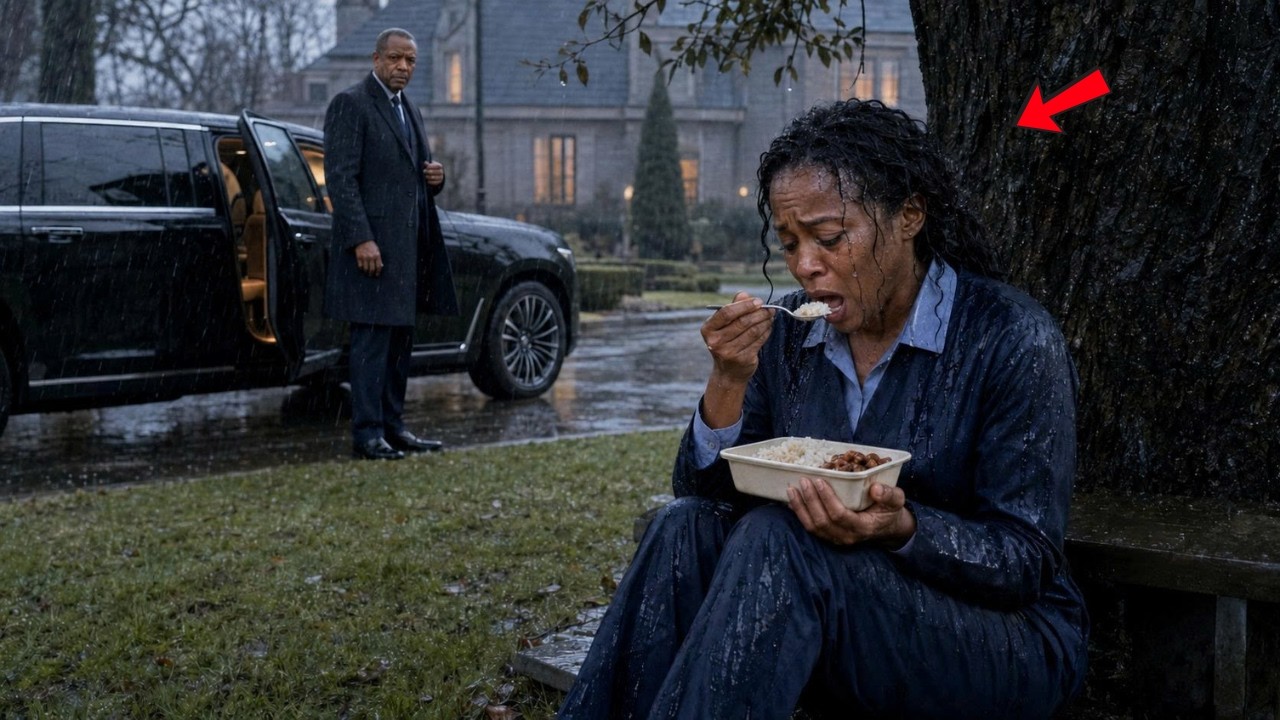
Her shoulders were trembling, not from cold—she was crying. Darius, owner of dozens of highrises, stood motionless beside his still-open car door. What he was about to discover would make the empire he had built seem cheaper than the half-eaten lunch in her hands. Weeks earlier, an investment meeting and a lawyer’s call about escrow deadlines occupied his mind.
But now he watched this woman through water-blurred glass, and he asked the housekeeper if she knew who she was. Evelyn Price, his head housekeeper of 15 years, offered a name: Renee Carter, a cleaner who had worked there for 9 months. When Darius pressed for details, Evelyn evaded, and Darius’s confusion turned into unease. He went to find Renee herself the next day.
At exactly 12:05, Renee stepped out holding a plastic container and a water bottle. She walked to the stone bench beneath the maple tree, sat with back to the house, alone. Darius approached. She sprang to her feet, her face pale.
“Do not stand up,” he said calmly. “I do not mean to disturb your lunch. ”
“It’s no trouble, Mr. Witmore.
” Her voice was quiet, careful. Up close, her exhaustion was visible—dark circles, cracked lips, reddened hands. When he asked why she ate outside in the rain instead of the break room, she hesitated, then spoke flatly. Three weeks ago, at his fundraiser, a guest named Mrs.
Caldwell said her uniform smelled of cleaning chemicals, called it inappropriate near guests, and someone suggested she eat outside. Renee had decided not to cause trouble, so she ate outside since then, smiling emptily as she said it was quite pleasant fresh air. Darius felt punched in the chest. He walked inside and confronted Evelyn.
She confirmed it, adding she had spoken to the staff who made inappropriate remarks, but Renee asked her not to make a fuss. Evelyn’s eyes turned cold as she said Darius’s guests were regularly rude to staff, treating them invisible, and he had never noticed because he never stayed long enough to see it—or perhaps because he did not consider them worth noticing. She left him standing, the floor collapsing beneath his feet. He realized he had never examined how his household employees were treated, had approved budgets without seeing the system’s cruelty, and he had become the kind of person who saw uniforms instead of human beings.
Three days later, he requested Renee’s file. It was thin. She was 39, hired through an agency, making far below what he assumed, with no health insurance for her daughter, Maya, aged 16. She took extra commercial cleaning shifts at night.
He drove to her neighborhood, parked outside her apartment, watched her laugh with her daughter through the window, realizing this was a life he had never truly seen. On the way home, he passed a parcel he’d once deemed “not worth developing”—now knowing Renee lived blocks away, that note felt cold and cruel. Desperate to understand, Darius called his old friend Terrence, who ran a commercial cleaning company, and asked him to hire him under a fake name for a night. “This is insane,” Terrence said, but he agreed.
That Friday, dressed in jeans anda canvas jacket, Darius became Curtis Boone, a new cleaner at his own building, Cascadia Tower. Renee Carter was there too. She smiled warmly at him, telling him to keep a steady pace and drink water—kindness from the heart, not the cautious formality she showed Mr. Whitmore.
The shift supervisor treated them with contempt. For four hours, Darius scrubbed toiletsand mopped floors until his body screamed. Renee moved at twice his speed, never stopping, never complaining. On the break, she showed him a worn photo of Maya, her daughter, who was applying for a nursing program alongside high school.
“I work here, work for Mr. Whitmore during the day,” she said, “and save every dollar I can. ”
“It’s not a burden,” she continued. “It’s a purpose.
”
Darius clenched his hands beneath the table. They talked more over the next three shifts—he returned to work beside her three more times. She told him about her ex-husband leaving eight years ago, about nights when she didn’t know how she’d keep going, about small dreams she was protecting. He listened, moved by her sincerity, but the more she trusted Curtis Boone, the heavier his guilt became, because the person listening was the very employer who had let her eat lunch in the rain without knowing it.
nOn the final night, he knew he had to tell her the truth. The next afternoon, he found her on the bench, springing to her feet at his approach. “I need to tell you something, and you’re going to be angry,” he said. “Curtis Boone.
That was me. ”
The color drained from her face. “You lied to me,” she said, her voice turning cold and sharp. She spoke of pouring her heart out to him about her fears during a field trip she couldn’t afford, about nights she didn’t know how long she could keep going.
“I thought Curtis understood because he was lonely too,” she said. “But that was my employer in disguise to see how workers behave. ”
“I only wanted to understand,” he said, his voice breaking. “Four hours,” she said, tears rising but voice strong.
“I’ve been juggling two jobs for eight years since my husband walked out. Do you think four hours can stand equal to eight years? ” She wiped her eyes. “I don’t need your money to compensate for your guilt.
I just need to be left alone. ”
For two weeks, she barely spoke beyond greetings, working flawlessly but walling him off. Darius tried the only language he knew—money. He prepared a check large enough to cover Maya’s entire tuition, thinking it would fix things.
She refused to take it. “You think money can fix everything? ” she said. “Kindness without respect is still a form of power, Mr.
Whitmore. You’re still deciding what’s good for me. That’s exactly how power works, only wearing a gentler disguise. ”
“Then what am I supposed to do?
” he asked, helpless. Renee looked at him straight. ” Do not try to save me isn’t needed. ” She need a workplace that did not humiliate her for the smell of chemicals on her uniform, fair pay for everyone, not just her because he felt guilty, and protection from rude guests without fear of losing her job.
“Fix the system that allowed this to happen in the first place,” she said. ” Do not just try to soothe your conscience by writing a check for me alone. ”
Darius stood silent, the envelope still in his hand, suddenly feeling strange and heavy. He put it away.
That night, he finally understood the real problem was not Renee Carter—it was the entire way he had run his life for 30 years, viewing workers as tools, confusing paying people with kindness. He thought of his mother, Odessa, who’d died young from working herself into an early grave for families that perhaps never wondered whether she was allowed to sit at their table. For the first time, he wanted to find out the truth about all the other Renee Carters around hime
The next morning, he called a meeting with Evelyn, human resources, and his lawyer. He rewrote policies: raised base pay for all household employees well above minimum, added full health insurance covering family members, expanded paid sick leave, established a confidential reporting line for employee complaints, officially opened the break room to everyone, and drafted a code of conduct requiring guests to respect staff.
He also reviewed contracts with commercial cleaners, demanding higher wages for workers in his buildings regardless of employer. Terrence warned it would increase costs and anger shareholders. “I own most of the shares,” Darius said. “I can take responsibility for this decision.
”
He did not announce these changes to Renee, no fanfare, no seeking thanks. He simply did the work quietly. Two weeks later, at a dinner with business partners, Vanessa Caldwell—the same woman who had mocked Renee’s uniform—insulted a young server named Danielle over a bleach smell. Darius set down his wine glass, cold and calm.
“Vanessa, I need you and Robert to leave my house right now. ” The table fell silent. When she protested, he repeated, eyes hard. “You insulted an employee working hard in my house, right in front of her, as if she weren’t human.
I don’t allow that here anymore. ”
Robert Caldwell pulled his wife up, face red with rage. “You’ll regret this, Witmore. ” Darius did not care.
When they left, he glanced at Danielle, still holding her tray,anda small disbelieving smile flickered across her face. He lost shared investments and a golf club membership over it. He did not care about any of it. That evening, Evelyn Price—who had never brought him anything in 15 years of work—placed a cup of hot tea she’d made him-self on his desk.
“I think you need this,” she said, then stopped at the door. “I have worked for many wealthy people, Mr. Witmore. Most of them never changed.
You’re the first one I’ve seen truly try. ” She smiled, a rare smile, then left
Six months passed without sudden reconciliation, only small, steady changes. Renee began eating in the break room with co-workers, warm and no longer forced outside. With her new salary and health insurance covering Maya, she gave up night cleaning shifts gradually—first one evening a week, then two—until she kept only the job at the mansion.
For the first time in years, she had full evenings with her daughter. Darius did not try to grow close to her, but he greeted her every morning by her real name, asked how she was briefly, sincerely. Some afternoons he found her sitting on the bench beneath the maple tree—not because she’d been pushed there, but because she liked the fresh air, only this time it was true instead of a lie she told herself
One May afternoon, Renee sat there reading her phone with a radiant expression. Darius stopped, keeping a polite distance.
“Good news? ” he asked. She looked up, and for the first time since the laundry room, she smiled naturally. “Maya just received her acceptance letter for the nursing program.
She applied by herself, wrote the essay by herself, did not need anyone’s help. ”
“I’m very happy for her,” Darius said, and meant it. “You must be very proud. ”
“Very proud.
” She put the phone away. ” With the new salary, I’ve saved enough for her first semester without taking out another loan. Six months ago, I did not even dare dream of that. ” She looked at him, eyes still cautious but no longer cold.
“I’m not saying this to thank you for saving me, Mr. Witmore. I did this myself. But I acknowledge you cleared the path for me to do it myself instead of standing in my way like before.
”
“That’s all I ever wanted,” Darius said quietlyer
“I’m still angry with you about the Curtis Boone thing,” she said directly. ” Maybe I’ll never completely forget that. But I can see that you changed, not only with me, but with everyone here. That means more to me than any apology.
”
It was not complete forgiveness, and Darius accepted it. The boundary she set proved she was protecting her own dignity, something that should never have been threatened in the first place. Around the same time, he began repairing his relationship with his daughter, Aaliyah, calling just to ask how she was—not about money or transfers. At first, she was so surprised she stayed silent.
Gradually, the calls grew frequent and genuine. At the end of May, she flew to Seattle to visit him for the first time in three years. He told her something he’d never said. “I was wrong, Aaliyah.
I gave you everything except myself. I thought money could replace being present, and I was wrong. ”
She looked at him, something softer than the familiar distance in her eyes. “I kept thinking you didn’t care because you never truly asked me anything.
You only asked how much money I needed. ”
“I know. I’m sorry. I want to do things differently if you give me the chance,” he said.
She nodded slowly, and for the first time in many years, they hugged, not because of social formality, but because they both needed it
At the end of June, Darius stood by the office window, looking down at the back garden. The stone bench beneath the maple tree was still there, but it no longer symbolized silent humiliation. It had become a place where anyone could sit, because they wanted to, not because they were forced to. He thought of his mother, of what she had once whispered to him on the cold tile floor in Tacoma—that he was going to go very far.
She had been right, but not in the way she had imagined. True greatness did not lie in highrises bearing his name. It lay in the fact that he had finally learned how to see the people who had always been there, right in front of his eyes, only waiting to be seen—as human beings, no more, no less. He walked down into the garden, sat on the stone bench beneath the maple tree, alone with the Seattle rain falling lightly on his shoulders.
This time, he did not hurry to find shelter. He simply sat there, finally seeing the people around him, as they had always deserved to be seen.