Maryan Brooks knew the dust cloud rising at the bend in the road before she heard the engines. She had just watered the last row of tomatoes while it was still dark, and now the county’s trucks were crawling toward her gate, their insignia gleaming in the early light. She stood on the porch, one hand resting on the wooden chair. A young official stepped out first, then workers in matching shirts.
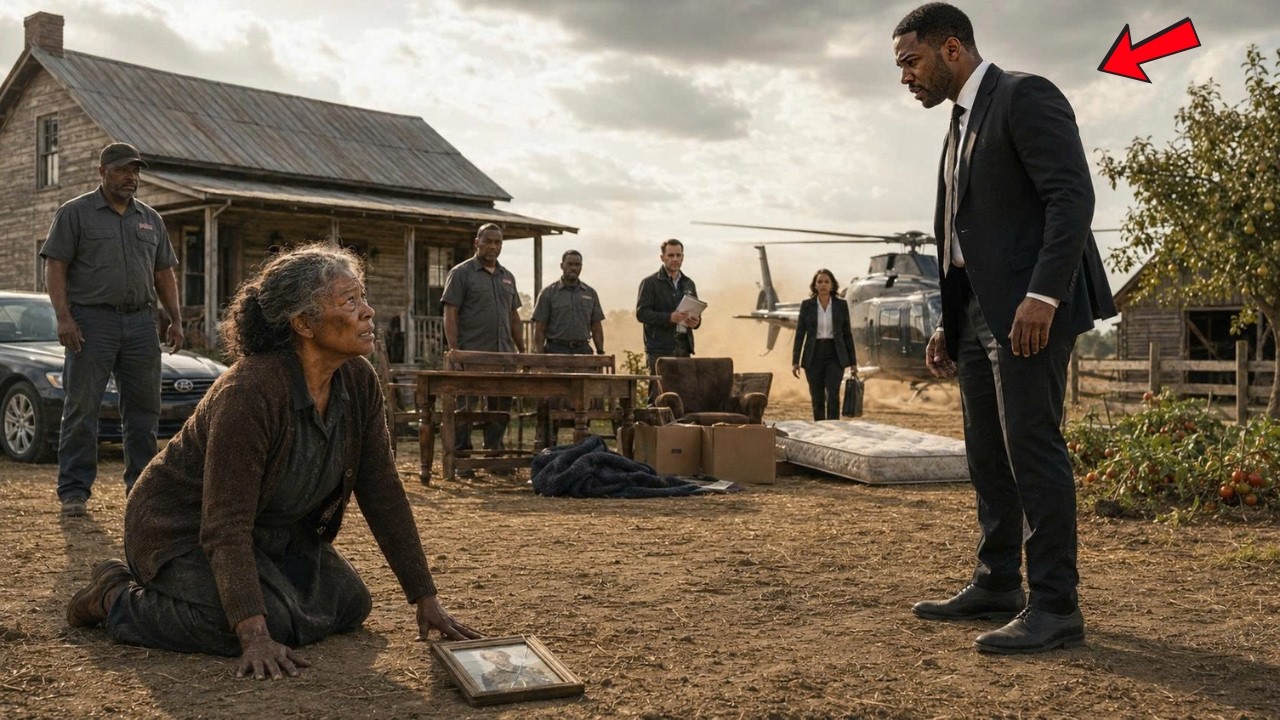
They opened the back of the truck and began unloading pallets and cardboard boxes, as if this move had been planned for years. The only problem was, no one had ever asked Maryan if she wanted to leave. For three months, she had received notices. Remediation demands.
County decisions. And finally, an order to vacate. She had read every page so many times she could recite the sentences she didn’t understand. So when the official stood before her and explained that the eviction order had taken effect, she simply listened in silence.
Some silences aren’t acceptance. They’re just the last words running out. The workers began with the dining table. Anthony had built it in the third year of their marriage, back when they were so poor they had to choose between fertilizer and shoes.
The tabletop still bore a round burn mark in the left corner from the day she had set down a hot cast-iron pot too quickly. The young man lifting the other end didn’t know that. He also didn’t know that she had spent countless evenings setting two plates out of habit before remembering only one person remained. The cupboard went next.
Then the cardboard boxes. Then the brown armchair with its worn armrests. No one shouted. No one snatched anything.
They simply turned a lifetime into objects that could be carried, numbered, and moved on. A picture frame slid off the edge of a box and fell face down onto the hard ground. The crack of glass was so faint it was lost under the truck’s engine. Maryan stepped down, walked over slowly, and bent down.
In the photograph, Anthony was in his early forties, standing among bean rows, smiling so wide his eyes had disappeared beneath his straw hat. A crack now ran across his face. There are losses you can prepare for with paperwork and months of telling yourself you’ll be fine. But it’s hard to prepare for the moment a stranger sets your memories on the ground like they’re just in the way.
Maryan pressed her hand against her knee to stand up. The pain made her stop short. Nancy Price stood outside the fence with a few neighbors. She had driven from Louisville since early morning, clutching her handbag.
Three weeks earlier, Nancy had said the compensation wasn’t really that bad, that a small house in town might be easier than thirty acres. Maryan had asked only one question then. “If I leave, how do I bring Anthony with me? ”
Nancy had no answer.
She still didn’t have one. A worker came out carrying a box of bedding, with the dark blue wool blanket on top. Maryan looked at it, then at her own hands, rough and swollen from years of labor. The young worker asked if she wanted to carry the shoes out herself.
She didn’t answer. She stepped into the yard, her left knee gave way, and she sank to the ground. Thomas Reddick, the county official, checked his watch and turned his face away. Someone outside the fence said it was a shame.
Someone else said there was no other way. Then a low, heavy sound echoed from the south. At first it was like distant thunder, then it grew thicker and steadier until everyone turned their heads at once. Twenty-two years earlier, on this same piece of land, thirty-eight-year-old Marion Brooks had been carrying a bucket of squash when she saw a small figure standing motionless at the far end of the fence.
The boy didn’t come in right away. He stood on the other side of the wire, one hand gripping a wooden post, his eyes darting between her and the road behind him, ready to vanish if he heard a strange noise. He wore a faded blue shirt too big for his shoulders, and jeans stained with dirt at both knees. His dark ankle boots had a heel nearly loose on one side.
But what Marion noticed most wasn’t his clothes. It was the way he looked at the bucket of squash in her hands. Not at her. Not at the house.
Only at the food. She had grown up in a family of six children in years when a pot of beans had to stretch across three meals. She knew a hungry child could hide many things, but the eyes rarely knew how to lie. “Are you looking for someone?
” she asked. He shook his head too quickly, then lowered his eyes to his shoes. She didn’t ask more. She picked up the bucket, took a few steps, then stopped.
“The gate isn’t locked,” she said. Ten minutes later, she set a bowl of bean soup on the kitchen table. The boy was already sitting in the chair closest to the door, his back angled toward the way out. Marion noticed, but said nothing.
She cut a piece of cornbread and set it beside the bowl, then turned to wash tomatoes to give him privacy. The spoon hit the side of the bowl very quickly. When she turned back, half the soup was gone. He ate with his shoulders hunched, his left hand close to the plate, as if afraid someone would take it away.
By the last piece of cornbread, he slowed down, broke it in half, and slipped one half into his shirt pocket. She opened the pot and ladled out more soup. He looked up. “I don’t have any money.
”
Marion set the ladle down. “This isn’t for sale here. ”
His name was Isaiah Cole. He was twelve years old.
His mother, Denise, had died after years of kidney treatment. His father, Malcolm, was also gone. After his father died, Isaiah had stayed with an aunt, then moved through temporary care placements when she couldn’t keep him anymore. No one had beaten him.
There was no horrifying story that explained the weariness in his eyes. Just rooms that weren’t his own, bags that had to stay packed, and the constant feeling that every adult was counting down how much longer he would stay. That afternoon, Isaiah helped her stack buckets of squash too fast, as if a meal had to be repaid with work. By the sixth bucket, Marion took it from his hands because his thin arms were shaking.
He stood still, his face tensing, thinking he had done something wrong. She handed him a cup of water. “Drink first. ”
That night, Marion cleared out the small room next to the kitchen and set up the single bed.
She laid out clean sheets and an old t-shirt of Anthony’s. Isaiah stood at the threshold, not stepping in. “I’ll only stay one night,” he said. Marion pulled down the curtain.
She didn’t tell him he could stay. She also didn’t tell him he had to leave. The next morning, she woke at five-fifteen and found the bed already made, the blanket folded into a neat square. Isaiah was outside, trying to lift a bucket of squash he’d been told to leave alone.
Marion took the bucket, pointed to the spigot, and said, “Wash your face first. ”
That simple sentence became his first routine at the farm. He washed, ate, then followed her to the field. The first day, she had him pick split tomatoes.
The second day, sort squash by size. The third day, she handed him a roll of twine and told him to hold it straight while she rebuilt a row of bean stakes. No one mentioned how long he would stay. He stopped asking once he noticed that two plates appeared on the table every evening without Marion needing to think about it.
Isaiah asked very little but remembered almost everything. He knew she hung the shed key on the third nail. He knew the west spigot had to be turned back half a turn or the water would spray your shoes. He knew she paused in the field around four in the afternoon, not from tiredness, but to watch which way the leaves turned against the wind.
One morning, while Marion was out delivering vegetables, he planted a row of radishes on his own. They came out crooked, running diagonally across the row that should have been straight. He tried to cover the trail with his shoe. Marion looked at it a long time.
“I suppose they need their own road, too. ”
He wasn’t sure if she was scolding him or joking, until she turned away with the corner of her mouth curved. Then Isaiah burst out laughing. It was short, a little hoarse from disuse, but it made the yard, which had known only the sounds of chickens and the water pump, feel completely different.
His past surfaced in pieces. One evening, he mentioned his mother used to cook red beans on Sundays and always put in too much pepper. Another day, he said his father could take apart any engine but always lost the screws. What he spoke of least was the time after his father died.
He only said he’d moved many times. Different rules everywhere. At some places, he couldn’t open the refrigerator without asking. At others, he had to keep everything in one bag so it would be easy to move.
He never explained why he always woke before everyone else and folded his blanket as if preparing to leave. Marion didn’t ask. She just took the cloth bag he kept under the bed, washed it, and hung it on a hook in the closet. He found it that evening, confused.
She gave him no explanation. But that night, the bag was not placed beside the foot of the bed. In November, a child services worker, Evelyn Hart, came to the farm. She wasn’t unkind, but she explained that a twelve-year-old couldn’t simply disappear from the system without proper guardianship records.
What followed were months of birth certificates, school confirmations, home inspections, and long trips into town. Marion, at thirty-eight, had never imagined she’d have to prove that there was enough food in the house and enough blankets on the bed. She signed every page. By the end of winter, temporary guardianship was approved.
Isaiah said nothing when she set the papers on the table. He read his name, read hers, then smoothed the curled corner flat with his finger. The next morning, Marion woke to the sound of a shovel scraping at hard ground. She found Isaiah at the edge of the shed with a young Bartlett pear tree she’d bought on a late-season discount.
Its trunk was so small a strong gust could tip it over. “You said this tree has to wait a long time before it bears fruit, right? ”
Marion looked at the hole he’d dug, then at his hands, red from the cold. She took the shovel and widened the hole while he held the trunk straight.
They filled the earth around the base with their hands, pressing each layer down until the tree could stand on its own. Before going inside, Marion tied a strip of red cloth around the trunk so the mower wouldn’t hit it. Isaiah looked back at it twice, as serious as if they’d just planted something far more important than a discount sapling. That spring, the pear tree grew exactly six new leaves.
Isaiah counted every one. By summer, he had grown nearly a hands-width taller, and his old ankle boots had split at the right heel. Marion sat under the kitchen light one Sunday evening, using a large needle and black thread to stitch the sole back together. Isaiah pretended to read a book.
He knew what she was doing, but didn’t look. She didn’t bring up buying new ones either, because they both knew the week’s money had already gone to the electric bill and a broken water valve. Life on the farm was never short to the point of desperation. It was only ever short enough that every decision carried weight.
Marion knew how to stretch a pot of soup an extra day with potatoes, how to cut her own portion of meat thinner without Isaiah noticing. Some days he would say he’d already eaten at school, but Marion would see the lunchbox untouched in his bag. She didn’t call him out. She simply split the last piece of cornbread in half and set one half on his plate.
When Isaiah turned thirteen, he began helping her deliver vegetables to two small shops on Saturday mornings. He remembered prices, remembered who often came up short on change, and remembered which shop owner slipped extra dollars into the payment envelope because she knew Marion would refuse it offered directly. That season, Isaiah used his saved wages to buy her a new pair of gardening gloves. They were cheap, a little too big, and so bright purple that Marion burst out laughing when she opened the wrapping.
She wore them for three years. The winter he turned fourteen was unusually cold. Ice covered the water trough most mornings, and Marion had to knock it loose with a shovel handle. Isaiah started coughing in early January.
By the third day, he had a fever and had to sit down in the middle of stacking firewood. Marion took him to the clinic, then to the hospital. Pneumonia. He needed a few days of monitoring.
There was no scene of chaos, only small things that frightened Marion more than any ambulance siren. His shoes sitting neatly beneath the bed. The cup of water he hadn’t finished. Her coat rolled into a pillow on the chair because she refused to leave the room overnight.
Isaiah slept a lot. Every time he woke, he asked how the farm was doing, as if the vegetable rows in mid-January were the most important thing in the world. By the second day, Marion received an estimate of the remaining costs after insurance and assistance. It wasn’t a fortune, but for a woman who had just replaced a water pump and still had two months of low income before planting season, it was large enough to make her sit in the car for nearly ten minutes before putting the key in the ignition.
That night, she opened the small wooden box on the top shelf of the closet. Inside were a few of Anthony’s things. A tie clip. Two ticket stubs from a baseball game.
A black-faced mechanical watch with a scratched metal band, the one he had worn every day from opening the shed in the morning until washing his hands before dinner. Since his death, she had never worn it. She only wound it a few times a year just to hear the second hand ticking. The next morning, the watch left the house in her coat pocket.
She sold it to a used watch shop in Bowling Green, receiving just enough to cover most of the balance and buy the extra medicine Isaiah needed. Isaiah discovered this almost two months later, looking for the tie clip for school picture day. Marion watched from the doorway and knew he understood. “He’ll pay you back for it someday,” he said.
She meant to tell him not to say that, but he looked up before she could speak. “Not just the watch. All of it. ”
Marion walked over, set her hand on his hair, and pulled him to his feet.
Outside the window, the Bartlett pear tree was putting out small green buds. And on the dirt road in the distance, an unfamiliar black sedan was slowly turning the bend toward the farm. It stopped outside the gate for nearly a minute, long enough for Marion to see the sunlight reflect off the windshield, then slowly turned around. The person inside didn’t step out.
Isaiah only glanced over once, but Marion noticed the license plate was from Louisville. Three days later, a thick envelope arrived. It was a letter from a law firm inquiring about the guardianship status of Isaiah Cole, asking Marion to get in touch with a representative of the paternal family. She read it twice at the kitchen table.
Isaiah saw his name at the top of the page, but she only told him someone was looking into his father’s old records. The contact stopped there. Marion’s guardianship was confirmed, and for nearly two years, nobody pressed further. It was only when Arthur Cole’s health began to decline that the sedan returned.
By then, Isaiah was sixteen, nearly as tall as Marion, and strong enough to carry two buckets of tomatoes at once, though she still pretended not to notice. The pear tree had grown taller than the shed roof. That spring, it had produced its first white blossoms, but hadn’t held onto any fruit. Marion said it was still young.
Isaiah said it was just being careful. The man who stepped out of the back seat had neatly trimmed gray hair, a dark suit, and the bearing of someone used to others stepping aside for him. Arthur Cole. Isaiah’s grandfather.
Isaiah recognized the last name before he recognized the face. His father had once kept an old photo of himself with Arthur in front of a red semi-truck. Malcolm had been young, smiling widely. Arthur had stood beside him, one hand on his son’s shoulder, but his face barely smiling at all.
The conversation took place at the table Anthony had once built. Arthur didn’t say much. It was the lawyer who opened the folder and explained what had been prepared: a private high school in Louisville, an education fund, a college program, housing, health care, and later a position at Cole Transit Group if Isaiah proved capable. No one used the word inheritance.
But it was present in the room as clearly as the clock on the wall. Arthur had built the trucking company from three rented trucks into a network spanning multiple states. Malcolm had left the family after a long disagreement over how to live his life and his marriage. Arthur had not searched for his son while there was still time.
He didn’t try to deny it, and he didn’t apologize for it either. He only looked at Isaiah a long time. “I let too many years slip by. ”
Isaiah did not answer.
Marion looked down at her own hands. They were rough, knuckles swollen from years of labor. Across the table were Arthur’s hands, clean, wearing a thin watch probably worth more than her truck. The difference didn’t make her feel lesser.
It only made her understand something she didn’t want to understand. She could give Isaiah a home. Arthur could give him doors she had never been allowed to walk through. That evening, after the sedan left with a promise to return in three days, Isaiah didn’t finish his meal.
“I’m not going,” he said. Marion broke apart the cornbread. “Arthur knows nothing about you. Doesn’t know you hate soft-cooked carrots.
Doesn’t know the pear tree needs extra watering in July. Doesn’t know you used to wake before dawn just to make sure you could still stay the next morning. ”
He finally looked straight at her. “Just tell me to stay.
”
If Marion said that one sentence, Isaiah would stay. She knew it as surely as she knew rain was coming when the leaves turned their pale undersides to the sky. But she also knew Isaiah’s mind ran faster than the roads around this farm. He read economics books borrowed from the library alongside engine repair manuals.
He had taught himself spreadsheets to calculate seed costs for her. She set the bread down. “You don’t owe me staying. ”
Over the following three days, Arthur’s lawyer worked with the agency handling Isaiah’s records.
Because Marion was his legal guardian, no car could simply arrive and take him away. Marion herself had to sign the request to transfer guardianship. She read the paper a long time before putting pen to it. On the last line, her hand shook and the signature slipped off the ruled line.
On the morning the process was approved, the black sedan appeared again. In the kitchen, Isaiah sat bent over his dark blue ankle boots, the ones Marion had mended so many times, slowly undoing each lace. He took them off, set them side by side beneath the kitchen cabinet, then went to get the new shoes Arthur had sent the day before. They were black, the leather stiff, the laces bright white.
They fit better and were cleaner than almost anything he had ever worn. But Isaiah managed to put on only one before stopping. He bent down to look at the blue shoes on the floor, the right heel still bearing the black stitches Marion had sewn. “I’m leaving these here.
”
Marion was folding shirts on a chair. She froze. “So I’ll still have something to come back for,” he said, trying to sound light, but his voice went hoarse. Marion didn’t laugh.
She simply folded the shirt once more, smoothed the crease flat, and placed it into the small suitcase Arthur had brought. Before the car reached the gate, Marion opened the drawer beside the stove and took out a faded recipe card. On the front was her bean soup recipe, the handwriting crowded between old grease stains. On the back, she had written her name and the farm’s address in large, clear letters.
She pressed it into Isaiah’s hand. “In case you forget. ”
Isaiah looked at her as if the words had hurt him. “I won’t forget.
”
Marion knew that, but she also knew something else. Not every parting happens because people forget each other. Sometimes life simply piles one day on top of another until the promise remains intact, but the road leading back to it becomes buried. Arthur didn’t rush them.
He stood in the yard at enough distance for Marion and Isaiah to have their final few minutes. Isaiah hugged her very tightly. She felt his shoulders shaking, but didn’t prolong the embrace. She was afraid that if she held on a few seconds longer, she would be the one to say the words she’d spent three days trying to swallow.
He got into the car without looking back. The sedan drove the length of the dirt road, leaving a thin layer of dust hanging over the bean rows. Marion stood in the middle of the yard until the sound of the engine disappeared. Afterward, she went inside.
She saw the two bowls still turned upside down on the rack and, out of habit, took both down before realizing she only needed one. In the first few months, letters arrived regularly. Isaiah wrote about his new school, about jackets with crests, about classes he never imagined taking, about a library so large it took nearly a week to remember the way between floors. He complained the dining hall food was too bland, that no one knew how to cook beans properly, then asked whether the pear tree had grown taller.
Marion always wrote back. She wrote about a long rainy season, a tractor belt breaking, a stray cat that had started sleeping under the shed, and a pear tree that had produced two small fruits, though one had fallen before ripening. She never wrote about the evenings when the house was so quiet she could hear the refrigerator click off. She never mentioned that the shoes were still sitting beneath the kitchen cabinet, exactly where Isaiah had left them.
In the first year, Isaiah sent almost one letter a month. In the second, they grew sparser. Arthur controlled his class schedule, summer programs, and internships. Letters passed through the family office before being sent.
Some were held back because Arthur felt Isaiah was clinging too much to the past. Some letters from Marion were moved onto a different stack, set aside, then forgotten inside folders no one ever opened again. There was no scene of anyone tearing up a letter in front of Isaiah. There were only letters that never arrived.
Marion kept writing for nearly three more years. Then she began to slow down, not because she ran out of things to say, but because each time she opened an empty mailbox, it took a little more effort to remind herself that a child growing up didn’t mean he had betrayed her. By the time he turned eighteen, Isaiah was old enough to call on his own. But the distance had taken on a new shape.
In his mind, the promise he’d made at fourteen remained word for word: “I’ll pay you back for it someday. All of it. ”
He looked at himself in his dorm room, looked at the thin wallet holding the recipe card folded into fourths, and told himself to wait a little longer. Wait until he had a job.
Wait until he had earned money. Wait until he could return without needing to ask Marion for anything ever again. That spring, the pear tree produced its first real harvest. Marion picked nine fruits.
She set the finest one on the small plate at the far end of the table, the spot where Isaiah used to sit, and left it there until small brown spots appeared on its golden skin. In the end, she ate that pear alone. She cut away the soft part, divided the rest into four pieces, and stood by the sink eating each piece slowly. It was sweeter than she expected.
She placed the seeds in her palm, looked at them, and laughed at the absurd thought that maybe she should send them. She didn’t. From that year on, every season the tree bore fruit, she still set the finest one aside on that plate for a few extra days before eating it. Time on a farm doesn’t pass by the calendar.
It passes by tin roofs that need replacing, fences that lean a little further after each winter, engines that once started on the first try and now need three. Marion’s knees began to ache when the weather turned cold. Her hair grayed at the temples. The old pickup was replaced by another old one, and the purple gloves Isaiah had bought wore through until the index finger was torn.
But she kept them in the tool drawer. The dark blue shoes never left the kitchen. Once, when Nancy Price came over for coffee, she bent down to look at the dust-covered shoes and asked Marion why she didn’t just throw them out. Marion paused mid-pour.
“They’re not trash yet. ”
Nancy looked at her, then at the shoes now so worn they barely held their shape, and didn’t ask anything more. In Louisville, Isaiah’s life moved to a different rhythm. After college, Arthur didn’t give him a nice office.
He sent him down to a distribution warehouse, where he started out checking inventory, tracking truck schedules, and learning how a small error on a data sheet could leave dozens of drivers waiting overnight. Arthur said anyone who wanted to run the company had to know the smell of the warehouse floor before the smell of the board room. Isaiah didn’t object. He worked harder than necessary, not to please Arthur, but because since he was twelve, he had grown used to proving his worth before anyone got the chance to ask.
While others took lunch breaks, he reviewed shipping routes. When the system ran into trouble, he stayed late to find where things fell through. Within a few years, he was put in charge of one distribution center, then two, then an entire region. Every time he was promoted, he thought of Kentucky.
The first time he received a paycheck large enough that his bank account no longer frightened him, Isaiah opened his wallet in his small apartment. The recipe card was still tucked behind his driver’s license, folded into fourths. Marion’s handwriting had faded. He picked up his phone, looked up the county’s main line, then set it down.
Not yet, he thought. One more year. When he bought his first car with his own money, he took the card out again. When he became a regional vice president, he did the same.
The old promise slowly changed shape. At fourteen, it had been a child’s word of thanks. By twenty-five, it had become a standard he never felt he lived up to. A bouquet seemed too little.
A phone call after years of silence seemed too late. Going back just to say he missed her felt selfish. So Isaiah kept waiting for a better version of himself. Arthur aged faster than the company did.
After a decline in health, he gradually withdrew and handed more authority to Isaiah. There had never been easy affection between them, but in his final years, Arthur stopped asking how many contracts he’d won and sometimes asked instead whether he’d had dinner yet. For a man like Arthur Cole, that was almost a way of apologizing. By the time Isaiah turned thirty-two, Arthur handed over control of Cole Transit Group.
Isaiah now had everything he had once thought he needed before he could go back: money, position, the ability to make powerful people listen. But the years of silence had become a wall. The longer it stretched, the harder the first sentence became. In Kentucky, Marion knew nothing of those battles.
She only knew the summers were hotter, tractor repairs cost more, and more farms around her were being carved up by new fences and company signs. The Prices sold part of their land. The Dawsons moved to Tennessee. Fields that once flowed together into a single stretch of green began to disappear.
One morning in early autumn, Marion drove out to get the mail and saw two orange survey stakes near the edge of the road. Across the fence, a silver SUV was parked on land that used to belong to the Dawsons. Two men in reflective vests stood beside a surveying tripod. One pointed toward her farm, drawing a sight line straight across through the Bartlett pear tree, now taller than the shed roof.
Three days later, a white envelope explained it all. A company called North River Distribution was proposing to build a new distribution center south of Bowling Green. On the attached map, most of the surrounding land had already been shaded gray. The Brooks farm sat like a small patch of green wedged between large gray blocks, and the planned road ran almost straight through her eastern edge.
At first, it was only a purchase offer. The number was large enough that Marion had to read it twice. Nancy called that evening. Her family had sold their remaining land and planned to move to Louisville for good.
She said the money could let Marion live comfortably for the rest of her life: no more fixing the shed roof, no more waking up at two in the morning because the water pump was making a strange noise. Marion listened to all of it, then looked out the kitchen window. The pear tree stood bare in late autumn. “Comfortable where?
”
Nancy was quiet a long time before saying that sometimes holding onto a place just for the memories isn’t the best thing to do. The offers kept climbing. Then they stopped climbing. In their place came letters from the county planning office.
The name signed on most of the paperwork was Thomas Reddick. Thomas was fifty-three and had worked for Warren County for nearly twenty years. He wasn’t the type who enjoyed watching people lose their homes. His colleagues considered him a man of principle, a man of few words who rarely let emotion interfere with his work.
What they didn’t know was that Thomas had learned to see land through a very particular emotion since he was a boy. His father had once owned a tobacco farm less than ten miles from there. When the industry declined, buyers began showing up one after another. Thomas’s father refused them all, borrowed money to plant one more season, then another, always believing that if he just held on one more year, things would go back to how they were.
They never did. The family lost nearly all their savings before he finally agreed to sell. Thomas was twenty at the time. He remembered clearly his mother sitting in the dark kitchen adding up bills on a calculator while his father kept insisting the land belonged to the family and no one had the right to force them out.
From then on, Thomas believed one simple thing: sometimes people call their fear loyalty. When the Brooks farm file landed on his desk, he saw a sixty-year-old woman living alone on thirty acres, a deteriorating shed roof, an outdated electrical system, and a major project that needed exactly that corridor of land to complete its transit route. In Thomas’s eyes, Marion wasn’t someone who needed to be defeated. She was someone who hadn’t yet understood that the time to let go had come.
That belief caused small boundaries to start shifting. A safety report on the shed, originally calling only for repairs, was folded into the master file as a more serious hazard. A zoning provision meant for manufacturing structures was applied broadly to Marion’s vegetable packing area. A transit route proposal that hadn’t yet completed its approval process was referenced in letters as though the direction was all but certain.
Each action was small enough that no one would leap out of their chair over it. But they piled on top of each other. Marion received a notice to repair the shed. She used her savings to replace two support beams.
The next month came a notice about the outdoor wiring, then the equipment shed, then the driveway. Every time she resolved one issue, another envelope appeared. By early spring, she had started carrying a chair out to the mailbox because her knees could no longer bear standing under the sun to read long pages. Nancy called once more.
“Marion, sell it. You’re spending everything you have just to prove you have the right to stay. ”
Marion sat at the kitchen table with a repair invoice and the latest notice in front of her. Outside the window, the Bartlett pear tree was blooming white across an entire corner of the yard.
There are things that, once you sell them, no amount of money can buy back. Two weeks later, an envelope bearing the county’s seal was hand-delivered. Marion signed for it on the porch, took off her glasses to clean them, then opened it. Inside was no longer an offer, nor a repair notice.
The first line stated the date of the final inspection. Near the bottom of the page was a request to enforce the eviction order. And beneath Thomas Reddick’s signature was a date circled in red ink. The eviction was less than three weeks away.
Marion stood by the window a long time after reading it. The date slipped into even the most ordinary tasks. When she watered the tomatoes, she remembered it. When she packed vegetables into crates, she remembered it.
At night, her eyes landed on the calendar beside the refrigerator, where a square near the end of the month was marked in red. She still worked every morning. Not because she believed a few rows of vegetables could change a county decision. She simply didn’t know how to live any other way.
The beans still needed picking before they grew tough. The ripe tomatoes still had to come off the vine. The pear tree still needed its dead branches pruned, even though people might come in a few weeks and tell her the place was no longer hers. Nancy called almost every night.
Every time, Marion listened, thanked her, then said she was fine. On the final call, Nancy started crying before she could finish her sentence. She had contacted a lawyer she knew, but the cost was far beyond what Marion could afford, and the county’s file had grown so thick that every page seemed to spawn another. Marion didn’t blame Nancy.
She set the phone down, opened the low cabinet, and looked at the dark blue shoes still sitting inside. After nearly two decades, the rubber had turned yellow, the stitching dry and stiff. But their shape still reminded her of a sixteen-year-old boy slowly untying his laces to put off the moment he had to leave. More than four hundred miles away, Isaiah Cole was sitting at the head of a long table on the twenty-eighth floor of Cole Transit Group’s headquarters.
That morning’s meeting had been six months in the making. North River Distribution, the company that had spent hundreds of millions expanding across Kentucky and Tennessee, was now facing financial trouble after several projects ran over budget. Cole Transit had the opportunity to acquire most of their real estate at a price Arthur would have called a gift for anyone patient enough to wait for it. Isaiah didn’t see it as a gift.
He had learned from Arthur that a cheap deal usually just meant someone else was trying to sell you a problem that hadn’t yet been called by its right name. So Claire Whitman and the legal team had to review every property, every permit, every land use right. Claire was the kind of person who could silence a room of ten just by saying she’d found a footnote that didn’t line up. That morning, she stopped on a project near Bowling Green.
There was one parcel not yet cleared. North River’s records stated the issue would be resolved through an eviction procedure before the deal closed, but the sequence of paperwork left her uneasy. A shed repair report had been used as the basis for a broader land use issue. An unfinished transit proposal appeared in later documents as though it were already established.
It wasn’t enough for Claire to conclude wrongdoing, but it was enough to ask that things be paused. Isaiah was still looking at the cost table when he asked for the address. Claire read out the street name: Peterson Ridge Road. Isaiah’s finger stopped.
She continued with the parcel number, then the owner’s name. Marion Brooks. The pen dropped from his hand onto the table. No one understood why their boss was suddenly looking at Claire as if she had just spoken the name of someone who had died.
He reached into his jacket’s inner pocket and took out the leather wallet, replaced three times, but always holding the same thing in its deepest compartment: the recipe card folded into fourths. The paper had gone soft as cloth, one corner nearly torn through. Isaiah turned it over. The address matched.
One line was printed by machine in legal records worth hundreds of millions. The other was written in the handwriting of the woman who had once set a bowl of soup in front of him when he was twelve years old and never asked how he would pay her back. “When are they carrying out the order? ” he asked.
Claire opened the appendix. Her face changed before she answered. “This morning. ”
The chair scraped back hard as Isaiah stood.
“Clear my schedule for today. ”
He was calling the company’s aviation department as he walked out. In the elevator, he no longer thought about needing to be richer or more successful before he could go back. He only asked Claire whether the lawyers in Kentucky could file an emergency motion to halt the eviction before he arrived.
The motion was filed just as the helicopter left Louisville. Claire sat across from Isaiah, the file open on her knees, while he barely looked down at the pages. Through the window, the fields of Kentucky slid past below. He had flown over this land dozens of times on business trips, had seen signs pointing toward Bowling Green and told himself he would come back another day.
But this morning, every minute of delay carried a specific shape: a table being carried out of a kitchen, a door being locked, a sixty-year-old woman standing and watching the place she had lived more than half her life turned into a completed case file. At the farm, Marion was still sitting on the ground when the sound of the engine grew loud enough to drown out the truck. Wind from the rotor blades swept dust across the yard, sending papers flying into the grass. Thomas Reddick looked up as the helicopter descended onto the open ground to the west, right across from the tomatoes Marion had watered that morning.
The cabin door opened before the dust had settled. A man stepped down. Behind him came Claire, clutching a document case to her chest. Marion didn’t make out his face right away.
Her knees still ached, her hands still covered in dirt. The man crossed the yard, looked at the outdoor table, the armchair, the cardboard boxes, then stopped at the broken picture frame by her feet. For a brief moment, his steps slowed. Marion lifted her head.
She looked at the short-cropped hair, shoulders far broader than she remembered, the face of a man who had lived long enough that youth remained only in a few features. But there were things time couldn’t change. The way he stood with his right foot slightly angled. The small scar near his eyebrow.
The eyes that still looked at her the way that boy once had, sitting closest to the door because he hadn’t yet believed he was allowed to stay. For nearly two decades, Isaiah had imagined this reunion in hundreds of ways. In his imaginings, he always had a speech prepared, an apology good enough, a thank you big enough. None of those versions had Marion sitting in the dust with Anthony’s broken picture frame beside her feet.
Isaiah knelt down a small distance from her. “I’m home. ”
Just those three words made Marion turn her face away. She raised the back of her hand to her eyes, but the dust on her skin smeared into a brown streak across her cheek.
Isaiah didn’t hug her right away. He stayed there, at the same level as her, as if he still remembered a rule Marion had once taught him: sometimes a person in pain doesn’t need to be pulled up before they’re ready to stand on their own. Claire walked over to Thomas and the official overseeing the eviction. She didn’t raise her voice.
She presented the electronic confirmation of the emergency motion, along with a document confirming Cole Transit would not complete the deal if clearing Marion’s parcel remained a required condition. The irregularities in the file were laid out clearly: a repair report whose scope had been expanded, an unfinished transit proposal used as grounds, a chain of procedures that needed to be reviewed by the court. Thomas read for a long time. Part of him still believed Marion would have an easier life if she sold.
But for the first time, he had to face the possibility that his own belief had crept into how he read rules never written to serve his own fear. The county official’s phone rang a few minutes later. Confirmation had come through from the court. The eviction had to be paused while the file was under review.
The workers carrying the furniture stopped. No one cheered. Only a different kind of silence settled over the yard. Two weeks later, an independent review found that certain zoning grounds had been applied beyond the scope of their approval.
The county withdrew the eviction order. Cole Transit Group removed Marion’s parcel from the route plan, forcing the project to redesign its layout. Thomas was reassigned off the file during the internal review. That afternoon, as the last of the belongings were brought back into the house, the same young worker who had carried the dining table out now helped lift it back through the kitchen door.
Marion walked behind them. When the table was set down in its old spot, she reached out and touched the round burn mark in the left corner, just once. Then she went to get a cloth to wipe away the dust. Isaiah didn’t buy her a mansion.
He called someone to fix the shed roof, replace the old wiring, and reinforce the porch. Marion argued over every invoice until Isaiah stopped telling her the numbers. On the first afternoon everything had truly settled, they walked into the kitchen. Isaiah looked down at the foot of the cabinet.
The dark blue ankle boots were still there. He stood motionless so long that Marion had to pull out a chair and sit down. Isaiah bent down and lifted the shoes with both hands. The black stitches Marion had sewn years ago had gone stiff, a few places nearly coming undone.
He slid his fingers through the heel and laughed while tears fell onto the back of his hand. Marion opened a drawer and took out the old pot. “Do you still eat bean soup? ”
Isaiah set the shoes down on the chair beside him, took the recipe card, soft as cloth, out of his wallet, and set it on the table.
Marion looked at the paper, worn white along its folds, then turned to the cabinet and reached for the bag of beans still sitting on the same shelf she had kept them on for all these years. She poured them into the old pot. Isaiah stood by the sink, washing vegetables, clumsily asking if she remembered whether he liked his soup thick or thin. Marion didn’t answer right away.
She simply added one more cup of water to the pot, the exact amount she had always used back in the years when Isaiah still sat in the chair closest to the door. Outside the window, the Bartlett pear tree swayed gently in the wind. On the chair beside the table sat the blue shoes, too worn to ever be worn again. Beside them lay the recipe card, softened by someone opening it far too many times.
Perhaps a home is never made only of wood, nails, or a piece of paper certifying ownership. Sometimes it’s made of a chair someone keeps empty. A pair of shoes no one is willing to throw away. A recipe known by heart.
And a door that, after all those years, the one returning still knows he is allowed to walk through.


