Isaiah Bennett stood at the kitchen window of his million-dollar mansion, watching for the third week straight as his cook, Danielle Carter, slipped out the back gate with paper bags full of untouched food. He had said nothing. He had told himself it was none of his business. He was wrong.
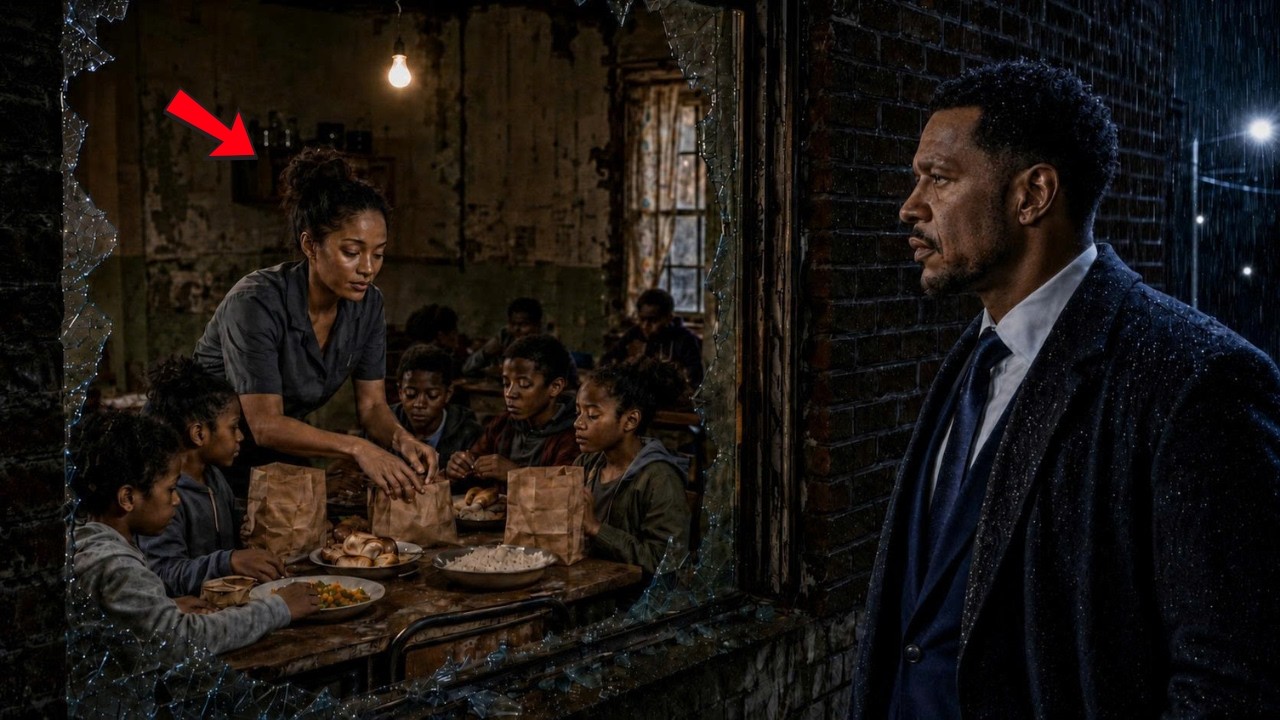
One rainy Friday night, he finally put on his coat and followed her into the Atlanta downpour, through suburban streets into a part of the city he had never set foot in. She stopped at an old apartment building with stained brick walls and broken windows patched with tape. She pushed open the rusted iron door and disappeared inside. Isaiah pressed himself against the damp wall, peering through a cracked ground-floor window.
He expected to catch her selling the food, or giving it to a struggling relative. What he saw made his chest tighten. Danielle sat at a small, scratched wooden table beside her nine-year-old daughter, Aaliyah, who was reading aloud from a book. Around them, five or six other children bent over notebooks or stacked old textbooks.
The food containers were set down in the middle, steam still rising. Danielle’s voice was gentle as she guided the little girl through each word. A boy ran in, soaked from the rain. “Miss Danielle, I finished all my math homework today.
”
“Then wash your hands first, young man,” she replied, her voice warm. Isaiah watched a quiet rhythm unfold. Wash hands. Finish work.
Then dinner. No one forced it, but everyone followed it. He noticed a little girl curled in the corner, sleeves pulled over her hands, keeping her distance. Danielle didn’t call her out in front of everyone.
She simply placed a folded sweater beside her seat and said, “I bought the wrong size. Try it on for me and see if it fits. ”
The girl hesitated, then picked up the sweater and held it to her chest like a treasure. Isaiah had signed dozens of charity checks.
He had stood beside signs at donation ceremonies while photographers took pictures. But he had never seen kindness given this way—quietly, without display, designed so the receiver never felt like a charity case. He stood in the rain for a long time, watching. He thought about his former fiancée, who had ended their engagement three days after they staged a story of his company going bankrupt, then started dating his best friend.
For years, he had looked at every kindness with suspicion, wondering what people wanted from him. But this, witnessed through a broken window with no camera and no audience, wavered that suspicion. He thought about the $20 million he had spent renovating his garden, the yacht that never went to sea, the luxuries that had never made him feel anything like what he saw through that window. The next morning, Danielle stood at the stove as usual.
She placed a cup of coffee before him and said, almost naturally, “One spoonful of sugar, but only after the coffee has cooled a little. ”
Isaiah was stunned. He had never told anyone that habit. “You remembered?
”
“I just noticed,” she said with a light smile. After that, he started seeing her everywhere. When a young kitchen assistant dropped a tray of bread and trembled in fear, Danielle knelt beside him. “It was just an accident,” she said.
“If we spend our whole lives afraid of mistakes, we’ll never dare to learn anything new. ”
Isaiah stood in the doorway, unnoticed, realizing she was kind not because anyone was watching, but because that was who she was. That evening, he stopped her at the back door as she reached for her paper bags. “I followed you last night,” he said.
Danielle turned pale, her grip tightening on the bags. “If taking the leftover food violates the rules, I’ll stop immediately. I’ll resign. ”
“Do you really think I’m here because I’m angry?
” He softened his voice. “I’ve kept thinking about one thing. You work twelve hours here, use your own wages to support children who aren’t related to you, and you ask for nothing. I truly don’t understand why.
”
Danielle smiled sadly. “My answer is a long one. The children are waiting for me. If you still want to know, I’ll tell you tomorrow.
”
She left before he could say another word. The next afternoon, she finished early and returned to the apartment. When she opened the door, Isaiah stood there in a simple dark coat, looking nothing like the powerful employer she knew. “You’re already here,” she said, stepping aside to let him in.
After dinner, when the children were occupied, she led him to the fire escape that overlooked a small concrete yard. There, she told him her story. “When I was eight, I lost both my parents within a year. Relatives said they couldn’t take another child.
Others simply shut the door. One evening I sat outside a grocery store, too tired to keep walking. My elementary school teacher happened to walk by. She didn’t ask what I was doing.
She sat down beside me, bought me a loaf of bread, and talked with me until dark. “The next day she came back. The week after, she asked if I wanted to live with her family. They weren’t rich, but they always found a way to add another chair.
She told me, ‘Poverty only describes your circumstances right now. It has no right to decide who you are. ’”
Danielle’s eyes filled with tears. “I kept the first paper bag she gave me that day.
It’s old and creased, almost torn, but I can’t throw it away. It reminds me I was once on the other side of the door, waiting for someone to open it and give me a chance. ”
She made a promise to herself after that: if she could afford to feed one hungry child, she would. If one became five, she would feed five.
If five became twenty, she would find a way. Isaiah listened without interrupting. Then, standing on that fire escape, he told her his own story. The staged bankruptcy.
The fiancée who left in three days. The friend she married instead. “I think she saved my future,” he said. “The mistake was believing I would never meet anyone sincere again.
”
Danielle smiled gently. “I’ve trusted the wrong person too. Aaliyah’s father left when I was six months pregnant. For a long time, I wondered if I should ever trust anyone again.
But if I closed my heart, I’d teach Aaliyah the wrong lesson. I want her to believe there are still kind people in this world, even if you have to travel a long way to find them. ”
They stood in the quiet breeze, both carrying wounds, no longer feeling they had to bear them alone. A few days later, Isaiah drove Danielle to a low hill overlooking Atlanta.
Empty land stretched before them. “I bought this land years ago and never knew what to use it for,” he said. “I think I’ve found its purpose. A real place.
Not just somewhere to hand out food, but a place that gives people hope. ”
Danielle felt tears in her eyes, but she didn’t nod immediately. “Before you decide what to build, I want you to meet every family in that apartment building. Sit down.
Listen to what they truly need. Don’t decide for them just because you have money. ”
He was confused. “I thought helping meant acting quickly.
”
“There’s a difference between helping and giving charity. Charity is when the person with more decides for the person with less. Real help begins with listening, allowing people to decide their own lives. ”
He nodded slowly, remembering every word.
The following week, Isaiah cleared his entire meeting schedule for three days and knocked on every door in that building with Danielle. One man, who had just lost his job, looked at him bitterly. “Are you here to do charity? Take a few pictures and leave?
”
Isaiah sat down on an old plastic chair. “I’m here because Danielle told me I need to listen before I do anything. I didn’t bring a plan. I only want to know what would actually help your family.
”
The man began to talk about choosing between night shifts and staying home with his children, about his oldest son repeating a grade because no one could help with homework. Behind almost every door, a different story echoed, but the need was the same: not money, but opportunity and someone who believed they deserved it. Three weeks later, Isaiah bought an abandoned warehouse a fifteen-minute walk from the apartment building. This time, every design decision was made with the families who would use it.
Danielle led the community kitchen. Evelyn took charge of the library and after-school tutoring. Isaiah handled the day care, employment counseling, and an emergency fund managed by residents themselves. Over six months, the building took shape.
Aaliyah, now reading fluently, often followed her mother to the construction site. “I’ll be able to read books here every day, right, Mom? ”
“That’s right, my girl. And you’ll help the other children learn to read, too.
”
Seven months after that rainy night, the Bennett-Carter Community Center opened. A large wooden sign stood above the door, with a smaller line beneath: A place to eat, to learn, to believe. At the ribbon-cutting, Evelyn took the scissors from her son’s hand and placed them in Danielle’s. “This should be cut by the person who built all of this.
If you hadn’t opened the door for those children, this place would still be an abandoned warehouse, and my Isaiah would still be sitting alone behind his reports. ”
Danielle’s eyes filled with tears as she cut the ribbon. The children rushed inside, their laughter echoing through the halls. At the ceremony, Isaiah spoke without a prepared speech.
He shared a number that troubled him more than all the others: children in poverty who aren’t reading proficiently by third grade are three times more likely to drop out. “But only when a child is educated, respected, and trusted to believe they have a future can their entire life truly change. That’s what I learned—not from a financial report, but from a woman who taught me the true meaning of giving. ”
Then nine-year-old Aaliyah stepped up to the podium, holding a sheet of paper covered in her own handwriting.
Her voice was small at first, then grew stronger. “A year ago, I was afraid to read aloud in class. My mother told me that poverty only describes your circumstances right now. It has no right to decide who you are.
Today, I can read. And I think if there had been a place like this when my mother was little, maybe she wouldn’t have had to struggle so much. I thank Uncle Isaiah. I thank Grandma Evelyn.
And I thank Mom for giving me and all the other kids here a chance to believe we can become anyone we want to be. ”
The courtyard erupted in applause. Aaliyah ran into her mother’s arms. Isaiah walked over to Danielle as the crowd dispersed, the afternoon sun washing everything in gold.
“You didn’t just carry food out of my kitchen that night. You changed the way I see money, dignity, and the true value of a human being. ”
She smiled, her eyes still wet. “I didn’t do it alone.
”
“No,” he said, holding out his hand. “We did it together. ”
She placed her hand in his without hesitation. In Isaiah’s coat pocket, carefully folded, was a brown paper bag, exactly like the kind Danielle had used that year.
He had asked her for one the week before, without explaining why. He kept it as a reminder that sometimes the thing that changes an entire life begins with the simplest things.