“Hey, you—the Black guy with the busted light—pull that heap of junk over. ”
A cruiser screeched in, cutting off the Buick. Morgan checked his mirror. Tail light was fine.
“Officer, there’s nothing wrong with my car. ”
“I say it’s broken. It’s broken. ”
Harmon yanked the door open and hauled him out.
“Pathetic. Can’t afford a decent car, yet you talk back. ” He flung Morgan’s papers onto the asphalt. “This license even real?
”
“That’s my license. You’re accusing me? ”
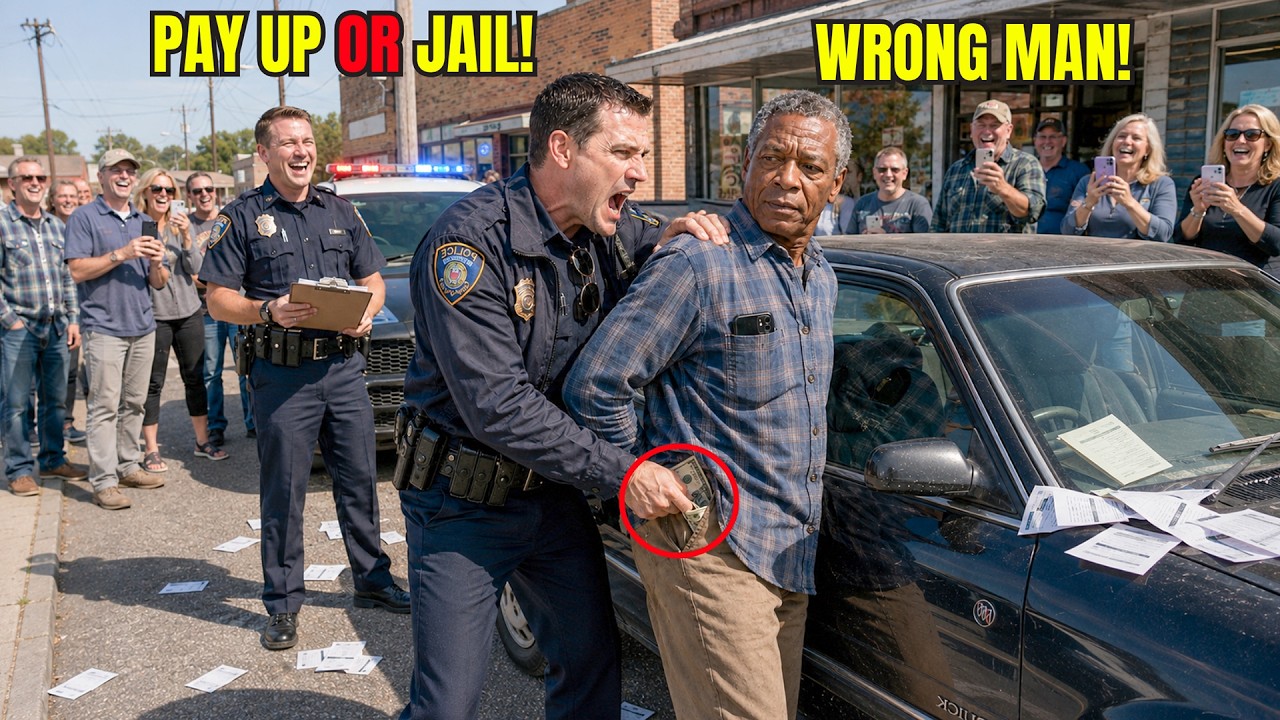
“Shut your mouth. Pay up or jail, old man.
I run this town. Don’t cross me. ”
“I haven’t done anything wrong. No reason to give you money.
”
Enraged, Harmon shoved his head down, rifled through his pockets, and pulled out $200. He smirked and stuffed the bills into his jacket. Passersby walked on. No one helped.
Through it all, Morgan’s eyes stayed locked on the badge number. Harmon had no idea this greed would lead to his catastrophic downfall. Three weeks earlier, a stack of letters sat unopened on a mahogany desk in Washington, DC. Morgan Underwood had just been sworn in as chairman of the Federal Police Oversight Commission.
But these weren’t ordinary complaints. They were handwritten, shaky cursive on lined paper. No return address. Just a postmark from a small southern town: Milbrook.
Morgan opened the first, read it twice, then the second, the third, the fourth. Every letter described the same thing: officers shaking down Black residents for cash, fake citations, threats of arrest for walking, driving, breathing in the wrong neighborhood. One letter mentioned a woman forced to pay $500 a month to keep her family together. Another described a man fined for parking in his own driveway.
A third told of a store owner charged $200 for a sign violation that didn’t exist—then charged again the next month for the same imaginary infraction. The handwriting trembled in places. Not from age. From something deeper.
Whoever held that pen had pressed hard enough to leave grooves on the paper beneath. Morgan traced those grooves with his thumb. He could feel the weight behind every word. The letters were detailed: dates, badge numbers, dollar amounts.
Whoever wrote them had been watching for years. Morgan leaned back in his chair. He’d read hundreds of complaints in his career. Internal affairs investigations that went nowhere.
Task forces that produced reports nobody read. Blue walls that never cracked. But these letters weren’t angry. They were exhausted.
The handwriting of someone who had given up on shouting and settled for whispering into the dark, hoping somebody—anybody—might hear. He set the last letter down and stared at it. The distance between Washington and Milbrook shrank with every sentence he reread. These weren’t strangers writing from another world.
They were citizens. His citizens. And they were drowning. Morgan picked up the phone and called his deputy.
“Pull everything we have on Milbrook Police Department. Every complaint, every disciplinary record, every use-of-force report from the last ten years. ”
The file arrived two hours later. It was thin.
Suspiciously thin for a department with 47 formal complaints against a single officer: Brett Harmon. Not one had resulted in disciplinary action. Morgan stared at the name. Harmon.
Twelve years on the force, three commendations, zero consequences. He called a meeting with his senior advisers. The next morning, six people sat around a conference table. Morgan laid out the letters, the file, the pattern.
“Send an inspection team,” his deputy suggested. “Standard protocol. ”
“Standard protocol is exactly what they’re prepared for,” Morgan said. “They’ll clean up, put on a show, and the moment we leave, it goes right back.
I’ve seen it a dozen times. ”
“Then what do you propose? ”
Morgan paused, looked out the window at the Capitol Dome. Thirty years ago, he’d worn a badge himself, walked a beat in a neighborhood that looked a lot like Milbrook’s South Side.
He remembered the casual cruelty of colleagues who saw skin color before humanity. The way complaints disappeared into filing cabinets. The silence that protected the loudest bullies. “I’m going myself,” he said.
“Alone. Undercover. ”
The room went quiet. “Sir, with respect, you’re the chairman.
If something goes wrong…”
“If something goes wrong, then we’ll know exactly how wrong things are. ”
He opened his desk drawer, unpinned his federal badge, and placed it inside. The metal caught the light for a moment before the drawer closed. “I’ll come back for this,” he said, “when the time is right.
”
That evening, Morgan made one phone call to Milbrook’s police chief, Richard Thompson. Thompson was the only officer in the department who had ever forwarded a complaint to the federal level—quietly, without telling his own officers. “I need your help,” Morgan said. “But no one else can know.
”
Thompson listened. Then he asked one question: “When do you arrive? ”
“Friday. I’ll have the GPS frequency ready.
Audio feed direct to your office. 24/7 monitoring. If anything goes sideways, you’re eight minutes out. ”
Morgan hung up.
He looked at the stack of letters one more time. Then he reached into his closet and pulled out an old flannel shirt—faded blue, frayed at the cuffs. He hadn’t worn it in years. He packed light.
No suits, no briefcase, no federal ID. Just the flannel, worn khakis, scuffed boots, and a phone loaded with encrypted recording software. That night, he stood in his bathroom and looked in the mirror. He removed the cuff links, pulled off the Swiss watch engraved with his initials—a gift from the attorney general—and replaced it with a $5 digital from a drugstore bin.
The man staring back at him looked ten years older. Good. That was the point. The next morning, he drove a dented 2004 Buick off a used car lot in Virginia and pointed it south.
The AC rattled. The radio picked up only static and gospel stations. The seats smelled like someone else’s life. Twelve thousand people lived in Milbrook.
The town split clean down the middle by a set of railroad tracks that hadn’t carried a train in twenty years. North side: treelined streets, a country club, homes with irrigation systems. South side: cracked sidewalks, check-cashing stores, a liquor shop on every other corner. Morgan crossed the tracks on a Friday afternoon.
The Buick rattled over the rails, and something shifted—not in the car, but in the air. The lawns disappeared. The streetlights were spaced farther apart. Two police cruisers sat parked at opposite ends of the same block.
Engines idling. Officers watching. He pulled into a gas station. The pumps were old, the kind with mechanical dials.
A handwritten sign on the door read: “No loitering. Violators will be reported. ”
Morgan stepped out, stretched his back, and looked around. A woman hurried past with her head down.
Two men sitting on a bench across the street stood up and walked away when they saw the cruiser parked near the corner. The air smelled different here. Fried food from a takeout window. Exhaust from idling cruisers.
Something metallic and stale underneath it all. The smell of a neighborhood that had been holding its breath for years. This was Milbrook’s South Side, and Morgan Underwood had just become nobody. But nobody had a plan.
And nobody was recording. The first morning, Morgan walked. Just walked down Elm Street, past the laundromat, past the boarded-up pharmacy, past the church with the peeling paint. He counted the cruisers.
Four in six blocks. All parked. All watching. At 11:00, he saw it.
A young man—mid-20s, Black, wearing a fast-food uniform—was walking home from a night shift. Harmon’s cruiser rolled up beside him. Slow, deliberate. The way a predator matches pace with prey.
“Stop right there. ”
The young man stopped, hands already up. He knew the drill. “Where are you coming from?
”
“Work, sir. Just finished my shift at—”
“I didn’t ask for your life story. Hands on the wall. Spread.
”
Harmon patted him down, checked his pockets, found nothing. Opened his backpack: a uniform, a water bottle, a paperback novel. “What’s this? ” Harmon held up the book like it was contraband.
“It’s a book, sir. ”
“I can see it’s a book. Why are you carrying it? ”
The young man said nothing.
There was no right answer. Harmon tossed the backpack onto the sidewalk. The water bottle rolled into the gutter. Then he pulled out a citation pad.
“Littering. ”
“I was walking, sir. ”
“You were standing still when I pulled up because you told me to stop. ”
Harmon’s jaw tightened.
He scribbled the citation and held it out. “$50. Pay at the station. And next time, walk faster.
”
The young man took the paper. His hands were steady, but his eyes were somewhere else. Somewhere past anger, past humiliation, in a place where feeling anything at all had become a luxury he couldn’t afford. Morgan watched from across the street, phone tucked into his shirt pocket, camera lens barely visible.
The video was already recording. Timestamp 11:07 a. m. Badge number 4451.
That afternoon, Morgan witnessed a second stop. A woman loading groceries into her trunk outside the corner market. Harmon rolled up, told her she was double-parked. She wasn’t.
The space behind her was empty. He wrote a citation anyway. $100 for obstructing traffic on a street with no traffic. She took the paper without a word, loaded the last bag, and drove away.
Her hands gripped the steering wheel so tight her knuckles paled. Morgan recorded that one too. Timestamp 3:42 p. m.
Same badge number. A second officer stood nearby during the first stop. Younger, stiffer. His name tag read Nolan.
He held a clipboard, pretending to write something, but the pen hadn’t moved in thirty seconds. His knuckles were white around the barrel. When Harmon walked back to the cruiser, Nolan lingered. He looked at the young man picking up his backpack.
Then he looked away, got in the car, said nothing. Morgan stayed by the wall until both cruisers turned the corner. Then he pulled out his phone, saved the file, and opened an encrypted channel. One message to Thompson:
“Worse than we thought.
I’m staying. ”
He slid the phone back into his pocket and started walking again. He’d been in Milbrook less than 24 hours, and he already had his first pieces of evidence. But evidence of a few stops wouldn’t bring down a system.
He needed the pattern. He needed the network. He needed the people who’d been living inside this nightmare long enough to know where the bodies were buried. And he needed them to trust a stranger.
The South Side taught Morgan things no federal briefing ever could. He learned to read the rhythm of fear. The way a street emptied sixty seconds before a cruiser appeared, as if the neighborhood had its own nervous system. The way shopkeepers glanced at the door every few minutes—not expecting customers, but dreading uniforms.
The way conversations stopped mid-sentence when a siren wailed three blocks away. He learned the geography of intimidation. Harmon’s cruiser always parked at the same three intersections—the ones with the clearest sight lines down the busiest streets. Not for safety.
For surveillance. For making sure every resident knew they were being watched. Trust wouldn’t come easy. Not in a town where strangers meant trouble and questions meant danger.
Morgan would have to earn it the old-fashioned way: by showing up, shutting up, and letting people decide for themselves. The barber shop on Elm Street had been there longer than most of the buildings around it. The sign above the door, “Webb’s Cuts,” was hand-painted, the letters slightly crooked, the paint flaking at the edges. A brass bell jingled when Morgan pushed the door open.
Inside, the air smelled of aftershave and old wood. Three chairs, only one occupied. A radio on the counter played something low and bluesy. Clarence Webb stood behind the middle chair, scissors moving in a slow, practiced rhythm.
“Morning,” Morgan said. “Taking walk-ins? ”
Clarence looked him over. New face, old clothes, cautious eyes.
“Have a seat. Be with you in ten. ”
Morgan sat in the waiting chair by the window. He picked up a magazine six months old and pretended to read.
Through the glass, he could see two cruisers rolling past. When it was his turn, Morgan settled into the barber chair. The leather was cracked but comfortable. Clarence draped the cape around his shoulders.
“Just moved here? ” Clarence asked. “Thinking about it. Looking for a quiet place.
”
Clarence’s scissors paused for just a beat. “Then you picked the wrong town, friend. ”
“That bad? ”
“Depends on which side of the tracks you’re on.
” Clarence resumed cutting. “North side’s real quiet. South side’s quiet too, but a different kind. The kind where people are quiet because they’re afraid to make noise.
”
Morgan let the silence sit. “Afraid of what? ”
Clarence glanced at the window. A cruiser rolled past.
He waited until it was gone. “There’s an officer. Harmon. He’s been running the South Side like it’s his personal business for years.
Every store, every shop owner—we all pay monthly. He calls it keeping the peace. We call it something else. ”
“How long has this been going on?
”
Clarence set the scissors down and picked up the clippers. The buzz filled the space between them. “Longer than most people want to remember. I’ve been cutting hair in this shop for 31 years.
My father ran it before me. Built it with his own hands. Poured the floor, hung the mirrors, painted the sign outside. ” He paused.
“When I took over, I thought the hardest part would be keeping customers. Turns out the hardest part is keeping my dignity. ”
“Nobody reports it? ”
Clarence laughed, short and bitter.
“Report to who? The police. He is the police. ” He pointed to a sign on the wall—a small wooden board with business hours painted in careful lettering.
“See that? He’s made me change it three times this year. Says my hours violate city code. Different code every time.
$200 each time I fix it. You know what the real code violation is? Being Black and owning something. ”
He went on.
The other businesses had the same story. The diner, the laundromat, the grocery on Fourth Street. They all paid. Some paid more because they complained once.
Harmon had a long memory and a short temper. Clarence set the clippers down and brushed loose hair from Morgan’s shoulders. His voice went quiet. “You want to know the worst part?
It’s not the money. Money comes and goes. It’s the knowing. Knowing that every morning you open your door, you’re opening it into somebody else’s territory.
Your shop, your sign, your hours—none of it belongs to you. Not really. Not as long as he’s out there. ”
He picked the clippers back up.
The buzz returned. “My father would have shut this place down before he paid a dime to a man like that. But my father didn’t have to choose between his pride and his livelihood every single month. ”
Morgan studied the sign, memorized it.
That sign would matter later more than either of them knew. “I’m sorry,” Morgan said. “That’s not right. ”
“No,” Clarence agreed.
“It’s not. But right doesn’t mean much when wrong carries a badge. ”
Morgan left the barber shop with a fresh haircut and a heavy chest. He walked three blocks south and sat on a bench outside a laundromat.
His notebook was small, pocket-sized, spiral-bound. He wrote in a personal shorthand that looked like grocery lists to anyone glancing over his shoulder. But every entry was a name, a date, a dollar amount, a badge number. This wasn’t one corrupt officer.
This was a franchise. And Harmon was the franchise owner. Over the next four days, Morgan mapped the operation. Day two.
He sat in a diner on South Main, nursing a cup of coffee that tasted like it had been brewed during the previous administration. Through the window, he watched Harmon and Nolan make their rounds. They moved like clockwork. Four stores in forty minutes.
Harmon walked in. Nolan waited by the cruiser. Three minutes later, Harmon walked out with an envelope. Every time.
Every store. No receipt, no paperwork, just envelopes. Morgan counted four envelopes in one morning. At $200 minimum per stop, that was $800 before lunch.
Five days a week, four weeks a month. The math was simple and sickening. He recorded it all from the diner window. The angle wasn’t perfect, but the pattern was undeniable.
Day three. Morgan discovered Harmon wasn’t alone. Three other officers worked the same system across different zones of the South Side. Each had a territory.
Each collected on a schedule. They met every Friday evening in the parking lot behind the station. Four cruisers in a circle, windows down, envelopes passing between them like cards in a poker game. Morgan photographed the meeting from behind a dumpster two blocks away.
The zoom wasn’t great, but the badge numbers were readable. Four officers. Organized extortion. Territory division.
Weekly collections. He sent an encrypted report to Thompson that night. “Four officers, organized extortion, territory assignments, Friday meetings for distribution. ”
Thompson’s reply was immediate: “Enough for a warrant.
”
“Not yet. I need direct footage. I need the smoking gun. ”
Day four.
Morgan returned to the barber shop. Clarence was alone, sweeping hair from the floor. Something had shifted between them. The weariness had softened into something approaching trust.
Clarence talked about his wife. She’d been pulled over by Harmon two years ago, parked legally in a church lot. Harmon said she was blocking a fire lane. She wasn’t.
He wrote a $300 citation and told her if she contested it, he’d find a reason to come back every week. She stopped leaving the house after that. Three months of silence. Three months of curtains drawn and doors double-locked.
She passed away the following spring. “Doctor said it was her heart,” Clarence said, sweeping the same spot he’d already swept twice. “But I know what it really was. It was fear.
Fear ate her alive. ”
Morgan gripped the armrest of the waiting chair. His own wife had faced the same kind of quiet cruelty. Different town, different badge, same poison.
She’d fought it longer, but the weight never fully lifted. “I’m sorry about your wife,” Morgan said. Clarence nodded. “She deserved better.
They all do. ”
That evening, alone in his rented room, Morgan sat on the edge of the narrow bed. The room smelled of mildew and pine. A single bulb hung from the ceiling, casting yellow light across the cracked linoleum.
He pulled out his wallet and looked at a photograph tucked behind his driver’s license. His wife smiling. The photograph was old enough that the colors had started to shift. The reds turning orange, the whites turning cream.
But her smile hadn’t changed. “I won’t let it happen again,” he whispered. “Not here. Not to them.
”
He put the wallet away, picked up the phone, scrolled through the evidence folder. Forty-two files. Photos, videos, audio clips, timestamps spanning six days. It was a lot.
But it wasn’t enough. He needed the moment. The single undeniable piece of evidence that would make every defense attorney choke. The kind that plays in a courtroom and turns a jury’s stomach.
He needed the smoking gun. And he had a feeling he knew exactly where to find it. Day five. Nolan sat alone in a coffee shop on the edge of the South Side.
Off duty. No uniform. Just a plain t-shirt and jeans, staring into a cup he hadn’t touched. Morgan sat down across from him.
“Mind if I join you? ”
Nolan looked up. Recognition flickered. “You’re the guy from the gas station the first day.
”
“Good memory. ”
Silence. Nolan turned the cup in his hands. The coffee was cold.
“You like being a cop? ” Morgan asked. The question landed like a stone in still water. Nolan didn’t answer right away.
He stared at the table, at his own hands, at the badge-shaped tan line on his belt where his shield usually sat. “I became a cop to help people,” he said finally. “My dad was a firefighter. My mom was a nurse.
I grew up believing that’s what you do. You serve. You protect. ” Nolan’s jaw tightened.
“And now I write fake citations and look the other way while my training officer robs people who can’t fight back. So, no. I don’t like being a cop. Not this kind.
”
Morgan nodded slowly. He didn’t push, didn’t recruit, didn’t reveal. “Sometimes,” Morgan said, standing up, “all it takes is one person choosing to do the right thing at the right moment. Just one.
”
He left a $5 bill on the table for Nolan’s untouched coffee and walked out. Nolan watched him go. His hands were shaking. Not from cold.
Something had cracked open inside that young officer. And cracks, once started, don’t stop spreading. The smoking gun arrived on a Tuesday night. Clarence had passed the word quietly: Harmon would be visiting Denise Carter that evening.
Collection night. The monthly shakedown. Morgan positioned himself across the street from Denise’s apartment, hidden in the shadow of a parked delivery truck. His phone was propped against the dashboard.
Camera steady. Night mode on. Audio amplified. At 9:15, Harmon’s personal truck—not his cruiser, his personal vehicle—pulled up to the curb.
He got out, checked both directions, and walked to Denise’s door. He knocked. Three sharp wraps. The kind that don’t ask permission.
The door opened. Denise stood in the frame. Behind her, the apartment was dim. A television flickered in the background.
“It’s the first,” Harmon said. Not a greeting. A statement. A demand.
Denise reached behind the door and pulled out an envelope. She held it out without making eye contact. Harmon took it, opened it, counted. His lips moved as he thumbed through the bills.
“300. ” His voice dropped. “Where’s the rest? ”
“That’s everything I have this month.
I picked up extra shifts, but I can’t—”
“I don’t care about your shifts. ” Harmon stepped closer. The door frame trapped the sound between them, but Morgan’s microphone caught every word. “The deal is 500.
Not three, not four. Five. You know what happens when you come up short. ”
“Please.
I just need another week. ”
“A week. ” Harmon leaned in. His voice went quiet.
The dangerous kind of quiet. “Let me make this real simple for you. One phone call. That’s all it takes.
One call to CPS and your whole life falls apart. You think anyone’s going to believe you over me? I wear a badge. You wear an apron.
”
Denise’s hands were shaking, but she didn’t step back. She stood in that doorway, chin level, shoulders square. Even terrified, she refused to shrink. “I’ll have it next week,” she said.
Steady. Barely. “You’d better. ” Harmon pocketed the envelope and turned to leave.
“Because next time, I won’t be this nice. ”
Morgan’s phone captured everything. The threat. The amount.
The personal vehicle. Proof this wasn’t official business. The timestamp. The audio.
The posture of a woman being extorted, and the swagger of a man who believed he was untouchable. Harmon walked back to his truck, paused, and scanned the street. For a moment, his eyes swept across the delivery truck where Morgan sat motionless in the shadow. Morgan stopped breathing.
His hand covered the phone screen to kill the glow. Harmon squinted. Then shrugged. Got in.
Drove away. Morgan exhaled. His hands were trembling—not from fear. From rage.
Pure, controlled, purposeful rage. He sent the video to Thompson within the hour. Encrypted channel. Priority flag.
Thompson watched it. The line was silent for eleven seconds. “That’s it,” Thompson said. “That’s the gun.
”
“Not yet,” Morgan replied. “I want him to do it to me in public. On camera. In front of witnesses.
So there’s no defense, no excuse, no ‘it was taken out of context. ’ I want the whole world to see exactly who Brett Harmon is. ”
Thompson paused. “That’s dangerous.
”
“That’s the point. ”
Morgan hung up and sat in the dark for a long time. The phone in his hand held enough evidence to end Harmon’s career ten times over. But Morgan didn’t want a quiet dismissal.
He didn’t want a resignation letter and a pension. He wanted a reckoning. And reckonings require witnesses. The next afternoon, Morgan drove the Buick down South Main Street for what he knew would be the last time as a nobody.
He drove slowly, windows down, the flannel shirt unbuttoned at the collar. He looked like what he’d looked like for eight days: an old man with nowhere important to be. Harmon’s cruiser appeared in the rearview mirror within four minutes. Like clockwork.
Like a shark that had spotted a familiar shape in the water. The lights came on. The siren chirped once—short, sharp, performative. Morgan pulled over, calm, deliberate.
He placed both hands on the steering wheel and waited. Harmon walked up to the driver’s side. Nolan trailed behind, clipboard in hand, eyes on the ground. “Well, well,” Harmon said, leaning into the window.
“The old man with the junk car. We keep running into each other. ”
“I’m just driving home, officer. ”
“Your tail light’s out.
”
Morgan glanced at the mirror. The tail light was fine. They both knew it. It didn’t matter.
“Step out of the vehicle. ”
Morgan stepped out. Slow. Controlled.
His phone sat in his shirt pocket, recording. The GPS pinged his location to Thompson’s office in real time. Harmon circled him like a foreman inspecting equipment he was about to condemn. “You know, I’ve been thinking about you.
Old man, old car, always creeping around my streets. What’s your story? ”
“No story. Just living.
”
“Just living? ” Harmon smiled. The kind of smile that had nothing to do with happiness. “Well, just living has a price around here.
”
He snatched Morgan’s wallet from his back pocket, flipped it open, pulled out the bills. $200. Held them up to the light like he was checking for counterfeits. “This will do.
”
“That’s my money. You have no right. ”
“I have every right. I am the right.
” He stuffed the bills into his jacket. “Pay up or jail, old man. Same as last time. Same as every time.
”
Morgan stood still. “I want my money back. ”
Harmon laughed loud. Theatrical.
He turned to Nolan. “You hear that? He wants his money back. ” He turned back to Morgan.
“You’ll get it back when you can afford a lawyer—which, looking at you, will be never. ”
He shoved Morgan’s registration papers off the hood of the Buick. They scattered across the road. “Pick them up.
And while you’re down there, stay down. You look more natural on your knees. ”
Morgan knelt slowly. Not because he was broken.
Because he was building a case that would be airtight from every angle. Two pedestrians had stopped to watch. One held up a phone. Good.
Nolan stood three feet away. His face had gone from pale to gray. His hand rested on his belt—not on his weapon, just on the leather. Like he was holding on to something solid to keep from falling apart.
“Officer Nolan. ” Harmon’s voice was casual, conversational. “Write it up. Broken tail light.
Failure to comply. Resisting. ”
Nolan’s pen hovered over the pad. He didn’t write.
“Nolan. Write it up. ”
Nolan’s hand shook. The pen touched the paper.
Then stopped. The moment hung there—fragile, electric. The weight of a career and a conscience, balanced on the tip of a ballpoint pen. Then the sound of tires.
Fast. Urgent. A black SUV rounded the corner and braked hard at the curb. The door opened before the vehicle fully stopped.
Thompson stepped out. Full dress uniform. Every button fastened. Every crease pressed.
His face was a mask of controlled fury. The kind that comes not from surprise, but from listening to eight days of cruelty through a speaker, and finally being able to do something about it. He saw Morgan on his knees. Papers scattered.
Harmon standing over him with $200 in his jacket, a smirk still fading from his face. Thompson walked straight past Harmon. Didn’t look at him. Didn’t acknowledge him.
He extended his hand to Morgan, gripped his forearm, and helped him to his feet. Then he turned, squared his shoulders, and spoke in a voice loud enough for every phone, every bystander, every badge on that street to hear. “Good evening, boss. I’m sorry you had to go through this.
”
The word landed like a thunderclap. Boss. Harmon’s smirk collapsed. His face went from confidence to confusion to horror in the space of two heartbeats.
“Boss? ” His voice cracked. “What? What are you talking about?
”
Thompson didn’t rush. He let the silence do its work. Let every camera capture the look on Harmon’s face. Then he spoke.
“Officer Harmon, allow me to introduce Chairman Morgan Underwood of the Federal Police Oversight Commission. ” He paused. “Your boss’s boss’s boss. ”
Morgan straightened his flannel shirt, brushed the gravel dust from his knees, and looked at Harmon with eyes that had never once—not for a single second—belonged to a victim.
Harmon’s mouth opened, closed, opened again. No sound came out. His hands—the same hands that had rifled through Morgan’s pockets—hung limp at his sides. Nolan dropped his clipboard.
The pen clattered on the asphalt. “You—” Harmon started. “You can’t. This was—I didn’t—you didn’t know.
”
Morgan’s voice was quiet. Calm. The voice of a man who had spent eight days collecting every word, every threat, every dollar. “That’s exactly the point.
”
Morgan reached into his shirt pocket and pulled out the phone. He held it up so Harmon could see the screen. The recording app timer still running. “Eight days.
192 hours. Every conversation, every extortion, every lie. It’s all here. ” Morgan’s voice was steady.
“Every stop, every shakedown, every dollar you stole from people who couldn’t fight back. Denise Carter. The man on Elm Street. The shop owners.
All of it. ”
Harmon’s eyes darted to Nolan. “Nolan. Say something.
Tell them you were there. You know how it works. ”
Nolan looked at Harmon. Then at Morgan.
Then at Thompson. And for the first time in his career, Kyle Nolan made a choice. “I know exactly how it works,” he said. “And I’ll testify to every bit of it.
”
Harmon lunged forward. Not at anyone. Just forward. The way a man moves when the ground beneath him disappears.
Thompson caught his arm. “Brett Harmon, you are relieved of duty, effective immediately. Federal agents are en route. I’d suggest you start thinking about your rights, because you’re going to need every single one of them.
”
Within two hours, it was over. Harmon was in federal custody. Three other officers—pulled from their homes, from bars, from the station house—joined him. Four badges.
Four sets of handcuffs. Four careers built on the backs of people who had no power to say no. The charges were federal extortion, civil rights violations, fraud, obstruction. The kind of charges that don’t get plea-bargained down to community service.
But Morgan wasn’t done. Punishment was the floor, not the ceiling. He called the town meeting that same night. The community hall on the South Side hadn’t been this full since the last hurricane warning.
Every seat taken. People standing along the walls. Officers from the department—the ones who weren’t in handcuffs—sat in the front row, stiff and uncertain. Morgan stood at the podium, still wearing the flannel shirt, still looking like the old man who’d wandered into town eight days ago.
“I lived here for eight days,” he said. “Not as the chairman. Not as a federal official. As a Black man in Milbrook.
I walked your streets. I sat in your barber shop. I ate in your diner. And I experienced what you experience every day.
”
The room was silent. Not the silence of indifference. The silence of people hearing their own story told back to them by someone who finally understood. “I was stopped twice for driving while Black.
I was extorted for $200 on a public street. I was forced to my knees and told to pick up my own papers off the ground. ” He paused. “And I’m the chairman.
Imagine what happens to the people who don’t have a title to fall back on. ”
He gripped the podium and let his gaze sweep the room. Every face. Every pair of eyes.
He wanted them to know he saw them. “I met a woman who pays $500 a month to a man who swore an oath to protect her. I met a barber who built his shop with his own father’s hands and watches it get shaken down every thirty days. I met a young man who was cited $50 for the crime of walking home from work.
” His voice dropped—not softer, heavier. “This is not policing. This is occupation. And it ends tonight.
”
He turned to the officers in the front row. Some looked at the floor. Some looked at him. “To the officers in this room who knew what was happening and said nothing: I understand fear.
I lived inside it for eight days. But silence in the face of injustice is not neutrality. It is participation. Starting tonight, you have a choice.
Be part of the solution, or step aside for someone who will. ”
He turned back to the audience. “And to every resident in this room: you are not powerless. You were never powerless.
The system made you believe you were. That lie ends now. ”
He laid out the reforms. Not suggestions.
Mandates. Mandatory de-escalation training—not a two-hour PowerPoint, but a six-week immersive program with community role-playing and accountability benchmarks. Body cameras for every officer, activated at the start of every shift. Footage reviewed monthly by an independent civilian board.
An anonymous reporting system—a dedicated phone line and online portal managed by a third-party organization, not the department. Quarterly financial audits of all departmental funds, including seized assets and citation revenue. A restitution fund. Every dollar collected through fraudulent citations would be tracked, calculated, and returned to the residents who paid them.
“Every person in this room who was forced to hand over money under threat will receive a full refund,” Morgan said. “Every single dollar. That is not charity. That is justice.
”
And personnel changes. “Officer Nolan,” Morgan said. Nolan stood up from the second row. His face was still gray.
His hands still trembled. “You made a choice today. Not an easy one. Not a safe one.
You chose to stand on the right side when the wrong side was all you’d ever been shown. That takes more courage than most people will ever understand. ”
Morgan offered him a position. Not a promotion based on seniority, but a role in the new community liaison unit—a bridge between the department and the people it was supposed to serve.
“Courage isn’t the absence of fear,” Morgan said. “Courage is being terrified and standing up anyway. ”
Nolan nodded. He didn’t trust himself to speak.
Then Morgan turned to the audience. “Denise Carter. ”
Denise stood up from the back row. She’d been sitting near the door, close to the exit.
The way someone sits when they’re not sure they belong. “Miss Carter, you were extorted for months. Threatened with losing everything. And through all of it, you never stopped standing tall.
Not once. ”
He offered her a seat on the newly formed civilian oversight board. Not a token appointment. A voting member.
A voice in every decision about how police power would be exercised in Milbrook going forward. Denise walked to the front of the room. Her hands were clasped tight. Her chin was up.
When she reached the microphone, she took a breath that seemed to fill the entire hall. “I accept,” she said. “For every person in this room who was afraid to speak. For every person who paid money they couldn’t afford to people who didn’t deserve it.
I’ll be their voice. And I won’t be quiet. ”
The room erupted. Not in cheers, but something deeper.
A sound that was part relief, part grief, part the kind of hope that only comes after you’ve been hopeless long enough to forget what hope felt like. Morgan reached into his briefcase—the one Thompson had brought from Washington. He pulled out his federal badge. The same one he’d locked in his desk drawer eight days ago.
He held it up. Then he set it down on the podium, right next to something Clarence had brought from the barber shop: the business hours sign. The one Harmon had forced him to change three times. The one that represented every petty humiliation, every small theft of dignity, every moment when power was used not to protect but to punish.
The badge and the sign sat side by side. Authority and its abuse. The cure and the disease. “This sign,” Morgan said, “will never be changed by anyone other than its owner again.
And this badge—this badge exists to make sure of that. ”
Clarence sat in the front row. His hands were folded in his lap. His shoulder shook once.
A single quiet tremor. Then the tears came. Not the tears of a man who was afraid. The tears of a man who, for the first time in years, wasn’t.
Three months passed. Milbrook didn’t transform overnight. Real change never does. But the cracks that Harmon’s arrest had opened kept spreading, and what grew through them was something the South Side hadn’t seen in a generation.
The cruisers still patrolled South Main Street, but the windows were down now. Officers waved. Residents waved back. Some of them.
Not all. Trust doesn’t rebuild on a schedule. Nolan ran the community liaison unit out of a small office donated by the church on Elm Street. Every Saturday morning, he hosted what he called “Coffee and Conversation.
” Officers and residents sitting across from each other at folding tables, drinking bad coffee and talking. No uniforms. No weapons. Just people.
The first Saturday, three residents showed up. By the second month, the line stretched out the door. Nolan had changed. Not just his role—his posture.
The stiffness was gone. The gray pallor that had lived in his face for months had lifted. He looked people in the eye now. He shook hands with both of his.
When residents brought complaints, he didn’t file them away. He walked to the station that same afternoon, stood in front of the sergeant’s desk, and didn’t leave until he had an answer. He started visiting the diner on South Main every morning before shift. Same booth.
Same coffee. The waitress stopped charging him after the third week. Not because she had to. Because she wanted to.
“You’re different,” she told him one Tuesday. “You actually listen. ”
Nolan stirred his coffee and stared at the table. “I should have listened sooner.
”
Denise Carter stood before the town council every month and delivered the oversight board’s report. Her voice never wavered. The woman who once trembled when she heard a knock at her door now knocked on doors herself—checking in on neighbors, collecting concerns, making sure no complaint disappeared into a filing cabinet ever again. She’d stopped picking up extra shifts.
The oversight board position came with a modest stipend. Enough to breathe. Enough to plan. Enough to start imagining a future that wasn’t built around fear.
She enrolled in an evening paralegal course at the community college two towns over. Three nights a week, she drove twenty miles each way, studying case law and civil procedure by the light of her dashboard on the way home. She told no one except Clarence. Not out of secrecy.
Out of superstition. She didn’t want to jinx it. But when she passed her first exam, the grade posted on the community board at Webb’s Cuts. Clarence put it up without asking.
Denise pretended to be annoyed. She wasn’t. Clarence’s barber shop became something more than a barber shop. The front half was still chairs, mirrors, and the hum of clippers.
But the back half—behind a curtain Clarence had hung himself—was now the community liaison office. A desk. A phone. A filing cabinet that actually worked the way filing cabinets were supposed to.
Complaints went in. Action came out. The business hours sign still hung by the door. Same spot.
Same nail. Same slightly crooked letters. But now the hours were Clarence’s hours. Nobody else’s.
The South Side itself was shifting. The boarded-up pharmacy on Elm Street reopened—not as a pharmacy, but as a community health clinic staffed by volunteers from the county hospital. The check-cashing store on Fourth Street lost half its customers after a real bank opened a branch two blocks away. Not a big bank.
A credit union. The kind that cashes checks for free and doesn’t ask where you work. A mural appeared on the side of the laundromat. Nobody knew who painted it.
Just one morning it was there. A row of hands, every shade, reaching upward toward an open sky. The diner on South Main extended its hours. Not because anyone told them to.
Because people started coming out after dark again. Couples walked the sidewalks. The bench outside the laundromat—the one where Morgan had sat writing in his notebook—became a gathering spot. Two men played chess there every evening.
Nobody told them to move along. The Saturday coffee meetings outgrew the church office. Nolan moved them to the community hall. He added a suggestion box by the door.
The first month it filled twice. Small things. Ordinary things. The kind of things that only feel extraordinary when you remember what it was like before.
Morgan went back to Washington. He had a commission to run, a staff to manage, reports to file. But every month—every single month—he drove the Buick back to Milbrook. Not the government sedan.
The Buick. Dented. Rattling. Air conditioning that worked only when it felt like it.
He’d park on Elm Street, push open the barber shop door, and hear the brass bell jingle. Clarence would look up from whatever head he was working on and say the same thing every time: “What’ll it be, my friend? ”
“Same as always. ”
Morgan would sit in the chair.
Clarence would drape the cape. And for twenty minutes, they were just two men. No titles. No badges.
No history of injustice. Sharing the kind of silence that only exists between people who’ve been through something together and come out the other side. One afternoon, three months after the arrest, Clarence said something that stopped Morgan mid-sentence. “You knew, didn’t you?
”
Morgan met his eyes in the mirror. “Knew what? ”
“That I sent them the letters. ”
Morgan held the gaze.
He didn’t deny it. Didn’t confirm it. Just held it. “Your handwriting,” Morgan said finally.
“The way you loop your lowercase G. Same as the sign on your wall. ”
Clarence’s scissors paused. “Why didn’t you say anything?
”
“Because you wrote those letters when no one was listening. You wrote them for years. You didn’t know if anyone would ever read them. And you wrote them anyway.
That took more courage than anything I did in eight days. ”
Clarence looked down, then back up. His eyes were wet, but his hands were steady. “She would have been proud,” Clarence said quietly.
“My wife. She would have been proud that somebody finally heard. ”
“Somebody heard,” Morgan said. “Somebody always hears.
Even when it doesn’t feel like it. ”
They sat in silence for a while. The radio played something soft. The afternoon light came through the window at an angle that made the old wood glow.
Two men. One mirror. No words needed. Milbrook was not a perfect town.
It never would be. The railroad tracks still divided north from south. The wealth gap still yawned. Old habits still surfaced in small ways.
A suspicious glance. A clutched purse. A question asked with just a little too much authority. But something had shifted.
Something fundamental. The South Side had a voice now. It had Denise reading reports. It had Nolan hosting Saturday coffees.
It had Clarence’s back room where complaints were heard and acted on. It had a system that, for the first time, worked for the people it was supposed to protect. Morgan Underwood drove back to Washington on a Sunday evening. The Buick’s engine knocked.
The radio found a gospel station somewhere between Milbrook and the state line. The sun set behind him, painting the rearview mirror in shades of orange and red. He wasn’t a superhero. He didn’t wear a cape or carry a weapon.
He was a man who believed that if you wanted to fix a broken system, you had to step inside it. Feel what it felt like. Let it bruise you. And then change it from within.
He thought about the letters. The shaky handwriting. The years of silence. The courage it took to write what no one wanted to read.
And he thought about a barber shop on Elm Street, where a sign hangs by the door with slightly crooked letters, and the hours are whatever Clarence Webb says they are.

:max_bytes(150000):strip_icc():focal(712x466:714x468):format(webp)/lindsay-clancy-trial-day-8-8626-62ca6b1442254d0cb37ba007f286a34d.jpg)