A woman in a nurse’s uniform fell asleep on the bus before her stop, her hand wrapped tight around two crumpled paychecks. Marcus Bell watched from the sixth row, the seat his mother had taught him to take decades ago. She had told him, “You will see everything without anyone noticing you are looking. ”
He rode this route every few weeks.
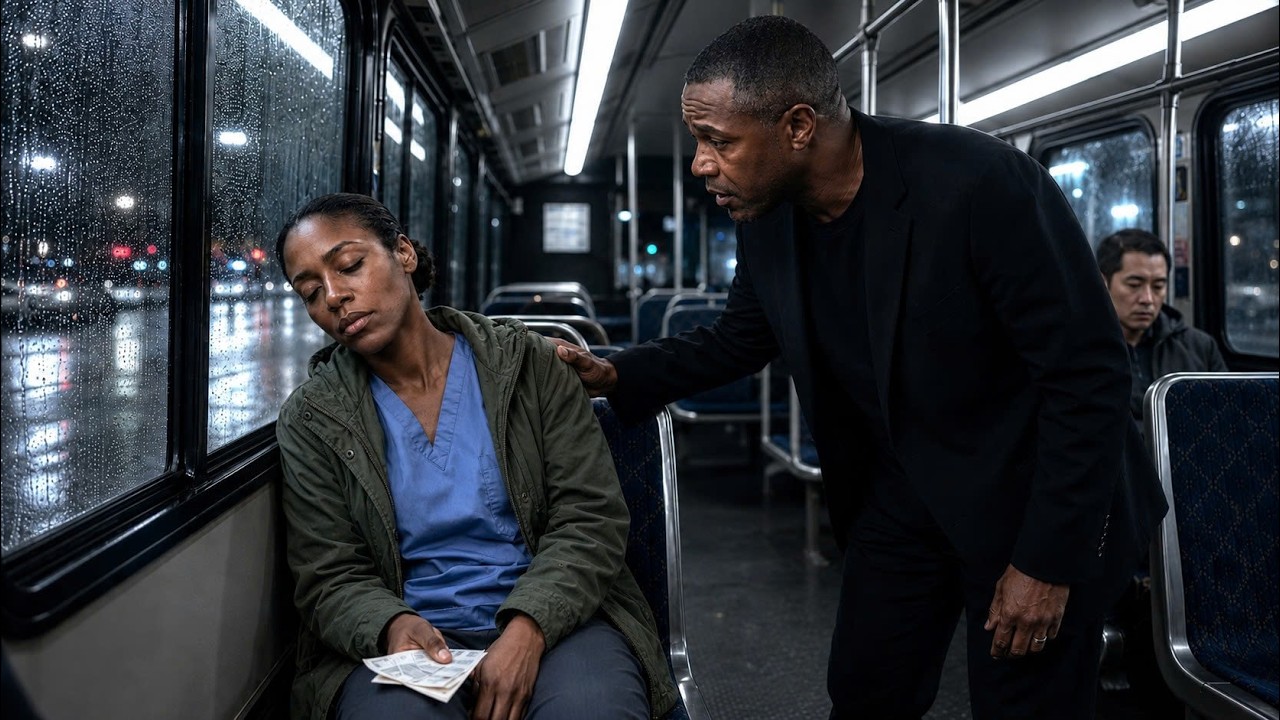
Not because he needed to. He lived twelve miles away in a penthouse overlooking the city. But his mother used to ride this bus for fourteen years, and he came back to sit where she had sat. Now a stranger’s exhaustion had pulled him out of his own thoughts.
She had boarded near the hospital, told the driver her stop, then closed her eyes. It wasn’t the drowsy sleep of someone tired from a long day. It was the collapse of a machine that had run past its limit. She whispered to the window, not to anyone, “I don’t know how much longer I can hold on.
”
He heard it. He always heard everything from the sixth row. The bus shook through three stops. She didn’t move.
Her stop was long gone. He stood and walked closer, stopping beside her without touching her shoulder. “Ma’am, it is your stop. ”
Her eyes snapped open.
Her hand clenched harder around the papers, a reflex, an instinct. She looked out the window, realized where she was, and her shoulders slumped for a breath before she straightened them lại. “How far past is it? ”
“Three stops.
”
She was doing the math in her head. Not distance. Time. What time it was compared to when she promised to return.
Someone was waiting. He said he could call a car for her. She turned and looked at him, flat, measuring, and said, “No, thank you. ”
She stepped off.
He stepped off after her. She didn’t invite him. She didn’t chase him away. The bus was gone, and they walked the same direction in the cool October air.
Her name was Simone Carter, 33, two children, Malik, 8, and Nia, 5. She woke at 5:15 every morning, packed two lunches in reused plastic bags, dropped the kids at Miss Vernell’s, the 72-year-old neighbor downstairs who charged $400 a month, less than half a daycare, and never asked questions when Simone came home late. Then she caught the 6:00 bus to Grady Hospital, where she cleaned patient rooms, operating rooms between surgeries, restrooms, hallways, every surface needing sterilization. $14.
60 an hour, 40 hours a week. At 2:30 she walked four blocks, rode twenty-two minutes to the Coleman Logistics Distribution Center, clocked in at 4:00, and worked until 9:30 stacking packages on pallets. $16. 25 an hour, 27 and a half hours a week, never thirty, because thirty meant benefits, and benefits cost money.
She walked home because the bus was gone, trying to hold on. She started speaking not because she trusted him, because she was too tired to hold up the walls. She said, “People think the hardest part is the work. Two jobs, sixteen hours, standing all day.
That’s not the hard part. Being tired I can do. The hard part is when my son looks at me and says, ‘Mom always looks tired’, and I have to tell him I’m fine. He’s only eight.
He already knows I’m lying. ”
Marcus didn’t answer. There were no words a man who owned eleven distribution centers could say to a woman who cleaned rooms and stacked pallets and walked home at ten at night without sounding like an insult wrapped in sympathy. Listening cost nothing, and he knew it.
It lay inside him like something cold. Her phone rang. Her face changed immediately. Not worry.
Not fear. Something softer hesitated. She answered, warm, patient, “Mom knows, honey. Mom knows it’s late.
Mom will be home in twenty minutes. Have you brushed your teeth? Did Nia eat all the rice? All right, go to sleep.
Mom is coming home. ”
Marcus heard every word. That voice. The voice a mother makes when standing in the dark, far from her children, pretending everything is fine so they don’t carry the weight into sleep.
He had heard that voice every night for nineteen years, through a thin wall, through a closed door, through a telephone line when his mother called from a nursing home at two in the morning. Have você comido? Honey, go to sleep. Mom is coming home.
Nearly thirty years apart, but the voice was exactly the same. “Sorry about that,” she said. “How old are they? ” he asked.
“Eight and five. ”
He nodded. “You work two jobs. ”
Not a question.
An affirmation. He had seen the two paychecks in her hand on the bus. She said yes, flat, without explanation. “Where is the second job?
”
“Coleman Logistics, the distribution center on Metropolitan Avenue. ”
He didn’t stop walking. His face didn’t change. But something behind his eyes shifted.
Coleman Logistics was a subsidiary of Bell Logistics Group. His company. Acquired four years ago. The evening shift, 4:00 to 9:30, designed for people who had other jobs during the day.
The salary structure. The 27-and-a-half-hour limit. The benefits threshold. All signed off by him, summarized on a slide as a labor optimization model, projected savings, $4,700,000 per year.
. “How much do they pay? ” he asked. “$16.
25 an hour. How many hours? ” She almost laughed. “25, 26, 27.
They keep everyone right below thirty. Next week, they cut hours to pull the average back down. Everyone knows that trick. No one says it.
”
He asked questions he already knew the answers to, needing to hear them spoken by the person living inside that system. 16:25. 27 and a half. No health insurance.
No retirement. No paid leave. She was describing his company to him without knowing it. They reached her street.
Rows of small houses, narrow porches, curtains faded from washing. Cars with expired registration stickers because $89 was the choice between a safe car and shoes for her daughter. She stopped in front of a three-story brick building. She looked up at the third floor, a window with light behind a thin curtain.
Miss Vernell, still awake, still waiting. “I’m home,” she said, firm, decisive. No invitation. No lingering.
He wanted to say something. He could feel its shape in his chest. Something about what he knew now, about the company he built and the woman standing in front of him,
and the straight line connecting those two things. His mouth opened.
“Can I help you with something? ”
The question popped out raw. Not money. Not anything specific.
Just a question from a man who had just realized he was standing at the other end of a line he had never seen before. “You don’t owe me anything,” she said. “I know. ”
“Then why are you still standing here?
”
He didn’t have an answer. He stood, hands in his pockets, trying to find something that didn’t sound like a lie or a pity. The third-floor window shifted. Miss Vernell’s shadow glided behind the curtain.
“I have to go in now. ” She turned. But this time she didn’t open the door immediately. She stood there, back to him, shoulders lowered a little, as if considering a sentence.
Then she said, without turning around, “Thank you for waking me up. ”
The door opened. Hallway light spilled out, then vanished as it closed behind her. He stood on the sidewalk, looking up at the third-floor window, where the light brightened, then shifted as a shadow moved inside.
He pulled out his phones. A message from his assistant asking about tomorrow’s flight to New York. He stared at it, then put the phone away. He called a car, sat in the back seat, watching her street recede, thinking about two crumpled paychecks in the hand of a sleeping woman.
He opened his laptop when he got home. Didn’t turn on the light. Didn’t take off his coat. He logged into the human resources portal of Bell Logistics Group.
He typed her name. Employee ID 4812. Start date fourteen months ago. Hours per week 27.
5. Benefits: none. Emergency contact: Vernell Grant. Relationship: neighbor.
Not a mother. Not a sister. Not a husband. A neighbor.
Because when there is no one else, a 72-year-old woman downstairs who leaves the door unlocked becomes the closest thing to a safety net. He clicked her performance file. Fourteen months. Not a single absence.
Not a single late arrival. Not once in fourteen months. The most recent review box said two words: meets expectations. He stared at those two words for a very long time.
Three days later, he drove to Metropolitan Avenue. He didn’t call ahead. Didn’t bring his assistant. Didn’t tell the operations manager or the regional vice president.
He parked in the employee lot and walked in at 4:20. He asked the shift manager about break time. Fifteen minutes per shift. He asked about the breakroom.
A room the size of a large closet. One table, six chairs, one microwave, forty people per shift sharing it. He asked about employee retention. The manager looked at him and said, “Very bad, sir.
Average retention time is about eight months. People are exhausted. ”
“Why? ”
“Because this is their second job, sir.
By the time they come in here, they have already worked a full day somewhere else. ”
He walked through the production area. He saw her before she saw him. Third conveyor belt.
She was still wearing her nurse uniform under the warehouse vest because she didn’t have time to change. Scanner in her right hand, left hand pulling boxes off the belt, stacking pallets, fast, accurate, no extra movements. She looked up, saw him, nodded slightly, politely, distantly, the nod of a person on shift, every second belonging to someone else. Then she turned back and continued working.
He stood there watching her move forty-seven boxes in twenty-two minutes. He counted. Ten days later, his phone rang at 2:14 in the afternoon. The operations manager at Coleman Logistics.
An even voice, mechanical from reporting bad news too many times. “We have an incident at Metropolitan. An employee collapsed on the warehouse floor. She was taken to Piedmont Atlanta Hospital.
”
He put his pen down. “What name? ”
“Carter. Simone Carter.
”
He stood, grabbed his coat, said nothing. He drove toward the hospital like it was a magnetic pull, not a choice. The attending physician told him the diagnosis. Exhaustion.
Moderate dehydration. Iron deficiency anemia. Not dramatic. It doesn’t come with sirens.
It accumulates slowly over months, years. It happens when the body doesn’t get enough iron to make the red blood cells that carry oxygen to the muscles, to the brain, to the organs. She said her life wasn’t in danger now, but if she continued at this pace, it could become more serious. He walked along the fourth-floor hallway, room 412.
The door was open. She was lying on the bed, eyes open, looking up at the ceiling, an IV in her left arm. She looked smaller than on the bus. Not because she changed, because the context had changed.
A woman walking home at night carries her own size. A woman in a hospital bed has been shrunk down to the size the institution assigns her. She turned her head when he stepped in. “You again?
” Not warm. Not cold. Flat realization. “I heard what happened,” he said.
“Heard from who? ”
The right question. How could a stranger on the bus know she collapsed in a warehouse? Know her name?
Know which hospital she was in? He didn’t hesitate. He didn’t soften it. “Coleman Logistics is a subsidiary of Bell Logistics Group.
I am Marcus Bell. I own the warehouse where you collapsed. ”
Silence. Not the fleeting silence of shock.
The long silence of piecing together. She was rearranging everything she thought she knew about the past ten days, inserting this new puzzle piece. It didn’t honor him at all. “So you own the place that takes away more than half my waking time, pays me just enough to have to work another job just to survive.
” She paused, because she was tired, and pauses weren’t choices but necessity. “And now you’re sitting in the hospital I had to enter because of that. What did you come here for? ”
She didn’t raise her voice.
She didn’t speak harshly. She spoke the way people speak a thing that has been true for a long timeand only now found someone to say it to. “I don’t have a good answer for that,” he said. “That’s the first real thing you said.
”
“Can I sit? ”
She looked at the plastic chair next to the bed. She looked at it, then back at the ceiling, and that was enough to be considered permission. He sat down.
“I want to pay the hospital bills, and everything you need while you’re not working,” he said. She turned her head, looking at him, not with gratitude, not with anger, but with the clarity of a woman who had heard offers before and knew what they cost. “I didn’t collapse for you to feel better about yourself by writing a check. ”
She said it without cruelty.
She was drawing a line, not to attack, but to protect. She would not become a story someone retells at a dinner party, an anecdote proving a rich person has a heart. He sat with that. He understood it.
He had grown up on the other side of that boundary, watching his mother refuse help from the church three times in one winter because accepting it meant owing a thing she couldn’t name and couldn’t repay. “I didn’t come here to help you,” he said. “I came here because I need to understand what I broke. ”
A long silence, the longest of the afternoon.
She studied him, not his words, but his face, the stillness of his hands. Then she said, “Miss Vernell is watching the two kids. She’s 72. She has arthritis in both knees.
She watches them every day for $400 a month because that’s all I can afford. And she still does it because she says she likes having company. But the truth is she does it because she knows I have no one else. ”
She paused.
“Malik asked me last week. Mom, when do you get to rest? I opened my mouth but couldn’t say anything. I couldn’t think of an answer.
”
He didn’t interrupt. He didn’t offer a solution. He sat on the plastic chair in room 412 and listened to a woman describe the life his company had contributed to designing, and he didn’t turn his face away. “You want to know what you broke?
” She looked at him, steady, clear. “You didn’t break me. I’m still here. But you built something that makes people like me have to choose between being a good worker and being a good mother.
And you made it impossible for us to be both. Not because we aren’t strong enough, because the numbers don’t allow it. ”
Marcus Bell, who had sat in boardrooms with senators, on podiums with Fortune 500 CEOs, sat on a plastic chair in a hospital room with a woman earning $16. 25 an hourand understood that the most important meeting of his career was happening right now.
. He convened an emergency board meeting the following Monday. He didn’t bring slides. He brought himself anda handwritten piece of paperwith four proposals.
He read them out loud:
“Increase the minimum hours per week for all part-time warehouse employees from 27. 5 to 32, crossing the benefits threshold. Effective in ninety days. Increase the base salary across all subsidiary distribution facilities to $19 an hour.
Provide basic health insurance for all employees regardless of hour classification. Establish a child care support fund for single parents across the entire system. ”
The CFO, Mr. Reeves, the man who had presented the $4,700,000 savings slide six months ago, calculated on the spot.
The total annual cost for these four proposals was about $12 million. The room fell silent. “Last year we made a profit of $340 million,” Marcus said. “This is 3.
5 percent. If we can’t afford to keep our people alive, then what are we building? ”
No one answered. Not because they disagreed, because the question wasn’t asked to get an answer.
It was asked to stay in the room and make everyone uncomfortable enough to act. There was opposition. There always is when money flows down instead of up. Two board members worried about the president.
One worried about shareholders. Reeves said the numbers needed modeling. Marcus said, “Go ahead and model it. But the decision has been made.
We will do it. The only question is how fast. ”
Three weeks later, the modeling team confirmed what researchers long noted. Companies that increase wages and provide benefits for their lowest-income employees usually reduce turnover and absenteeism,and increase productivity.
$12 million wasn’t a loss. It was a reallocation. The cost of constantly replacing exhausted employees who quit after an average of eight months — recruiting, training, losing people, starting over — had quietly consumed even more than twelve million. It was just scattered across many budget categories, so it never aggregated into a number large enough to cause alarm.
. Five months later, bus route number 19 ran through Atlanta on a Tuesday evening as usual. Same route, same stops, same humming engine. But not entirely the same passengers.
Simone Carter sat by the window at 6:30 in the afternoon. The light outside was still yellow. October had long passed. It was March, days gradually getting longer.
She wore jeans anda sweater. Not a nurse uniform, not a warehouse vest, just the normal clothes of someone who had gotten off her shift at 3:30, picked up her daughter, picked up her son,and was now giving herself ten minutes sitting alone on the bus before going home. . She didn’t sleep.
Her eyes were open, watching the city glide by. The same streets, the same buildings. Everything outside was still the same. But the woman inside the bus was not.
She now worked one job full-time, seven to three-thirty at Coleman Logistics, $19 an hour, with health insurance. She had quit Grady the same week. She had walked into the HR office and said she would leave, and they asked if there was anything they could do to keep her,and she said no, sincerely, not with anger, but with the calm certainty of a person who had just been given back a thing she didn’t know she had lost. Time in her hand.
Not paychecks in her pocket, time in her schedule, time in her body, time with her children. The bus stopped her stop. She stepped off, walked three blocks, climbed the stairs, knocked twice. The door opened.
Malik, 8, stood at the threshold, the look of a child getting used to something new, not yet certain it would stay. Behind him, Nia ran forward, arms spread wide. Simone knelt downand hugged them both, not hurried, not brief. The way people hug when finally having enough time to hug fully.
Miss Vernell sat at the kitchen table, the same chair, the same smile. “Home early again,” she said. “What? ” Simone asked.
“Home early again. ”
She cooked dinner. Rice, chicken, canned green beans because fresh ones were still $2 more. But that was about to change when the first paycheck under the new rate arrived.
She stood by the stove stirring the rice. Malik did homework at the table. Nia drew on the back of a receipt. Miss Vernell told a story about the laundromat,and no one looked at the clock.
Malik looked up from his notebook. “Mom looks different. ”
She turned around. “Different, how?
”
“Mom doesn’t look tired anymore. ”
She said nothing. She stood there by the stove and let that sentence settle. For fourteen months, he had seen his mother come home in the dark, seen the weight in her eyes, seen the slowness in her hands, seen her fall asleep before hearing the end of the story he told about his day.
He was eight. He had noticed everything. Children do not have the words, but they have eyes. And now, 6:50 on a Tuesday evening in March,standing by the stove with the bright light and the pot of rice,and not anywhere else,she was back.
Not a different person. The same person, just having enough time in the day to be herself again. Marcus Bell did not call her. Didn’t check in.
Didn’t send a card or a message. He didn’t need her to know what he had done, and he didn’t need her thanks. What he had done was not for her. It was for the 4,200 people in his system.
People carrying the same weight she had carried. Names he would never know. Faces he would never see on any bus. .
He still rode bus route 19 once a month. Still paid cash. Still sat in the sixth row. His mother’s seat.
But something had changed in the way he looked out the window. He used to search for her, the ghost of a woman who rode this route for fourteen yearsand never returned. Now he looked at the other passengers. The woman in the nurse uniform three rows ahead.
The man with the grocery bag between his knees. The teenager with the cracked phone. He looked at them,and for the first time in twenty-seven years of building a career, he asked himself the right question. Not how much this costs, but what it costs them.
Wealth does not make a person good. It only gives them the choice to become good. Most of the time that choice is never tested,because rich people rarely stand close enough to the consequences of what they build. They sign policies from the 32nd floor.
They look at spreadsheets in the back of a car. They nod at numbers representing people they will never meet. The distance protects them not from harm, but from knowing about it. This story is not about charity.
Not about a rich man saving a poor woman. That is not what happened. What happened was simpler and harder. A man stood close enough to see the thing he built from the inside.
And what he saw was a woman falling asleep on the bus, her hand tight around two paychecks. Because one job in his system was not enough to live on,and the other job was the only way to make the numbers balance. And the numbers should never have demanded that. This story is fiction, but the numbers in it are not.
Eight million Americans work more than one job at the same time. The benefits gap for part-time labor is real. The scheduling algorithms keeping employees at twenty-seven or twenty-eight hours to dodge the thirty-hour threshold are real. The iron-deficiency anemia wearing down the bodies of overworked, underfed women is real.
The eight-year-old telling his mother she looks tired is real. It is happening in millions of homes tonight. If there is someone who finishes this story and looks at the people around them differently tomorrow —the cashier, the bus driver, the warehouse worker stacking shelves at nine in the evening — then this story has done what it needed to do. Because the people carrying that weight deserve to be seen.
And sometimes being seen is exactly where everything begins. ..