The $60 was still warm from his hand when he walked back through the restaurant doors. I stood on the sidewalk outside the Larder, Holden’s new restaurant, the one I’d spent three years hearing about, worrying about, quietly helping to fund through money I’d claimed came from freelance consulting. My daughter was pressed against my chest in a carrier a maternity nurse had helped me buckle that morning. Clara was two days old.
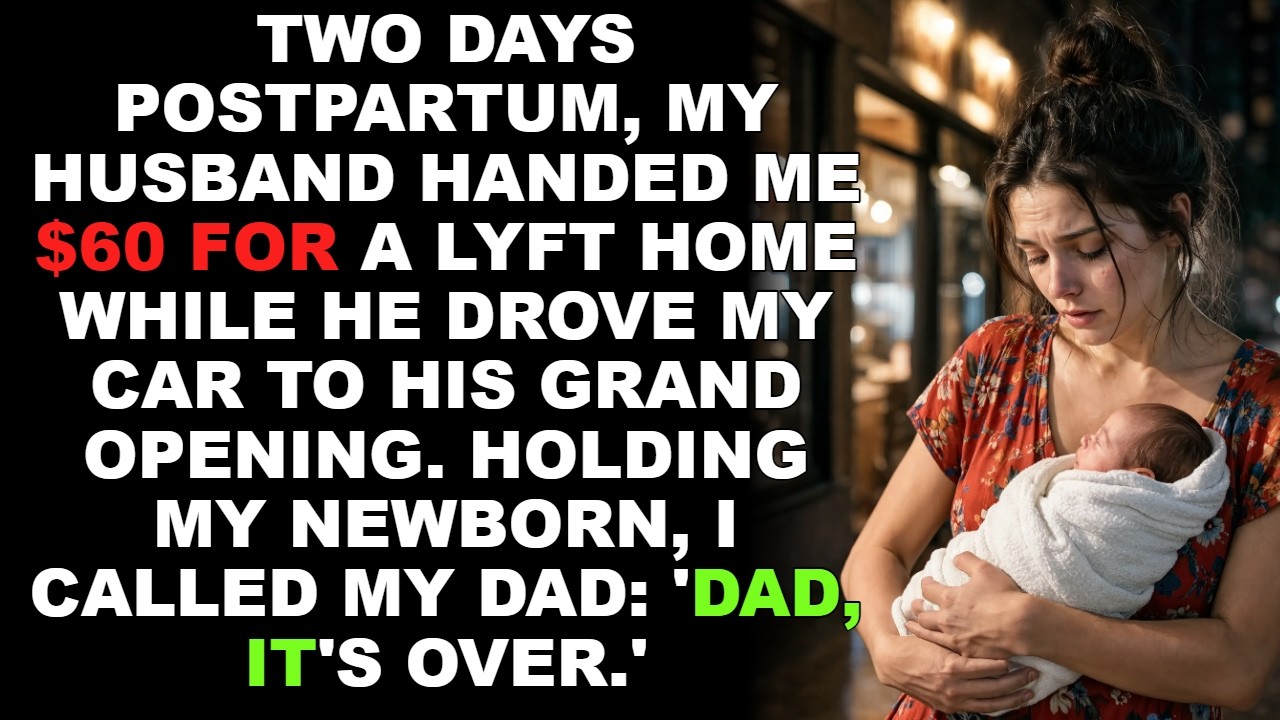
I was still bleeding. The Nashville October air cut through my light cardigan, and my C-section incision pulled with every small movement. In my right hand, three folded twenties, the way you’d tip a valet. “Lyfts are usually quick around here,” my husband had said, already half-turned toward the glass doors.
“I’ll be home by ten, eleven at the latest. ”
He didn’t wait for me to answer. Through the window, I watched him move between tables, shaking hands, laughing, wearing the wide warm smile I’d fallen in love with at a dinner party four years ago. The smile I hadn’t seen directed at me in months.
His investors were laughing. The opening night crowd glittered under warm Edison bulbs. Inside the Larder, everything was going perfectly for Holden Shaw. Out here on the sidewalk, I looked down at my daughter’s face.
Her eyes were closed. Her tiny mouth made the rhythmic reflex newborns do even in their sleep, searching for something that wasn’t there. I thought about ordering a Lyft. I thought about our apartment, the fridge I knew was empty because I’d been in the hospital for two days and Holden had been at the restaurant.
I thought about his mother, Dolores, who had ridden to the hospital that morning to help with discharge and spent the drive over suggesting I could rest just as easily in a booth as on the couch. I thought about my sister-in-law Bryn in the front seat, nodding along, telling me how she’d been back at her spin class six days after her second kid. Then I looked at the money in my hand. Sixty dollars, the same amount Holden gave our dog sitter.
I put the bills in my cardigan pocket. I took out my phone. I didn’t open the Lyft app. I called my father.
My full name is Petra Calloway. I’d been going by Petra Shaw, my mother’s maiden name, for six years, since I graduated from Vanderbilt and decided I wanted to find out who I was before anyone decided for me. It sounds odd, hiding a name, but if you’ve ever watched people’s faces rearrange themselves the instant they hear “Calloway” in certain Nashville rooms, you’d understand. My father is Franklin Calloway.
He founded Calloway Capital and Development in 1987 with a $40,000 SBA loan and spent the next thirty years turning it into one of the largest privately held real estate investment firms in the Southeast. Hotels, mixed-use developments, industrial parks across five states. The kind of company whose name appears in the footnotes of other people’s deals. The kind of man whose phone calls get answered on the first ring.
Growing up, I watched two people I considered friends slowly reveal that what they really wanted was proximity to that name. I swore I wouldn’t let it happen again. So when I moved back to Nashville after graduate school, I was Petra Shaw. I wore it like quiet armor.
I met Holden at a mutual friend’s dinner party in East Nashville. He was telling a story about a market trip to Mexico City, describing the mole he’d tasted at a street stall in Oaxaca, with the reverent joy of someone talking about something they genuinely love. He wasn’t performing. He was just a man who cared about food, deeply and without embarrassment.
I liked that about him immediately. He knew I had some family money. You can’t hide a certain upbringing entirely. But he never pressed.
For a long time, I took that as respect for my privacy. I understand now that it was curiosity. He wasn’t interested in who I was. He was interested in the version of me that was useful to him.
A wife. A quiet source of financial calm. Someone who would believe the projections and not ask too many hard questions about the restaurant’s burn rate. The white Land Cruiser had been a gift from my father for my twenty-eighth birthday, registered in my name.
From about four months into our marriage, Holden had been its primary driver. He called it “our car” with the easy ownership of someone who has never considered the question of whose it actually is. My father answered on the second ring. “Petra.
”
His voice has a quality I’ve never found a precise word for. Steady, the way load-bearing things are steady. You don’t think about them holding themselves up; they just do. “Dad.
” My voice cracked at the edges. “I’m outside Holden’s restaurant. I was discharged from the hospital this morning. He drove my car here with his mother and his sister.
And then he handed me sixty dollars and told me to take a lift home. ”
I stopped. “I have Clara with me. She’s in the carrier.
It’s cold. ”
A silence. Not the silence of someone processing. The silence of someone who has already processed and is deciding what to say next.
“What’s the address? ” he asked. I gave it to him. “Don’t go back inside.
Is there somewhere nearby you can sit? ”
There was a coffee shop two doors down, I told him. “Go there. Get something warm.
” A pause. “Are you in pain? ”
“Some,” I said. “Okay.
” Another pause, then very quietly, with the controlled flatness I recognized as the sound of something being held in place by pure will: “I’m going to make a few calls. We’ll talk when you get here. ”
The call ended. I walked to the coffee shop, eased into a corner booth, and ordered a decaf, wrapping both hands around the cup.
I didn’t cry. I felt, for the first time in I couldn’t remember how long, completely calm. The calm of something having been decided. Not by me, exactly, but through me.
Like I was finally just the messenger of something that had been accumulating for two years. The black Escalade arrived in eleven minutes. The woman who stepped out was Mrs. Odom, my father’s chief of staff.
She didn’t make a production of it. Didn’t exclaim or comfort or ask rapid anxious questions. She held the door, introduced the two women already seated inside—a postpartum nurse and a pediatric nurse, both with quiet competence and bags of supplies—and got back in the front seat. No drama, just execution.
My father’s estate is in Franklin, Tennessee, twenty minutes south of the city. I grew up there. The driveway is lined with oaks older than the house, and the main house sits back from the road in a way that looks understated until you’re standing in front of it, and you realize that understated is its own kind of statement. My father was waiting on the front steps.
He looked at me first, then at Clara in the carrier. She was awake now, looking at everything with the total fascinated attention newborns have, completely absorbed by the oak trees, the light, the size of the sky. My father watched her for a long moment. Something moved across his face that I couldn’t fully name.
Tenderness and grief and fury compressed into a single expression, all held very still. “Come inside,” he said. He didn’t hug me on the steps. He’s not a man who communicates through gestures like that.
What he did was walk beside me up the stairs with one hand at my elbow, steady as he’d always been. That evening, after Clara was settled with the pediatric nurse in my old bedroom, I sat in my father’s study and told him everything. Not just the sidewalk—all of it. The way Holden’s attention had contracted during the pregnancy, his irritability sharpening while his presence softened.
The comments from Dolores about how I was too cautious and not supportive of what Holden was trying to build. The weeks when he came home from restaurant planning sessions smelling of whiskey and already halfway somewhere else before he sat down. The morning I went into labor three weeks early, and he arrived at the hospital forty minutes after I called because, he said, he’d needed to finish something. I told it flat, no tears.
My father listened with his hands folded on the desk. He asked two questions. First: Is there anything that happened that you haven’t told me? Second: What do you want?
I looked out the window at the dark Tennessee hillside. “I want to be done. I want him to understand what he chose, and I want a long time to pass before he stops understanding it. ”
My father nodded once, the way he nods when a meeting has reached its conclusion.
He picked up his phone and walked to the other room. I didn’t hear the specific calls he made that night, but I knew their shape because I’d overheard enough of them growing up. Calm, specific, no raised voice, no ultimatum. Just a clear statement of where Franklin Calloway stood on a given matter, delivered to people who understood exactly what that meant.
Holden’s restaurant group had three primary investors: a private equity fund out of Brentwood, a regional hospitality holding company, and a semi-retired commercial developer who’d been in Nashville real estate for thirty years. All three had, at various points in the past decade, done significant business with Calloway Capital. The kind of business where a phone call from my father carried real weight. Not as a threat, but as: Franklin Calloway is reconsidering his advisory relationship with funds carrying Whitfield Restaurant Group exposure.
That was enough. The lead partner at the Brentwood fund began making calls of his own within eighteen hours. The commercial bank that held Holden’s primary business loan, which he’d been drawing on heavily for renovations and equipment, had their regional vice president at a Calloway-developed property the following morning. A conversation happened, measured, professional, not a threat, just a conversation between men who understood each other.
My father came into the breakfast room the next day, poured his coffee, and said, in exactly the tone he uses to report quarterly numbers: “The Brentwood Group is reviewing its position. The bank has requested a preliminary financial audit of his current portfolio. The developer made his decision yesterday. ”
I looked up from feeding Clara.
“It’ll move at its own pace,” he said. “These things do. But the structure was already fragile. We’re just removing what was propping it up.
”
I looked back at my daughter. She had my mother’s brow when she concentrated, that small focused furrow. She had no idea that the world she’d been born into two days ago had already shifted completely in her favor. “Thank you,” I said.
He sat down and opened his newspaper. What I learned afterward, in pieces: the opening night of the Larder had not ended as Holden planned. Word moves fast in Nashville’s investment community, and when one of the Brentwood fund partners quietly mentioned that they were reconsidering exposure to the Whitfield Group, that conversation spread to three other tables before the dessert course. By midnight, several of the investors who’d raised champagne flutes during Holden’s speech were already on the phone with their own advisers.
The operating credit line, which he’d been drawing against aggressively for the build-out, was frozen pending the bank’s review. Without it, he couldn’t make payroll for the first of the month. I knew none of this in real time. I was in a sun-filled room learning how to be my daughter’s mother, sleeping in a real bed for the first time since before she was born.
But I knew it the way you know a storm is moving through somewhere, not because you can see it, but because you chose to open the window. Holden’s calls to my cell phone went from twelve the first day to seven the second to three the third. The tone shifted each time: irritated, then tighter, then something I hadn’t heard from him before, a quality closer to fear than anger. I turned the phone face down and went back to Clara.
He drove to our apartment on day four, and finding it empty, worked out enough of the situation to get an address. A produce box arrived at the estate gate on a Tuesday. Inside: some of my clothes folded badly, a few books, my face wash, and a note torn from a legal pad. “Petra, you’ve made your point.
Stop being dramatic and come home. Clara needs stability. I have a business to rescue and I can’t do that with you playing games. The apartment is a mess and you took the car.
”
He hadn’t asked if Clara was eating. He hadn’t asked if Clara was sleeping. He hadn’t asked if Clara existed as a person at all, or only as a piece of his argument. I set the note on the entry table and told Mrs.
Odom to have the books donated to the library and the rest disposed of. His mother and Bryn arrived at the estate gate on a Thursday morning, unannounced, dressed in what I recognized as their considered best. I was in the back garden with Clara when Mrs. Odom came to tell me.
I took a moment. “The garden sitting area,” I said. “Give them fifteen minutes. ”
I went upstairs, changed into a clean blazer, and came back down.
They were in the white iron chairs near the pergola, and the way their eyes moved over the property—the careful, calibrated performance of not looking impressed while clearly looking—told me everything about what they’d understood in the past seventy-two hours. Dolores started immediately. How worried they’d been. How stressed Holden was.
How marriage required showing up even when it was hard. How Bryn had been on her feet in six days after her second delivery. And certainly nobody expected me to host a dinner. Just to be present.
Just to be supportive. “Dolores,” I said. She stopped. “Do you remember what you said in the car on the way to the restaurant?
That I could rest just as easily in a booth. I had delivered a baby by emergency C-section thirty-six hours earlier. You told me to stop making a fuss and come support my husband’s opening. ”
I watched her steadily.
“The moment you said that, I understood exactly what I was dealing with. ”
Bryn cut in. Something about context, about excitement, about nobody thinking it was a big deal. “He handed me sixty dollars,” I said, “and went back inside.
”
The garden was quiet. A cardinal somewhere in the oaks. “My daughter was two days old. He handed me sixty dollars and turned his back.
”
Dolores recalalibrated quickly, the way she always did. Shifted to the sympathetic register, the we-are-family tone. If there were things Holden had done wrong, we could talk about it, but right now he needed support. What he really needed was for me to come home and help him through this.
“He needs me to fix it,” I said. “That’s what you came to ask. ”
Neither of them answered. I stood.
“Mrs. Odom will see you out. ”
Bryn’s voice rose. “You can’’t just—”
Two of my father’s security staff materialized at the garden entrance, unhurried, simply present.
Bryn went very quiet. I walked back into the house without looking back. Holden came himself four days later. I watched him on the gate monitor, a man I didn’t recognize in the shape of a man I’d known for four years.
Wrinkled Oxford shirt, no jacket, hair unwashed. He’d lost weight he didn’t have to lose. He pressed the intercom button three times before Mrs. Odom’s voice came through, and when it did, he flinched at the formality of it.
I let him stand there for forty minutes. Not out of cruelty, exactly. Because I wanted him to look at the gate, really look at it—the ironwork, the stone columns, the length of driveway behind it—and understand without a single word from me that he had been operating without complete information for four years. That the woman he’d handed sixty dollars to on a sidewalk was not who he’’d assumed she was.
I wanted that knowledge to arrive in his body before I said anything at all. Then I had him brought to the formal sitting room. I came in from the interior hallway. He was standing in the middle of the room, hands at his sides, looking at the art on the walls the way people look at things they can’t quite believe are real.
He heard my footsteps and turned. He said my name like a question. I sat in the chair by the window. I didn’’t gesture for him to sit.
He sat anyway, on the edge of the settee, rigid. “I need help,” he said. “Something is happening to my investors, to the bank. I don’t understand how it’s all happening at once.
It’’s like something systematic, like someone. ” He stopped. He looked at me. “Did you do something?
”
I considered him. “Holden,” I said, “who do you think my father is? ”
He blinked. “What?
”
“You’ve been married to me for two years. You met him once, briefly, by phone. What do you actually know about him? ”
He shifted.
“You said he was in real estate. I assumed you never talked about him much, so I figured—”
“You figured he was ordinary,” I said, “because I didn’t correct you. ”
I watched his face. “My father is Franklin Calloway of Calloway Capital and Development.
”
The name landed the way names like that land in people who know what they mean. I watched the color leave his face in a slow, unmistakable tide. “My full name is Petra Calloway. I’ve been using my mother’’s maiden name since I was twenty-two because I wanted someone to choose me, not what my family owns.
” I paused. “You chose me, and then you handed me sixty dollars on a sidewalk two days after I gave birth and went back to your investors. ”
He was staring at me. Whatever he’d rehearsed on the drive here was gone.
“The people pulling their money,” I said,, “have worked with my father’’s firm for years. He didn’’t threaten anyone. He simply made his position clear. That was enough.
” I let that sit. “The foundation of your company was already unstable. He just removed what was holding it up. ”
A sound came out of Holden that wasn’t a a word.
He pressed both hands over his face. “You could have told me,” he said finally. “If I had known—”
“If you had known,” I said,, “you would have treated me differently, which is exactly why I didn’t tell you. ”
I stood.
“You didn’t treat me like a person. You treated me like a problem you could hand sixty dollars to and walk away from. The fact that that person had a powerful father doesn’’t change what you did. ”
He looked up.
His eyes were red.. “Tell your father to to stop. I’ll do anything. Counseling, whatever you want.
I swear I’ll——”
“I want a divorce. I want full custody of Clara. And I want you to spend a significant amount of time understanding what you chose that night when you walked back through those doors. ”
I walked to the the door and opened it.
“Mrs. Odom will give your attorney my father’s legal team’’s contact information. ”
I closed the door behind me and stood in the hallway, very still for a moment. Somewhere upstairs I could hear the soft sound of the monitor from Clara’s room, the small ambient noises of her breathing in her sleep.
I just went upstairs. The divorce was finalized eleven weeks later.. Holden’’s second attorney—the first had withdrawn—accepted every term without negotiation. Full custody of Clara, no child support in exchange for no visitation rights, a clause his lawyer tried twice to remove before Holden himself apparently told him to let it go.
A financial settlement I let my father’s team structure and didn’t read closely until after it was signed. The Land Cruiser sat in the estate garage for three weeks. I drove past it every morning on the the way to the kitchen. I didn’’t feel what I’d expected to feel—not anger, not even grief.
Something more like recognition. That car had been mine, and and then it had been a symbol of something I’d let happen, and now it was something I could choose what to do with. I called the development director at Thistle Farms, the Nashville nonprofit that supports women survivors of trafficking and abuse. Could they use proceeds from a vehicle’s sale?
They could, significantly. The car transporter came on a Wednesday. I I stood on the front steps with Clara on my hip and watched the Land Cruiser get loaded onto the flatbed. Clara watched too, with the total solemn fascination of a three-month-old encountering machinery for the first time.
I didn’’t cry when it pulled out of the driveway. I didn’t feel the dramatic interior shift I’d half expected. I just felt the October morning, my daughter’s weight against my side, and something quiet and clean in my chest where all the noise used to live. My father came to stand beside me.
We watched the road in silence. “I’m going to need office space. I want to build something—a fund, maybe—for women in the postpartum period who don’t have someone to call, who don’t have a father they can ask for help. ”
My father looked at me.
“Okay. When do you want to start? ”
“Monday. ”
He nodded..
That was that. We set up the first program. We called it Clara’s Table, which felt right. We leased office space in Midtown that winter.
Emergency postpartum support, home health aides, meal delivery, crisis counseling for for families in Davidson and Williamson counties who had nowhere else to turn. By the following spring, we were serving sixty families a month. By the year after, three hundred. I am thirty-two years old.
My daughter is almost one. She has my father’s eyes and what I’’m told is my mother’s stubbornness. And she has never, for a a single day of her life, wanted for anything that mattered. I still think about that sidewalk sometimes.
The cold air, the pull of the incision, the sixty dollars in my hand. I don’’t think about it with pain anymore. I think about it the way you think about the last moment before something breaks. That exact still second when everything that was going to happen had already been decided.
And all that remained was for the world to catch up. He made that decision, not me. I just made the phone call.