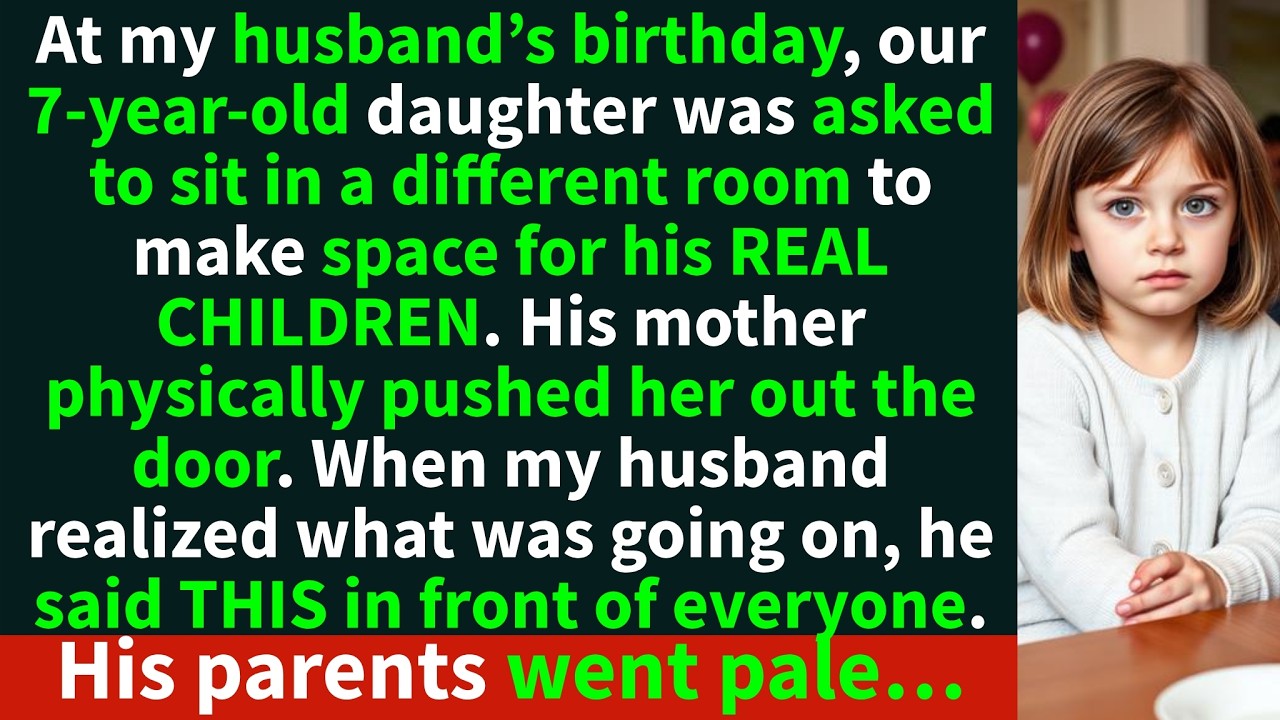
At my husband Greg’s birthday party, the first thing I noticed was not the cake or the banner. It was the empty chair beside the children’s plates. Our seven-year-old daughter, June, was not at the kids’ table. Greg’s fifteen-year-old daughter, Amber, and twelve-year-old son, Mason, from his first marriage, were laughing with their cousins, passing rolls, stealing chips off each other’s plates.
They looked comfortable. They looked claimed. June’s paper cup sat beside an untouched slice of pizza, her purple napkin folded into a neat triangle by her fork. “Where’s June?
” I asked. Amber glanced over, confused. “I thought she was with you. ”
I moved past the dessert table and checked the hallway.
The side room door was pulled nearly shut. Through the gap, I saw one small sneaker swinging under a chair. It stopped when she heard me. June was sitting alone at a round table meant for overflow coats and extra napkins.
Someone had stacked paper plates in front of her like a little wall. She wasn’t crying. She wasn’t pouting. She sat very still, both hands flat on her lap, which was worse.
Seven-year-olds are only that still when they’re asleep, guilty, or trying hard not to be noticed. I pushed the door open gently. “Hey, Bug. What are you doing in here?
”
She looked up fast, like she’d been caught taking up space. “Did you want a break from the noise? ” I asked. She shook her head.
“Did someone tell you to sit here? ”
She pressed her lips together, then nodded once. “Grandma Janet said I should. ”
My mother-in-law had been circulating the party in a navy dress, smiling like she owned the building.
“Why would grandma say that? ”
June looked toward the door before answering. “She said the other room was for daddy’s real children. ”
She said it carefully, like she’d practiced getting the sentence right.
Then she added, “I tried to go back with Amber and Mason, but she held my shoulders and moved me out. Then she closed the door. ”
She lifted her hands and placed them on her own shoulders to show me. Her fingers pressed too hard for a demonstration.
“Mom, am I not Daddy’s real child? ” June asked. I took both of her hands before I trusted myself to stand. “You are Daddy’s daughter,” I said slowly.
“You are his real child. You are mine. You belong at that table. ”
Inside, I was furious in that special way where a person becomes calm because the alternative is being escorted out of a birthday party by security.
I kissed her forehead. “Stay right here for one minute. I’m getting daddy. ”
She grabbed my wrist.
“Is he going to be mad at me? ”
I leaned closer. “No, sweetheart. Not at you.
”
When I found Greg, he was near the cake table, laughing while his father told the same fishing story everyone had heard twice. “I need you for a second,” I said. He saw my face and stopped smiling. He knew that face.
We stepped behind a stack of extra chairs, close enough to see the side room door, far enough that nobody could hear. “June is in there,” I said. “Your mother told her the main room was for your real children. ”
Greg blinked once.
“June says Janet put her hands on her shoulders, moved her out, and closed the door when she tried to come back. ”
Greg did not say, “Maybe she misunderstood. ” He did not say, “It’s my birthday. ” He looked past me at that nearly closed door, and something in his face went still.
Not shocked. Recognizing. “She said that to June? ” he asked.
“Yes. ”
His jaw tightened. “Show me. ”
We walked into the side room together.
Greg slowed down before he reached June, then pulled out the chair beside her and sat so his face was level with hers. “Junie,” he said softly. “Your mom told me grandma said something that hurt you. Can you tell me what happened?
”
“Grandma said the other room was for your real children. ”
His hand moved over hers. “What did she do after that? ”
“She pushed me by my shoulders and shut the door.
”
His face barely changed, but I saw the muscle in his cheek jump. He held her hand gently. “Listen to me. You are my daughter.
You are my real child. Nothing anyone says can change that. ”
June stared at him for one whole breath. Then she nodded.
Greg stood up. “Come with me. ”
He walked June back into the main room, holding her hand, not behind him, not tucked away, but beside him. He picked up his glass and tapped it with a fork.
The clink cut through the chatter. “Can I have everyone for a second? ” he said. He thanked everyone for coming.
He mentioned Amber and Mason, said he was proud of them, and smiled at both of them so they would not think this was a test they had failed. Then he placed his hand on June’s shoulder. “And I’m grateful for my youngest daughter, June, who should never have to wonder whether she belongs in a room with her family. ”
The silence shifted.
Greg looked directly at Janet. “A few minutes ago, my mother told my daughter to sit in another room because she was not my real child. Mom, I’m going to have to ask you to leave. ”
To understand why that sentence landed like a dropped plate, you have to go back eight years before June was born and before Janet decided I was a permanent stain on her family history.
I met Greg when he was still legally married. I know how that sentence lands, and I knew it then, too. Janet stopped it there professionally for nearly a decade. The truth was less dramatic.
Greg and his ex-wife Michelle were already separated in every meaningful way when I met him. He lived in a small apartment over a dentist’s office. Michelle had the house during the school week. They shared a calendar, not a bedroom.
On our third coffee, Greg said, “I need to be clear. My divorce is not final. I have two kids. I’m not looking for a secret.
”
I told him, “Then we go slow, or we don’t go at all. ”
He nodded. “Slow is fair. ”
Janet later turned that whole beginning into one dirty word.
She called it betrayal. I met Michelle at a school concert six months later. She did not throw a drink at me or pull me into a bathroom for a warning speech. She shook my hand, stiff but civil.
Michelle said, “The kids know who you are. I just need adult behavior from everyone. ”
I said, “That’s what I want, too. ”
It was awkward, but it was honest.
Greg paid child support, showed up for practices, packed lunches on his weekends, and answered Michelle’s texts even when the tone was all business and no warmth. He did not abandon his first family. He did not trade two children for a new start. The first time Janet met me, she smiled with only the bottom half of her face.
Greg introduced me as his girlfriend at a backyard barbecue, and she said, “Oh, your friend. How nice. ” She handed me a paper plate without looking at me and immediately turned to Amber. “Sweetheart, I saved you the corner brownie.
”
It was small enough to deny, which was Janet’s specialty. The point was not the brownie. The point was the ranking. When I got pregnant with June, Janet did not soften.
Greg called her from our kitchen, smiling so hard his eyes shone. “Mom, we’re having a baby. ”
I could hear the pause through the phone. Then Janet said, “Well, that was fast.
”
After June was born, Janet brought a pale yellow blanket and made sure everyone heard that Amber’s baby blanket had been hand crocheted by a great aunt. It was kind on paper, but her voice turned it into comparison. At June’s first birthday, Amber and Mason got squeezed close for photos beside Greg. June was passed back to me when she reached for Janet’s necklace.
“She’s fussy,” Janet said, though June was smiling. Greg noticed more than Janet thought he did. At first, he tried the private correction route. After one family dinner where Janet gave Amber and Mason wrapped gifts and handed June a coloring sheet from a restaurant, Greg called her the next day.
“You don’t get to make one child feel like a guest,” he said. Janet answered loudly enough that I caught every third word. “Ridiculous. Spoiled.
Your wife. ”
Greg closed his eyes. “This is not about my wife. It’s about June.
”
For a few months, visits got shorter. Janet behaved when Greg stood directly beside June, but slipped when he walked away. She was careful, not kind. If he confronted her, she used the same polished shield.
“You’re reading into things. ” Or “That’s not what I meant. ”
Convenient, really, how nothing Janet said ever meant what it meant. By the time Greg’s birthday came around, he had already warned Janet more than once not to drag the past onto a child.
After Thanksgiving, he told her in our driveway, “You can dislike how my life changed, but you cannot punish June for existing. ”
Janet cried just enough to make Steve uncomfortable and then said, “I love all my grandchildren. ”
Greg replied, “Then act like it when nobody is applauding. ”
That sentence cost us three quiet months, which were honestly peaceful.
Then Janet returned with polite texts, holiday emojis, and a promise to move forward. Greg wanted his birthday party simple, mostly because Amber and Mason were with us that weekend and he did not want separate celebrations dividing the kids. I agreed, but I watched Janet at the rental hall. She hugged Amber first.
She asked Mason about basketball. She touched June’s shoulder and said, “You’re getting tall. ”
I told myself tall was at least neutral. I even told Greg, “Maybe she’s trying.
”
He squeezed my hand and said, “We’ll watch. ”
I was wrong. Ten minutes later, June’s chair was empty. Back in the main room, Janet went pale before she went red.
Steve, a few feet behind her, went pale too, his fork hovering above a paper plate. Pale came first because every person in that rented hall had heard Greg say exactly what she had done. Red came next because embarrassment arrived before shame, and Janet was mostly angry that the curtain had been opened while she was still on stage. She gave a small, confused laugh and looked around.
“What? I didn’t say it like that. ”
Greg did not raise his voice. He did not move his hand from June’s shoulder.
Amber stared at her plate. Mason looked between the adults, his face tight with the awful knowledge that kids get when grown-ups finally say the hidden part out loud. Michelle was not there. Amber and Mason were with us that weekend.
That mattered because Janet could not blame the ex-wife or some old divorce tension. It was just Janet, her son, and the child she had sent away. Janet tried again, switching from denial to management. “There wasn’t enough space at the children’s table,” she said, turning slightly toward the relatives.
“I thought June would be more comfortable in the other room. ”
I looked at the table behind Greg. There were two empty folding chairs at the end, one holding a gift bag and the other holding Mason’s hoodie. Greg looked at them, too.
He did not argue. He let the room see the chairs. He let them see June leaning into his side. Greg said, “Please leave.
”
Steve stepped forward. “Greg, don’t speak to your mother like that. ”
Greg looked at Steve, not Janet. That mattered because Steve had always been her escape hatch.
“Please don’t make this harder. ”
Five words. No threat, no speech. Steve’s mouth opened, then closed.
He glanced at June, and for the first time that day, I saw something like regret move across his face. It did not make him brave, but it made him quiet. His choice became the choice of the room. Greg turned back to his mother.
“Purse, Mom. ”
For another few seconds, nobody moved. It was the longest pause I have ever heard. Someone’s toddler whispered, “Can I have frosting?
” and got shushed so fast the poor kid almost levitated. Janet’s face settled into a hard, glossy calm. “Fine,” she said. She reached for her handbag, then looked at Amber and Mason.
“I hope you two know I love you,” she said, aiming the line like an arrow. Amber’s eyes filled. Greg stepped in faster. “Amber and Mason are not part of this,” he said.
“Do not use them to make yourself look wounded. ”
Amber looked up at him, startled. Mason stopped picking at the corner of his napkin. Janet’s lips parted, but no sound came out.
No one rushed to comfort her. It was the first time I had ever seen Greg protect all three children in one sentence without making any of them compete for the protection. Janet made a slow performance of gathering her coat, checking the pockets, smoothing the sleeves. Steve set his plate down and followed her.
Not because he believed she was right, but because he had to go home with her and apparently wanted to survive the car ride. At the door, Janet turned once more. “You’ll regret doing this in front of everyone. ”
Greg’s face did not change.
“No,” he said. “I regret not doing it sooner. ”
That sentence took the last bit of air from the room. Janet looked at June then, not with apology, but with the sharp surprise of someone discovering the small person had witnesses.
Then Janet and Steve walked out. The door clicked behind them. The party did not restart all at once. For a minute, people stared at their plates, the balloons, the floor, anywhere except the family at the center of the room.
Then Aunt Carol cleared her throat and said too brightly, “Who wants coffee? ”
A cousin moved the gift bag from one of the empty chairs. Amber pulled June’s own chair out for her without being asked. Mason pushed the roll basket her way.
June climbed onto the seat, still quiet, but no longer hidden. Greg cut the cake with hands that were steady, but not relaxed. “Chocolate corner? ” he asked June.
She nodded. He gave her the first slice, not as a reward, as a correction. Before we left, Amber leaned toward June and whispered, “You can sit by me next time. ” June nodded without looking up from her frosting.
At home that night, revenge was not the first item on the list. June was. Greg sat cross-legged beside her on the living room rug while she changed her doll’s dress without really looking at it. “Junie,” he said, “I want to say it again when it’s quiet.
You are my daughter. You are Amber’s sister and Mason’s sister. You belong with us. ”
June kept working one tiny plastic shoe onto the doll’s foot.
“Grandma sounded sure. She said. ”
Greg’s throat moved. “Grandma was wrong.
”
I added, “Adults can be wrong loudly. ” That got the smallest almost smile from her. Greg opened his arms but did not pull her in. He let her choose.
After a few seconds, she crawled into his lap and tucked her face under his chin. He held her and looked at me over her hair. Later, June asked whether she had to call Janet tomorrow. Greg said, “No, you don’t have to fix what an adult broke.
”
No speech passed between us. We both understood the same thing. The public sentence had mattered. The private one had to keep happening.
It had to become a routine, not a rescue scene. After June fell asleep, Greg went to the small desk in our bedroom and opened his laptop. I thought he was checking work email until I saw the banking screen and the recurring payment list. For the last year, since Janet and Steve retired, Greg had been sending them money every month to help cover the mortgage they still had not paid off.
They called it temporary help. Then temporary became routine. He had never missed a transfer. Even when we had to move our own bills around, they were always stretched, which was interesting because they were never stretched enough to cancel their two vacations a year.
Greg stared at the payment line with his hands folded under his chin. “I kept telling myself it was for dad, too. And because they’re my parents. ”
“What are you thinking?
” I asked. “I’m thinking my daughter got removed from a room by someone whose mortgage I helped pay. ”
He did not sound angry anymore. He sounded done.
The quiet move took less than five minutes. Greg cancelled the recurring transfer, downloaded the confirmation, and saved it in a folder with a boring name because that is what real consequences often look like. No shouting, no dramatic paragraph, no family-wide announcement. Just one boundary delivered where it would be felt.
Then he opened a message to his parents and typed: “After what happened today, I will no longer be covering any portion of your mortgage. I need space and June will not have unsupervised contact with mom. Any visits with June will be supervised for now. ”
He read it twice, removed one extra sentence, and sent it.
The screen showed delivered before either of us breathed. The silence afterward was heavier than a fight. Our phones did not ring. For once, Janet did not have an immediate script ready.
Greg closed the laptop and sat back. “She’s going to say I’m using money to control her. ”
I looked toward June’s closed door. “She used a door to control a child.
”
He nodded once. Then he turned off the desk lamp, and the room went dark except for the hallway nightlight. The calls started the next afternoon. Steve called first.
Greg let it go to voicemail, then listened on speaker while we folded laundry at the kitchen table. Steve sounded tired. “Your mother is upset. ” Then came a long breath.
“What she said was wrong. I should have said that yesterday. ”
Greg did not call back right away. He sent one text: “I’m willing to talk to you later.
The boundary stands. ”
After that, cousins and aunts checked in quietly. Nobody staged an intervention. Nobody demanded we apologize for embarrassing Janet.
One cousin wrote, “I saw the chairs. You did the right thing. ” Aunt Carol left a message saying, “June can sit by me at every party from now on. ”
After Amber and Mason went back to Michelle’s house, Amber texted Greg: “June.
Okay. ” Greg showed June the message the next morning, and June asked if she could send a heart back. Michelle texted me, too. Just one line: “Tell Greg I’m glad he handled it without putting the older kids in the middle.
”
A year later, the new normal is not perfect, but it is safe. Greg still does not pay the mortgage. His parents never seriously asked again because they know the answer. Steve reaches out on his own now.
He takes June for ice cream only when Greg or I are there. And he has never once asked us to just let it go. Janet is kept at a careful distance. Public visits, supervised contact, no closed doors, no separate rooms.
She never gave the apology people imagine in movies. But the little digs stopped, the unequal gifts stopped. The old home wrecker energy disappeared from her mouth, if not necessarily from her soul. Amber and Mason still come over, and June still saves seats for everyone.
Sometimes Greg sees her doing it and goes quiet for a second. Then he says, “Thanks, kiddo,” and sits where she points. I do not call it forgiveness. I call it a boundary that held.
June is eight now, and she walks into family rooms like she has a right to the chair because she does.

:max_bytes(150000):strip_icc():focal(1020x517:1022x519):format(webp)/The-Madison-Alaina-Pollack-Beau-Garrett-Amiah-Miller-Michelle-Pfeiffer-Patrick-J-Adams-Elle-Chapman-031626-8f59726fafc04c1e8aba2b1f19374842.jpg)
