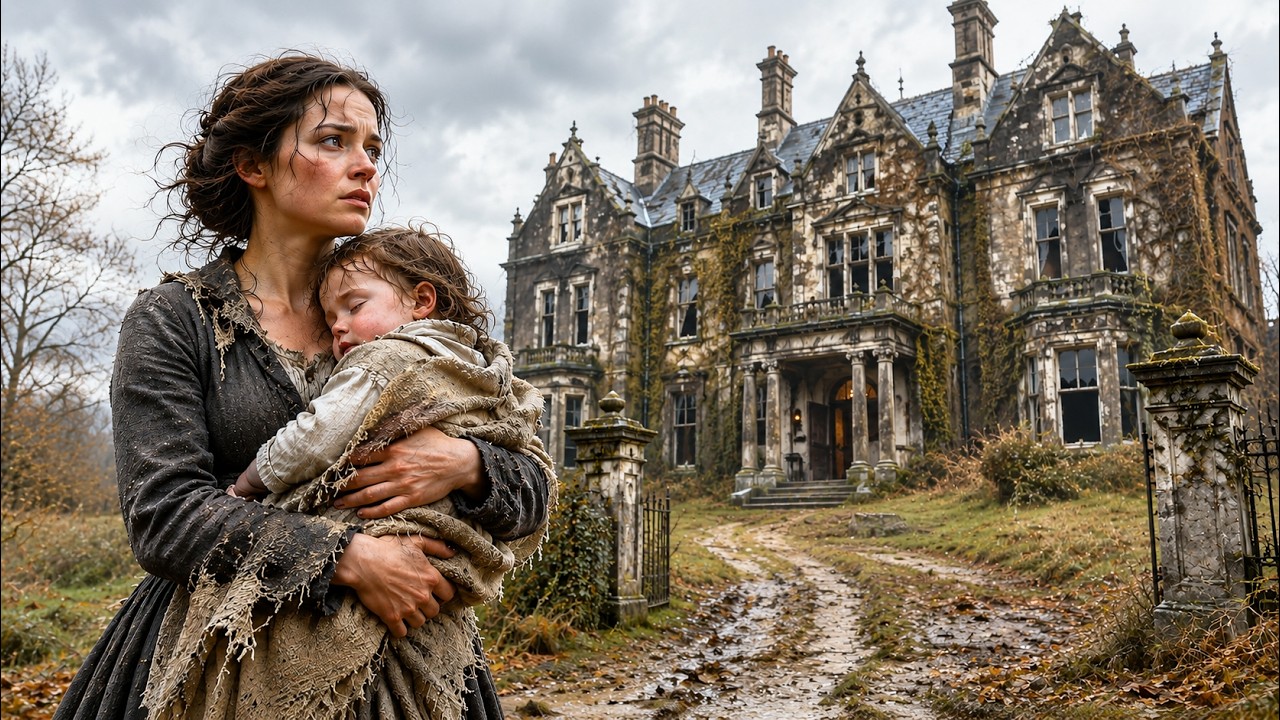
The innkeeper’s laughter still rang in her ears as Mary Selwood staggered up the muddy lane toward Blackwood Manor. In her arms, her daughter Clara burned with fever, each weak cough a knife twisting in Mary’s chest. She was twenty-two years old, widowed in all but name, abandoned by a husband who had promised to send for her from America and never wrote again. She had walked for weeks, begged rides from strangers, and spent her last coin to reach this forgotten village where her mother’s deathbed confession had pointed her.
The name Anna Kelwood, the village of Oak Haven. It was the only thread she had left to cling to. The men at the Shepherd’s Crook had made their opinion clear. No room, no charity, no welcome.
But one of them had sneered a suggestion: if she wanted a roof, Blackwood Manor was hers for the taking. Rotting, haunted, shunned for a decade since the old lord died. She had nowhere else to go. She hitched Clara higher and kept walking.
The manor loomed against the bruised sky like a corpse. Collapsed roofs, shattered windows, ivy thick as a man’s arm prying the stone apart. She found a servant’s door on the north side, rusted and rotten, and pushed it open with her shoulder. The darkness inside swallowed her.
Dust lay thick as snow. Furniture hid under ghostly white cloths. The air smelled of damp stone and decay. But it was dry.
It was shelter. She settled in the vast, filthy kitchen, built a small fire from fallen branches, and wrapped Clara in her last clean shawl. Days passed in a blur of survival. Stoke the fire.
Ration the oats. Sponge Clara’s forehead. The child’s fever gradually broke in the dry air, her cough softening. Mary began to breathe.
And then, with the immediate terror of survival fading, something else stirred in her. Curiosity. The house was immense, broken, but not empty. It felt like it was waiting.
She started exploring. The dining hall with its table set for a dinner that never happened, silver tarnished black. The ballroom with its warped parquet and silent piano. And then the library, vast and lined with thousands of moldering books.
She spent hours there, drawn by the oddly dry air and the quiet comfort of all those silent stories. That was when she noticed it. A section of the dark wood paneling behind the great oak desk was different. Smoother.
Warmer. The dust seemed to avoid it. It was a detail so small no one would ever notice unless they had nothing else to do but study it. She pressed.
She tapped. She searched for seams and found none. It fit perfectly flush. But she couldn’t let it go.
And when she began cleaning the library, scrubbing the great desk with beeswax, her rag snagged on something sharp beneath the desktop. A sliver of brass. The tip of a key, broken off in a lock. But there was no lock on the desk.
She looked at the brass fragment, then at the smooth panel on the wall. The two were speaking to each other. She had only to understand the language. She spent the next day running her hands over every inch of the desk.
Pressing every rosette, tracing every line. Late in the afternoon, her thumb found a knot of wood in the carved leg that gave slightly when she pressed. A soft click. Across the room, a hairline crack appeared in the panel.
She pushed, and a section of the wall swung silently inward. A hidden study. Small, spartan, preserved in time. A leather chair before a delicate writing desk.
Maps and architectural drawings on the walls. And on the desk, commanding the room, a heavy iron-bound strongbox. There was no keyhole, only a complex lock plate with a tiny, almost invisible hole clogged with something. She remembered the brass tip.
It wasn’t a broken fragment. It was the key itself, designed to be snapped off for ultimate security. Using the tip of a hearth poker, she worked the lock. After tense minutes, the lid sprang open.
Inside, stacks of gold sovereigns gleamed in the candlelight. A fortune. But what lay beneath the gold made her heart stop. A packet wrapped in oilskin, sealed with a wax crest bearing the Blackwood family seal.
She broke it with shaking fingers. Two documents. The first was a baptismal certificate, dated thirty years earlier, for a girl named Elelena. The mother’s name was listed as Anna Kelwood of Oak Haven.
Mary’s blood ran cold. Anna Kelwood was her mother. The second document was a last will and testament in Lord Alister Blackwood’s own hand. It disinherited his cousins and all other relatives.
It stated with absolute clarity that the entirety of his estate, Blackwood Manor, its lands, its contents, and the gold in the box, passed to his sole and beloved heir. His unacknowledged daughter. Elelena. The final line struck her like a physical blow: “To my dearest Elelena, child of my heart and daughter of Anna Selwood, to whom I could never give my name, but to whom I give all else.
”
Her mother had never spoken the name Elelena. But Mary knew with bone-deep certainty that it was her mother’s true name. She was not Elelena. She was Elelena’s daughter.
By law and by blood, this house, this land, this fortune. It was all hers. The truth barely had time to settle before the world erupted in fury. A violent autumn storm broke over the valley, wind howling like a wolf, rain lashing the windows with the force of thrown gravel.
A terrible tearing sound came from above, and water began pouring through a new hole in the roof, cascading down the grand staircase. Mary rushed about with buckets and basins, securing the will, the certificate, and a handful of gold in the folds of her dress. Amidst the roar, she heard a desperate human cry from the lane. Through a cleaned kitchen window, she saw a farmer’s cart stranded in the mud, its axle snapped.
A man and woman struggled to control a terrified horse, while a small child huddled in the back. With a jolt, she recognized the farmer. John Carter. The man who had given her a lift to Oak Haven.
She unbarred the door and ran out into the tempest. “Here! ” she yelled. “Bring them inside quickly.
”
He stared at her in disbelief, but the urgency in her voice was enough. They half carried his wife and shivering son into the kitchen. The boy was soaked through, burning with fever. Then another figure appeared.
A rider on a black horse. Mr. Thorne, the solicitor, drawn by the commotion. He had called her a vagrant once, ordered her off the property with contempt.
Now his face was livid with rage. “Fools! This place is a death trap! Get out of there, I say!
”
He made to dismount, to enforce his authority. But Mary stood in the doorway, wind whipping her dress, firelight casting her in silhouette. She was a guardian at the gate. “They are my guests,” she said, her voice quiet but ringing with steel.
“They are safe here. ”
Thorne stared, speechless, at the transformation of the timid vagrant he had dismissed so easily. Mary made her choice in that moment. This was not a ruin she was squatting in.
It was her home. And she would defend it. The storm raged through the night, but the manor held. Mary gave the Carter family the driest space by the hearth, shared her last oats and potatoes, brewed hot mint tea for their sick son, and sponged his forehead with calm, practiced hands.
By dawn, the boy’s fever had broken. John Carter looked at her with something she hadn’t seen directed at her in years. Respect. “We would have perished out there,” he said, his voice thick.
“You saved my boy. This house… it held. And you made it a home. ”
He promised to return with his brothers.
They were carpenters. They would see to the roof, it was the least they could do. True to his word, John Carter returned to the village and told his story. The solicitor’s rage, the young woman’s courage, her kindness to his son, her calm command in the face of the storm.
The whispers of scorn that had followed Mary turned to murmurs of curiosity, then grudging admiration. The fool on the hill had become the angel of the storm. A few days later, her resolve solidified, Mary walked into Oak Haven. She carried Clara on one hip and the oilskin packet in her hand.
She went directly to the parish church and asked for the vicar, Mr. Ashworth, an elderly man with kind, watery blue eyes. In the quiet of his study, she laid the baptismal certificate and Lord Alister’s will on his desk. The vicar studied the certificate, his finger tracing the parish seal.
“Anna Kelwood,” he murmured. “I remember the talk. A pretty girl who worked at the manor for a summer. The old lord was quite taken with her.
”
He read the will slowly. When he finished, his expression was one of pure astonishment. He cross-referenced the names and dates in his heavy parish ledgers. It was all there.
All true. Without another word, he led her across the village green to the offices of Thorne and Son Solicitors. Mr. Thorne looked up, his face souring.
“What is this? I told you to leave—”
The vicar cut him off, placing the will firmly on the desk. “You will want to read this, Elias. ”
Thorne scoffed, picked up the document with disdain, and began to read.
Mary watched the color drain from his face. His legal eye, trained to find flaws and loopholes, found none. The will was ironclad, witnessed, clear in intent. The insolvent ruin he had been so eager to condemn was the seat of a vast, unencumbered inheritance.
And its owner was the very woman he had called a vagrant and tried to cast out into the storm. He looked from the will to Mary, his mouth opening and closing silently. He had been humbled not by argument or threat, but by the quiet, irrefutable weight of the truth held in the steady hands of the woman he had so utterly misjudged. The seasons turned.
News of Mary’s inheritance spread like wildfire. First through Oak Haven, then through the surrounding countryside. Tenant farmers came to pay their respects and overdue rents. Merchants came to offer their services.
John Carter and his brothers spent weeks repairing the roof, their hammers echoing a rhythm of renewal across the valley. Villagers brought seedlings for a kitchen garden and helped clear the overgrown paths. They no longer saw a fool on a hill, but a woman who had seen value where they had seen only ruin. Mr.
Thorne became a model of professional diligence, managing the legal transfer with quiet, chastened efficiency. Mary treated him with cool, formal grace, never once mentioning his past cruelty. She was not a woman who dealt in vengeance. She dealt in restoration.
She hired local craftsmen to replace broken windows, plaster walls, sand warped floors. She worked alongside them, her hands never idle. One soft spring evening, as golden light spilled across the valley, she stood on the terrace overlooking the gardens. Clara, now a healthy, thriving toddler with her grandfather’s dark eyes, sat in a woven basket batting at a dandelion puff.
The house stood behind her, no longer a skeleton but a warm living thing, its new window panes catching the sun like sheets of gold. Mr. Ashworth walked up the path to join her. “It is a miracle what you have done here, Mrs.
Kelwood,” he said gently. “You have restored more than just a house. ”
Mary looked down at her hands, nails still rimmed with garden soil. Then at her sleeping child, safe and content.
Then at the warm light embracing the old stone walls of her home. “I didn’t find an inheritance,” she said, her voice soft but clear, carrying the weight of her entire journey. “I found a place to belong.
”