Nobody came. Not really. Lily, sweetheart, you can’t be in here. My father, Richard Sterling, one of the wealthiest men in the country, was dying.
I sat beside his bed in a room filled with expensive artwork, fresh flowers, and enough medical equipment to fill a small hospital wing. Almost nobody had come to see him. His other children hadn’t visited. His business partners had sent representatives.
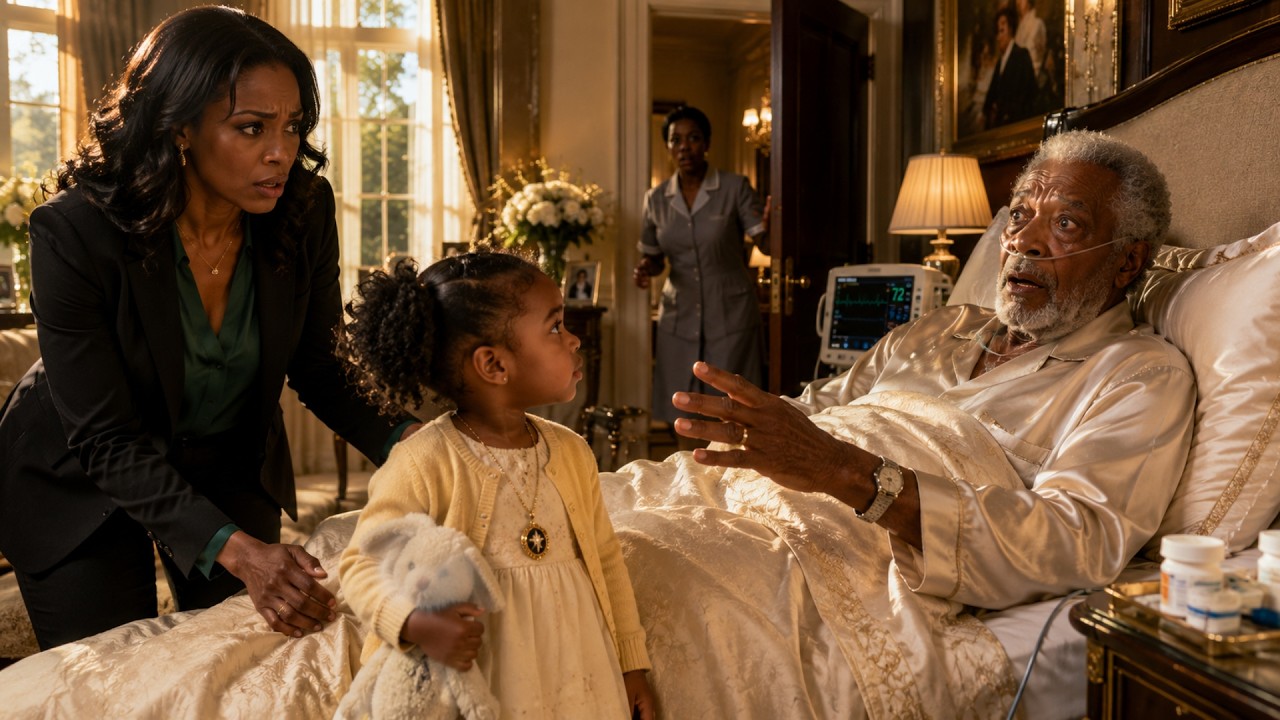
His closest friends barely stayed a few minutes. I was holding his hand when the door opened. Maria’s three-year-old daughter, Lily, wandered in carrying a small stuffed rabbit. I moved to take her back outside.
Then my father opened his eyes. For the first time in days, he smiled. “Why does that little girl have your mother’s necklace? ”
I stopped.
My mother had been dead for over twenty years. That moment changed everything I thought I knew about my family. I’m Victoria Sterling, 36 years old. To understand why that question mattered, you need to understand what my father was really like.
He built a massive business empire from a modest manufacturing company he inherited. We had everything growing up—private schools, beautiful homes, luxury vacations, trust funds. What I never had was emotional closeness with my father. He showed love through money, not presence.
He genuinely believed providing for his children was the fullest expression of fatherhood he could offer. I stopped expecting more from him early on. I remember my fourteenth birthday. I had hoped he might actually show up, but he sent his assistant with an expensive gift and a typed note.
I decided then to stop hoping for anything different. My brother Alexander responded differently. He became obsessed with the family wealth and his supposed right to inherit it. My sister Caroline became consumed with status and appearances.
I became the difficult daughter—the one who moved away, built an independent career, and refused to compete for our father’s attention. His health started declining seriously about eight months before he died. I began visiting regularly. Alexander always had excuses—too busy managing the business.
Caroline said the doctors recommended limiting visitors. But I knew the truth. They were waiting for him to die so they could collect their inheritance. Our housekeeper, Maria, had worked for my father for nearly fifteen years.
She was quiet, loyal, dedicated. Her daughter Lily sometimes accompanied her to work when Maria couldn’t afford childcare. I assumed my father barely noticed the child. I was wrong.
About six weeks before he died, Lily wandered into his room. Rather than the indifferent reaction I expected, my father grew visibly emotional. He asked Maria, “How old is she? ” His eyes glistened.
When I asked him about it later, he changed the subject. Then I started noticing strange details. He knew the name of Lily’s favorite stuffed animal. He asked Maria if she had ever told Lily about the garden.
Alexander noticed too, and his reaction told me everything. “Dad doesn’t need distractions right now,” he said, agitated. It wasn’t concern for our father’s health. He was worried about something else entirely.
I began searching through old family records. In a file cabinet in the study, I found a sealed envelope containing a faded photograph—my father standing beside a much younger Maria, holding a baby. I recognized the baby as Lily. But the handwritten date was over three years earlier, before Lily could possibly have been born.
I also found an old letter that deepened the mystery. I confronted my father during one of his more lucid afternoons. What he told me changed everything. Lily wasn’t his secret child.
The truth was more complicated and more painful. Maria’s late older sister had worked as my father’s personal assistant. Years ago, she discovered that Alexander had been systematically stealing significant funds from the family business, concealing it through falsified records. She confronted Alexander, planning to tell my father everything.
Before she could, she died suddenly and unexpectedly. My father had kept the evidence she left behind—proof of Alexander’s theft—hidden for years. Instead of confronting Alexander publicly, he had quietly ensured Maria and Lily remained financially protected, while he kept gathering more evidence and waited for the right moment. That’s why Lily made him cry.
She was a living connection to the woman whose loyalty had cost her life. A quiet act of atonement he had never shared with anyone. “Why didn’t you tell us? ” I asked him.
He was quiet for a long time. “I was afraid,” he said. “Afraid that revealing the connection would put Maria and Lily at further risk. ”
I think there was a simpler truth beneath that.
After decades of keeping his emotions guarded, he didn’t know how to share something so vulnerable. Investigating further, I discovered Alexander’s deception was far more extensive. He had built an elaborate narrative convincing key people that our father’s failing health meant he couldn’t manage the business anymore. He was preparing to take control uncontested.
My father had known about all of it, documenting everything patiently. About a week after our conversation, Lily climbed onto my father’s bed and offered him her stuffed rabbit. He started crying. “I spent my whole life building something for my children,” he told me, his voice raw.
“And somehow I forgot to become their father. ”
I waited my entire adult life to hear that. Two weeks later, my father’s attorney called the family together. Everyone expected the traditional inheritance discussion.
Alexander arrived dressed like he was already stepping into his new executive role. Instead, the attorney methodically presented documentation of Alexander’s years of theft—the original evidence Maria’s sister had uncovered, plus everything my father had gathered himself. Then he read my father’s final instructions. My father hadn’t left the company to any of us.
He established a charitable foundation to ensure Maria and Lily remained financially secure for life. He arranged benefits for longtime employees. The company went under independent professional management. I received a meaningful inheritance—enough to secure my future, but not the kind of overwhelming wealth that would repeat our family’s corrosive pattern.
Alexander faced serious legal consequences. Caroline lost the prominent position she always assumed would be hers. Our family’s reputation suffered considerably. I didn’t feel satisfied watching this unfold.
I felt grief. Grief for how much unnecessary pain we had inflicted on each other fighting over wealth and inheritance our father had never wanted to define us. In his final weeks, we finally had the conversations I had hoped for my whole life. He apologized directly for the years of emotional distance.
“I didn’t need the money, Dad,” I told him. “I know,” he said quietly, his hand tightening around mine. After a long pause, he added, “I’m sorry it took me this long. ”
He died peacefully, surrounded not by his empire, but by a small, quiet circle of people who genuinely cared.
Maria was nearby. Lily slept in a chair beside her. There was no anxious waiting for a will reading—just the unremarkable presence of people who wanted him comfortable in his final moments. Several months later, I returned to the estate.
Lily ran toward me, her face lighting up with the same uncomplicated warmth she had shown my father. Maria and I have grown closer, our relationship shifting from formal to genuine friendship. She still works at the estate, but the foundation means she no longer worries about childcare. Standing on the grounds where I had spent so much of my complicated childhood, the estate felt different.
It finally felt like an actual home. My father spent his life believing leaving something meaningful meant accumulating wealth and building a name people would remember. But what brought him peace in his final weeks was a small child who had no idea he was a billionaire. She just walked into his room one afternoon and treated him like an ordinary person deserving of simple kindness.
I used to believe my father died surrounded by people who wanted something from him. Now I understand differently. He left this world surrounded by the small handful of people he had finally learned how to love, even if that lesson came later than any of us would have wished. Sometimes life has an unexpected way of showing us what matters most.
The people who chase everything they feel entitled to may end up with nothing that truly matters. And the people we most easily overlook—the quiet housekeeper, her small daughter—can become exactly the ones who remind us what we were always supposed to value in the first place.